

Microplate Reader (Equipment) Market 2026
By Type (Absorbance Microplate Readers, Fluorescence Microplate Readers, Luminescence Microplate Readers, Multimode Microplate Readers), By Application (Genomics And Proteomics Research, Drug Discovery, Clinical Diagnostics, Other Applications), By End User (Pharmaceutical/Biotechnology Companies/Cros, Academic And Research Institutions, Other End-Users), And By Region, Opportunities And Strategies – Global Forecast To 2035
Microplate Reader (Equipment) Market Definition
A microplate reader (equipment) is an analytical laboratory device used to detect and measure biological, chemical, or physical reactions within the wells of a microplate. It operates by reading optical signals, such as absorbance, fluorescence, luminescence, or time-resolved fluorescence, produced by samples during experimental assays. The primary purpose of microplate readers is to enable high-throughput quantitative analysis of multiple samples quickly and accurately and concentration of analytes in microplate wells, typically across 96-, 384-, or 1536-well formats. The microplate readers (equipment) market consists of sales by entities (organizations, sole traders and partnerships) of microplate readers (equipment) that are used extensively across various research and clinical settings, including academic research laboratories, pharmaceutical and biotechnology companies, clinical diagnostic laboratories, contract research organizations (CROs) and environmental and food safety testing facilities.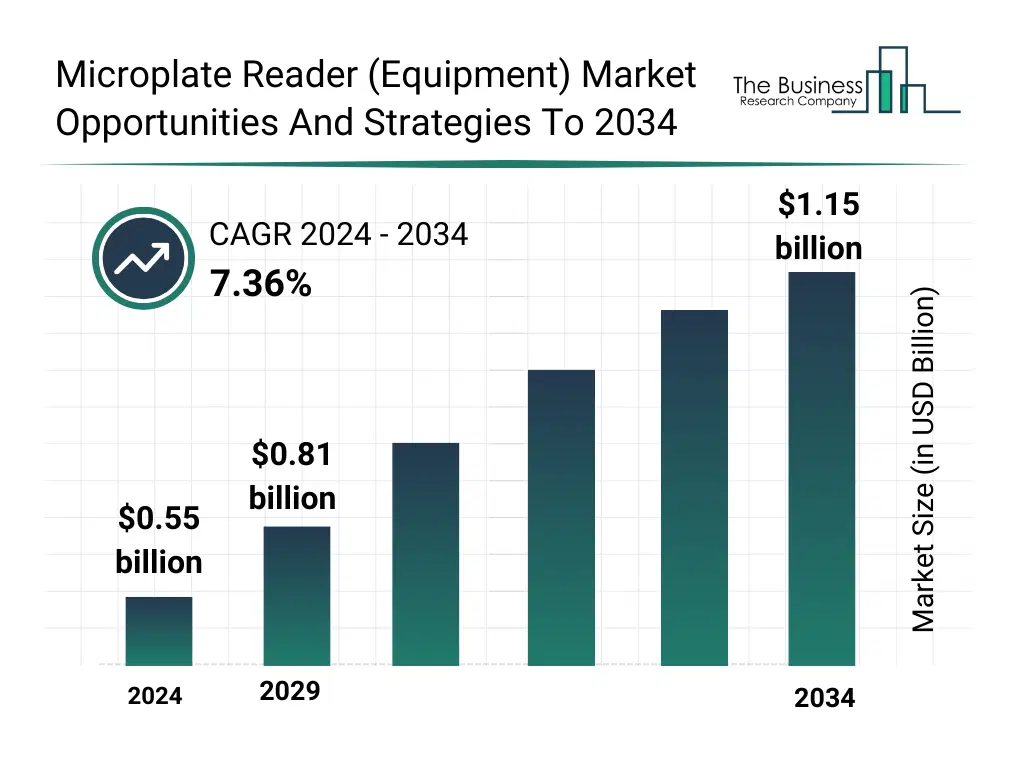
Microplate Reader (Equipment) Market Size
The global microplate readers (equipment) market reached a value of nearly $553.38 million in 2024, having grown at a compound annual growth rate (CAGR) of 8.49% since 2019. The market is expected to grow from $553.38 million in 2024 to $808.53 million in 2029 at a rate of 7.88%. The market is then expected to grow at a CAGR of 7.36% from 2029 and reach $1,153.44 million in 2034. Growth in the historic period resulted from the expansion of CROs and biotech startups, rising R&D expenditure in the pharmaceutical and biotech industries, growing focus on personalized medicine and precision diagnostics and increased focus on vaccine and biologics development. Factors that negatively affected growth in the historic period was budget constraints in academic and public institutes and need for skilled personnel. Going forward, the rising prevalence of chronic diseases, increase in translational research and biomarker discovery, expansion of academic and research institutes and growing demand for high-throughput screening (HTS) in pharma will drive the growth. Factors that could hinder the growth of the microplate readers (equipment) market in the future include high capital investment, competition from alternative assay technologies and impact of trade war and tariff.Microplate Reader (Equipment) Market Drivers
The key drivers of the microplate reader (equipment) market include: Rising Prevalence Of Chronic Diseases During the forecast period, the rising prevalence of chronic diseases will propel the growth of the microplate readers (equipment) market. Microplate readers enable high-throughput, accurate and reproducible measurements for assays that are essential in the diagnosis, monitoring and research of chronic illnesses such as diabetes, cardiovascular diseases and obesity. These instruments allow laboratories to efficiently analyze biomarkers, evaluate therapeutic efficacy and support personalized treatment strategies. As healthcare systems and research institutions increasingly prioritize early detection, monitoring and targeted therapy development, the demand for reliable and advanced microplate readers is expected to rise significantly, thereby driving the growth of the microplate readers (equipment) market. The rising prevalence of chronic diseases growth contribution during the forecast period in 2024 is 1.50%.Microplate Reader (Equipment) Market Restraints
The key restraints on the microplate reader (equipment) market include: High Capital Investment High capital investment requirements are restricting the growth of the microplate readers (equipment) market during the forecast period. Advanced microplate readers, especially multimode systems with capabilities like fluorescence, luminescence and time-resolved fluorescence, can cost between $10,000 and $50,000, making them a significant financial commitment for many laboratories. Additionally, maintenance costs, which can absorb 15–20% of the purchase value annually, further strain budgets, particularly in smaller or underfunded research settings. While leasing options exist, they may not be accessible to all institutions, especially in developing regions. Consequently, the high initial and ongoing expenses are limiting the adoption of advanced microplate readers, thereby slowing market growth, particularly in emerging economies where research budgets are constrained. Growth affected by high capital investment requirements across regions during the forecast period in 2024 is -2.50%.Microplate Reader (Equipment) Market Trends
Major trends shaping the microplate reader (equipment) market include: Introduction of Next-Generation Multimode Microplate Readers for Enhanced Research Flexibility Leading companies in the microplate readers market are increasingly developing next-generation multimode readers designed to offer greater flexibility, wider assay compatibility and enhanced research capabilities. These advanced systems are engineered to support multiple assay formats, enhance throughput and deliver highly reliable results across various applications, including absorbance, fluorescence and luminescence detection. For instance, in July 2025, Molecular Devices, a US-based developer of high-performance bioanalytical instrumentation, introduced the SpectraMax® iD5e and iD3s microplate readers. These systems offer enhanced detection capabilities, user-friendly interfaces and versatile assay support, providing researchers with a comprehensive solution for a wide range of experimental workflows. By leveraging advanced detection technology and the company’s expertise in laboratory instrumentation, Molecular Devices aims to deliver microplate readers that combine precision, versatility and efficiency to meet the evolving needs of both domestic and global research markets. Development of Portable Microplate Readers for Mobile Luminescence Assays Companies in the microplate readers market are focusing on the development of portable and compact readers that provide flexibility, ease of use and reliable assay performance for researchers working in varied laboratory environments. These innovations aim to support luminescent cell health assays, enhance mobility and allow seamless integration into diverse workflows. For instance, in June 2024, Promega, a US-based life sciences company specializing in assay development and laboratory instrumentation, introduced the Portable 96-Well Plate Reader. This reader is designed for luminescent cell health analysis, offering high sensitivity, user-friendly operation and portability, making it suitable for on-the-go experimentation or use in multiple laboratory setups. By leveraging compact design and advanced detection technology, Promega aims to deliver a solution that combines mobility, precision and convenience to meet the evolving needs of both domestic and global research markets.Opportunities And Recommendations In The Microplate Reader (Equipment) Market
Opportunities – The top opportunities in the microplate readers (equipment) market segmented by type will arise in the multimode microplate readers segment, which will gain $88.88 million of global annual sales by 2029. The top opportunities in the microplate readers (equipment) market segmented by application will arise in the drug discovery segment, which will gain $111.62 million of global annual sales by 2029. The top opportunities in the microplate readers (equipment) market segmented by end user will arise in the pharmaceutical/biotechnology companies/CROs segment, which will gain $137.54 million of global annual sales by 2029. The microplate readers (equipment) market size will gain the most in the USA at $67.60 million. Recommendations- To take advantage of the opportunities, The Business Research Company recommends the microplate readers (equipment) companies to focus on expanding advanced multimode microplate reader offerings, focus on developing portable and compact microplate readers, focus on advancing automated on-deck microplate readers, focus on expanding portable and versatile microplate reader offerings, focus on developing advanced absorbance microplate readers, focus on enhancing microplate reader software solutions, focus on enhancing microplate reader software solutions, focus on expanding multimode microplate reader capabilities, focus on expanding multimode microplate reader offerings, focus on expanding global and multi-channel distribution, focus on expanding global and multi-channel distribution, focus on targeted digital and content-driven promotion, focus on collaborative and experiential promotion, focus on expanding microplate reader adoption in genomics and proteomics research, focus on expanding microplate reader adoption in academic and research institutions.
Microplate Reader (Equipment) Market Segmentation
The microplate reader (equipment) market is segmented by type, by application type and by end-user.By Type –
The Microplate Reader (Equipment) market is segmented by type into:
- a) Absorbance Microplate Readers
- b) Fluorescence Microplate Readers
- c) Luminescence Microplate Readers
- d) Multimode Microplate Readers
By Application Type –
The Microplate Reader (Equipment) market is segmented by application type into:
- a) Genomics And Proteomics Research
- b) Drug Discovery
- c) Clinical Diagnostics
- d) Other Applications
By End-User –
The microplate reader (equipment) market is segmented by end-user into:
- a) Pharmaceutical/Biotechnology Companies/Cros
- b) Academic And Research Institutions
- c) Other End-Users
- d) Household Appliances
By Geography - The microplate reader (equipment) market is segmented by geography into:
- • China
- • India
- • Japan
- • Australia
- • Indonesia
- • South Korea
- • Bangladesh
- • Thailand
- • Vietnam
- • Malaysia
- • Singapore
- • Phillipines
- • Hong kong
- • New Zealand
- • USA
- • Canada
- • Mexico
- • Brazil
- • Argentina
- • Chile
- • Colombiia
- • Peru
- • France
- • Germany
- • UK
- • Italy
- • Spain
- • Austria
- • Belgium
- • Denmark
- • Finland
- • Ireland
- • Netherland
- • Norway
- • Portugal
- • Sweden
- • Switzerland
- • Russia
- • Czech Republic
- • Poland
- • Romania
- • Ukraine
- • Saudi Arabia
- • Israel
- • Iran
- • Turkey
- • UAE o Africa
- • Egypt
- • Nigeria
- • South Africa
-
o Asia Pacific