
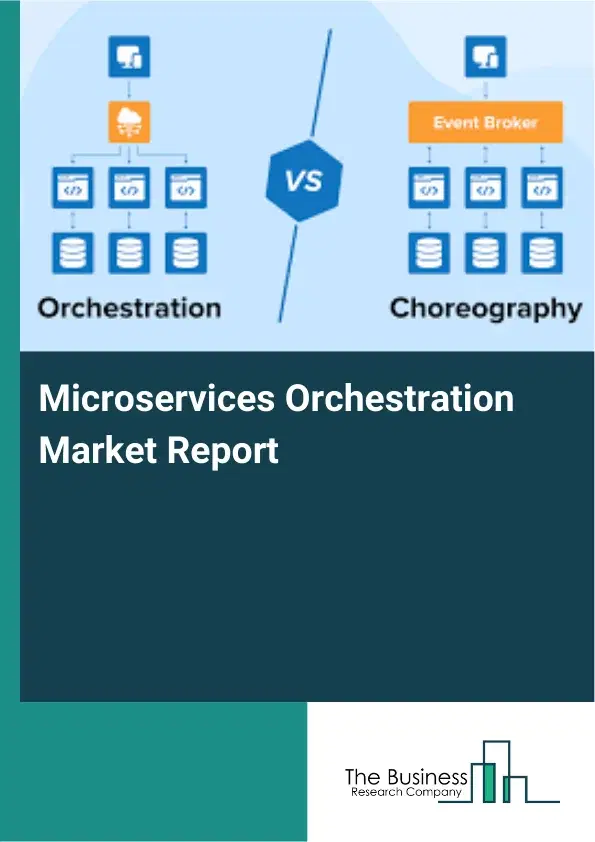
Microservices Orchestration Market Report 2026
Global Outlook – By Component (Platforms And Tools, Services), By Deployment Mode (Cloud-Based, On-Premises, Hybrid), By Enterprise Size (Large Enterprises, Small And Medium Sized Enterprises), By Application (Application Deployment And Scaling, Service Discovery And Networking, Monitoring And Logging, Resource Management, Security And Policy Enforcement), By End User Industry (Information Technology And Telecommunications, Banking, Financial Services, And Insurance, Retail And Electronic Commerce, Healthcare, Manufacturing, Government And Public Sector) – Market Size, Trends, Strategies, and Forecast to 2030
Microservices Orchestration Market Overview
• MicroServices Orchestration market size has reached to $5.22 billion in 2025 • Expected to grow to $14.68 billion in 2030 at a compound annual growth rate (CAGR) of 23% • Growth Driver: The Increasing Adoption Of Cloud-Native Architectures Is Driving The Growth Of The Market Due To Demand For Scalable And Agile Digital Infrastructure • Market Trend: Innovations In Agentic AI And Context-Aware Orchestration Enhance Microservices Workflow Automation • North America was the largest region in 2025 and Asia-Pacific is the fastest growing region.Market Gains By 2030 – Top Opportunities By Segment
Market Gain identifies the most promising market opportunities by highlighting the segments or products expected to generate the highest incremental revenue growth over the next five years.
What Is Covered Under Microservices Orchestration Market?
Microservices orchestration refers to the coordinated management and control of multiple independent microservices to operate together as a unified application. It governs service interactions, workflows, and dependencies across distributed environments. It automates deployment, scaling, monitoring, and fault handling to ensure consistent performance. The main components of microservices orchestration include platforms and tools, and services. Platforms and tools refer to solutions that enable the coordination, management, and automation of microservices across distributed systems, ensuring seamless deployment, scaling, and monitoring. These solutions can be deployed through cloud-based, on-premises, or hybrid modes and are adopted by enterprises of different sizes, including large enterprises and small and medium-sized enterprises. These are used to various applications such as deployment and scaling, service discovery and networking, monitoring and logging, resource management, and security and policy enforcement. The cater to various end users such as microservices orchestration include information technology and telecommunications, banking, financial services, and insurance, retail and electronic commerce, healthcare, manufacturing, and government and public sector.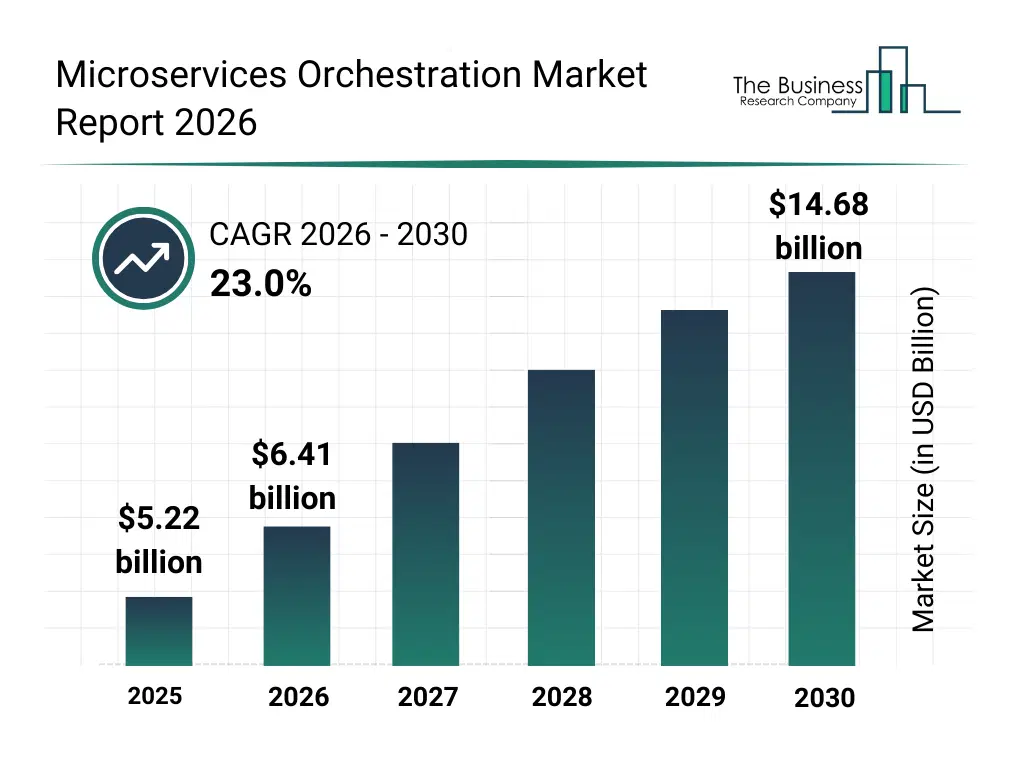
What Is The Microservices Orchestration Market Size and Share 2026?
The microservices orchestration market size has grown exponentially in recent years. It will grow from $5.22 billion in 2025 to $6.41 billion in 2026 at a compound annual growth rate (CAGR) of 22.8%. The growth in the historic period can be attributed to increasing adoption of Microservices Architecture, demand for agile and scalable applications, early implementation of container technologies, need for centralized monitoring and management, growing cloud migration initiatives.What Is The Microservices Orchestration Market Growth Forecast?
The microservices orchestration market size is expected to see exponential growth in the next few years. It will grow to $14.68 billion in 2030 at a compound annual growth rate (CAGR) of 23.0%. The growth in the forecast period can be attributed to rise in hybrid and multi-cloud deployments, integration of ai-driven orchestration, expansion of devops and ci/cd adoption, increasing demand for service mesh platforms, enhanced focus on security and compliance automation. Major trends in the forecast period include automated workflow orchestration, container management and scaling, service discovery and networking optimization, observability and performance monitoring, security and policy enforcement.
Global Microservices Orchestration Market Segmentation
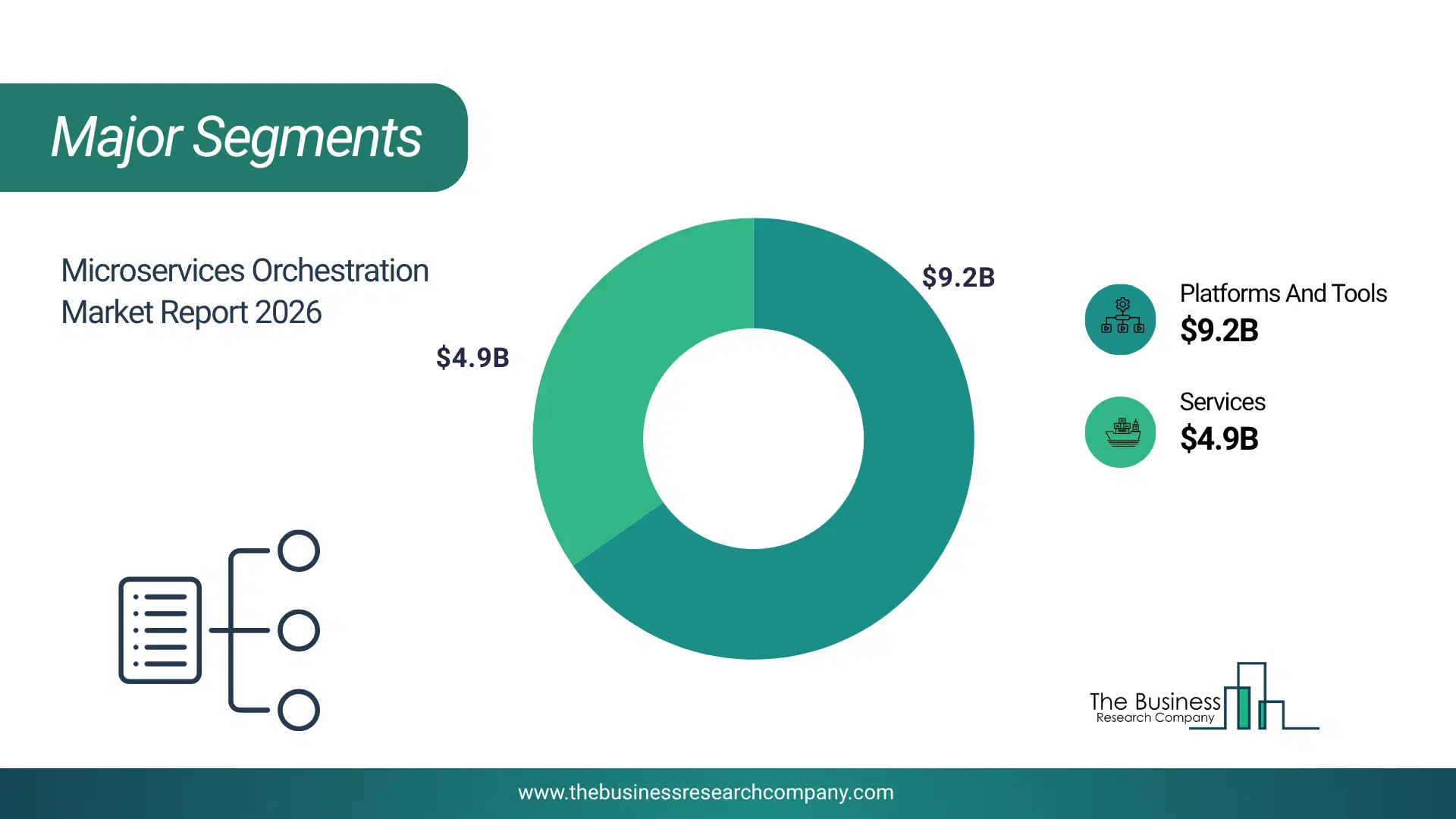
1) By Component: Platforms And Tools, Services 2) By Deployment Mode: Cloud-Based, On-Premises, Hybrid 3) By Enterprise Size: Large Enterprises, Small And Medium Sized Enterprises 4) By Application: Application Deployment And Scaling, Service Discovery And Networking, Monitoring And Logging, Resource Management, Security And Policy Enforcement 5) By End User Industry: Information Technology And Telecommunications, Banking, Financial Services, And Insurance, Retail And Electronic Commerce, Healthcare, Manufacturing, Government And Public Sector Subsegments: 1) By Platforms And Tools: Container Orchestration Platforms, Workflow And Pipeline Orchestration Tools, Service Mesh Platforms, Configuration And Deployment Management Tools, Application Programming Interface Management And Gateway Tools, Observability And Performance Management Tools 2) By Services: Consulting And Strategy Services, System Integration Services, Deployment And Implementation Services, Training And Skill Development Services, Managed And Support Services, Security And Compliance Services The top segments in the microservices orchestration market will be: • Platforms And Tools will reach $9.13 billion by 2030. • Services will reach $4.84 billion by 2030.What Is The Driver Of The Microservices Orchestration Market?
The increasing adoption of cloud-native architectures is expected to propel the growth of the microservices orchestration market going forward. Cloud-native architectures refer to application designs built specifically for cloud environments that use microservices, containers, and scalable infrastructure to deliver flexibility, resilience, and rapid deployment. The growing adoption of cloud-native architectures is driven by organizations’ need for scalable and agile digital infrastructure that enables faster application deployment, improved reliability, and rapid response to changing business requirements. Microservices orchestration supports cloud-native architectures by coordinating, scaling, and managing distributed services efficiently, ensuring high availability, seamless communication, and optimized resource utilization. For instance, in December 2023, according to the Cloud Native Computing Foundation, a US-based organization, cloud-native solutions accounted for over 40% of the global market value in 2023. Therefore, the increasing adoption of cloud-native architectures is driving the growth of the microservices orchestration industry.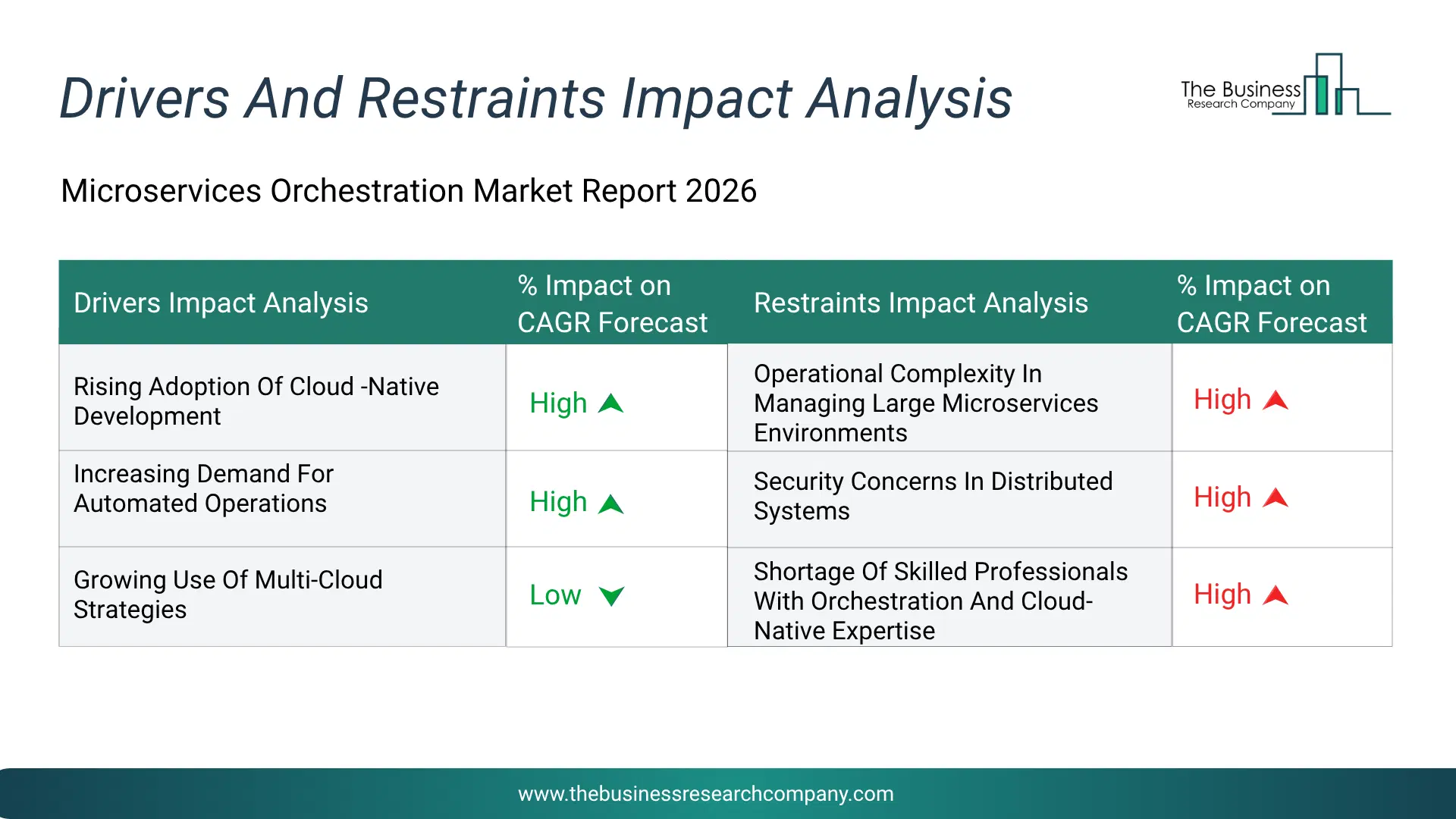
Infographic Chart Showing Key Market Drivers Analysis And Restraints For Microservices Orchestration Market
The chart presents an impact analysis of key drivers and restraints, quantifying their relative influence on the market's growth rate and helping assess the balance between growth enablers and limiting factors. This chart offers a high-level perspective; the full report contains more detailed insights.
How Will The Drivers Impact Growth In The Global Microservices Orchestration Market?
• Rising Adoption Of Cloud -Native Development (High) – During the forecast period, the rising adoption of cloud -native development is expected to become a key growth driver for the microservices orchestration market by 2030. Organizations are increasingly building applications using microservices architectures that require efficient orchestration to manage containers, services, and workflows across dynamic environments. Cloud -native development enables faster innovation, scalability, and resilience, driving the need for orchestration platforms that can automate deployment and lifecycle management. Enterprises are therefore investing in orchestration tools to support agile development and continuous integration practices. • Increasing Demand For Automated Operations (High) – During the forecast period, the increasing demand for automated operations is expected to emerge as a major factor driving the expansion of the microservices orchestration market by 2030. Enterprises are focusing on reducing manual intervention in it operations by adopting automation-driven orchestration platforms that manage application deployment, scaling, and monitoring. Automation enhances operational efficiency, reduces errors, and improves system reliability in complex distributed environments. The growing adoption of devops and site reliability engineering practices is further accelerating the demand for orchestration solutions. • Growing Use Of Multi-Cloud Strategies (Low) – During the forecast period, the growing use of multi-cloud strategies is expected to act as a key growth catalyst for the microservices orchestration market by 2030. Organizations are increasingly deploying applications across multiple cloud environments to avoid vendor lock-in, improve resilience, and optimize costs. This trend requires robust orchestration platforms capable of managing workloads seamlessly across diverse cloud infrastructures. Microservices orchestration solutions enable consistent deployment, monitoring, and scaling across hybrid and multi-cloud environments. As multi-cloud adoption expands globally, the need for advanced orchestration capabilities is expected to rise significantly.How Will The Restraints Impact Growth In The Global Microservices Orchestration Market?
• Operational Complexity In Managing Large Microservices Environments (High) – During the forecast period, the operational complexity in managing large microservices environments acts as a major restraint for the microservices orchestration market because coordinating hundreds of interconnected services increases management difficulty. As applications scale, organizations face challenges in monitoring, service discovery, configuration, and performance optimization across distributed systems. This complexity raises operational risks, including misconfigurations and downtime, which can discourage adoption among enterprises with limited technical maturity. Additionally, the need for advanced skills and specialized tools increases implementation time and cost, slowing overall market growth. • Security Concerns In Distributed Systems (High) – During the forecast period, the security concerns in distributed systems act as a significant restraint for the microservices orchestration market due to the expanded attack surface created by multiple interconnected services. Each microservice communicates over networks, increasing exposure to threats such as unauthorized access, data breaches, and insecure apis. Ensuring secure service-to-service communication, identity management, and policy enforcement adds complexity and cost to deployment. These challenges make organizations cautious about large-scale adoption, particularly in regulated industries where strict security and compliance requirements must be met. • Shortage Of Skilled Professionals With Orchestration And Cloud-Native Expertise (High) – During the forecast period, the shortage of skilled professionals with orchestration and cloud-native expertise acts as a key restraint for the microservices orchestration market, as implementing and managing these platforms requires advanced technical knowledge. Organizations often struggle to find professionals skilled in kubernetes, container networking, security, and automation tools. This talent gap increases deployment timelines, operational risks, and training costs. As a result, many enterprises delay or limit adoption of orchestration solutions, slowing overall market growth despite strong demand.Key Players In The Global Microservices Orchestration Market
Major companies operating in the microservices orchestration market are Google LLC, Microsoft Corporation, Amazon Web Services Inc., Dell Technologies Inc., International Business Machines Corporation, Oracle Corporation, Broadcom Inc., SAP SE, Netflix Inc., Salesforce Inc., SUSE LLC, Alibaba Cloud Computing Ltd., TIBCO Software Inc., WSO2 LLC, Kong Inc., Workato Inc., Jitterbit Inc., Camunda Services GmbH, Temporal Technologies Inc., Solo.io Inc., Tetrate Inc., and Traefik Labs SAS.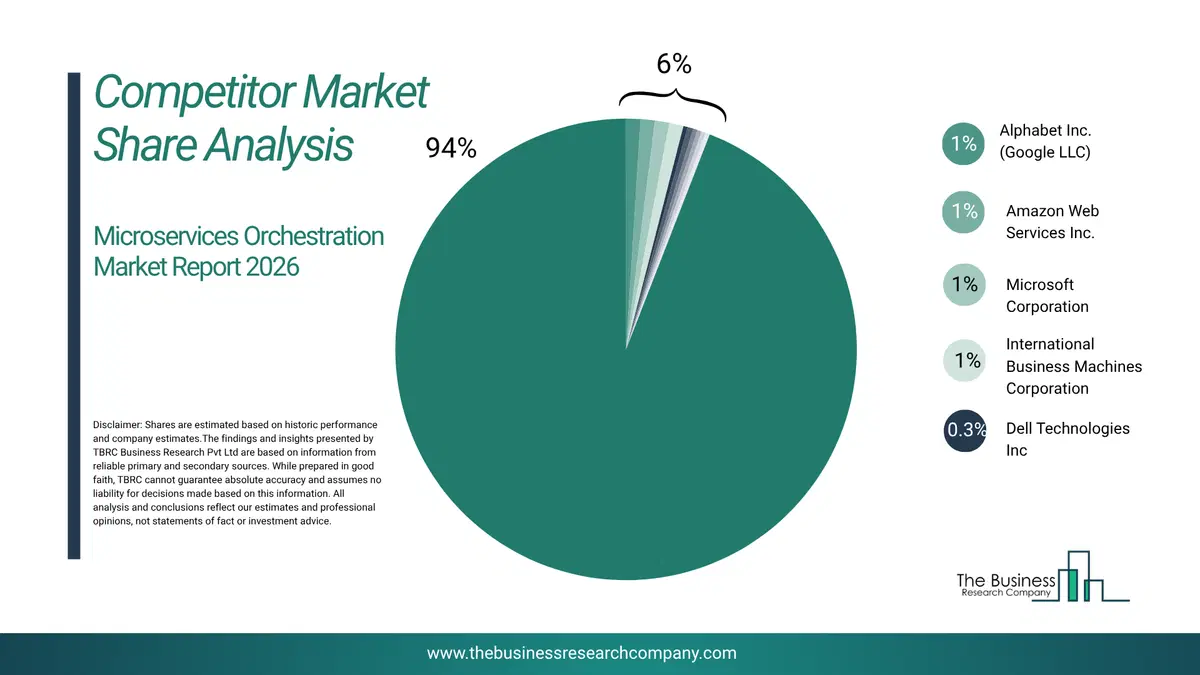
This chart is for illustrative purposes; the full report includes a detailed competitor analysis and comprehensive overview of the top 10 companies in the market.
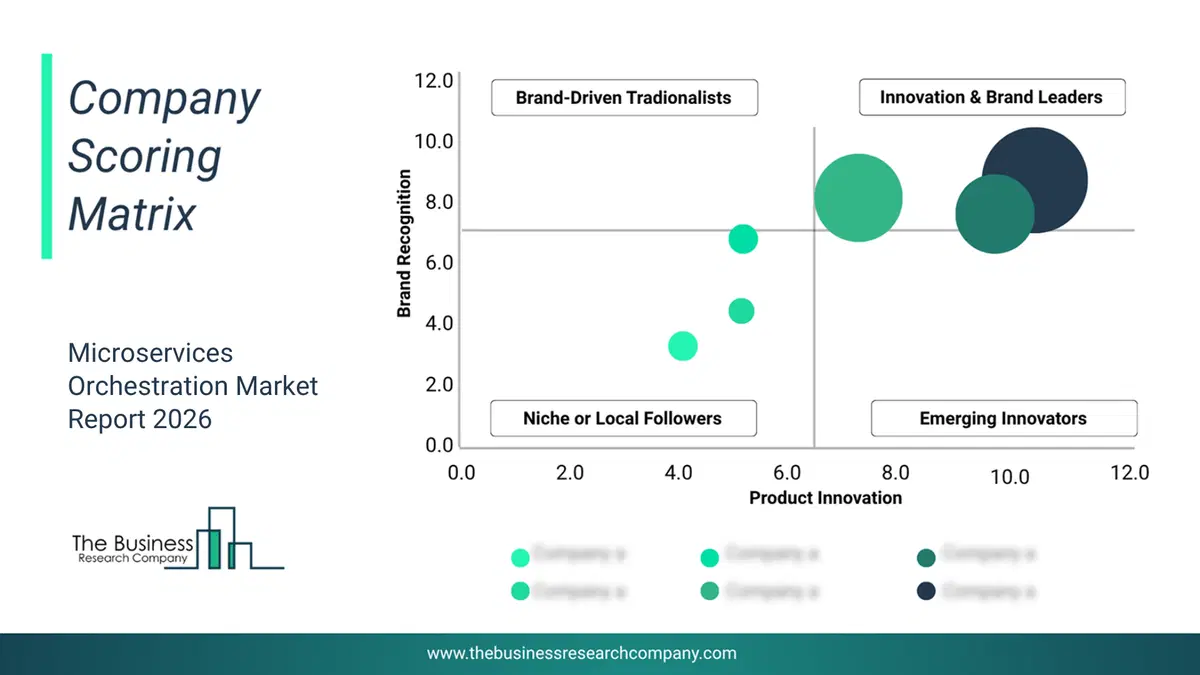
This chart maps companies by product innovation and brand strength, with bubble size indicating relative revenue, helping identify market leaders, challengers, and niche players. This is an illustrative chart; the full report provides a complete and accurate competitive analysis.
Global Microservices Orchestration Market Trends and Insights
Major companies operating in the microservices orchestration market are focusing on advanced innovations, such as model context protocol (MCP) connectors, to improve coordination across distributed services, enable seamless multi-agent communication, and enhance governance and adaptability in enterprise-scale workflows. Model context protocol (MCP) connectors refer to standardized integration mechanisms that allow AI agents and microservices to securely share context, discover services, and dynamically coordinate actions across complex enterprise systems. For instance, in October 2025, Camunda, a Germany-based open-source software company, introduced new agentic orchestration capabilities designed to support enterprise-grade AI agents. The launch integrates MCP connectors, AI agent memory, and unified orchestration clusters to enable secure, scalable, and context-aware coordination of AI-powered workflows, strengthening governance, improving automation reliability, and accelerating enterprise-wide adoption of AI-driven microservices orchestration.What Are Latest Mergers And Acquisitions In The Microservices Orchestration Market?
In January 2023, Mirantis Inc., a US-based cloud computing and Kubernetes platform company, acquired Shipa Inc. for an undisclosed amount. Through this acquisition, Mirantis aims to strengthen its application and microservices orchestration capabilities by integrating Shipa’s automated application discovery, operations, security, and observability into its Lens Kubernetes Platform and broader Kubernetes offerings. Shipa Inc. is a US-based startup that provides tools to support microservices orchestration.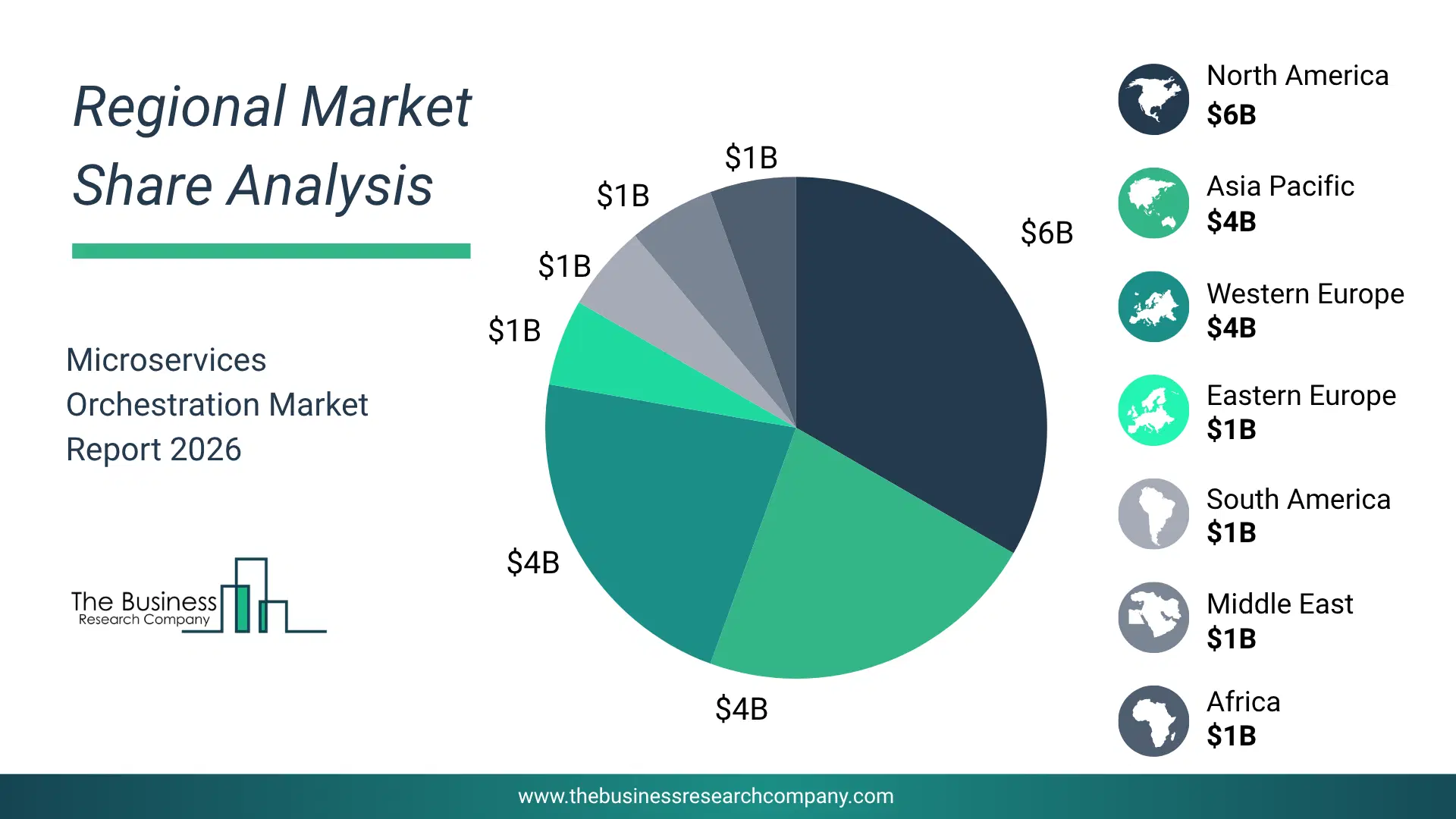
Regional Outlook
North America was the largest region in the microservices orchestration market in 2025. Asia-Pacific is expected to be the fastest-growing region in the forecast period. The regions covered in this market report are Asia-Pacific, South East Asia, Western Europe, Eastern Europe, North America, South America, Middle East, Africa. The countries covered in this market report are Australia, Brazil, China, France, Germany, India, Indonesia, Japan, Taiwan, Russia, South Korea, UK, USA, Canada, Italy, Spain.What Defines the Microservices Orchestration Market?
The microservices orchestration consists of revenues earned by entities by providing services such as workflow and process automation, container orchestration, service discovery and load balancing, monitoring and performance optimization, and security and access management. The market value includes the value of related goods sold by the service provider or included within the service offering. The microservices orchestration includes sales of service meshes, workflow automation software, DevOps and CI/CD tools, monitoring and observability solutions, and security and compliance tools. Values in this market are ‘factory gate’ values, that is, the value of goods sold by the manufacturers or creators of the goods, whether to other entities (including downstream manufacturers, wholesalers, distributors, and retailers) or directly to end customers. The value of goods in this market includes related services sold by the creators of the goods.How is Market Value Defined and Measured?
The market value is defined as the revenues that enterprises gain from the sale of goods and/or services within the specified market and geography through sales, grants, or donations in terms of the currency (in USD unless otherwise specified). The revenues for a specified geography are consumption values that are revenues generated by organizations in the specified geography within the market, irrespective of where they are produced. It does not include revenues from resales along the supply chain, either further along the supply chain or as part of other products.
This chart presents market attractiveness based on a quantitative evaluation of growth, competition, strategic alignment, and risk, offering a clear view of opportunity areas for decision-making. This chart is for illustrative purposes; the full report contains the complete analysis.

This chart highlights the Total Addressable Market (TAM) by estimating the maximum revenue opportunity using an assumption-driven approach, supporting strategic planning and opportunity sizing across markets. The chart is illustrative; the full report provides a more comprehensive analysis.
What Key Data and Analysis Are Included in the Microservices Orchestration Market Report 2026?
The microservices orchestration market research report is one of a series of new reports from The Business Research Company that provides market statistics, including industry global market size, regional shares, competitors with the market share, detailed market segments, market trends and opportunities, and any further data you may need to thrive in the microservices orchestration industry. The market research report delivers a complete perspective of everything you need, with an in-depth analysis of the current and future state of the industry.Microservices Orchestration Market Report Forecast Analysis
| Report Attribute | Details |
|---|---|
| Market Size Value In 2026 | $6.41 billion |
| Revenue Forecast In 2030 | $14.68 billion |
| Growth Rate | CAGR of 23% from 2026 to 2030 |
| Base Year For Estimation | 2025 |
| Actual Estimates/Historical Data | 2020-2025 |
| Forecast Period | 2026 - 2030 |
| Market Representation | Revenue in USD Billion and CAGR from 2026 to 2030 |
| Segments Covered | Component, Deployment Mode, Enterprise Size, Application, End User Industry |
| Regional Scope | Asia-Pacific, Western Europe, Eastern Europe, North America, South America, Middle East, Africa |
| Country Scope | The countries covered in the report are Australia, Brazil, China, France, Germany, India, ... |
| Key Companies Profiled | Google LLC, Microsoft Corporation, Amazon Web Services Inc., Dell Technologies Inc., International Business Machines Corporation, Oracle Corporation, Broadcom Inc., SAP SE, Netflix Inc., Salesforce Inc., SUSE LLC, Alibaba Cloud Computing Ltd., TIBCO Software Inc., WSO2 LLC, Kong Inc., Workato Inc., Jitterbit Inc., Camunda Services GmbH, Temporal Technologies Inc., Solo.io Inc., Tetrate Inc., and Traefik Labs SAS. |
| Customization Scope | Request for Customization |
| Pricing And Purchase Options | Explore Purchase Options |