

Microsurgery Robot Market Report 2026
Global Outlook – By Product Type (Dedicated Microsurgery Robots, Modular Microsurgery Systems, Robotic Surgical Instruments, Accessories And Consumables), By Component (Robotic Arms, Surgical Tools, Visualization Systems, Control Systems), By Technology (Teleoperated Robots, Autonomous Robots, Hybrid Systems), By Application (Oncology Surgery, Urology Surgery, Obstetrics And Gynecology Surgery, Micro Anastomosis, Reconstructive Surgery, ENT (Ear, Nose, And Throat) Surgery, Gastrointestinal Surgery, Cardiovascular Surgery, Ureterorenoscopy, Neurovascular Surgery), By End-User (Hospitals, Ambulatory Surgical Centers, Specialty Clinics, Other End-Users) – Market Size, Trends, Strategies, and Forecast to 2030
Microsurgery Robot Market Overview
• Microsurgery Robot market size has reached to $2.39 billion in 2025 • Expected to grow to $4.83 billion in 2030 at a compound annual growth rate (CAGR) of 15% • Growth Driver: Rising Demand For Minimally Invasive Surgeries Driving The Market Growth Due To Precision And Patient Recovery Benefits • Market Trend: Technological Advancements Of Mobile Tele-Surgical Systems To Enhance Access To Precision Surgical Care • North America was the largest region in 2025 and Asia-Pacific is the fastest growing region.What Is Covered Under Microsurgery Robot Market?
A microsurgery robot is a highly advanced robotic system designed to assist surgeons in performing delicate and precise operations on very small structures such as nerves, blood vessels, and tissues, often under high magnification and in confined spaces, by combining robotic arms, specialized instruments, and real-time imaging to enable controlled and stable movements during surgery. Its purpose is to enhance surgical accuracy and minimize human hand tremors during intricate procedures. The main product types of microsurgery robots include dedicated microsurgery robots, modular microsurgery systems, robotic surgical instruments, and accessories and consumables. Dedicated microsurgery robots are specialized robotic systems designed to perform highly precise and delicate surgical tasks on small anatomical structures. The various components include robotic arms, surgical tools, visualization systems, and control systems. These robots use technologies such as teleoperated robots, autonomous robots, and hybrid systems and are used in various applications, including oncology surgery, urology surgery, obstetrics and gynecology surgery, microanastomosis, reconstructive surgery, ENT (ear, nose, and throat) surgery, gastrointestinal surgery, cardiovascular surgery, ureterorenoscopy, and neurovascular surgery. The key end users are hospitals, ambulatory surgical centers, specialty clinics, and others.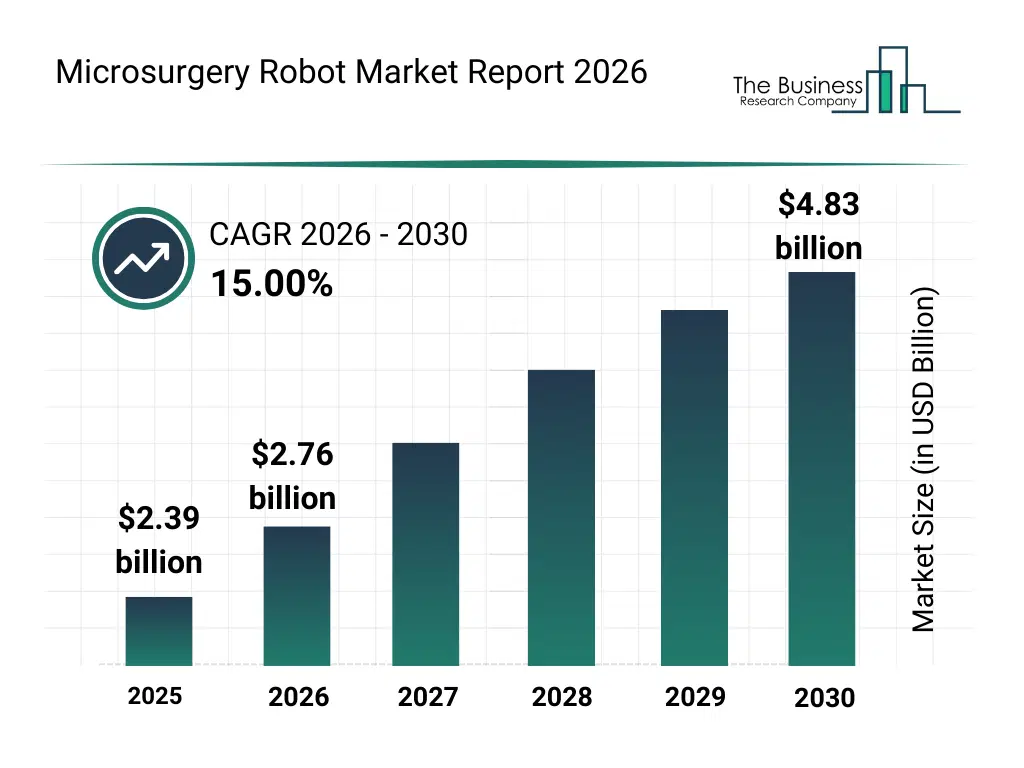
What Is The Microsurgery Robot Market Size and Share 2026?
The microsurgery robot market size has grown rapidly in recent years. It will grow from $2.39 billion in 2025 to $2.76 billion in 2026 at a compound annual growth rate (CAGR) of 15.5%. The growth in the historic period can be attributed to limited availability of advanced robotic systems, high cost of early robotic platforms, growing demand for minimally invasive procedures, increasing adoption in specialized surgical fields, early advancements in medical imaging technology.What Is The Microsurgery Robot Market Growth Forecast?
The microsurgery robot market size is expected to see rapid growth in the next few years. It will grow to $4.83 billion in 2030 at a compound annual growth rate (CAGR) of 15.0%. The growth in the forecast period can be attributed to increasing investment in ai-driven surgical robots, rising demand for teleoperated surgeries, development of compact and handheld robotic devices, integration with augmented reality and imaging systems, expansion of microsurgery applications in emerging regions. Major trends in the forecast period include miniaturization of surgical instruments, integration of real-time imaging in robotics, enhanced precision and stability in microsurgery, remote and teleoperated surgery adoption, customizable modular robotic systems.

Global Microsurgery Robot Market Segmentation
1) By Product Type: Dedicated Microsurgery Robots, Modular Microsurgery Systems, Robotic Surgical Instruments, Accessories And Consumables 2) By Component: Robotic Arms, Surgical Tools, Visualization Systems, Control Systems 3) By Technology: Teleoperated Robots, Autonomous Robots, Hybrid Systems 4) By Application: Oncology Surgery, Urology Surgery, Obstetrics And Gynecology Surgery, Micro Anastomosis, Reconstructive Surgery, ENT (Ear, Nose, And Throat) Surgery, Gastrointestinal Surgery, Cardiovascular Surgery, Ureterorenoscopy, Neurovascular Surgery 5) By End-User: Hospitals, Ambulatory Surgical Centers, Specialty Clinics, Other End-Users Subsegments: 1) By Dedicated Microsurgery Robots: Application-Specific Systems, Fully Integrated Robotic Units, Compact Handheld Robotic Devices 2) By Modular Microsurgery Systems: Interchangeable Robotic Modules, Hybrid Microsurgical Platforms, Customizable Component-Based Systems 3) By Robotic Surgical Instruments: Micro-Scissors, Micro-Forceps, Micro-Needle Holders, Micro-Suturing Tools 4) By Accessories And Consumables: Camera Systems, Light Guides, Sutures And Clips And Maintenance KitsWhat Is The Driver Of The Microsurgery Robot Market?
The increasing demand for minimally invasive surgical procedures is expected to propel the growth of the microsurgery robot market going forward. Minimally invasive surgical procedures involve performing operations through small incisions using specialized instruments and techniques that reduce tissue damage, recovery time, and surgical risk. Demand for minimally invasive surgical procedures is rising due to the rising geriatric population requiring delicate surgical interventions with lower complication risks, which is becoming more prevalent with global aging trends. The minimally invasive surgical procedures are fueling the adoption of microsurgery robots, as these systems offer the precision, stability, and control needed for delicate operations through small incisions, leading to faster recovery and reduced patient trauma. For instance, in March 2025, according to the American Hospital Association, a US-based healthcare industry trade group, 2.63 million surgical procedures were performed in the U.S. in 2023 using da Vinci robotic systems, a 17% increase from 2022. Therefore, the increasing demand for minimally invasive surgical procedures is driving the microsurgery robot industry.Key Players In The Global Microsurgery Robot Market
Major companies operating in the microsurgery robot market are Johnson & Johnson Services Inc., Medtronic plc, Stryker Corporation, Intuitive Surgical Inc., MicroPort Scientific Corporation, Renishaw plc, Titan Medical Inc., Vicarious Surgical Inc., CMR Surgical Ltd., Medical Microinstruments S.p.A., Virtual Incision Corporation, Asensus Surgical Inc., MicroSure BV, Medrobotics Corporation, Galen Robotics Inc., Moon Surgical SAS, Robocath SA, EndoQuest Robotics Inc., Distalmotion SA, Memic Innovative Surgery Ltd., Meerecompany Inc., SS Innovations International Inc.
This chart is for illustrative purposes; the full report includes a detailed competitor analysis and comprehensive overview of the top 10 companies in the market.
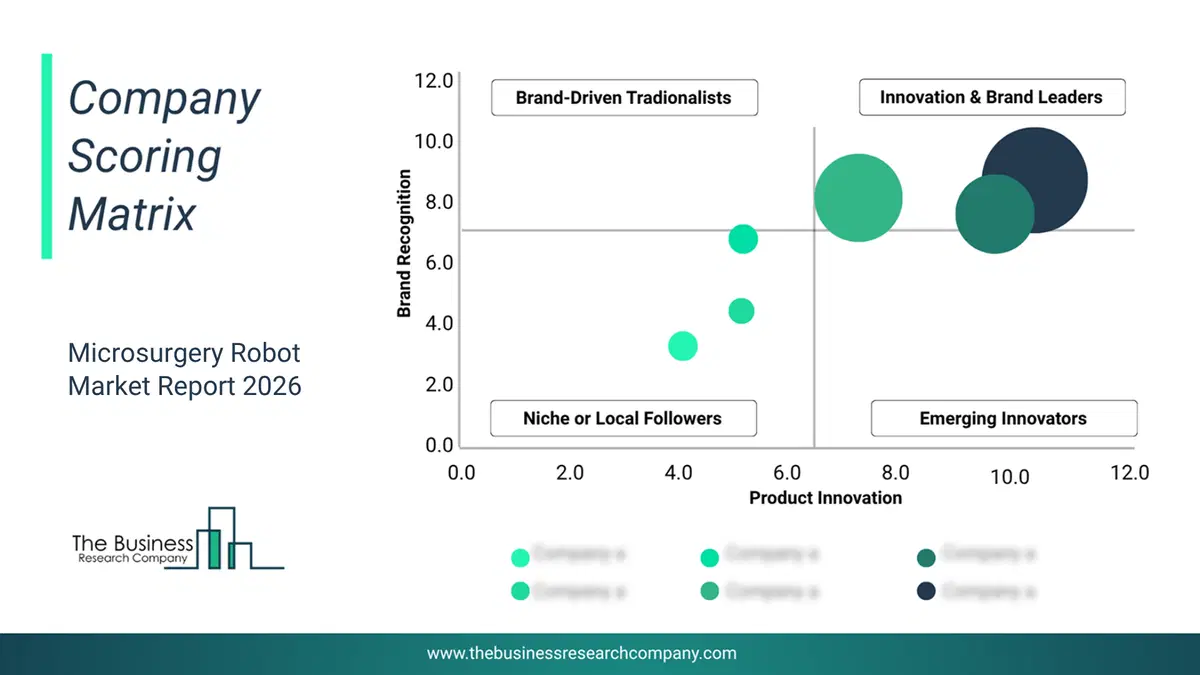
This chart maps companies by product innovation and brand strength, with bubble size indicating relative revenue, helping identify market leaders, challengers, and niche players. This is an illustrative chart; the full report provides a complete and accurate competitive analysis.
Global Microsurgery Robot Market Trends and Insights
Major companies operating in the microsurgery robot market are focusing on developing advanced solutions such as mobile telesurgical systems to expand access to advanced surgical care in remote and underserved areas. Mobile telesurgical systems are portable units equipped with robotic-assisted surgical technology, telecommunication tools, and a power supply, allowing real-time remote surgical support or operation. For instance, in March 2025, SS Innovations International, Inc., a US-based medical robotics company, launched India’s first Mobile Tele-Surgical Unit. It features the SSI Mantra Surgical Robot integrated within a fully equipped mobile van, along with satellite communication, independent power systems, and 4K display monitors to enable live telementoring or telesurgery. It is designed to deliver robotic surgery capabilities to remote, rural, or disaster-struck locations where conventional surgical infrastructure is unavailable. This innovation aims to bridge the gap between specialized surgical expertise and patients in need, regardless of geographic barriers.What Are Latest Mergers And Acquisitions In The Microsurgery Robot Market?
In September 2025, B. Braun Melsungen AG, a Germany-based healthcare technology company, acquired True Digital Surgery for an undisclosed amount. With this acquisition, B. Braun Melsungen AG aimed to strengthen its digital microsurgery capabilities and secure the technology and talent needed to advance its Aesculap AEOS platform as the industry shifts from traditional microscopes to digital exoscopes. True Digital Surgery is a US–based healthcare technology company that specializes in digital robotic-assisted 3D surgical microscopy and exoscope solutions for neurosurgery, spinal surgery, and ENT procedures.
Regional Outlook
North America was the largest region in the microsurgery robot market in 2025. Asia-Pacific is expected to be the fastest-growing region in the forecast period. The regions covered in this market report are Asia-Pacific, South East Asia, Western Europe, Eastern Europe, North America, South America, Middle East, Africa. The countries covered in this market report are Australia, Brazil, China, France, Germany, India, Indonesia, Japan, Taiwan, Russia, South Korea, UK, USA, Canada, Italy, SpainWhat Defines the Microsurgery Robot Market?
The microsurgery robot market consists of sales of surgical workstations, imaging consoles, haptic feedback systems, precision robotic arms, and integrated software platforms. Values in this market are ‘factory gate’ values, that is the value of goods sold by the manufacturers or creators of the goods, whether to other entities (including downstream manufacturers, wholesalers, distributors and retailers) or directly to end customers. The value of goods in this market includes related services sold by the creators of the goods.How is Market Value Defined and Measured?
The market value is defined as the revenues that enterprises gain from the sale of goods and/or services within the specified market and geography through sales, grants, or donations in terms of the currency (in USD unless otherwise specified). The revenues for a specified geography are consumption values that are revenues generated by organizations in the specified geography within the market, irrespective of where they are produced. It does not include revenues from resales along the supply chain, either further along the supply chain or as part of other products.
This chart presents market attractiveness based on a quantitative evaluation of growth, competition, strategic alignment, and risk, offering a clear view of opportunity areas for decision-making. This chart is for illustrative purposes; the full report contains the complete analysis.

This chart highlights the Total Addressable Market (TAM) by estimating the maximum revenue opportunity using an assumption-driven approach, supporting strategic planning and opportunity sizing across markets. The chart is illustrative; the full report provides a more comprehensive analysis.
What Key Data and Analysis Are Included in the Microsurgery Robot Market Report 2026?
The microsurgery robot market research report is one of a series of new reports from The Business Research Company that provides market statistics, including industry global market size, regional shares, competitors with the market share, detailed market segments, market trends and opportunities, and any further data you may need to thrive in the microsurgery robot industry. The market research report delivers a complete perspective of everything you need, with an in-depth analysis of the current and future state of the industry.Microsurgery Robot Market Report Forecast Analysis
| Report Attribute | Details |
|---|---|
| Market Size Value In 2026 | $2.76 billion |
| Revenue Forecast In 2030 | $4.83 billion |
| Growth Rate | CAGR of 15% from 2026 to 2030 |
| Base Year For Estimation | 2025 |
| Actual Estimates/Historical Data | 2020-2025 |
| Forecast Period | 2026 - 2030 |
| Market Representation | Revenue in USD Billion and CAGR from 2026 to 2030 |
| Segments Covered | Product Type, Component, Technology, Application, End-User |
| Regional Scope | Asia-Pacific, Western Europe, Eastern Europe, North America, South America, Middle East, Africa |
| Country Scope | The countries covered in the report are Australia, Brazil, China, France, Germany, India, Indonesia, Japan, Taiwan, Russia, South Korea, UK, USA, Canada, Italy, Spain. |
| Key Companies Profiled | Johnson & Johnson Services Inc., Medtronic plc, Stryker Corporation, Intuitive Surgical Inc., MicroPort Scientific Corporation, Renishaw plc, Titan Medical Inc., Vicarious Surgical Inc., CMR Surgical Ltd., Medical Microinstruments S.p.A., Virtual Incision Corporation, Asensus Surgical Inc., MicroSure BV, Medrobotics Corporation, Galen Robotics Inc., Moon Surgical SAS, Robocath SA, EndoQuest Robotics Inc., Distalmotion SA, Memic Innovative Surgery Ltd., Meerecompany Inc., SS Innovations International Inc. |
| Customization Scope | Request for Customization |
| Pricing And Purchase Options | Explore Purchase Options |