
Military Aerospace Simulation And Training Market Report 2026
Global Outlook – By Component (Hardware, Software, Services), By Training Type (Live Training, Virtual Training, Constructive Training, Mixed Training), By Application (Combat Training, Flight Training, Mission Planning And Rehearsal, Maintenance And Technical Training, Emergency Response Training, Intelligence, Surveillance And Reconnaissance Training, Electronic Warfare Training), By End User (Air Force, Navy, Army Aviation, Special Operations Forces, Defense Training Academies, Defense Contractors) – Market Size, Trends, Strategies, and Forecast to 2030
Military Aerospace Simulation And Training Market Overview
• Military Aerospace Simulation And Training market size has reached to $5.77 billion in 2025 • Expected to grow to $8 billion in 2030 at a compound annual growth rate (CAGR) of 6.7% • Growth Driver: Surge In Increasing Defense Budget Allocations Fueling The Growth Of The Market Due To Escalating Geopolitical Tensions • Market Trend: Technological Advancements In Multi-Domain Simulation Software Enhancing Defense Training Capabilities • North America was the largest region in 2025 and Asia-Pacific is the fastest growing region.What Is Covered Under Military Aerospace Simulation And Training Market?
Military aerospace simulation and training refer to systems and solutions designed to replicate real-world military aviation environments for training, mission rehearsal, operational planning, and skills development. These systems use advanced simulation technologies to create realistic and immersive training scenarios that enhance operational readiness, improve decision-making, and develop mission-critical skills while reducing the risks and costs associated with live training exercises. The main components of military aerospace simulation and training include hardware, software, and services. Hardware refers to the physical simulation infrastructure, including flight simulators, mission trainers, visual display systems, motion platforms, and control interfaces used to replicate realistic military aerospace environments for training purposes. These solutions support live training, virtual training, constructive training, and mixed training. The various applications involved are combat training, flight training, mission planning and rehearsal, maintenance and technical training, emergency response training, intelligence, surveillance and reconnaissance training, and electronic warfare training and they are utilized by end users including air force, navy, army aviation, special operations forces, defense training academies, and defense contractors.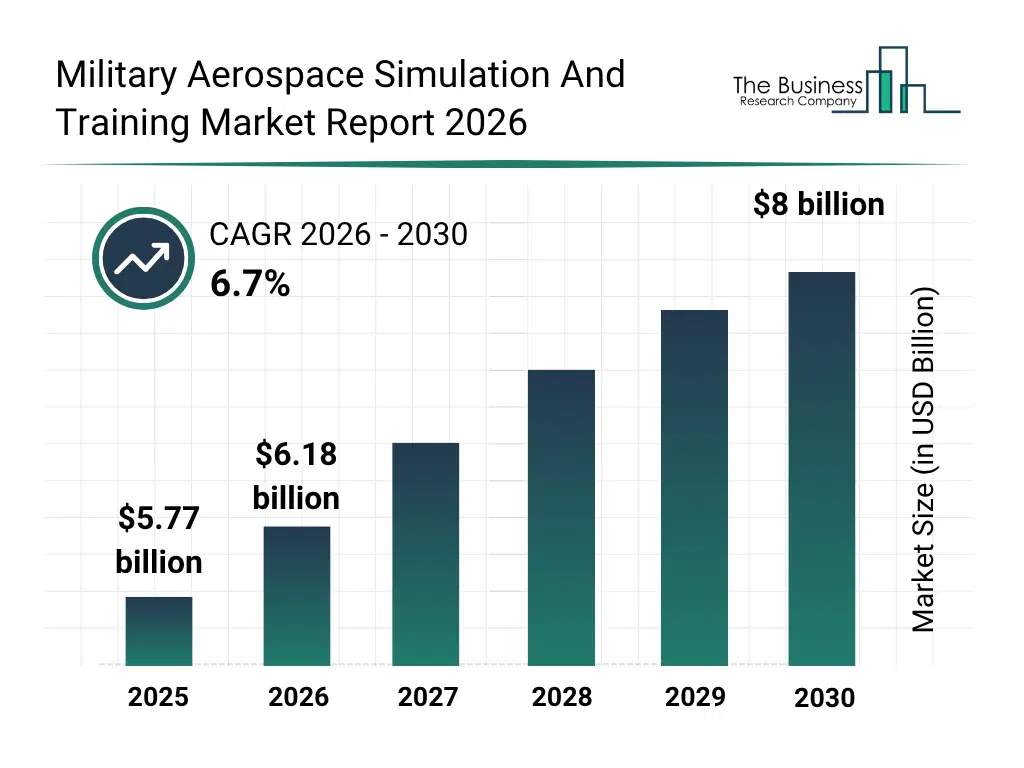
What Is The Military Aerospace Simulation And Training Market Size and Share 2026?
The military aerospace simulation and training market size has grown strongly in recent years. It will grow from $5.77 billion in 2025 to $6.18 billion in 2026 at a compound annual growth rate (CAGR) of 7.1%. The growth in the historic period can be attributed to increasing defense modernization programs, rising demand for cost reduction in military training exercises, growing need for enhanced pilot and operator skills, expanding adoption of mission rehearsal activities, increasing focus on improving operational preparedness.What Is The Military Aerospace Simulation And Training Market Growth Forecast?
The military aerospace simulation and training market size is expected to see strong growth in the next few years. It will grow to $8 billion in 2030 at a compound annual growth rate (CAGR) of 6.7%. The growth in the forecast period can be attributed to growing investments in advanced military simulation technologies, rising demand for immersive training environments, increasing adoption of next generation aircraft training systems, expanding defense budgets for training infrastructure development, growing need for continuous military personnel skill enhancement. Major trends in the forecast period include advanced simulation based military training systems, increasing adoption of scenario based mission rehearsal solutions, growing demand for cost effective virtual training environments, rising focus on operational readiness and skills development, increasing integration of realistic tactical training scenarios.
Global Military Aerospace Simulation And Training Market Segmentation
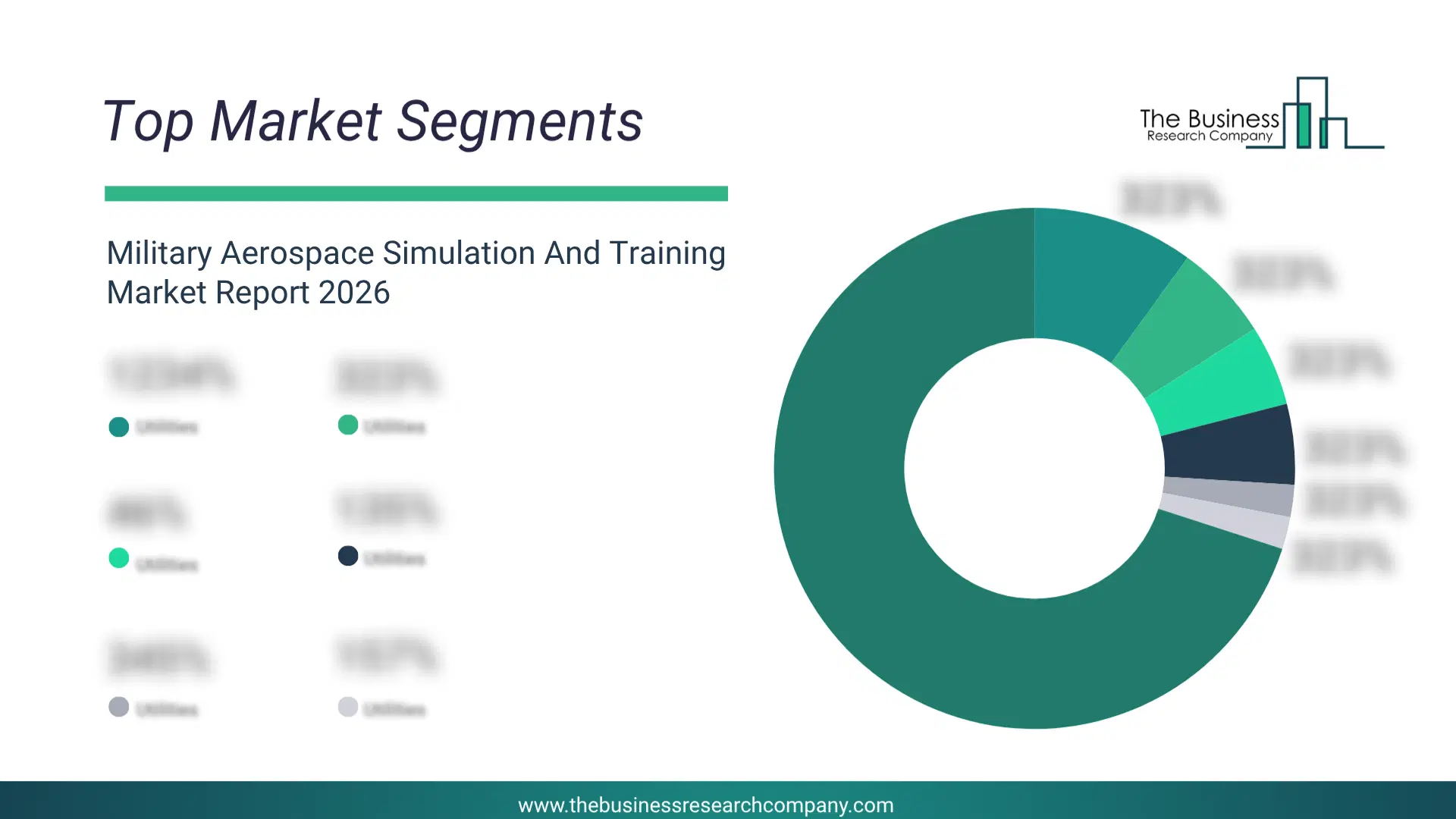
1) By Component: Hardware, Software, Services 2) By Training Type: Live Training, Virtual Training, Constructive Training, Mixed Training 3) By Application: Combat Training, Flight Training, Mission Planning And Rehearsal, Maintenance And Technical Training, Emergency Response Training, Intelligence, Surveillance And Reconnaissance Training, Electronic Warfare Training 4) By End User: Air Force, Navy, Army Aviation, Special Operations Forces, Defense Training Academies, Defense Contractors Subsegments: 1) By Hardware: Simulation Training Devices, Flight Simulation Cockpits, Visual Display Systems, Motion And Control Systems 2) By Software: Simulation And Modeling Software, Mission Planning Software, Virtual Reality And Augmented Reality Training Software, After Action Review And Analytics Software 3) By Services: Simulation System Integration Services, Training And Instruction Services, Maintenance And Technical Support Services, Managed Simulation And Training ServicesWhat Is The Driver Of The Military Aerospace Simulation And Training Market?
The increasing defense budget allocations is expected to propel the growth of the military aerospace simulation and training market going forward. A defense budget is the total government financial allocation designated for maintaining, equipping, and training a nation's armed forces, including procurement of defense systems and operational readiness programs. Defense budget allocations are rising due to escalating geopolitical tensions, as countries increase military spending to strengthen national security and prepare for potential conflicts. Defense budget allocations strengthen military aerospace simulation and training by enabling investments in advanced simulation technologies, modernized training infrastructure, and realistic training programs that enhance operational readiness and mission effectiveness. For instance, in April 2026, according to the Stockholm International Peace Research Institute (SIPRI), a Sweden-based independent arms and conflict research organization, global military expenditure reached $2,887 billion in 2025, an increase of 2.9% in real terms over 2024, marking the 11th consecutive year of growth. Therefore, increasing defense budget allocations is driving the growth of military aerospace simulation and training industry.Key Players In The Global Military Aerospace Simulation And Training Market
Major companies operating in the military aerospace simulation and training market are The Boeing Company, RTX Corporation, Airbus SE, Lockheed Martin Corporation, General Dynamics Corporation, Northrop Grumman Corporation, BAE Systems plc, L3Harris Technologies Inc., Thales S.A., Leonardo S.p.A., Textron Inc., Rheinmetall AG, CACI International Inc, Elbit Systems Ltd., Indra Sistemas S.A., Saab AB, Kongsberg Gruppen ASA, CAE Inc., FlightSafety International Inc., Cubic Corporation, Kratos Defense & Security Solutions Inc., HAVELSAN Hava Elektronik Sanayi ve Ticaret A.Ş., Patria Oyj, Zen Technologies Limited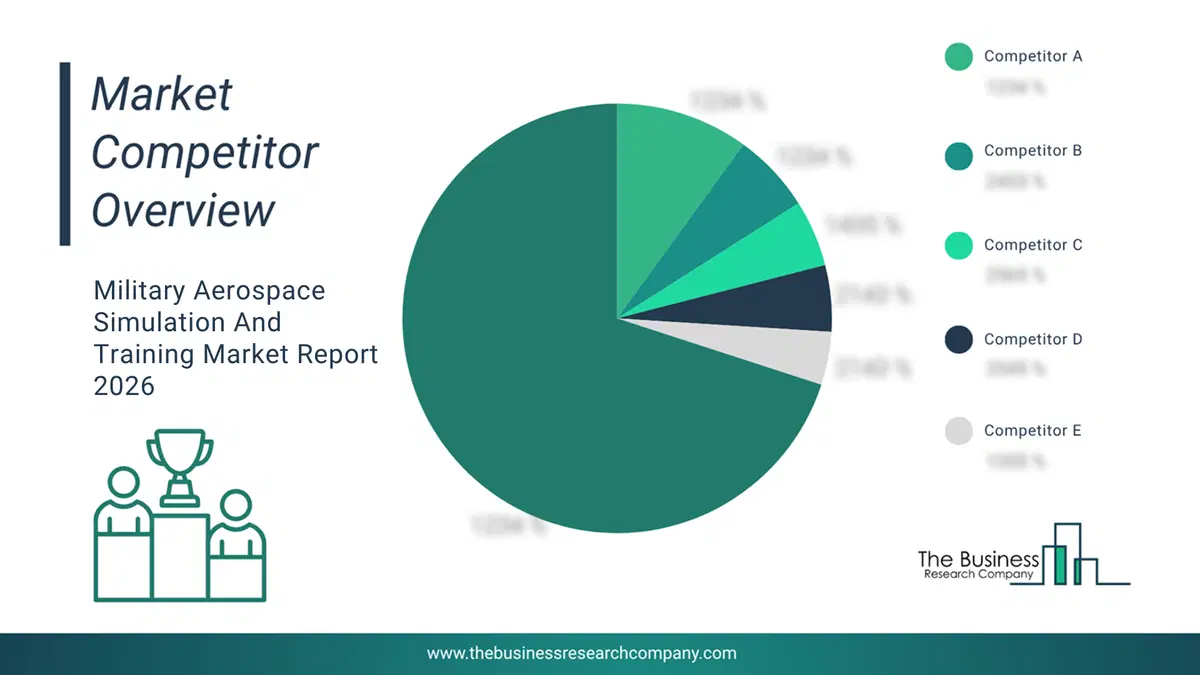
This chart is for illustrative purposes; the full report includes a detailed competitor analysis and comprehensive overview of the top 10 companies in the market.
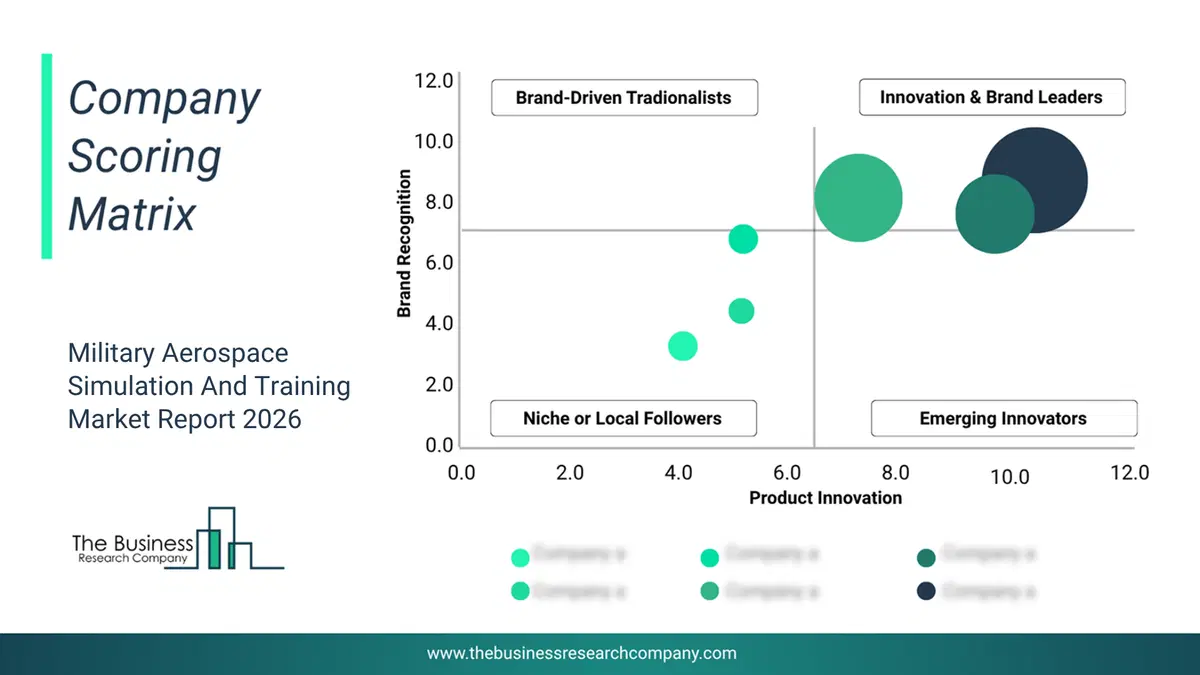
This chart maps companies by product innovation and brand strength, with bubble size indicating relative revenue, helping identify market leaders, challengers, and niche players. This is an illustrative chart; the full report provides a complete and accurate competitive analysis.
Global Military Aerospace Simulation And Training Market Trends and Insights
Major companies operating in the military aerospace simulation and training market are focusing on developing advanced software such as, multi-domain simulation and training software to enhance operational readiness, mission realism, joint-force interoperability, and defense training effectiveness. Multi-domain simulation and training software is an advanced digital platform that integrates land, air, sea, space, and cyber warfare scenarios into a unified virtual environment, enabling military personnel to conduct realistic, collaborative training exercises with greater flexibility and lower cost than traditional live training systems. For instance, in July 2024, Bohemia Interactive Simulations k.s., a Czech Republic-based simulation software company, released VBS4 24.1 and VBS Blue IG 24.1, upgraded multi-domain simulation and training software solutions. The update introduced more than 800 new capabilities, including enhanced AI-driven behaviors, improvised drone munitions, global airfield integration, advanced terrain editing, missile and rocket visual effects, smart artillery simulations, and improved rendering performance. The software also includes cost-effective development tools, automated benchmarking, and enhanced interoperability features that support realistic multi-domain and coalition training environments. These advancements reflect the growing adoption of high-fidelity, AI-enabled simulation platforms to improve defense preparedness and mission training outcomes.What Are Latest Mergers And Acquisitions In The Military Aerospace Simulation And Training Market?
In February 2024, Indra Sistemas S.A., a Spain-based aerospace, defense, and technology company, acquired Global Training Aviation S.L. (GTA) for an undisclosed amount. With this acquisition, Indra Sistemas, S.A. aimed to integrate the entire aviation simulation value chain by combining advanced simulator manufacturing with pilot and cabin crew training services, strengthening its presence in high-growth aviation markets across Europe, Asia, and Latin America, and accelerating the development of next-generation simulation technologies. Global Training Aviation S.L. is a Spain-based aviation training company that specializes in providing pilot and cabin crew training services through full-flight simulators, procedure trainers, and advanced aviation simulation systems.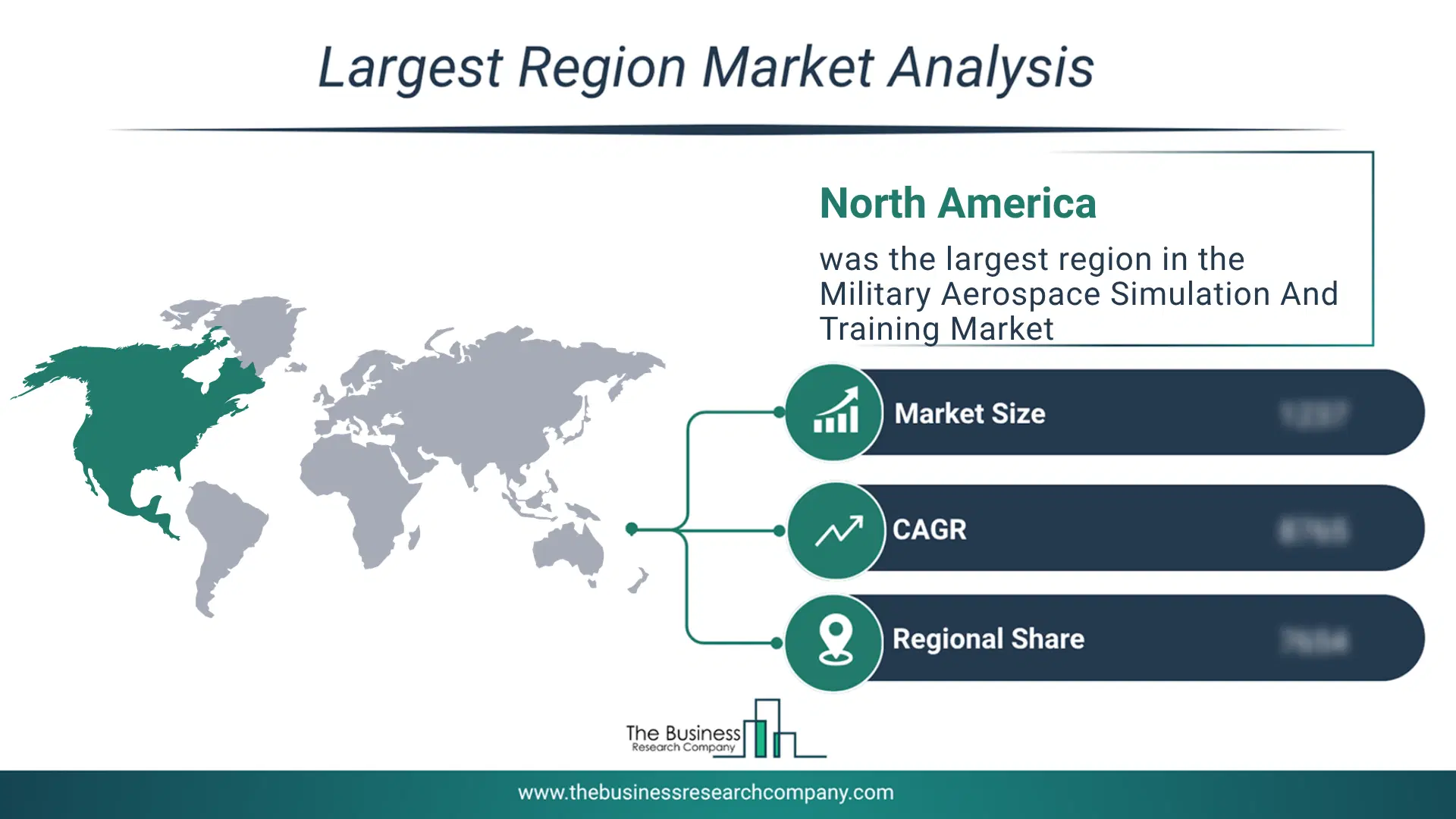
Regional Insights
North America was the largest region in the military aerospace simulation and training market in 2025. Asia-Pacific is expected to be the fastest-growing region in the forecast period. The regions covered in this market report are Asia-Pacific, South East Asia, Western Europe, Eastern Europe, North America, South America, Middle East, Africa. The countries covered in this market report are Australia, Brazil, China, France, Germany, India, Indonesia, Japan, Taiwan, Russia, South Korea, UK, USA, Canada, Italy, Spain.What Defines the Military Aerospace Simulation And Training Market?
The military aerospace simulation and training market consists of revenues earned by entities by providing services such as simulation-based training, mission rehearsal, instructor support, training program development, simulator installation, system integration, software updates, maintenance, and technical support. The market value includes the value of related goods sold by the service provider or included within the service offering. The military aerospace simulation and training market also includes sales of full-flight simulators, fixed-base flight simulators, mission training systems, flight training devices, virtual training systems, and simulation software. Values in this market are ‘factory gate’ values, that is, the value of goods sold by the manufacturers or creators of the goods, whether to other entities (including downstream manufacturers, wholesalers, distributors, and retailers) or directly to end customers. The value of goods in this market includes related services sold by the creators of the goods.How is Market Value Defined and Measured?
The market value is defined as the revenues that enterprises gain from the sale of goods and/or services within the specified market and geography through sales, grants, or donations in terms of the currency (in USD unless otherwise specified). The revenues for a specified geography are consumption values that are revenues generated by organizations in the specified geography within the market, irrespective of where they are produced. It does not include revenues from resales along the supply chain, either further along the supply chain or as part of other products.
This chart presents market attractiveness based on a quantitative evaluation of growth, competition, strategic alignment, and risk, offering a clear view of opportunity areas for decision-making. This chart is for illustrative purposes; the full report contains the complete analysis.

This chart highlights the Total Addressable Market (TAM) by estimating the maximum revenue opportunity using an assumption-driven approach, supporting strategic planning and opportunity sizing across markets. The chart is illustrative; the full report provides a more comprehensive analysis.
What Key Data and Analysis Are Included in the Military Aerospace Simulation And Training Market Report 2026?
The military aerospace simulation and training market research report is one of a series of new reports from The Business Research Company that provides market statistics, including industry global market size, regional shares, competitors with the market share, detailed market segments, market trends and opportunities, and any further data you may need to thrive in the military aerospace simulation and training industry. The market research report delivers a complete perspective of everything you need, with an in-depth analysis of the current and future state of the industry.Military Aerospace Simulation And Training Market Report Forecast Analysis
| Report Attribute | Details |
|---|---|
| Market Size Value In 2026 | $6.18 billion |
| Revenue Forecast In 2030 | $8 billion |
| Growth Rate | CAGR of 6.7% from 2026 to 2030 |
| Base Year For Estimation | 2025 |
| Actual Estimates/Historical Data | 2020-2025 |
| Forecast Period | 2026 - 2030 |
| Market Representation | Revenue in USD Billion and CAGR from 2026 to 2030 |
| Segments Covered | Component, Training Type, Application, End User |
| Regional Scope | Asia-Pacific, Western Europe, Eastern Europe, North America, South America, Middle East, Africa |
| Country Scope | The countries covered in the report are Australia, Brazil, China, France, Germany, India, Indonesia, Japan, Taiwan, Russia, South Korea, UK, USA, Canada, Italy, Spain. |
| Key Companies Profiled | The Boeing Company, RTX Corporation, Airbus SE, Lockheed Martin Corporation, General Dynamics Corporation, Northrop Grumman Corporation, BAE Systems plc, L3Harris Technologies Inc., Thales S.A., Leonardo S.p.A., Textron Inc., Rheinmetall AG, CACI International Inc, Elbit Systems Ltd., Indra Sistemas S.A., Saab AB, Kongsberg Gruppen ASA, CAE Inc., FlightSafety International Inc., Cubic Corporation, Kratos Defense & Security Solutions Inc., HAVELSAN Hava Elektronik Sanayi ve Ticaret A.Ş., Patria Oyj, Zen Technologies Limited |
| Customization Scope | Request for Customization |
| Pricing And Purchase Options | Explore Purchase Options |