
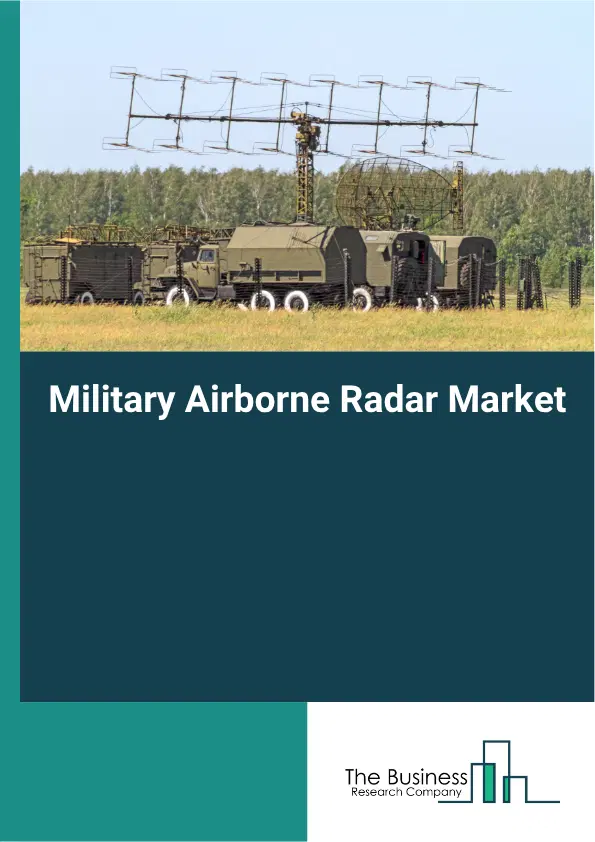
Military Airborne Radar Market Report 2026
Global Outlook – By Component (Antenna, Transmitter, Receiver, Duplexer, Power Amplifier, Other Components), By Range (Short Range, Medium Range, Long Range), By Technology (Phased Array Radar, Synthetic Aperture Radar, Pulse Doppler Radar, Frequency Modulated Continuous Wave Radar, Multifunction Radar), By Application (Surveillance, Targeting, Navigation, Weather Monitoring, Search And Rescue), By End User (Military Aviation, Defense Forces, Intelligence Agencies, Research Institutions, Commercial Aviation) – Market Size, Trends, Strategies, and Forecast to 2030
Military Airborne Radar Market Overview
• Military Airborne Radar market size has reached to $7.12 billion in 2025 • Expected to grow to $10.01 billion in 2030 at a compound annual growth rate (CAGR) of 7.0% • Growth Driver: Increasing Geopolitical Tensions Driving The Military Airborne Radar Market Growth Due To Rising Defense Procurement • Market Trend: Innovations In Multi-Mode Airborne Radar Technology Enhance Intelligence, Surveillance, and Reconnaissance (ISR) Capabilities • North America was the largest region in 2025 and Asia-Pacific is the fastest growing region.What Is Covered Under Military Airborne Radar Market?
Military airborne radar is an advanced radar system installed on military aircraft that uses electromagnetic waves to detect, track, identify, and classify aerial, maritime, and ground targets in all weather and visibility conditions. The system supports command and control, improves threat detection, and enables faster, more effective military decision-making across diverse mission operations. The main components of military airborne radar include antennas, transmitters, receivers, duplexers, power amplifiers, and other components. Antennas refer to devices that transmit and receive electromagnetic signals, enabling radar systems to detect, locate, and track objects from airborne platforms. These radar systems operate across short range, medium range, and long range and use phased array radar, synthetic aperture radar, pulse Doppler radar, frequency modulated continuous wave radar, and multifunction radar technologies. The various applications involved are surveillance, targeting, navigation, weather monitoring, and search and rescue, and they are used by several end users such as military aviation, defense forces, intelligence agencies, research institutions, and commercial aviation.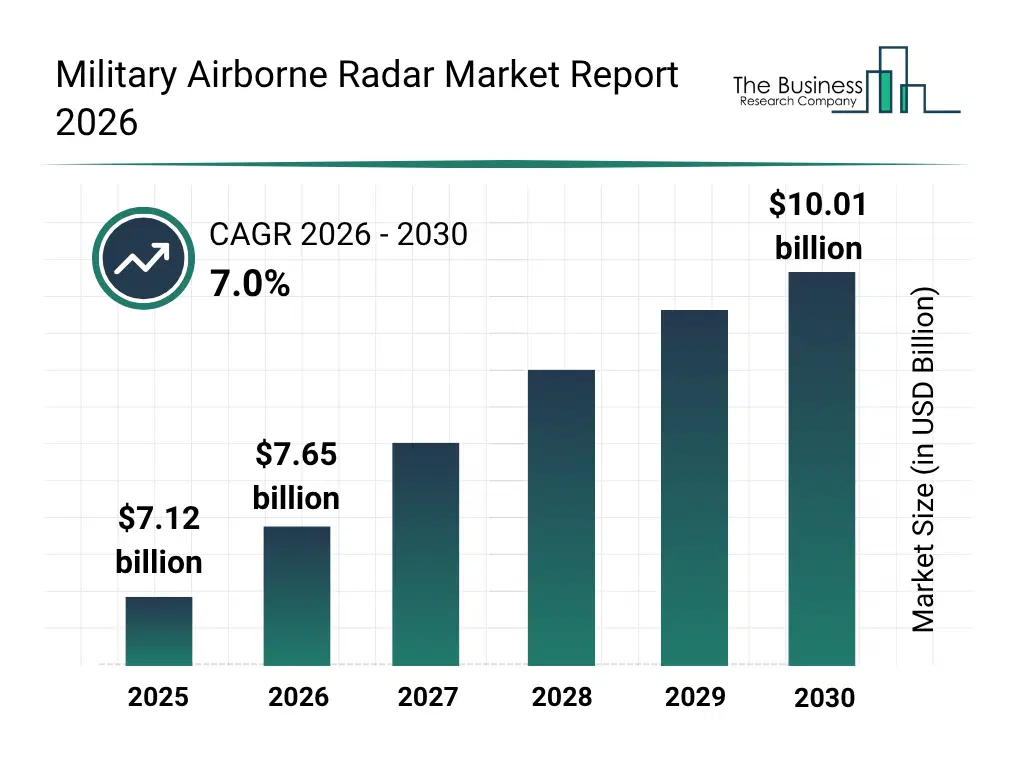
What Is The Military Airborne Radar Market Size and Share 2026?
The military airborne radar market size has grown strongly in recent years. It will grow from $7.12 billion in 2025 to $7.65 billion in 2026 at a compound annual growth rate (CAGR) of 7.4%. The growth in the historic period can be attributed to rising defense spending, increasing military aircraft modernization, growing demand for airborne surveillance, expansion of electronic warfare capabilities, increasing geopolitical tensions.What Is The Military Airborne Radar Market Growth Forecast?
The military airborne radar market size is expected to see strong growth in the next few years. It will grow to $10.01 billion in 2030 at a compound annual growth rate (CAGR) of 7.0%. The growth in the forecast period can be attributed to growing adoption of unmanned aerial systems, increasing demand for advanced threat detection, rising investment in next-generation fighter aircraft, increasing integration of AI-enabled radar processing, growing demand for multifunction airborne radar systems. Major trends in the forecast period include increasing adoption of active electronically scanned array radar, growing integration of multifunction radar systems, advancements in gallium nitride radar components, increasing demand for long-range detection capabilities, development of lightweight and compact airborne radar systems.
Global Military Airborne Radar Market Segmentation
1) By Component: Antenna, Transmitter, Receiver, Duplexer, Power Amplifier, Other Components 2) By Range: Short Range, Medium Range, Long Range 3) By Technology: Phased Array Radar, Synthetic Aperture Radar, Pulse Doppler Radar, Frequency Modulated Continuous Wave Radar, Multifunction Radar 4) By Application: Surveillance, Targeting, Navigation, Weather Monitoring, Search And Rescue 5) By End User: Military Aviation, Defense Forces, Intelligence Agencies, Research Institutions, Commercial Aviation Subsegments: 1) By Antenna: Active Electronically Scanned Array Antenna, Passive Electronically Scanned Array Antenna, Slotted Array Antenna, Planar Array Antenna 2) By Transmitter: Solid State Transmitter, Traveling Wave Tube Transmitter, Gallium Nitride Power Module, Gallium Arsenide Power Module 3) By Receiver: Superheterodyne Receiver, Digital Receiver, Multi Channel Receiver, Wideband Receiver 4) By Duplexer: Ferrite Duplexer, Circulator Duplexer, Coaxial Duplexer, Waveguide Duplexer 5) By Power Amplifier: Solid State Power Amplifier, Traveling Wave Tube Amplifier, Gallium Nitride Power Amplifier, Gallium Arsenide Power Amplifier 6) By Other Components: Signal Processor, Radar Processor, Frequency Synthesizer, Exciter ModuleWhat Is The Driver Of The Military Airborne Radar Market?
The increasing geopolitical tensions are expected to propel the growth of the military airborne radar market going forward. Geopolitical tensions refer to the state of conflict, rivalry, or instability between nations or regions arising from competing political, territorial, or strategic interests. The growing prevalence of geopolitical tensions is largely driven by escalating interstate conflicts and power competition, as ongoing wars and regional rivalries compel governments to reassess their security strategies and rapidly expand defense capabilities. The rising geopolitical tensions boost demand for military airborne radar systems as nations prioritize advanced aerial surveillance and threat detection technologies to monitor hostile airspace and gain strategic battlefield awareness. For instance, in July 2024, according to The Armed Conflict Location & Event Data Project (ACLED), a US-based non-profit organization, over 165,273 political violence events were recorded worldwide, marking a 15% increase from July 2023 to June 2024. Therefore, increasing geopolitical tensions are driving the growth of the military airborne radar industry.Key Players In The Global Military Airborne Radar Market
Major companies operating in the military airborne radar market are RTX Corporation, Lockheed Martin Corporation, Northrop Grumman Corporation, The Boeing Company, General Dynamics Corporation, BAE Systems plc, Thales Group, L3Harris Technologies Inc., Leonardo S.p.A., Honeywell International Inc., Rheinmetall AG, Saab AB, Israel Aerospace Industries Ltd., Elbit Systems Ltd., Aselsan A.Ş., Hindustan Aeronautics Limited, Bharat Electronics Limited, Hanwha Systems Co. Ltd., Indra Sistemas S.A., HENSOLDT AG, Kratos Defense & Security Solutions Inc., Qorvo Inc., Mercury Systems Inc., Terma A/S, NEC Corporation
This chart is for illustrative purposes; the full report includes a detailed competitor analysis and comprehensive overview of the top 10 companies in the market.
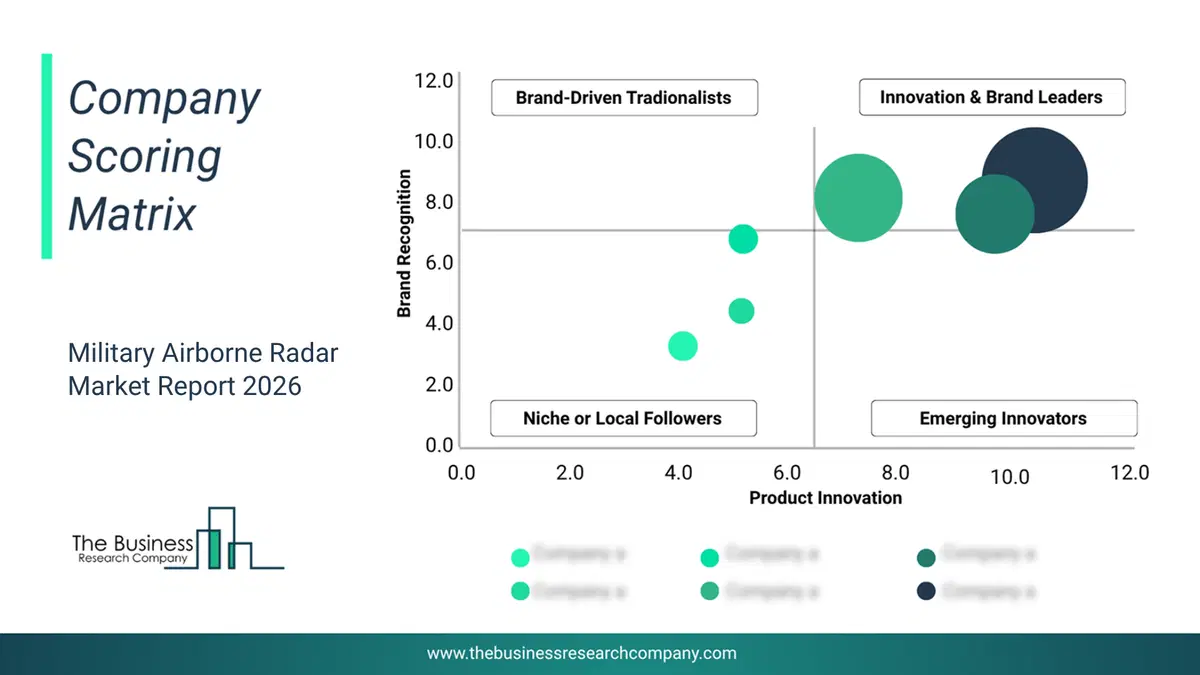
This chart maps companies by product innovation and brand strength, with bubble size indicating relative revenue, helping identify market leaders, challengers, and niche players. This is an illustrative chart; the full report provides a complete and accurate competitive analysis.
Global Military Airborne Radar Market Trends and Insights
Major companies operating in the military airborne radar market are focusing on developing advanced multi-mode airborne radar solutions to strengthen intelligence, surveillance, and reconnaissance (ISR) capabilities, improve situational awareness, and support defense operations across complex environments. Multimode airborne radar refers to an advanced radar system capable of operating in multiple radar modes, including Synthetic Aperture Radar (SAR), Ground Moving Target Indication (GMTI), and Inverse Synthetic Aperture Radar (ISAR), to detect, track, and image ground and maritime targets under diverse operational conditions. For instance, in June 2026, Robin Radar Systems, a Netherlands-based radar technology company, partnered with the Netherlands Organisation for Applied Scientific Research (TNO), a Netherlands-based research organization, to develop and commercialize a new multi-mode airborne radar platform for ground and sea surveillance, search and rescue, and intelligence, surveillance, and reconnaissance (ISR) missions. The radar is designed for deployment on large unmanned aircraft systems (UAS) and integrates onboard processing with SAR, GMTI, and ISAR capabilities to deliver long-range situational awareness and reliable imaging in darkness, adverse weather, smoke, and dust.What Are Latest Mergers And Acquisitions In The Military Airborne Radar Market?
In March 2026, Ondas Inc., a US-based provider of autonomous systems and private wireless solutions, acquired BIRD Aerosystems for an undisclosed amount. Through this acquisition, Ondas aims to strengthen its military airborne radar capabilities by integrating BIRD Aerosystems' multi-mode airborne radar technologies, intelligence, surveillance, and reconnaissance (ISR) solutions, and aircraft protection systems, thereby expanding its defense surveillance portfolio. BIRD Aerosystems is an Israel-based defense technology company that develops military airborne radar-integrated ISR systems and airborne surveillance solutions, including military airborne radar.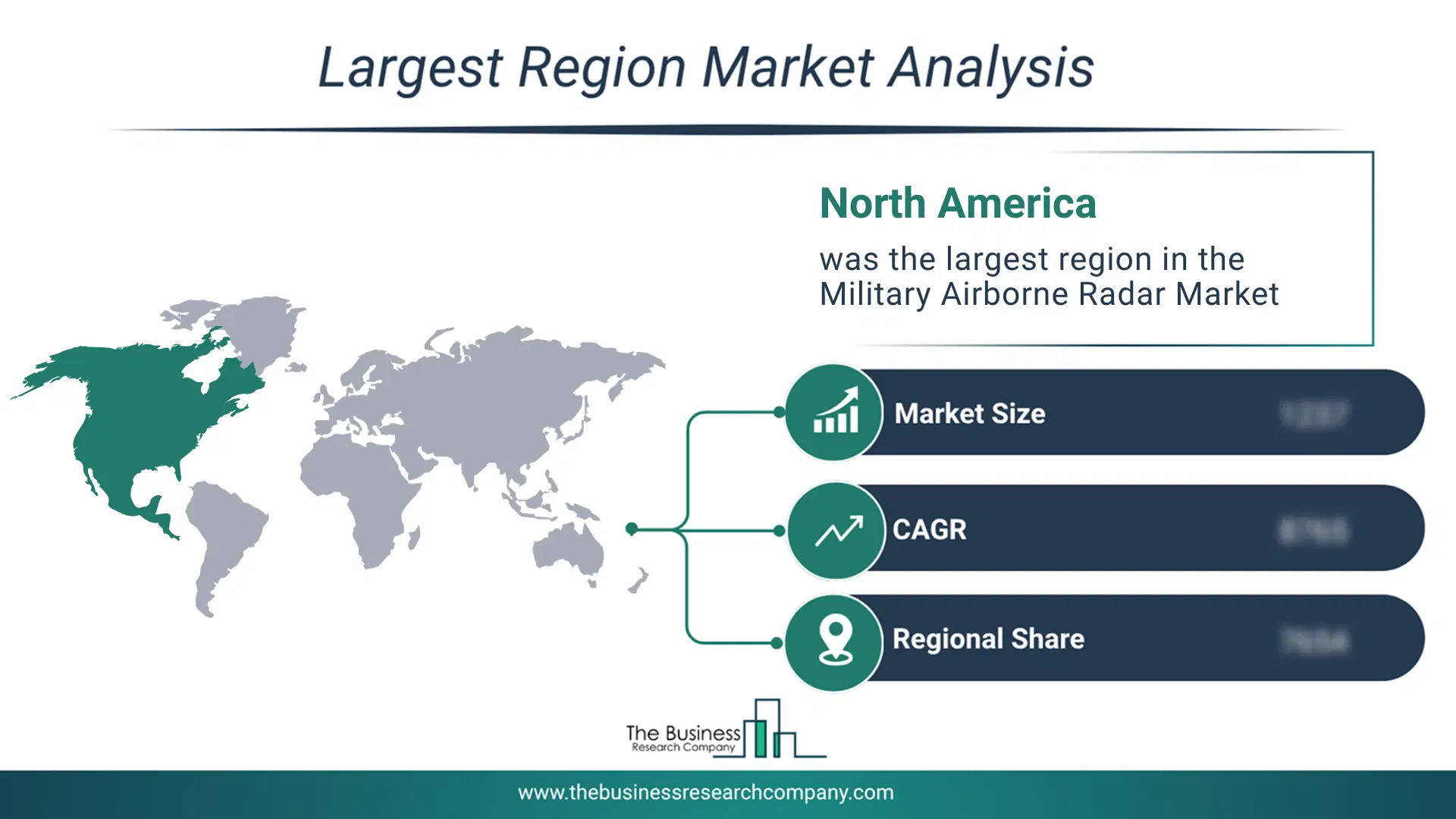
Regional Insights
North America was the largest region in the military airborne radar market in 2025. Asia-Pacific is expected to be the fastest-growing region in the forecast period. The regions covered in this market report are Asia-Pacific, South East Asia, Western Europe, Eastern Europe, North America, South America, Middle East, Africa. The countries covered in this market report are Australia, Brazil, China, France, Germany, India, Indonesia, Japan, Taiwan, Russia, South Korea, UK, USA, Canada, Italy, Spain.What Defines the Military Airborne Radar Market?
The military airborne radar market consists of sales of radar mission computers, radar control units, radar display units, radar data recorders, radar cooling systems, radar power supply modules, and waveguide assemblies. Values in this market are ‘factory gate’ values, that is, the value of goods sold by the manufacturers or creators of the goods, whether to other entities (including downstream manufacturers, wholesalers, distributors, and retailers) or directly to end customers. The value of goods in this market includes related services sold by the creators of the goods.How is Market Value Defined and Measured?
The market value is defined as the revenues that enterprises gain from the sale of goods and/or services within the specified market and geography through sales, grants, or donations in terms of the currency (in USD unless otherwise specified). The revenues for a specified geography are consumption values that are revenues generated by organizations in the specified geography within the market, irrespective of where they are produced. It does not include revenues from resales along the supply chain, either further along the supply chain or as part of other products.
This chart presents market attractiveness based on a quantitative evaluation of growth, competition, strategic alignment, and risk, offering a clear view of opportunity areas for decision-making. This chart is for illustrative purposes; the full report contains the complete analysis.

This chart highlights the Total Addressable Market (TAM) by estimating the maximum revenue opportunity using an assumption-driven approach, supporting strategic planning and opportunity sizing across markets. The chart is illustrative; the full report provides a more comprehensive analysis.
What Key Data and Analysis Are Included in the Military Airborne Radar Market Report 2026?
The military airborne radar market research report is one of a series of new reports from The Business Research Company that provides market statistics, including industry global market size, regional shares, competitors with the market share, detailed market segments, market trends and opportunities, and any further data you may need to thrive in the military airborne radar industry. The market research report delivers a complete perspective of everything you need, with an in-depth analysis of the current and future state of the industry.Military Airborne Radar Market Report Forecast Analysis
| Report Attribute | Details |
|---|---|
| Market Size Value In 2026 | $7.65 billion |
| Revenue Forecast In 2030 | $10.01 billion |
| Growth Rate | CAGR of 7.0% from 2026 to 2030 |
| Base Year For Estimation | 2025 |
| Actual Estimates/Historical Data | 2020-2025 |
| Forecast Period | 2026 - 2030 |
| Market Representation | Revenue in USD Billion and CAGR from 2026 to 2030 |
| Segments Covered | Component, Range, Technology, Application, End User |
| Regional Scope | Asia-Pacific, Western Europe, Eastern Europe, North America, South America, Middle East, Africa |
| Country Scope | The countries covered in the report are Australia, Brazil, China, France, Germany, India, Indonesia, Japan, Taiwan, Russia, South Korea, UK, USA, Canada, Italy, Spain. |
| Key Companies Profiled | RTX Corporation, Lockheed Martin Corporation, Northrop Grumman Corporation, The Boeing Company, General Dynamics Corporation, BAE Systems plc, Thales Group, L3Harris Technologies Inc., Leonardo S.p.A., Honeywell International Inc., Rheinmetall AG, Saab AB, Israel Aerospace Industries Ltd., Elbit Systems Ltd., Aselsan A.Ş., Hindustan Aeronautics Limited, Bharat Electronics Limited, Hanwha Systems Co. Ltd., Indra Sistemas S.A., HENSOLDT AG, Kratos Defense & Security Solutions Inc., Qorvo Inc., Mercury Systems Inc., Terma A/S, NEC Corporation |
| Customization Scope | Request for Customization |
| Pricing And Purchase Options | Explore Purchase Options |