
Military Biometrics Market Report 2026
Global Outlook – By Component (Hardware, Software, Services), By Biometric Type (Fingerprint Recognition, Facial Recognition, Iris Recognition, Voice Recognition, Deoxyribonucleic Acid Biometrics, Other Biometric Types), By Deployment Environment (Fixed Installations, Mobile And Tactical), By Application (Access Control, Identification And Authentication, Surveillance, Other Applications), By End User (Army, Navy, Air Force, Other End User) – Market Size, Trends, Strategies, and Forecast to 2030
Military Biometrics Market Overview
• Military Biometrics market size has reached to $7.32 billion in 2025 • Expected to grow to $11.17 billion in 2030 at a compound annual growth rate (CAGR) of 8.9% • Growth Driver: Increasing Complexity Of Security Threats Driving The Market Due To Rapid Digitalization And Expanding Attack Surfaces • Market Trend: AI-Driven Biometric Innovations Enhancing Defense Identification And Security • North America was the largest region in 2025 and Asia-Pacific is the fastest growing region.What Is Covered Under Military Biometrics Market?
Military biometrics refers to the use of unique biological and behavioral characteristics, such as fingerprints, facial recognition, iris scans, and voice patterns, to identify, verify, and track individuals in defense and military operations. It is used for secure access control, personnel identification, border security, threat detection, intelligence gathering, and enhancing operational security across military environments. The main components of military biometrics include hardware, software, and services. Hardware refers to biometric capture and authentication devices used for secure identity verification and access control in defense environments. These solutions are based on biometric types such as fingerprint recognition, facial recognition, iris recognition, voice recognition, deoxyribonucleic acid biometrics, and other biometric types and are deployed in environments including fixed installations and mobile and tactical settings. The various applications involved are access control, identification and authentication, surveillance, and others, and they are used by several end users such as army, navy, air force, and others.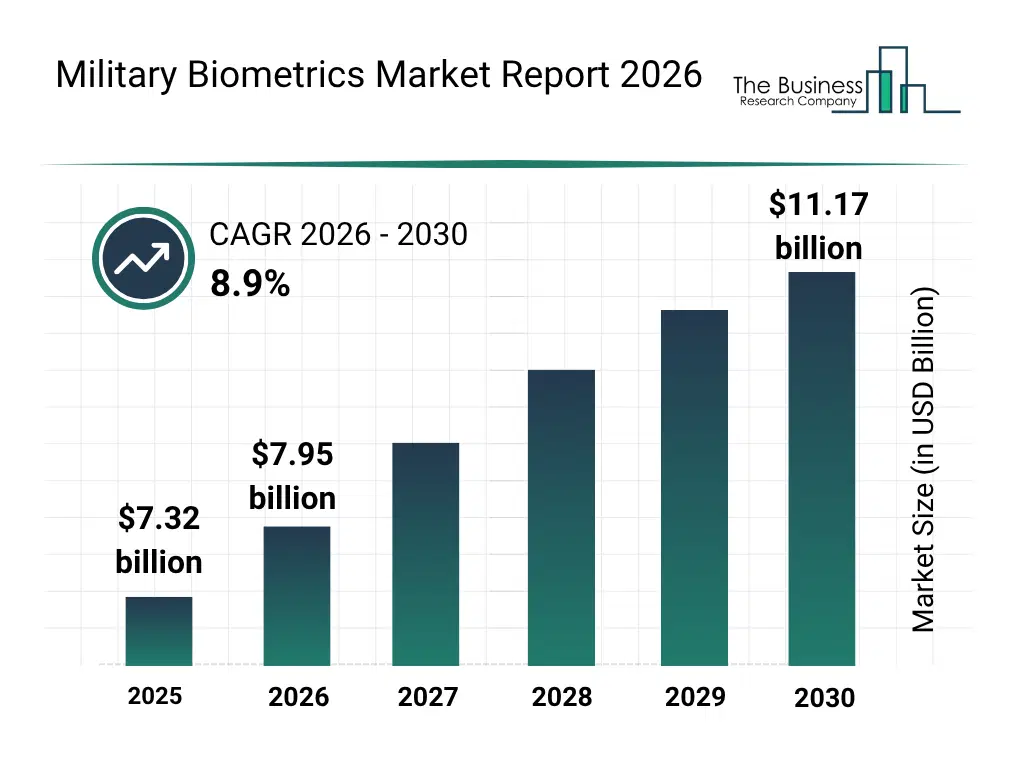
What Is The Military Biometrics Market Size and Share 2026?
The military biometrics market size has grown strongly in recent years. It will grow from $7.32 billion in 2025 to $7.95 billion in 2026 at a compound annual growth rate (CAGR) of 8.6%. The growth in the historic period can be attributed to rising cross-border terrorism and insurgency threats, increasing need for secure military access control systems, adoption of fingerprint-based identification in defense installations, modernization of military surveillance and intelligence systems, growing digitization of defense personnel records.What Is The Military Biometrics Market Growth Forecast?
The military biometrics market size is expected to see strong growth in the next few years. It will grow to $11.17 billion in 2030 at a compound annual growth rate (CAGR) of 8.9%. The growth in the forecast period can be attributed to expansion of AI-driven surveillance and identity verification systems, increasing deployment of contactless biometric technologies in defense, rising demand for real-time threat detection and authentication systems, integration of biometric systems with autonomous military platforms, growing investments in cybersecure defense infrastructure. Major trends in the forecast period include AI-powered biometric identity verification systems for real-time authentication, multimodal biometric fusion integrating fingerprint facial and iris recognition, edge-based biometric processing for battlefield and remote operations, behavioral biometrics for continuous identity monitoring in defense environments, cloud-enabled centralized biometric databases for military personnel tracking.
Global Military Biometrics Market Segmentation
1) By Component: Hardware, Software, Services 2) By Biometric Type: Fingerprint Recognition, Facial Recognition, Iris Recognition, Voice Recognition, Deoxyribonucleic Acid Biometrics, Other Biometric Types 3) By Deployment Environment: Fixed Installations, Mobile And Tactical 4) By Application: Access Control, Identification And Authentication, Surveillance, Other Applications 5) By End User: Army, Navy, Air Force, Other End User Subsegments: 1) By Hardware: Biometric Scanners, Mobile Biometric Devices, Handheld Identification Terminals 2) By Software: Biometric Authentication Software, Matching And Recognition Algorithms, Database Management Systems 3) By Services: System Integration And Deployment Services, Maintenance And Support Services, Training And Simulation Services For Defense PersonnelWhat Is The Driver Of The Military Biometrics Market?
The increasing complexity of security threats is expected to propel the growth of the military biometrics market going forward. A security threat is any possible action or event that can compromise the confidentiality, integrity, or availability of systems and data. Security threats are increasing mainly due to rapid digitalization, as more sensitive data and critical services move online, creating a larger attack surface for cybercriminals to exploit. Military biometrics enhances security threat management by continuously authenticating personnel and monitoring identities in real time, helping defense systems quickly flag intrusions, impersonation attempts, and insider threats. For instance, in October 2023, according to the Offshore Energy Exhibition & Conference (OEEC), a Netherlands-based event management company, the average cyberattack in the maritime industry now costs the affected organization around $550,000, compared to $182,000 in 2022. Therefore, the increasing complexity of security threats is driving the growth of the military biometrics industry.Key Players In The Global Military Biometrics Market
Major companies operating in the military biometrics market are Northrop Grumman Corporation, BAE Systems plc, Thales Group, Fujitsu Limited, NEC Corporation, Leidos Holdings Inc., General Dynamics Information Technology (GDIT), Parsons Corporation, IDEMIA Group, HID Global Corporation, Aware Inc., DERMALOG Identification Systems GmbH, Iris ID Systems Inc., Salto Group, Integrated Biometrics LLC, Neurotechnology UAB, Suprema Inc., Precise Biometrics AB, BIO-key International Inc., M2SYS Technology Inc., Anviz Global Inc.Global Military Biometrics Market Trends and Insights
Major companies operating in the military biometrics market are focusing on developing innovative solutions, such as AI-based biometric systems, to enable rapid and accurate identification, enhance border and battlefield security, and improve real-time authentication and threat detection capabilities in defense operations. An AI-based biometric system is a security solution that leverages artificial intelligence to capture, analyze, and compare human physiological or behavioral traits for real-time identity verification and access control. For instance, in June 2024, Ingenious Research Solutions Pvt. Ltd., an India-based defense technology company, launched Divya Drishti, an AI-based biometric system combining facial recognition with gait and skeletal analysis for enhanced security. This dual authentication tool improves accuracy by using immutable physiological traits, reducing false positives for applications in defense, law enforcement, and public infrastructure.What Are Latest Mergers And Acquisitions In The Military Biometrics Market?
In February 2024, Reveal Technology Inc., a US-based defense technology company, acquired DFL Technologies for an undisclosed amount. With this acquisition, Reveal Technology aims to enhance its tactical intelligence capabilities by integrating biometric identity solutions with its geospatial and situational awareness platforms to improve real-time battlefield decision-making. DFL Technologies is a US-based defense software company that offers military biometrics.Regional Outlook
North America was the largest region in the military biometrics market in 2025. Asia-Pacific is expected to be the fastest-growing region in the forecast period. The regions covered in this market report are Australia, Brazil, China, France, Germany, India, Indonesia, Japan, Taiwan, Russia, South Korea, UK, USA, Canada, Italy, Spain. The countries covered in this market report are Australia, Brazil, China, France, Germany, India, Indonesia, Japan, Taiwan, Russia, South Korea, UK, USA, Canada, Italy, Spain.What Defines the Military Biometrics Market?
The military biometrics market consists of revenues earned by entities by providing services such as automated watchlist screening and alert generation, real-time identity monitoring at entry and exit checkpoints, and forensic identity analysis for security investigations. The market value includes the value of related goods sold by the service provider or included within the service offering. The military biometrics market also includes sales of biometric enrollment kits, portable identity verification devices, and mobile handheld authentication terminals. Values in this market are ‘factory gate’ values, that is, the value of goods sold by the manufacturers or creators of the goods, whether to other entities (including downstream manufacturers, wholesalers, distributors, and retailers) or directly to end customers. The value of goods in this market includes related services sold by the creators of the goods.How is Market Value Defined and Measured?
The market value is defined as the revenues that enterprises gain from the sale of goods and/or services within the specified market and geography through sales, grants, or donations in terms of the currency (in USD unless otherwise specified). The revenues for a specified geography are consumption values that are revenues generated by organizations in the specified geography within the market, irrespective of where they are produced. It does not include revenues from resales along the supply chain, either further along the supply chain or as part of other products.What Key Data and Analysis Are Included in the Military Biometrics Market Report 2026?
The military biometrics market research report is one of a series of new reports from The Business Research Company that provides military biometrics market statistics, including military biometrics industry global market size, regional shares, competitors with a military biometrics market share, detailed military biometrics market segments, market trends and opportunities, and any further data you may need to thrive in the military biometrics industry. This military biometrics market research report delivers a complete perspective of everything you need, with an in-depth analysis of the current and future scenario of the industry.Military Biometrics Market Report Forecast Analysis
| Report Attribute | Details |
|---|---|
| Market Size Value In 2026 | $7.95 billion |
| Revenue Forecast In 2030 | $11.17 billion |
| Growth Rate | CAGR of 8.9% from 2026 to 2030 |
| Base Year For Estimation | 2025 |
| Actual Estimates/Historical Data | 2020-2025 |
| Forecast Period | 2026 - 2030 |
| Market Representation | Revenue in USD Billion and CAGR from 2026 to 2030 |
| Segments Covered | Component, Biometric Type, Deployment Environment, Application, End User |
| Regional Scope | Asia-Pacific, Western Europe, Eastern Europe, North America, South America, Middle East, Africa |
| Country Scope | The countries covered in the military biometrics market report are Australia, Brazil, China, France, Germany, India, Indonesia, Japan, Taiwan, Russia, South Korea, UK, USA, Canada, Italy, Spain. |
| Key Companies Profiled | Northrop Grumman Corporation, BAE Systems plc, Thales Group, Fujitsu Limited, NEC Corporation, Leidos Holdings Inc., General Dynamics Information Technology (GDIT), Parsons Corporation, IDEMIA Group, HID Global Corporation, Aware Inc., DERMALOG Identification Systems GmbH, Iris ID Systems Inc., Salto Group, Integrated Biometrics LLC, Neurotechnology UAB, Suprema Inc., Precise Biometrics AB, BIO-key International Inc., M2SYS Technology Inc., Anviz Global Inc. |
| Customization Scope | Request for Customization |
| Pricing And Purchase Options | Explore Purchase Options |