
Military Drones Market 2025
By Drone Type (Medium Altitude Long Endurance (MALE), High Altitude Long Endurance (HALE), Tactical Unmanned Aerial Vehicle (TUAV), Unmanned Combat Aerial Vehicle (UCAV), Small Unmanned Aerial Vehicle (SUAV)), By Technology (Remotely Operated, Semi-Autonomous, Autonomous), By Type (Fixed-Wing, Rotary Wing, Hybrid), By Application (Search And Rescue, National Defense, Military Exercises, Other Applications), And By Region, Opportunities And Strategies – Global Forecast To 2035
Military Drones Market Definition
Military drones or unmanned aerial vehicles (UAVs) are remotely operated or autonomous aircraft designed for defense and security purposes. They are equipped with sensors, cameras, communication systems and weapons, enabling missions such as surveillance, reconnaissance, target acquisition and combat operations without exposing human pilots to danger. The primary purpose of military drones is to enhance operational effectiveness and safety by providing real-time intelligence, precision strikes and persistent monitoring in conflict zones or strategic areas. The military drones market consists of sales, by entities (organizations, sole traders, or partnerships), of military drones that are deployed during both wartime and peacetime, including during military exercises, real-time conflict operations, search and rescue missions and border patrols. Complementary systems include satellites, manned aircraft, radar installations, ground surveillance systems and communication infrastructure. Substitute solutions may include manned reconnaissance aircraft, helicopters and satellite-based monitoring, depending on the operational need.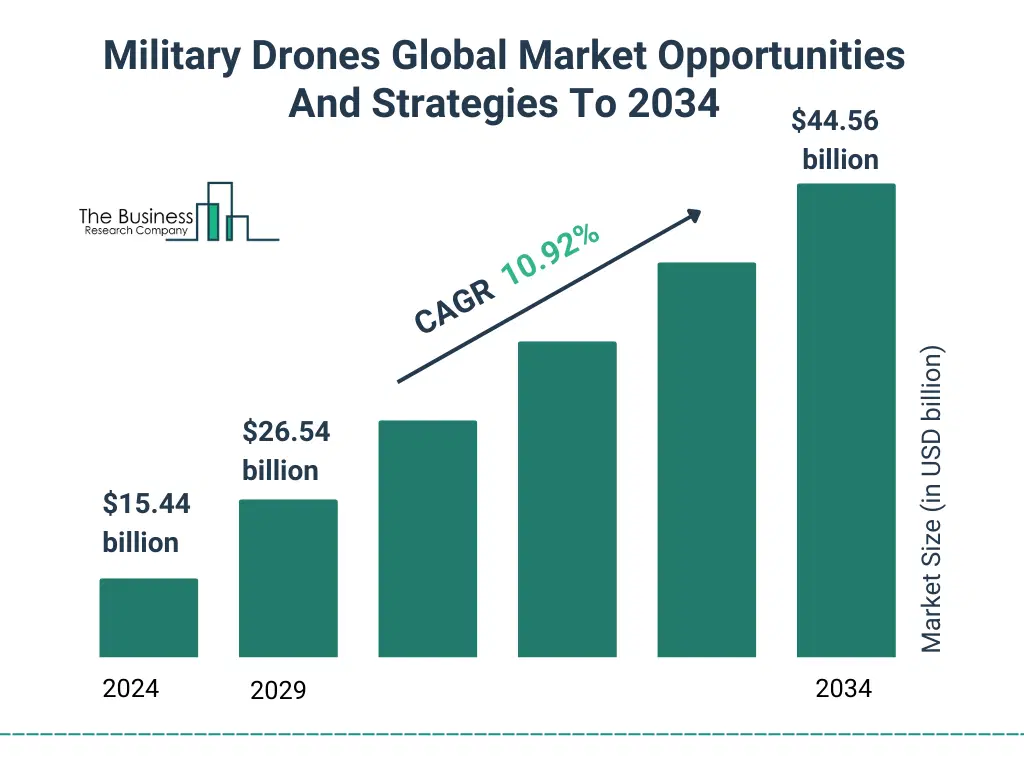
Military Drones Market Size
The global military drones market reached a value of nearly $15,444.15 million in 2024, having grown at a compound annual growth rate (CAGR) of 9.86% since 2019. The market is expected to grow from $15,444.15 million in 2024 to $26,539.16 million in 2029 at a rate of 11.44%. The market is then expected to grow at a CAGR of 10.92% from 2029 and reach $44,562.77 million in 2034. Growth in the historic period resulted from growing focus on unmanned systems in defense applications, rise in military modernization programs, increasing geopolitical conflicts and border disputes and government support and policies favoring drone deployment. Factors that negatively affected growth in the historic period were high cost of development and maintenance and susceptibility to hacking/jamming. Going forward, increasing need for monitoring and securing national borders, increased focus on counter-terrorism efforts, growing demand for intelligence, surveillance, and reconnaissance (ISR) capabilities and increasing military expenditure will drive growth. Factors that could hinder the growth of the military drones market in the future include regulatory and export control restrictions, limited endurance and payload capacity and trade war and tariffs.Military Drones Market Drivers
The key drivers of the military drones market include: Increasing Need For Monitoring And Securing National Borders During forecast period, the increasing need for monitoring and securing national borders is expected to propel the growth of the military drones market. Nations are increasingly focusing on strengthening border control due to rising geopolitical tensions, cross-border threats and the need for real-time intelligence. Military drones provide cost-effective, efficient and continuous monitoring capabilities compared to traditional methods, making them a preferred choice for defense forces. Their ability to cover difficult terrains, detect potential risks and enhance situational awareness supports defense modernization efforts. As a result, investments in drone technologies are expected to significantly boost market growth. Therefore, the increasing need for monitoring and securing national borders will drive the growth of the military drones market. The increasing need for monitoring and securing national borders growth contribution during the forecast period in 2024 is 2.25%.Military Drones Market Restraints
The key restraints on the military drones market include: Limited Endurance And Payload Capacity During forecast period, limited endurance and payload capacity is expected to hinder the growth of the military drones market. Many unmanned aerial systems face restrictions in flight duration, operational range and the weight they can carry, which can reduce mission effectiveness in extended surveillance or combat operations. These technical constraints may require additional resources, such as multiple drones or supplementary support systems, increasing operational costs for defense forces. Furthermore, limitations in payload capacity can restrict the integration of advanced sensors, communication equipment, or weaponry, affecting overall performance. Consequently, these factors are likely to slow the adoption and expansion of military drones in certain defense applications. Growth affected by limited endurance and payload capacity during the forecast period in 2024 is -1.25%.Military Drones Market Trends
Major trends shaping the military drones market include: Advancing Strategic Autonomy Through AI-Powered Indigenous Defense Solutions Companies operating in the military drones market are focusing on developing cost-effective, artificial intelligence (AI)-powered and indigenously manufactured drones with advanced endurance, precision strike capabilities and secure supply chains to reduce foreign dependency and enhance strategic autonomy. For instance, in August 2025, Flying Wedge Defence and Aerospace, an India-based defense company, has unveiled India’s first indigenous medium altitude long endurance (MALE) combat drone, the artificial intelligence (AI)-powered FWD Kaal Bhairava. Capable of 30-hour flights and a 3,000 km range, it is designed for surveillance, precision strikes and swarm missions. Positioned as an alternative to imported platforms like the MQ-9B Reaper, it reduces risks of foreign dependency, kill-switch vulnerabilities and high costs. With 80% locally sourced components and an indigenous maintenance ecosystem, the drone strengthens supply-chain security and strategic autonomy. Kaal Bhairava offers comparable capability to global counterparts at a fraction of the cost. Strengthening Military Readiness With Modular And Multi-Mission Drone Innovations Major companies operating in the military drones market are focusing on strategic collaborations and technology partnerships to develop advanced, modular and multi-mission drones that enhance electronic warfare, surveillance and defense capabilities for land, air and naval operations. For instance, in September 2025, Thales S.A., a France-based aerospace company, partnered with Autonomous Devices Limited, a UK-based defense and space manufacturing company, to develop EW-UAS, a versatile, modular drone-based electronic warfare system for naval and land forces. Thales provides an advanced payload capable of electronic support (detecting, identifying and locating threats) and electronic attack (jamming), while Autonomous Devices contributes a high-maneuverable, long-endurance drone. The turnkey solution leverages Thales’ command-and-control expertise and airspace certification knowledge. EW-UAS enhances military capabilities by detecting anti-ship missiles, conducting jamming missions and extending radar surveillance coverage, using passive detection and deception tactics to protect sensitive assets. Initial testing is ongoing, signaling a major step in modern electronic warfare.Opportunities And Recommendations In The military drones Market
Opportunities – The top opportunities in the military drones market segmented by drone type will arise in the UCAV segment, which will gain $3,753.60 million of global annual sales by 2029. The top opportunities in the military drones market segmented by technology will arise in the remotely operated segment, which will gain $8,399.29 million of global annual sales by 2029. The top opportunities in the military drones market segmented by type will arise in the fixed-wing segment, which will gain $4,975.70 million of global annual sales by 2029. The top opportunities in the military drones market segmented by application will arise in the national defense segment, which will gain $4,707.83 million of global annual sales by 2029. The military drones market size will gain the most in the USA at $2,541.59 million. Recommendations- To take advantage of the opportunities, The Business Research Company recommends the military drones companies to focus on developing stealth-enabled supersonic ucavs, focus on ai-powered, indigenous, cost-effective drones, focus on high-altitude, long-endurance stealth drones, focus on micro and nano-drone technologies, focus on autonomous collaborative and ai-driven drones, focus on versatile, ai-enabled and domestically supported uavs, focus on lightweight, rapidly deployable autonomous uavs, focus on tactical unmanned aerial vehicles (tuavs) for growth, focus on autonomous drones for market expansion, focus on hybrid-wing drones for rapid market growth, expand in emerging markets, focus on strategic partnerships and modular drone development, focus on value-based and tiered pricing strategies, focus on targeted government and defense engagement, focus on thought leadership and technical advocacy, focus on other applications for rapid market expansion.
Military Drones Market Segmentation
The military drones market is segmented by drone type, by technology, by type and by application.By Drone Type –
The military drones market is segmented by drone type into:
- a) Medium Altitude Long Endurance (MALE)
- b) High Altitude Long Endurance (HALE)
- c) Tactical Unmanned Aerial Vehicle (TUAV)
- c) Unmanned Combat Aerial Vehicle (UCAV)
- c) Small Unmanned Aerial Vehicle (SUAV)
By Technology –
The military drones market is segmented by technology into:
- a) Remotely Operated
- b) Semi-Autonomous
- c) Autonomous
By Type –
The military drones market is segmented by type into:
- a) Fixed-Wing
- b) Rotary Wing
- c) Hybrid
By Application –
The military drones market is segmented by application into:
- a) Search And Rescue
- b) National Defense
- c) Military Exercises
- d) Other Applications
By Geography - The military drones market is segmented by geography into:
- • China
- • India
- • Japan
- • Australia
- • Indonesia
- • South Korea
- • USA
- • Canada
- • Brazil
- • France
- • Germany
- • UK
- • Italy
- • Spain
- • Russia
-
o Asia Pacific
o Africa