

Contact Us
  Search
The Business Research Company Logo
Military Embedded Systems Market 2025
Published :May 2025
Pages :330
Format :PDF
Delivery Time :2-3 Business Days
Why 2-3 days? We update the report with the latest data and news before delivery. Let us know if you need us to expedite.
Report Price :$4,490.00

Military Embedded Systems Market 2025

By Component (Hardware, Software), By Installation Type (New Installation, Upgradation), By Platform (Land, Airborne, Naval, Space), By Technology (Edge Computing, Fog Computing, Mist Computing), By Application (Intelligence, Surveillance And Reconnaissance (ISR), Command And Control, Communication And Navigation, Electronic Warfare (EW), Weapon And Fire Control, Wearable, Other Applications), And By Region, Opportunities And Strategies – Global Forecast To 2035
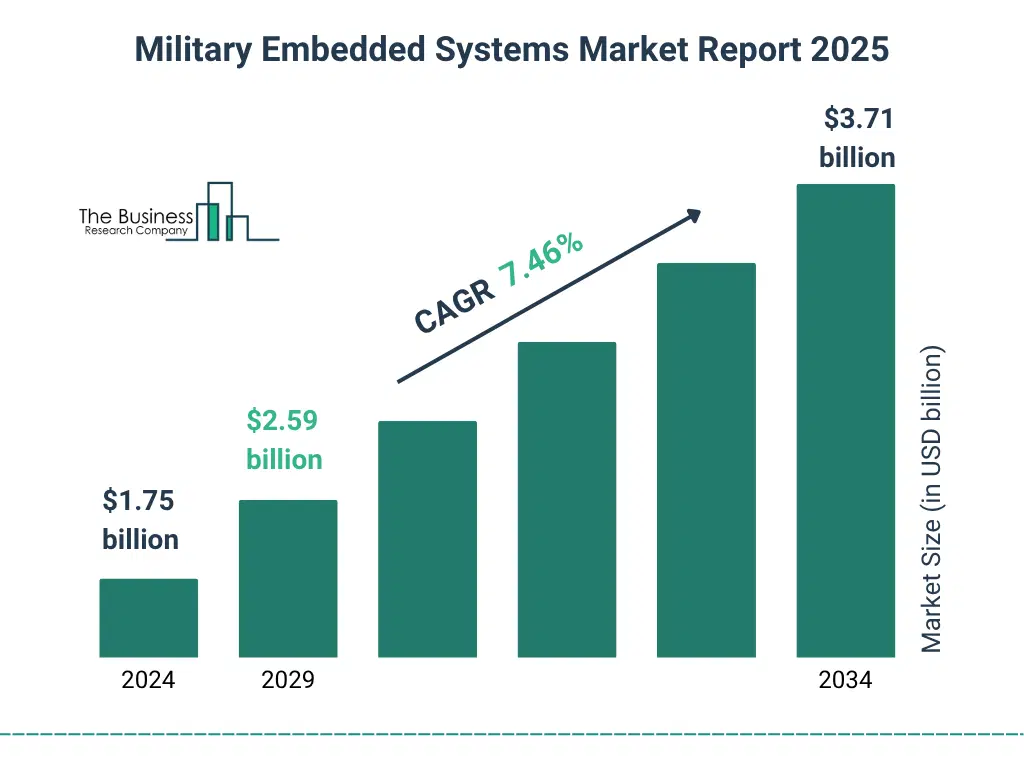
Military Embedded Systems Market Size and growth rate 2025 to 2029: Graph

Military Embedded Systems Market Definition

Military embedded systems are specialized computing systems designed for defense applications, integrating hardware and software components to perform critical functions in military operations. These systems are embedded into military platforms such as aircraft, naval vessels, ground vehicles and space assets, enabling real-time data processing, communication, control and automation. The military embedded systems market consists of sales by entities (organizations, sole traders and partnerships) of military embedded systems hardware and software that are utilized by defense forces, intelligence agencies and defense contractors for a range of operational needs, including intelligence gathering, surveillance, command and control, electronic warfare and weapons systems management.
Research Expert

Book your 30 minutes free consultation with our research experts

Military Embedded Systems Market Size

The global military embedded systems market reached a value of nearly $1,746.75 million in 2024, having grown at a compound annual growth rate (CAGR) of 5.59% since 2019. The market is expected to grow from $1,746.75 million in 2024 to $2,587.82 million in 2029 at a rate of 8.18%. The market is then expected to grow at a CAGR of 7.46% from 2029 and reach $3,709.02 million in 2034. Growth in the historic period resulted from the increased government and defense investment, rise in unmanned aerial vehicles, growth in demand for real-time data processing and rise in terrorist activities. Factors that negatively affected growth in the historic period were stringent military standards and challenges in upgrading legacy systems. Going forward, the increasing military modernization programs, increasing AI adoption, increasing cybersecurity threats targeting military networks and favorable government initiatives will drive the growth. Factor that could hinder the growth of the military embedded systems market in the future include complex systems and technological adaptation challenges.

Military Embedded Systems Market Drivers

The key drivers of the military embedded systems market include: Increasing Military Modernization Programs Increasing military modernization programs are expected to propel the military embedded systems market going forward. Military modernization programs refer to strategic initiatives aimed at upgrading defense capabilities through advanced technologies, equipment and operational frameworks to enhance national security and combat readiness. Increasing military modernization programs are driven by rising geopolitical tensions, rapid technological advancements, evolving warfare strategies and the need to replace aging defense infrastructure. Rapid technological advancements necessitate continuous upgrades in defense systems to maintain operational superiority, as outdated equipment can become ineffective against emerging threats. Military embedded systems play a crucial role in modernization by enabling real-time data processing, advanced automation and enhanced battlefield communication, ensuring superior situational awareness and decision-making capabilities. For instance, in July 2024, according to the data published by the Government Accountability Office (GAO), a US-based nonpartisan government agency, the United States Army has invested a total of $46.5 billion since fiscal year (FY) 2021 in modernization, adopting new acquisition approaches to develop equipment across six priority areas, fielding six systems by November 2023 under the Regionally Aligned Readiness and Modernization Model (ReARMM), with ten more planned over the next two years. Therefore, increasing military modernization programs are propelling the military embedded systems market.

Military Embedded Systems Market Restraints

The key restraints on the military embedded systems market include: Complex Systems The complex systems are expected to hamper the military embedded systems market going forward. Military embedded systems are hampered by complex system architectures that require advanced hardware integration and extensive software optimization. Consequently, complex systems limit the scalability, flexibility and adaptability of military embedded solutions, making upgrades and modifications challenging. This complexity also increases development costs and prolongs deployment timelines, impacting overall operational efficiency. For example, in January 2025, according to TimesTech Media, an India-based electronics and technology news website, military embedded systems demand exceptional computational power to handle large volumes of sensor data, run AI (artificial intelligence) algorithms and enable real-time decision-making. The adoption of high-performance processors, FPGAs (field-programmable gate array) and GPU (ground power unit) has transformed military computing by enhancing data processing speed and energy efficiency. Therefore, complex systems could hamper the military embedded systems market's growth.

Need data on a specific region in this market?

Opportunities And Recommendations In The Military Embedded Systems Market

Opportunities – The top opportunities in the military embedded systems market segmented by component will arise in the hardware segment, which will gain $490.88 million of global annual sales by 2029. The top opportunities in the military embedded systems market segmented by installation type will arise in the new installation segment, which will gain $449.57 million of global annual sales by 2029. The top opportunities in the military embedded systems market segmented by platform will arise in the land segment, which will gain $310.26 million of global annual sales by 2029. The top opportunities in the military embedded systems market segmented by technology will arise in the edge computing segment, which will gain $501.51 million of global annual sales by 2029. The top opportunities in the military embedded systems market segmented by application will arise in the intelligence, surveillance, and reconnaissance (ISR) segment, which will gain $278.60 million of global annual sales by 2029.The military embedded systems market size will gain the most in the USA at $328.46 millionon. Recommendations- To take advantage of the opportunities, The Business Research Company recommends the military embedded systems to focus on advancing rugged AI capabilities for harsh military environments, focus on expanding modular embedded computing for battlefield adaptability, focus on advancing rugged embedded processors for mission-critical performance, focus on accelerating investment in military embedded software solutions, expand in emerging markets, focus on capturing growth in the naval military embedded systems segment, focus on implementing value-based pricing to align with mission-critical demands, continue to use B2B promotions, focus on strengthening brand positioning through collaboration with defense primes and focus on expanding capabilities in electronic warfare systems.
Chat with us