
Military Engine Infrared Suppression Market Report 2026
Global Outlook – By Component (Exhaust Systems, Coatings, Heat Shields, Cooling Systems, Others Component), By Technology (Passive Suppression, Active Suppression, Hybrid Systems), By Platform (Airborne, Naval, Land-Based), By Application (Combat Aircraft, Helicopters, Naval Vessels, Armored Vehicles, Unmanned Aerial Vehicles, Others Application) – Market Size, Trends, Strategies, and Forecast to 2030
Military Engine Infrared Suppression Market Overview
• Military Engine Infrared Suppression market size has reached to $1.42 billion in 2025 • Expected to grow to $2.08 billion in 2030 at a compound annual growth rate (CAGR) of 8% • Growth Driver: Surge In Military UAV Deployment Fueling The Growth Of The Market Due To Enhanced Survivability Against Infrared Threats • Market Trend: Advancements In Aircraft Infrared Signature Reduction For Enhanced Survivability • North America was the largest region in 2025 and Asia-Pacific is the fastest growing region.What Is Covered Under Military Engine Infrared Suppression Market?
Military engine infrared suppression is the practice of reducing engine heat signatures in military vehicles to avoid detection by enemy infrared sensors and heat-seeking weapons, using methods such as exhaust cooling, thermal shielding, and specialized nozzles. It enhances stealth, survivability, and protection against infrared-guided threats in aircraft, tanks, helicopters, and naval vessels. The main component types of military engine infrared suppression are exhaust systems, coatings, heat shields, cooling systems, and others. Exhaust systems are engineered to control, route, and cool engine exhaust gases to reduce infrared emissions detectable by hostile sensors. Suppression technologies encompass passive suppression, active suppression, and hybrid systems, which are integrated across platforms, including airborne, naval, and land-based. Applications primarily cover combat aircraft, helicopters, naval vessels, armored vehicles, unmanned aerial vehicles, and others.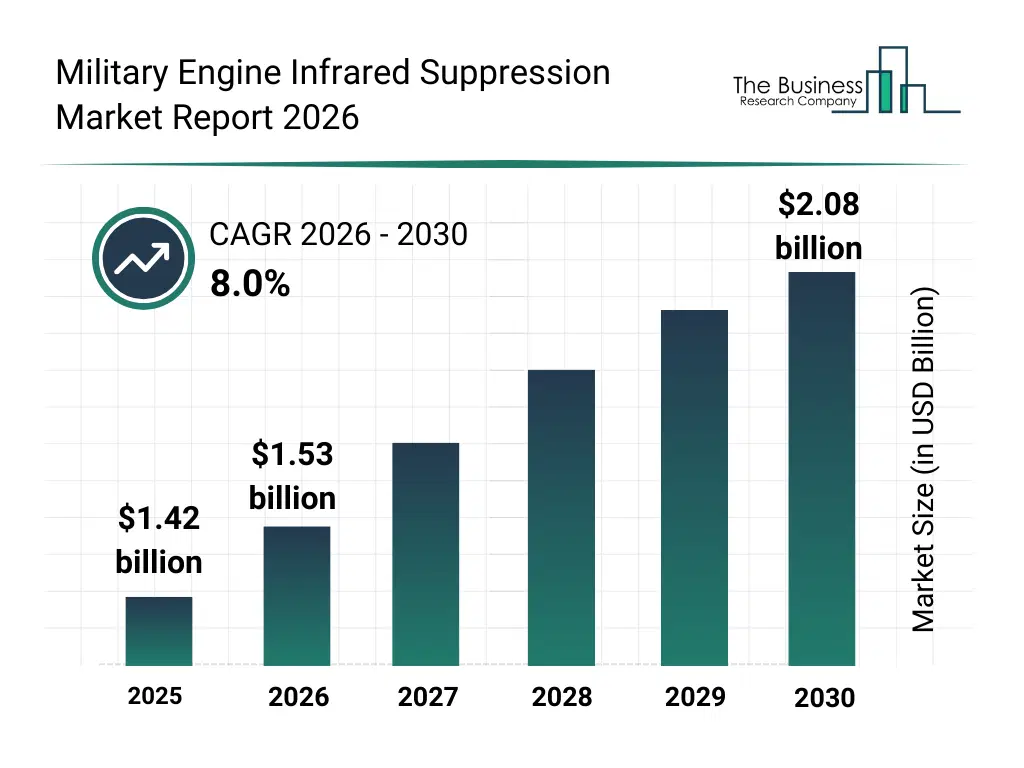
What Is The Military Engine Infrared Suppression Market Size and Share 2026?
The military engine infrared suppression market size has grown strongly in recent years. It will grow from $1.42 billion in 2025 to $1.53 billion in 2026 at a compound annual growth rate (CAGR) of 8.2%. The growth in the historic period can be attributed to early integration of exhaust cooling systems in military vehicles, development of thermal shielding technologies, adoption of specialized nozzle designs for IR suppression, deployment in aircraft and helicopters, expansion of marine infrared suppression systems.What Is The Military Engine Infrared Suppression Market Growth Forecast?
The military engine infrared suppression market size is expected to see strong growth in the next few years. It will grow to $2.08 billion in 2030 at a compound annual growth rate (CAGR) of 8.0%. The growth in the forecast period can be attributed to advancement in lightweight engine suppression systems, increased adoption in next-generation fighter aircraft and UAVs, integration with automated thermal management solutions, growth in naval vessel infrared suppression, development of modular IR suppression kits for field retrofitting. Major trends in the forecast period include advanced exhaust cooling technologies, integration of thermal barrier coatings, development of hybrid infrared suppression systems, platform-specific infrared signature reduction, increased focus on marine and naval infrared suppression.
Global Military Engine Infrared Suppression Market Segmentation
1) By Component: Exhaust Systems, Coatings, Heat Shields, Cooling Systems, Others Component 2) By Technology: Passive Suppression, Active Suppression, Hybrid Systems 3) By Platform: Airborne, Naval, Land-Based 4) By Application: Combat Aircraft, Helicopters, Naval Vessels, Armored Vehicles, Unmanned Aerial Vehicles, Others Application Subsegments: 1) By Exhaust Systems: Afterburner Suppressors, Exhaust Ducts with Shielding, Multi-Stage Exhaust Diffusers 2) By Coatings: Thermal Barrier Coatings, Infrared-Absorbing Paints, Ceramic-Based Coatings 3) By Heat Shields: Metallic Heat Shields, Composite Heat Shields, Ablative Heat Shields 4) By Cooling Systems: Air Cooling Systems, Liquid Cooling Systems, Hybrid Cooling Systems 5) By Other Components: Infrared Signature Reduction Accessories, Sensors and Monitoring Systems, Exhaust Gas MixersWhat Is Driver Of The Military Engine Infrared Suppression Market?
The increase in global defense budgets is expected to support growth in the military engine infrared suppression (IRSS) market. Increasing defense budgets is driven by rising geopolitical tensions, as countries allocate more funds to modernize their military capabilities and ensure national security in response to regional conflicts or global threats. Higher defense spending allows governments to invest in advanced technologies and modernize military vehicles and aircraft with systems that reduce engine heat signatures, enhancing survivability against infrared-guided threats. Rising geopolitical tensions and regional conflicts have prompted many countries to allocate more funds to research, development, and deployment of IRSS solutions. For instance, in April 2024, according to the Stockholm International Peace Research Institute (SIPRI), a Sweden-based independent resource on global security, total global military expenditure reached $2,443 billion in 2023, reflecting a 6.8% increase in real terms compared to 2022. Therefore, the growing defense budgets are driving the growth of the military engine infrared suppression industry.Key Players In The Global Military Engine Infrared Suppression Market
Major companies operating in the military engine infrared suppression market are Lockheed Martin Corporation, General Electric Company, Northrop Grumman Innovation Systems, Honeywell International Inc., BAE Systems plc, Collins Aerospace, Safran Electronics & Defense, Rolls-Royce Holdings plc, L3 Technologies, Rheinmetall AG, Elbit Systems Ltd., MTU Aero Engines AG, Teledyne FLIR LLC, Israel Aerospace Industries, Indra Sistemas S.A., Saab AB, Hensoldt AG, Chemring Group PLC, Rafael Advanced Defense Systems, W.R. Davis Engineering Limited, Decimin Control Systems
This chart is for illustrative purposes; the full report includes a detailed competitor analysis and comprehensive overview of the top 10 companies in the market.
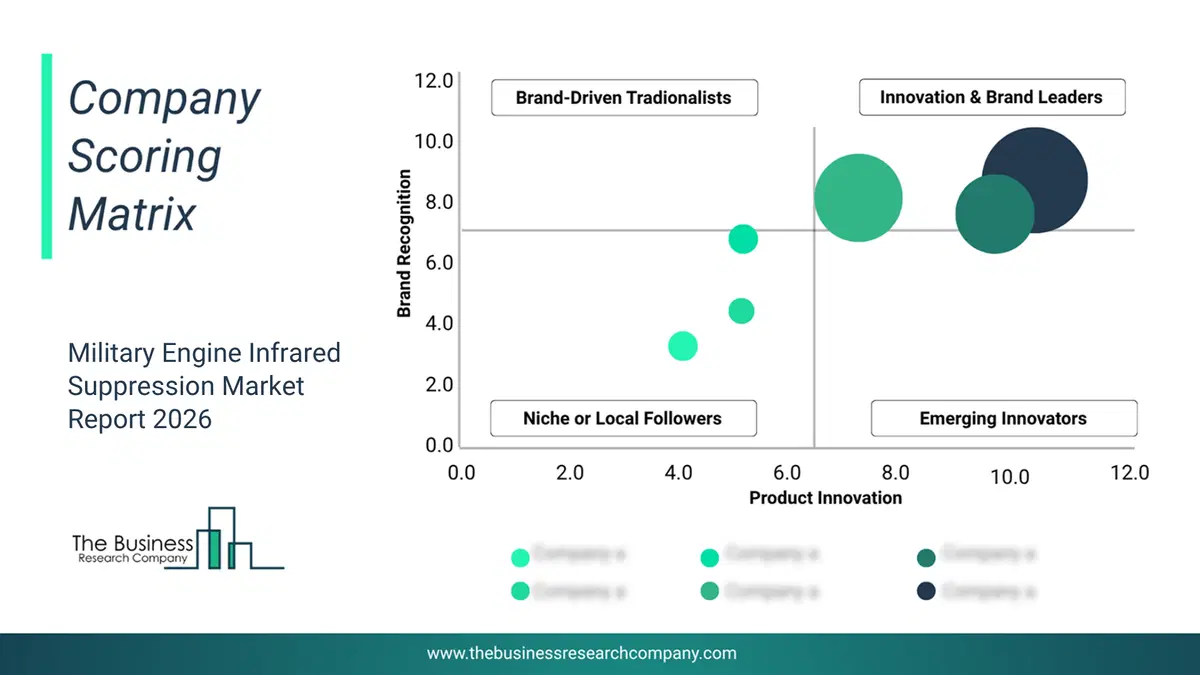
This chart maps companies by product innovation and brand strength, with bubble size indicating relative revenue, helping identify market leaders, challengers, and niche players. This is an illustrative chart; the full report provides a complete and accurate competitive analysis.
Global Military Engine Infrared Suppression Market Trends and Insights
Major companies operating in the military engine infrared suppression market are focusing on developing innovative solutions such as infrared signature suppression to enhance aircraft survivability and reduce detectability by heat-seeking threats. Infrared signature suppression refers to technologies and systems designed to reduce the heat emissions of a military engine or vehicle, making it less detectable to infrared sensors and heat-seeking missiles. For instance, in July 2025, the UK Chinook Mk 6, a UK-based heavy-lift, tandem-rotor helicopter, completed its first flight equipped with an advanced infrared suppression system (IRSS) designed to reduce its infrared signature and enhance survivability against heat-seeking missiles. This system modifies the helicopter’s exhaust by using extended exhaust mounts that cool and disperse engine heat, significantly lowering the thermal footprint that these missiles detect. This significantly enhances the helicopter’s survivability and crew safety in hostile environments. The upgrade ensures the Chinook remains an effective, resilient asset for transport and tactical missions in modern, high-threat combat zones.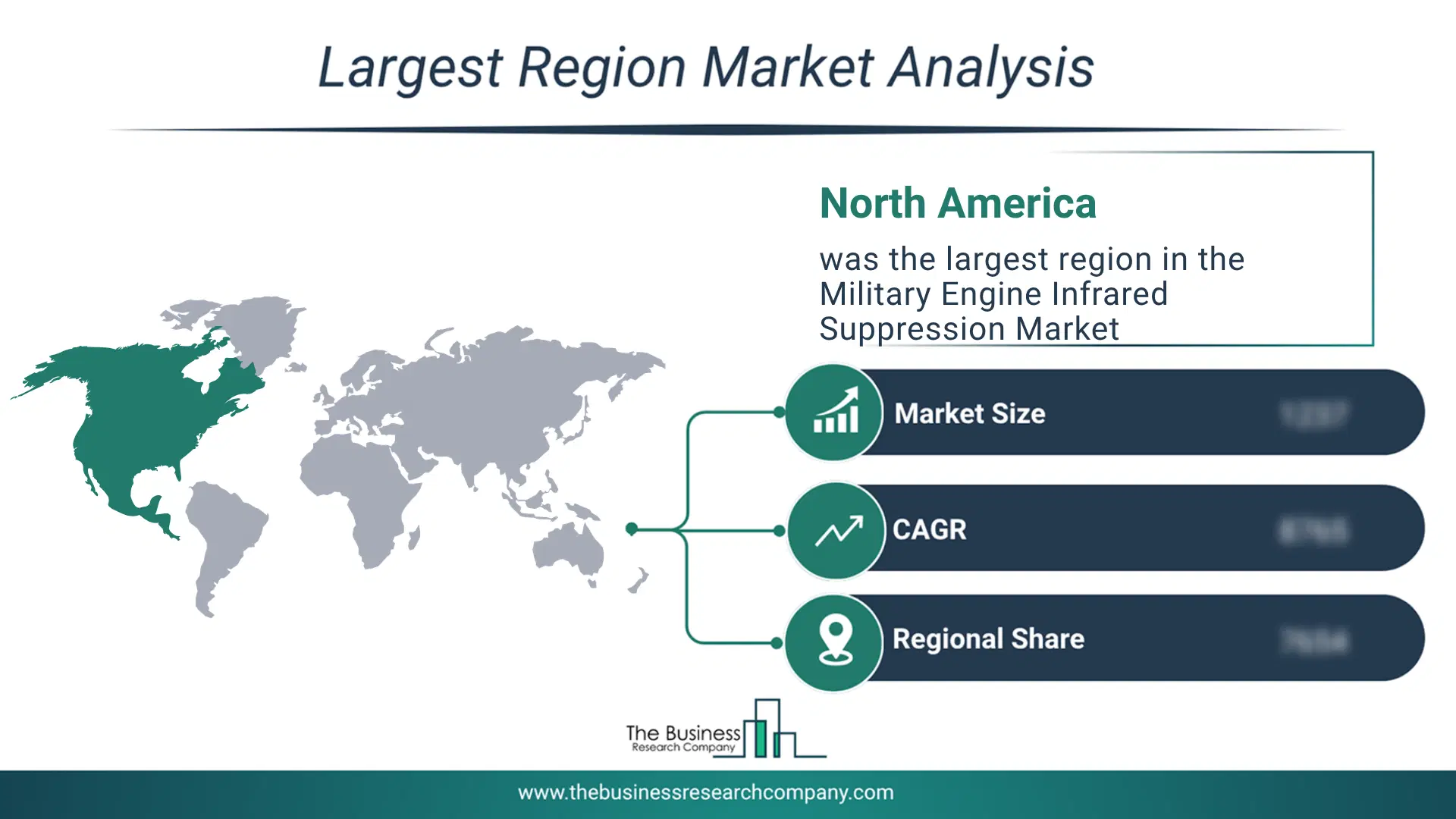
Regional Insights
North America was the largest region in the military engine infrared suppression market in 2025. Asia-Pacific is expected to be the fastest-growing region in the forecast period. The regions covered in the military engine infrared suppression market report are Asia-Pacific, South East Asia, Western Europe, Eastern Europe, North America, South America, Middle East, Africa. The countries covered in the military engine infrared suppression market report are Australia, Brazil, China, France, Germany, India, Indonesia, Japan, Taiwan, Russia, South Korea, UK, USA, Canada, Italy, SpainWhat Defines the Military Engine Infrared Suppression Market?
The military engine infrared suppression market consists of sales of the C-130J infrared suppression system, marine exhaust systems IRSS, and davis engineering infrared suppressors. Values in this market are ‘factory gate’ values; that is, the value of goods sold by the manufacturers or creators of the goods, whether to other entities (including downstream manufacturers, wholesalers, distributors, and retailers) or directly to end customers. The value of goods in this market includes related services sold by the creators of the goods.How is Market Value Defined and Measured?
The market value is defined as the revenues that enterprises gain from the sale of goods and/or services within the specified market and geography through sales, grants, or donations in terms of the currency (in USD unless otherwise specified). The revenues for a specified geography are consumption values that are revenues generated by organizations in the specified geography within the market, irrespective of where they are produced. It does not include revenues from resales along the supply chain, either further along the supply chain or as part of other products.
This chart presents market attractiveness based on a quantitative evaluation of growth, competition, strategic alignment, and risk, offering a clear view of opportunity areas for decision-making. This chart is for illustrative purposes; the full report contains the complete analysis.

This chart highlights the Total Addressable Market (TAM) by estimating the maximum revenue opportunity using an assumption-driven approach, supporting strategic planning and opportunity sizing across markets. The chart is illustrative; the full report provides a more comprehensive analysis.
What Key Data and Analysis Are Included in the Military Engine Infrared Suppression Market Report 2026?
The military engine infrared suppression market research report is one of a series of new reports from The Business Research Company that provides market statistics, including industry global market size, regional shares, competitors with the market share, detailed market segments, market trends and opportunities, and any further data you may need to thrive in the military engine infrared suppression industry. The market research report delivers a complete perspective of everything you need, with an in-depth analysis of the current and future state of the industry.Military Engine Infrared Suppression Market Report Forecast Analysis
| Report Attribute | Details |
|---|---|
| Market Size Value In 2026 | $1.53 billion |
| Revenue Forecast In 2030 | $2.08 billion |
| Growth Rate | CAGR of 8% from 2026 to 2030 |
| Base Year For Estimation | 2025 |
| Actual Estimates/Historical Data | 2020-2025 |
| Forecast Period | 2026 - 2030 |
| Market Representation | Revenue in USD Billion and CAGR from 2026 to 2030 |
| Segments Covered | Component, Technology, Platform, Application |
| Regional Scope | Asia-Pacific, Western Europe, Eastern Europe, North America, South America, Middle East, Africa |
| Country Scope | The countries covered in the military engine infrared suppression market report are Australia, Brazil, China, France, Germany, India, Indonesia, Japan, Taiwan, Russia, South Korea, UK, USA, Canada, Italy, Spain |
| Key Companies Profiled | Lockheed Martin Corporation, General Electric Company, Northrop Grumman Innovation Systems, Honeywell International Inc., BAE Systems plc, Collins Aerospace, Safran Electronics & Defense, Rolls-Royce Holdings plc, L3 Technologies, Rheinmetall AG, Elbit Systems Ltd., MTU Aero Engines AG, Teledyne FLIR LLC, Israel Aerospace Industries, Indra Sistemas S.A., Saab AB, Hensoldt AG, Chemring Group PLC, Rafael Advanced Defense Systems, W.R. Davis Engineering Limited, Decimin Control Systems |
| Customization Scope | Request for Customization |
| Pricing And Purchase Options | Explore Purchase Options |