

Military Gas Turbine Market Report 2026
Global Outlook – By Type (Turbojet Engines, Turboprop Engines, Turbofan Engines, Turboshaft Engines), By Type Of Gas Turbine (Micro Gas Turbines, Heavy-Duty Gas Turbines, Light-Duty Gas Turbines), By Component Type (Compressor, Combustor, Gas Turbine Rotor, Generator, Control Systems), By Application (Fighter Aircraft, Helicopters, Unmanned Aerial Vehicles (UAVs), Naval Ships, Other Applications ), By End User (Defense Agencies, Original Equipment Manufacturers (OEMs), Private Military Contractors) – Market Size, Trends, Strategies, and Forecast to 2030
Military Gas Turbine Market Overview
• Military Gas Turbine market size has reached to $12.44 billion in 2025 • Expected to grow to $16.25 billion in 2030 at a compound annual growth rate (CAGR) of 5.4% • Growth Driver: Increasing Defense Budgets Fueling The Growth Of The Market Due To Rising Investment In Military Aircraft Propulsion Systems • Market Trend: Advancements In Compact Propulsion Systems Drive Next-Gen Aerial Capabilities • North America was the largest region in 2025 and Asia-Pacific is the fastest growing region.What Is Covered Under Military Gas Turbine Market?
Military gas turbine refers to a type of engine used to power military aircraft, ships, and vehicles. It operates by compressing air, mixing it with fuel, igniting it, and using the resulting high-temperature, high-pressure exhaust gases to drive a turbine. Military gas turbines power aircraft, naval vessels, and ground vehicles by converting chemical energy from fuel into high-speed mechanical energy, enabling high performance, reliability, and rapid acceleration essential for combat operations. The main types of military gas turbines are turbojet engines, turboprop engines, turbofan engines, and turboshaft engines. Turbojet engines refer to a type of gas turbine engine that generates thrust by expelling jet exhaust at high speed. These are used for various types of gas turbines, including micro gas turbines, heavy-duty gas turbines, and light-duty gas turbines with different components include a compressor, combustor, gas turbine rotor, generator, and control systems that are used in varied applications such as fighter aircraft, helicopters, unmanned aerial vehicles (UAVs), naval ships, and others and are used by various end users such as defense agencies, original equipment manufacturers (OEMs), and private military contractors.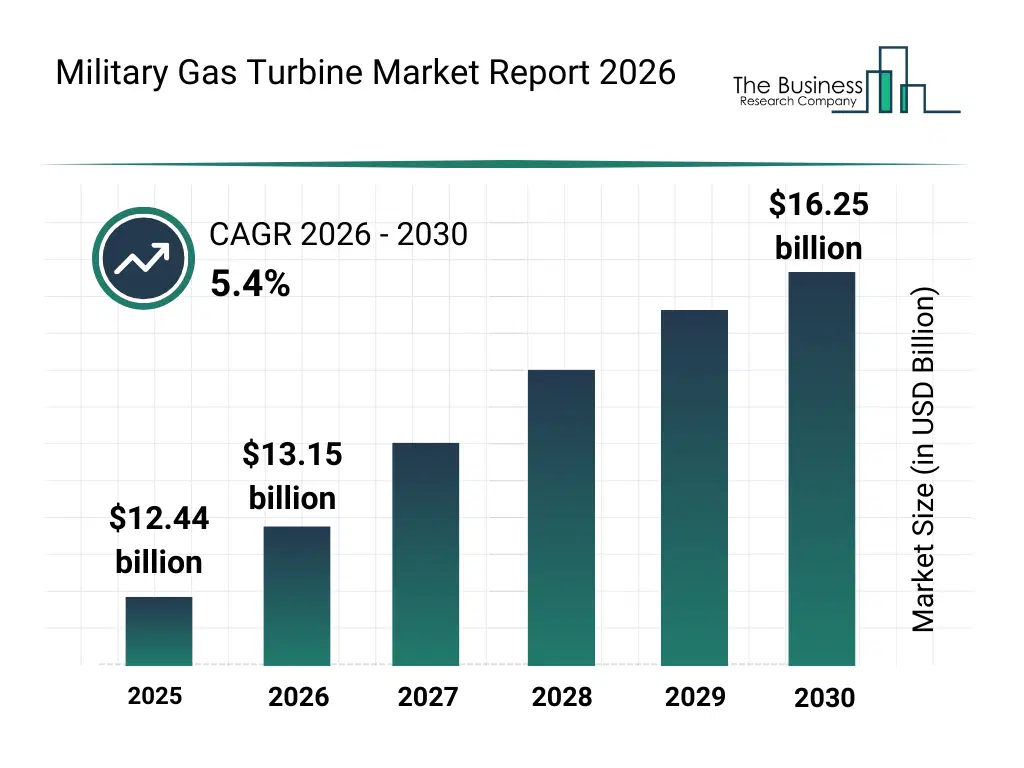
What Is The Military Gas Turbine Market Size and Share 2026?
The military gas turbine market size has grown strongly in recent years. It will grow from $12.44 billion in 2025 to $13.15 billion in 2026 at a compound annual growth rate (CAGR) of 5.7%. The growth in the historic period can be attributed to increasing global procurement of fighter jets and military aircraft requiring advanced turbine engines, modernization of naval fleets driving demand for efficient marine gas turbines, rising utilization of turboshaft engines in helicopters for combat and transport missions, continuous improvements in turbine materials enhancing durability and performance, expansion of defense budgets enabling large-scale engine upgrades and replacements.What Is The Military Gas Turbine Market Growth Forecast?
The military gas turbine market size is expected to see strong growth in the next few years. It will grow to $16.25 billion in 2030 at a compound annual growth rate (CAGR) of 5.4%. The growth in the forecast period can be attributed to growing adoption of next-generation turbofan engines with improved fuel efficiency and thrust, increasing investment in hybrid-electric and low-emission propulsion technologies for military platforms, rising demand for high-performance apus supporting advanced avionics and mission systems, expansion of unmanned combat aerial vehicles requiring compact high-power turbine solutions, accelerating development of lightweight turbine components using additive manufacturing to enhance operational efficiency. Major trends in the forecast period include rising demand for high-thrust, fuel-efficient military gas turbines, growing adoption of modular and upgradeable turbine architectures, increasing emphasis on multi-fuel and battlefield fuel flexibility, expansion of gas turbine use in uavs, rotorcraft and naval platforms, shift toward long-term performance-based logistics and mro contracts.
Global Military Gas Turbine Market Segmentation
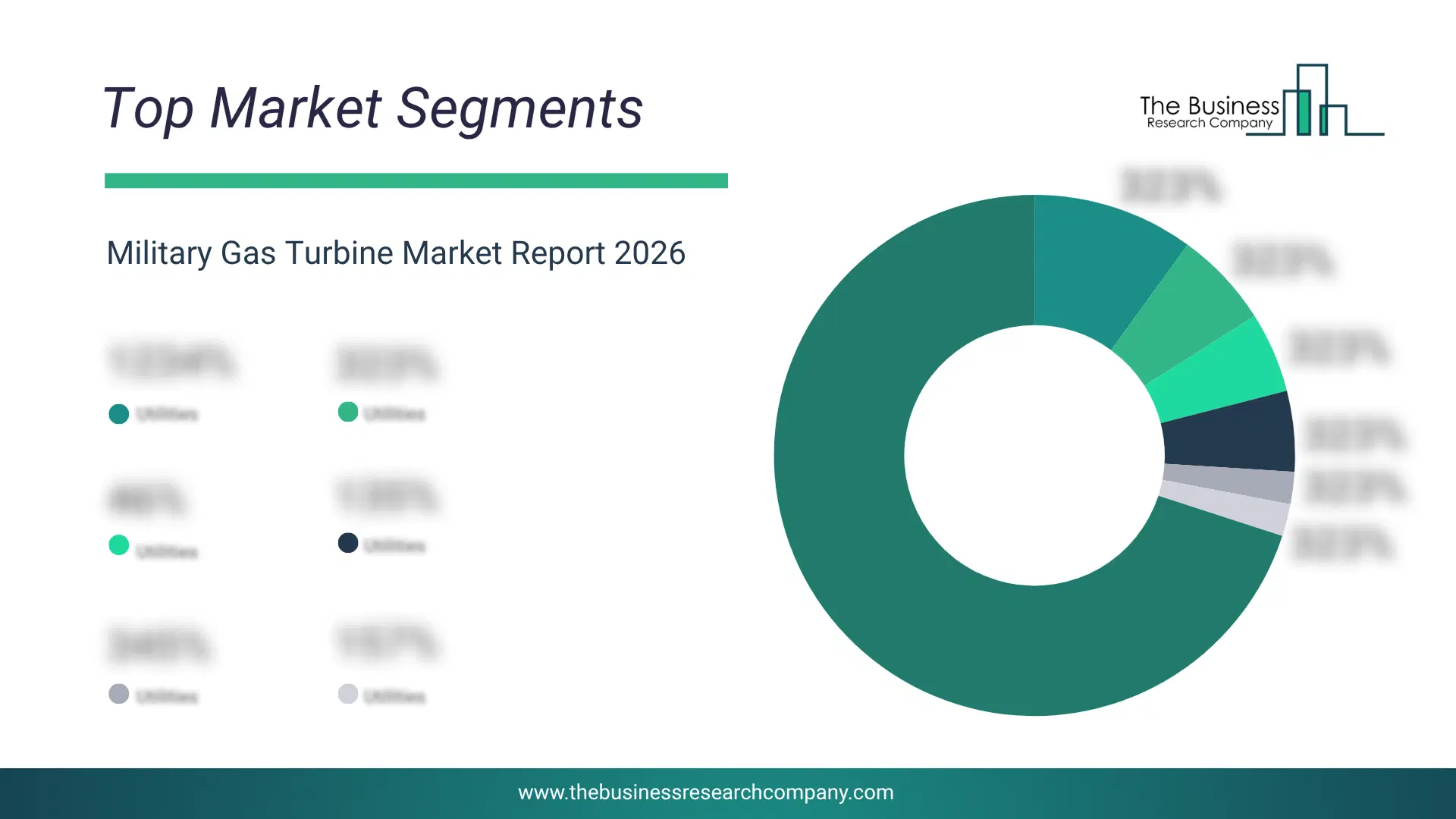
1) By Type: Turbojet Engines, Turboprop Engines, Turbofan Engines, Turboshaft Engines 2) By Type Of Gas Turbine: Micro Gas Turbines, Heavy-Duty Gas Turbines, Light-Duty Gas Turbines 3) By Component Type: Compressor, Combustor, Gas Turbine Rotor, Generator, Control Systems 4) By Application: Fighter Aircraft, Helicopters, Unmanned Aerial Vehicles (UAVs), Naval Ships, Other Applications 5) By End User: Defense Agencies, Original Equipment Manufacturers (OEMs), Private Military Contractors Subsegments: 1) By Turbojet Engines: Short-Range Missiles, Jet-Powered Target Drones, High-Speed Interceptor Aircraft, Supersonic Jet Fighters 2) By Turboprop Engines: Military Transport Aircraft, Maritime Patrol Aircraft, Reconnaissance Aircraft, Trainer Aircraft 3) By Turbofan Engines: Combat Aircraft, Unmanned Combat Aerial Vehicles (UCAVs), Strategic Bombers, Advanced Jet Trainers 4) By Turboshaft Engines: Type: Military Helicopters, Unmanned Rotorcraft Systems, Tiltrotor Aircraft, Naval Shipboard Auxiliary Power UnitsWhat Is Driver Of The Military Gas Turbine Market?
The increasing defense expenditure is expected to propel the growth of the military gas turbine market going forward. Defense expenditure refers to the total financial resources a government allocates for maintaining and developing its armed forces and ensuring national security. The increasing defense expenditure is due to rising geopolitical tensions, as escalating global conflicts, territorial disputes, and power rivalries compel nations to enhance military readiness and deterrence capabilities. Higher budgets allow governments to invest in advanced aircraft, naval vessels, and ground systems that rely on gas turbines for propulsion and power. These engines are favored for their high performance, reliability, and ability to operate in demanding environments. For instance, in January 2025, according to a report published by the Department of National Defense, a Canada-based defense department, Canada's defense spending is projected to increase to 1.37% of its Gross Domestic Product (GDP) in 2024–25, up from 1.31% in 2023–24. Additionally, 18.6% of the defense budget will be allocated to major equipment purchases, a rise from 14.8% in the previous year. Therefore, increasing defense expenditure is driving the growth of the military gas turbine industry.Key Players In The Global Military Gas Turbine Market
Major companies operating in the military gas turbine market are General Electric Company (GE), Honeywell Aerospace, Rolls-Royce North America Inc., Safran Aircraft Engines, GE Aerospace , Williams International Co L.L.C., Kawasaki Heavy Industries Ltd., Motor Sich JSC, MTU Aero Engines AG, John Wood Group PLC, Hindustan Aeronautics Limited (HAL), Bharat Heavy Electricals Limited, Avio Aero , Allison Engine Company , Safran S.A., Pratt & Whitney, ProEnergy Services LLC, Power Engineering International, Motor Sich JSC, IHI Corporation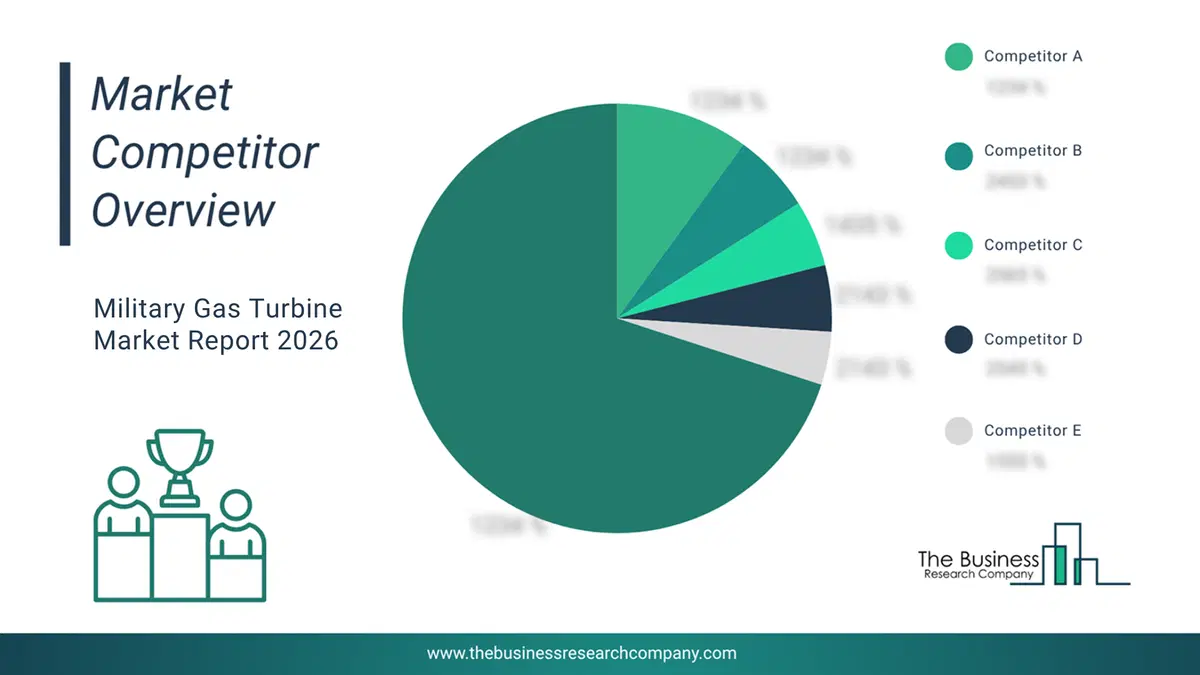
This chart is for illustrative purposes; the full report includes a detailed competitor analysis and comprehensive overview of the top 10 companies in the market.
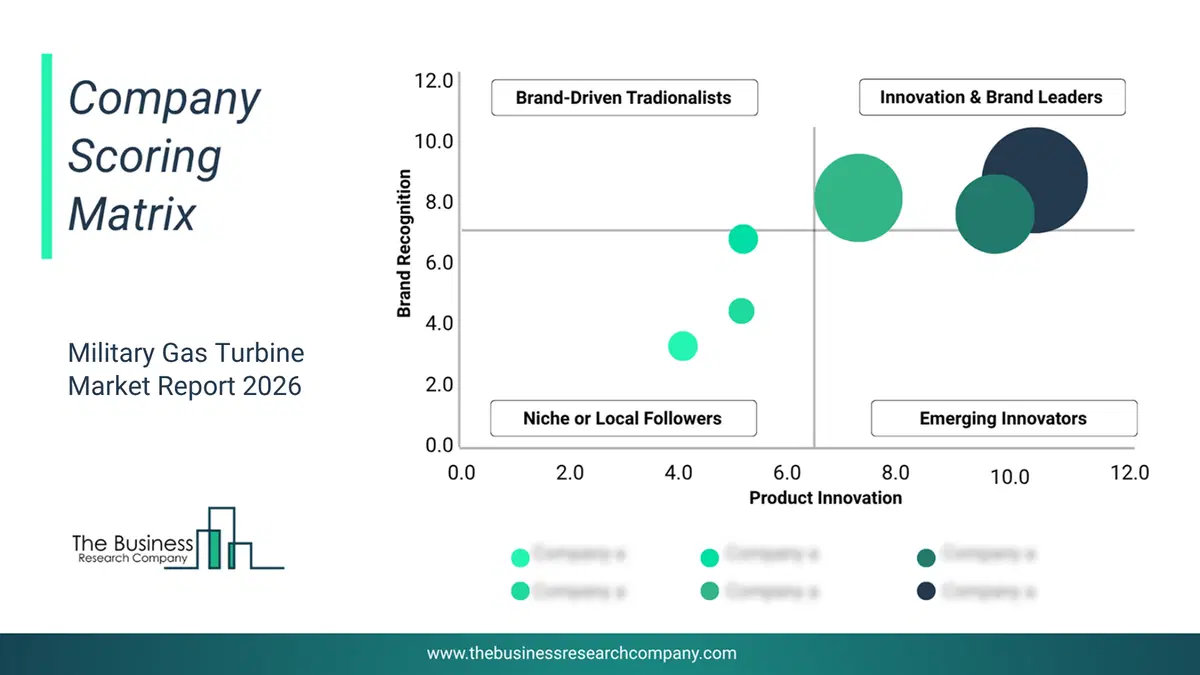
This chart maps companies by product innovation and brand strength, with bubble size indicating relative revenue, helping identify market leaders, challengers, and niche players. This is an illustrative chart; the full report provides a complete and accurate competitive analysis.
Global Military Gas Turbine Market Trends and Insights
Major companies operating in the military gas turbine market are focusing on developing innovative products, such as the micro turbojet engine, to enhance propulsion efficiency, operational versatility, and platform adaptability for modern defense systems. The micro turbojet engine is a small-sized jet propulsion engine that produces thrust by compressing air, mixing it with fuel, combusting the mixture, and expelling it at high speed through a nozzle. For instance, in February 2024, RVMT, an India-based aerospace company, launched INDRA RV25: 240N, the first indigenously developed micro turbojet engine. This state-of-the-art engine delivers a thrust of 240 Newtons (approximately 25 kg) and has been entirely designed, developed, and manufactured in India, with support from premier institutions such as IIT-Hyderabad. It features a compact design, high thrust-to-weight ratio, and precision-engineered components. The INDRA RV25 is ideally suited for unmanned aerial vehicles (UAVs) applications, target drones, and loitering munitions.What Are Latest Mergers And Acquisitions In The Military Gas Turbine Market? Ethosenergy Acquires Turbine Services Ltd. To Expand Turbine Parts Portfolio And Strengthen Rotating Equipment Capabilities
In May 2025, EthosEnergy, a US-based company specializing in rotating equipment services and solutions for power generation, Oil And Gas, industrial, and aerospace, acquired Turbine Services, Ltd. (TSL) for an undisclosed amount. The acquisition strengthens EthosEnergy’s turbine product portfolio and reinforces its commitment to high-quality service for critical rotating equipment. Turbine Services, Ltd. (TSL) is a US-based company that manufactures and supplies aftermarket parts for heavy-duty gas and steam turbines.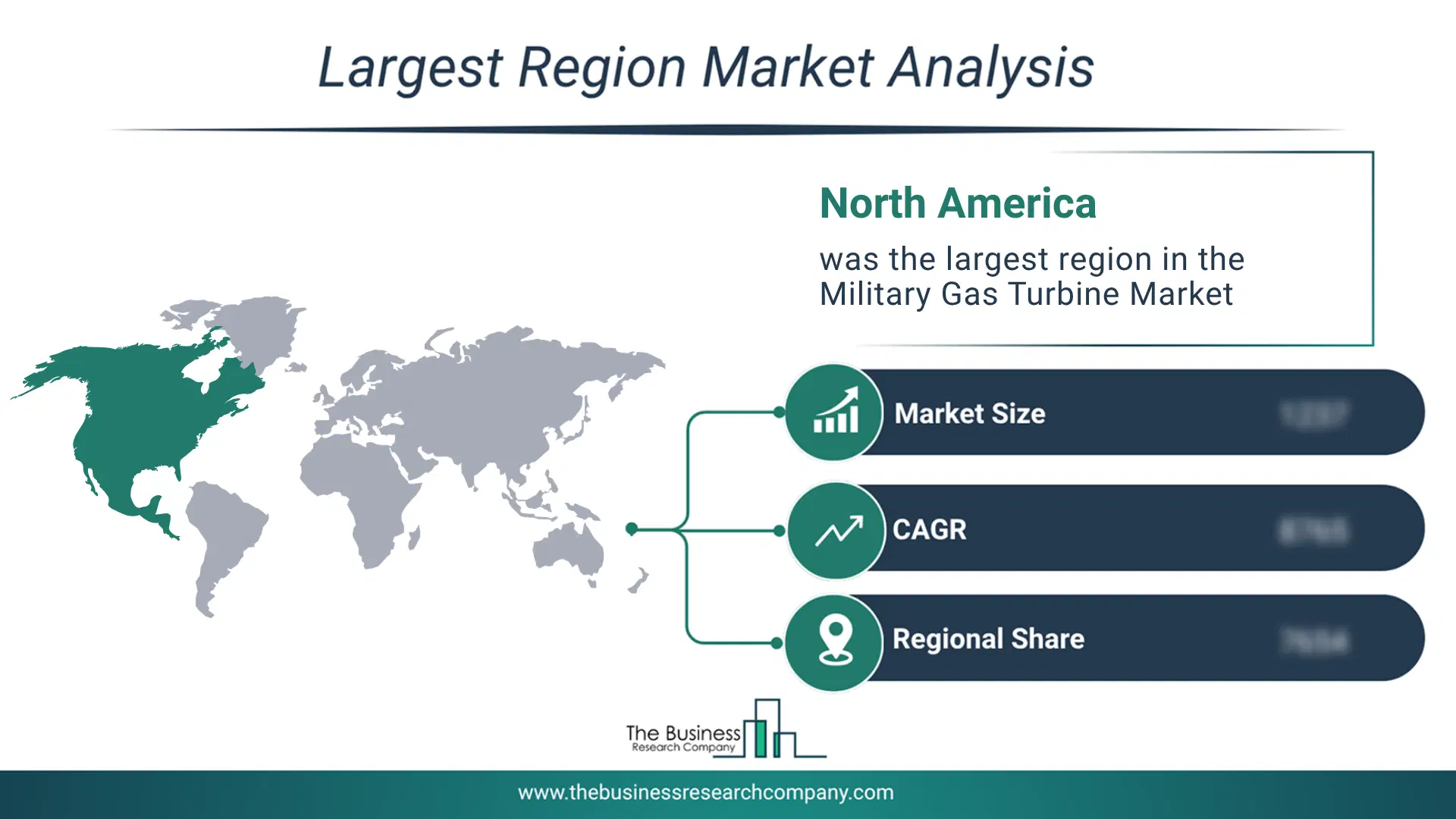
Regional Insights
North America was the largest region in the military gas turbine market in 2025. Asia-Pacific is expected to be the fastest-growing region in the forecast period. The regions covered in this market report are Asia-Pacific, South East Asia, Western Europe, Eastern Europe, North America, South America, Middle East, Africa. The countries covered in this market report are Australia, Brazil, China, France, Germany, India, Indonesia, Japan, Taiwan, Russia, South Korea, UK, USA, Canada, Italy, SpainWhat Defines the Military Gas Turbine Market?
The military gas turbine market consists of sale of turbojet engines, turbofan engines, turboshaft engines, and auxiliary power units (APUs). Values in this market are ‘factory gate’ values, that is, the value of goods sold by the manufacturers or creators of the goods, whether to other entities (including downstream manufacturers, wholesalers, distributors, and retailers) or directly to end customers. The value of goods in this market includes related services sold by the creators of the goods.How is Market Value Defined and Measured?
The market value is defined as the revenues that enterprises gain from the sale of goods and/or services within the specified market and geography through sales, grants, or donations in terms of the currency (in USD unless otherwise specified). The revenues for a specified geography are consumption values that are revenues generated by organizations in the specified geography within the market, irrespective of where they are produced. It does not include revenues from resales along the supply chain, either further along the supply chain or as part of other products.
This chart presents market attractiveness based on a quantitative evaluation of growth, competition, strategic alignment, and risk, offering a clear view of opportunity areas for decision-making. This chart is for illustrative purposes; the full report contains the complete analysis.

This chart highlights the Total Addressable Market (TAM) by estimating the maximum revenue opportunity using an assumption-driven approach, supporting strategic planning and opportunity sizing across markets. The chart is illustrative; the full report provides a more comprehensive analysis.
What Key Data and Analysis Are Included in the Military Gas Turbine Market Report 2026?
The military gas turbine market research report is one of a series of new reports from The Business Research Company that provides market statistics, including industry global market size, regional shares, competitors with the market share, detailed market segments, market trends and opportunities, and any further data you may need to thrive in the military gas turbine industry. The market research report delivers a complete perspective of everything you need, with an in-depth analysis of the current and future state of the industry.Military Gas Turbine Market Report Forecast Analysis
| Report Attribute | Details |
|---|---|
| Market Size Value In 2026 | $13.15 billion |
| Revenue Forecast In 2030 | $16.25 billion |
| Growth Rate | CAGR of 5.4% from 2026 to 2030 |
| Base Year For Estimation | 2025 |
| Actual Estimates/Historical Data | 2020-2025 |
| Forecast Period | 2026 - 2030 |
| Market Representation | Revenue in USD Billion and CAGR from 2026 to 2030 |
| Segments Covered | Type, Type Of Gas Turbine, Component Type, Application, End User |
| Regional Scope | Asia-Pacific, Western Europe, Eastern Europe, North America, South America, Middle East, Africa |
| Country Scope | The countries covered in the military gas turbine market report are Australia, Brazil, China, France, Germany, India, Indonesia, Japan, Taiwan, Russia, South Korea, UK, USA, Canada, Italy, Spain |
| Key Companies Profiled | General Electric Company (GE), Honeywell Aerospace, Rolls-Royce North America Inc., Safran Aircraft Engines, GE Aerospace , Williams International Co L.L.C., Kawasaki Heavy Industries Ltd., Motor Sich JSC, MTU Aero Engines AG, John Wood Group PLC, Hindustan Aeronautics Limited (HAL), Bharat Heavy Electricals Limited, Avio Aero , Allison Engine Company , Safran S.A., Pratt & Whitney, ProEnergy Services LLC, Power Engineering International, Motor Sich JSC, IHI Corporation |
| Customization Scope | Request for Customization |
| Pricing And Purchase Options | Explore Purchase Options |