
Military Information Market Report 2026
Global Outlook – By Component (Systems, Satellite Communication Systems, Radar And Sonar Systems, Radio Systems, Services, Consulting, Testing And Integration, Support And Maintenance), By Strategic Intelligence (Geospatial Intelligence (GEOINT), Signals Intelligence (SIGINT), Human Intelligence (HUMINT), Cyber Intelligence), By Deployment Mode (On-Premises, Cloud), By Application (Intelligence, Surveillance And Reconnaissance (ISR), Situational Awareness, Command And Control), By End-User (Army, Navy, Air Force, Other End Users) – Market Size, Trends, Strategies, and Forecast to 2030
Military Information Market Overview
• Military Information market size has reached to $58.91 billion in 2025 • Expected to grow to $78.66 billion in 2030 at a compound annual growth rate (CAGR) of 5.9% • Growth Driver: Increasing Electronic Warfare Spending Fueling Market Growth Due To Cyber Threats And Geopolitical Tensions • Market Trend: Development Of Advanced Tactical Military Communications Driving Market Expansion • North America was the largest region in 2025 and Asia-Pacific is the fastest growing region.What Is Covered Under Military Information Market?
Military information refers to comprehensive intelligence and data about the organization, capabilities, deployments, and strategic intentions of a nation's own or adversarial armed forces. This information is vital for effective military planning, real-time decision-making, threat evaluation, and ensuring operational readiness and national security. The main types of components in military information systems are satellite communication systems, radar and sonar systems, radio systems, services, consulting, testing and integration, and support and maintenance. Systems in the military are integrated hardware and software systems that provide communication, data processing, and operational coordination for defense. It includes strategic intelligence, such as geospatial intelligence (GEOINT), signals intelligence (SIGINT), human intelligence (HUMINT), and cyber intelligence, and is deployed through on-premises cloud. It is used for applications such as intelligence, surveillance, and reconnaissance (ISR), situational awareness, and command and control, catering to diverse end users, including the army, navy, air force, and others.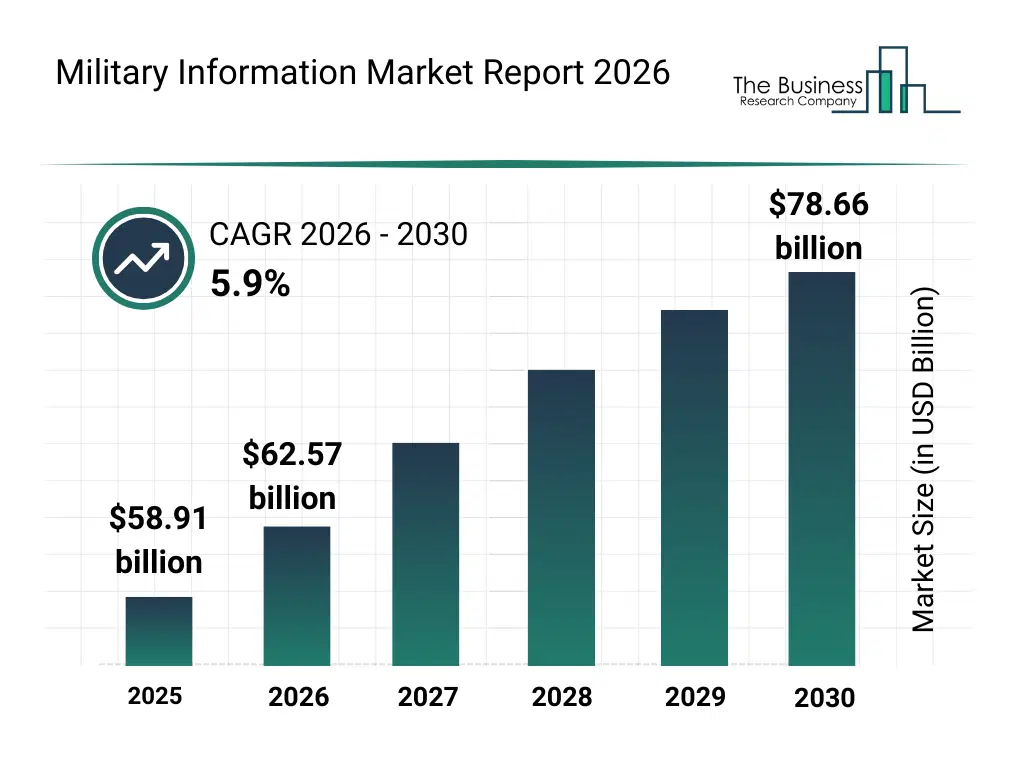
What Is The Military Information Market Size and Share 2026?
The military information market size has grown strongly in recent years. It will grow from $58.91 billion in 2025 to $62.57 billion in 2026 at a compound annual growth rate (CAGR) of 6.2%. The growth in the historic period can be attributed to increasing reliance on intelligence gathering to support strategic and tactical military operations, growth in digital data collection from surveillance, reconnaissance, and sensor networks, rising demand for threat assessment tools due to evolving geopolitical tensions, expansion of mission debriefing and analysis capabilities to improve operational outcomes, advancements in data processing technologies enabling faster dissemination of military information.What Is The Military Information Market Growth Forecast?
The military information market size is expected to see strong growth in the next few years. It will grow to $78.66 billion in 2030 at a compound annual growth rate (CAGR) of 5.9%. The growth in the forecast period can be attributed to growing adoption of artificial intelligence and machine learning for automated intelligence analysis, increasing need for integrated decision support platforms across joint military operations, rising investment in secure databases and real-time information dashboards, expansion of cyber-enabled intelligence capabilities to counter digital threats, accelerating demand for cloud-enabled military information systems to enhance scalability and accessibility. Major trends in the forecast period include growing multi-domain and joint-force intelligence integration, increasing outsourcing of intelligence analysis and support services, expansion of mission debriefing and after-action analytics solutions, rising focus on interoperable and standardized military information architectures, heightened emphasis on classified data governance and regulatory compliance.
Global Military Information Market Segmentation
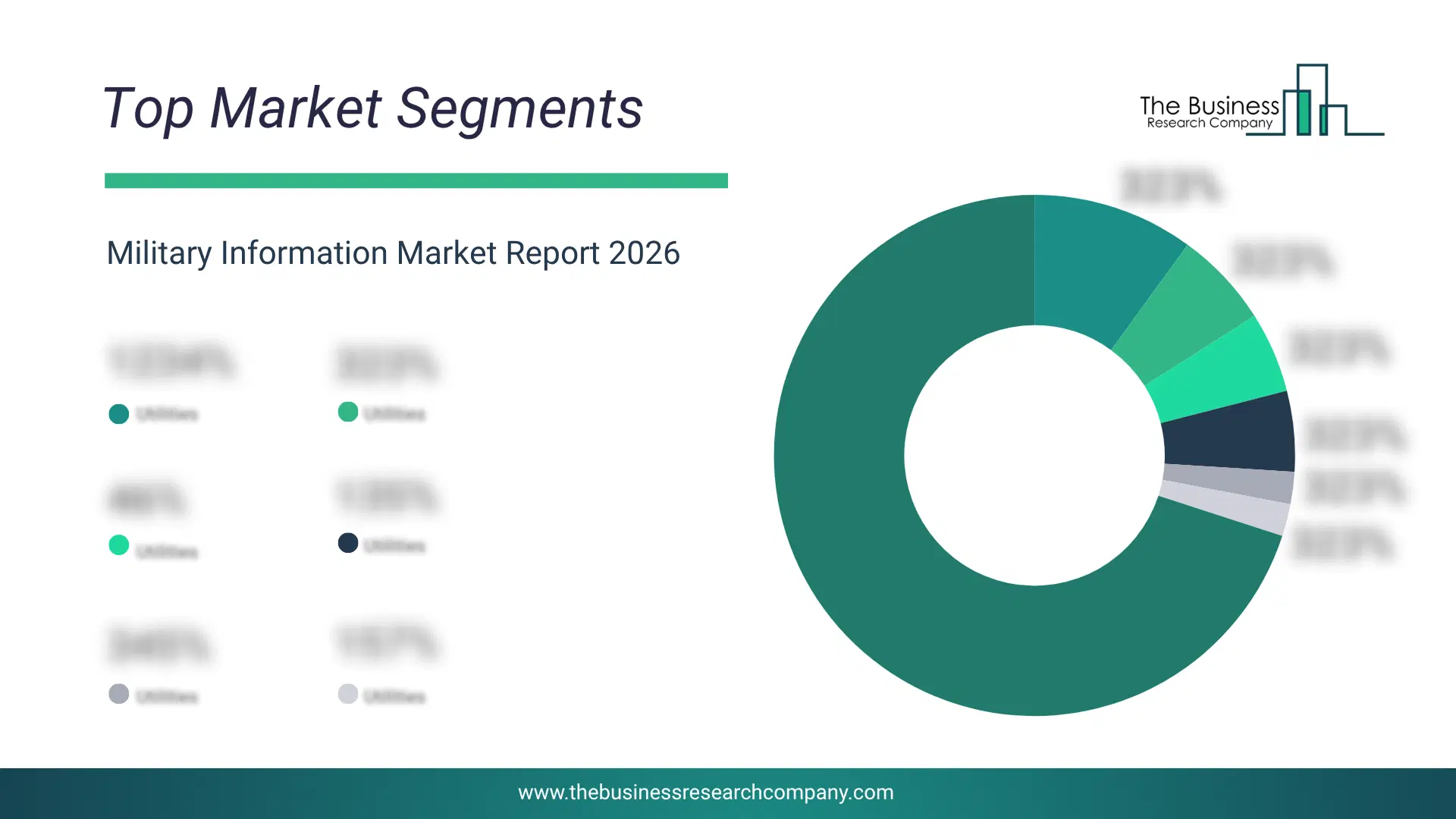
1) By Component: Systems, Satellite Communication Systems, Radar And Sonar Systems, Radio Systems, Services, Consulting, Testing And Integration, Support And Maintenance 2) By Strategic Intelligence: Geospatial Intelligence (GEOINT), Signals Intelligence (SIGINT), Human Intelligence (HUMINT), Cyber Intelligence 3) By Deployment Mode: On-Premises, Cloud 4) By Application: Intelligence, Surveillance And Reconnaissance(ISR), Situational Awareness, Command And Control 5) By End-User: Army, Navy, Air Force, Other End Users Subsegments: 1) By Systems: Electronic Warfare Systems, Command And Control Systems, Surveillance And Reconnaissance Systems, Navigation Systems, Signal Intelligence (SIGINT) Systems, Geospatial Intelligence (GEOINT) Systems 2) By Satellite Communication Systems: Military Communication Satellites, Ground Control Stations, Secure Satellite Terminals, Tactical Satellite Communication (TACSAT) Systems, Mobile Satcom Systems 3) By Radar And Sonar Systems: Airborne Radar Systems, Ground-Based Radar Systems, Naval Sonar Systems, Synthetic Aperture Radar (SAR), Passive Sonar Systems 4) By Radio Systems: Tactical Radio Systems, Software-Defined Radios (SDRs), High Frequency (HF) And Very High Frequency (VHF) Radios, Encrypted Radios, Handheld And Vehicular Radio Sets 5) By Services: Consulting, Testing And Integration, Support And Maintenance 6) By Consulting: Strategic Advisory Services, Mission Planning And Assessment, Operational Readiness Consulting, Threat Analysis And Countermeasure Planning 7) By Testing And Integration: System Interoperability Testing, Field Trials And Evaluation, Hardware-Software Integration, Environmental And Stress Testing 8) By Support And Maintenance: Lifecycle Support Services, Upgrades And Retrofits, Technical Support And Troubleshooting, Spare Parts Supply And Logistics Support, Preventive And Corrective MaintenanceWhat Is Driver Of The Military Information Market?
Increasing defense budgets for electronic warfare are expected to propel the growth of the military information market going forward. Electronic warfare refers to the use of electromagnetic spectrum-based technologies to detect, disrupt, deceive, or deny enemy electronic systems such as communications, radar, and navigation. Defense budgets for electronic warfare are increasing as militaries modernize their forces to gain dominance in multi-domain operations, where disrupting enemy communications and radar is critical to mission success. Defense budgets support military information systems by funding secure communications, intelligence gathering, and real-time data analysis to enhance operational effectiveness and battlefield awareness. For instance, in May 2025, according to the House of Commons of the United Kingdom, a UK-based government body, UK defense spending is projected to reach $72.7 billion (£56.9 billion) in 2024-25 and increase to $76.5 billion (£59.8 billion) in 2025-26, reflecting an average annual real-terms growth rate of 2.4% between 2023-24 and 2025-26. Therefore, the increasing defense budgets for electronic warfare are driving the growth of the military information industry.Key Players In The Global Military Information Market
Major companies operating in the military information market are Raytheon Technologies Corporation, Lockheed Martin Corporation, Airbus Defence and Space GmbH, General Dynamics Corporation, Northrop Grumman Corporation, BAE Systems plc, Thales Group, Leonardo S.p.A., Atos SE, Booz Allen Hamilton Holding Corporation, Rheinmetall AG, KBR Inc., CACI International Inc., Parsons Corporation, Indra Sistemas S.A., Rohde & Schwarz GmbH & Co. KG, Teledyne FLIR LLC, Palantir Technologies Inc., HENSOLDT AG, Kratos Defense & Security Solutions Inc.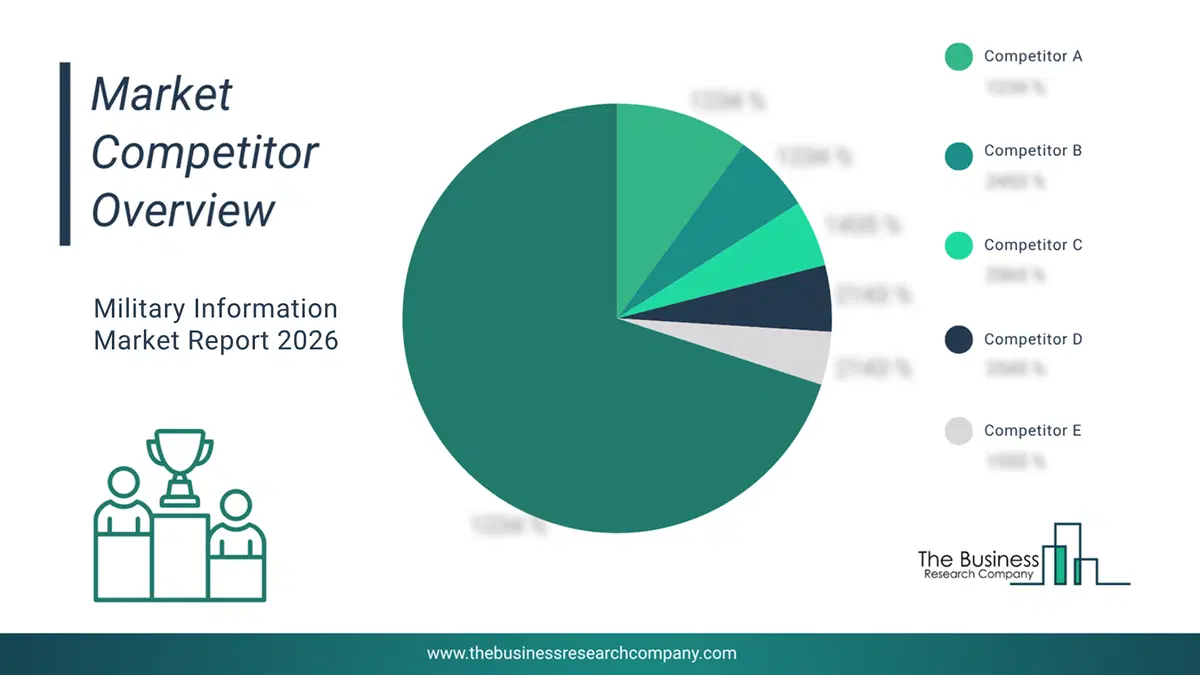
This chart is for illustrative purposes; the full report includes a detailed competitor analysis and comprehensive overview of the top 10 companies in the market.
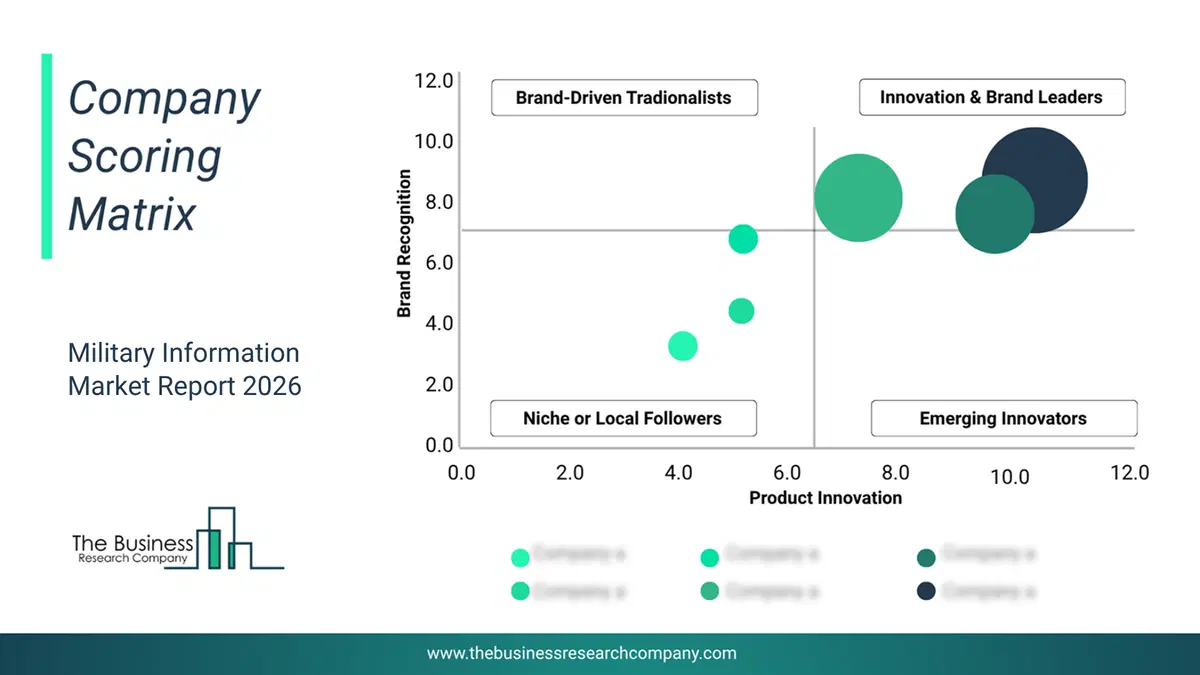
This chart maps companies by product innovation and brand strength, with bubble size indicating relative revenue, helping identify market leaders, challengers, and niche players. This is an illustrative chart; the full report provides a complete and accurate competitive analysis.
Global Military Information Market Trends and Insights
Major companies operating in the military information market are developing advanced tactical solutions for military communications to enhance battlefield connectivity, enable secure real-time data sharing, improve interoperability among allied forces, and integrate AI-driven networks for resilient, jamming-resistant operations in contested environments. Advanced tactical solutions for military communications refer to cutting-edge, secure, and adaptive systems such as AI-optimized networks, anti-jamming waveforms, and multi-domain interoperable radios designed to ensure real-time, resilient, and encrypted data exchange in contested battlefield environments. For instance, in February 2025, Kalyani Strategic Systems Limited (KSSL), an India-based aerospace and defense company, partnered with L3Harris Technologies, a US-based defense contractor company, to jointly develop advanced tactical solutions for military communications in India, focusing on C4ISR (Command, Control, Communications, Intelligence, Surveillance, and Reconnaissance) technologies. This partnership aims to strengthen India’s defense capabilities by leveraging L3Harris’s expertise and KSSL’s local manufacturing strengths, fostering indigenous innovation, and reducing reliance on foreign imports. The collaboration is well-positioned to deliver next-generation C4ISR solutions that meet the strategic needs of the Indian Armed Forces and support broader defense industrial cooperation between the U.S. and India.What Are Latest Mergers And Acquisitions In The Military Information Market? Anduril And Microsoft Partner To Enhance U.S. Army's Integrated Visual Augmentation System (IVAS)
In February 2025, Anduril, a US-based defense technology company that specializes in autonomous systems, partnered with Microsoft Corporation to advance the Integrated Visual Augmentation System for the U.S. Army. This partnership aims to combine their strengths in defense innovation, cloud computing, and artificial intelligence to advance the U.S. Army’s Integrated Visual Augmentation System (IVAS) program, enhancing soldier performance, combat effectiveness, and battlefield awareness through advanced AR and AI technologies while ensuring scalable, cost-effective production tailored to the Army’s evolving needs. Microsoft Corporation is a US-based technology company.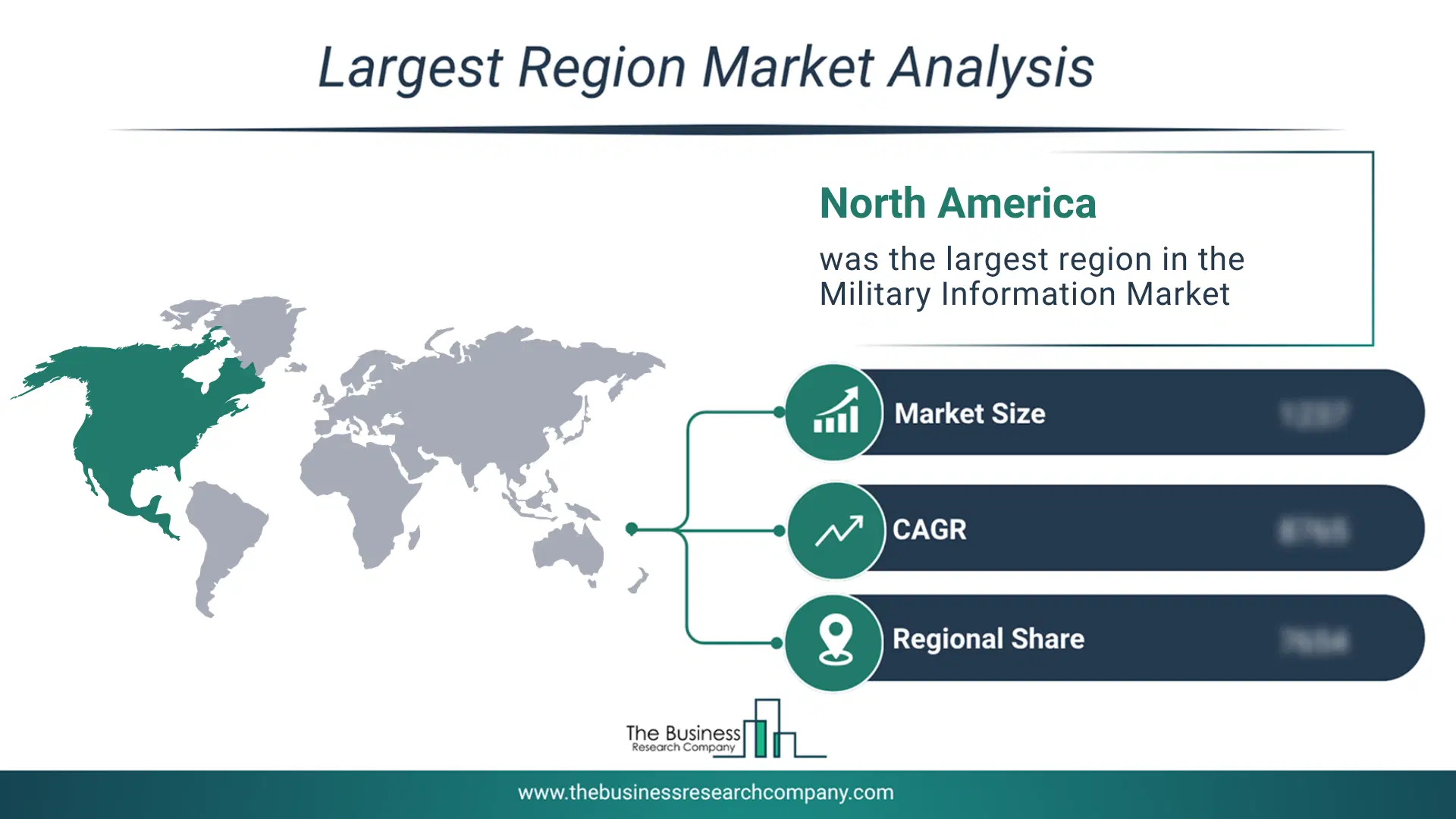
Regional Insights
North America was the largest region in the military information market in 2025. Asia-Pacific is expected to be the fastest-growing region in the forecast period. The regions covered in this market report are Asia-Pacific, South East Asia, Western Europe, Eastern Europe, North America, South America, Middle East, Africa. The countries covered in this market report are Australia, Brazil, China, France, Germany, India, Indonesia, Japan, Taiwan, Russia, South Korea, UK, USA, Canada, Italy, SpainWhat Defines the Military Information Market?
The military information consists of revenues earned by entities by providing services such as intelligence gathering, strategic planning support, threat assessment, logistical coordination, and mission debriefing and analysis. The market value includes the value of related goods sold by the service provider or included within the service offering. The military information market also includes sales of products including textual reports, data files and databases, interactive platforms, decision support tools, and real-time dashboards. Values in this market are ‘factory gate’ values, that is, the value of goods sold by the manufacturers or creators of the goods, whether to other entities (including downstream manufacturers, wholesalers, distributors, and retailers) or directly to end customers. The value of goods in this market includes related services sold by the creators of the goods.How is Market Value Defined and Measured?
The market value is defined as the revenues that enterprises gain from the sale of goods and/or services within the specified market and geography through sales, grants, or donations in terms of the currency (in USD unless otherwise specified). The revenues for a specified geography are consumption values that are revenues generated by organizations in the specified geography within the market, irrespective of where they are produced. It does not include revenues from resales along the supply chain, either further along the supply chain or as part of other products.
This chart presents market attractiveness based on a quantitative evaluation of growth, competition, strategic alignment, and risk, offering a clear view of opportunity areas for decision-making. This chart is for illustrative purposes; the full report contains the complete analysis.

This chart highlights the Total Addressable Market (TAM) by estimating the maximum revenue opportunity using an assumption-driven approach, supporting strategic planning and opportunity sizing across markets. The chart is illustrative; the full report provides a more comprehensive analysis.
What Key Data and Analysis Are Included in the Military Information Market Report 2026?
The military information market research report is one of a series of new reports from The Business Research Company that provides market statistics, including industry global market size, regional shares, competitors with the market share, detailed market segments, market trends and opportunities, and any further data you may need to thrive in the military information industry. The market research report delivers a complete perspective of everything you need, with an in-depth analysis of the current and future state of the industry.Military Information Market Report Forecast Analysis
| Report Attribute | Details |
|---|---|
| Market Size Value In 2026 | $62.57 billion |
| Revenue Forecast In 2030 | $78.66 billion |
| Growth Rate | CAGR of 5.9% from 2026 to 2030 |
| Base Year For Estimation | 2025 |
| Actual Estimates/Historical Data | 2020-2025 |
| Forecast Period | 2026 - 2030 |
| Market Representation | Revenue in USD Billion and CAGR from 2026 to 2030 |
| Segments Covered | Component, Strategic Intelligence, Deployment Mode, Application, End-User |
| Regional Scope | Asia-Pacific, Western Europe, Eastern Europe, North America, South America, Middle East, Africa |
| Country Scope | The countries covered in the military information market report are Australia, Brazil, China, France, Germany, India, Indonesia, Japan, Taiwan, Russia, South Korea, UK, USA, Canada, Italy, Spain |
| Key Companies Profiled | Raytheon Technologies Corporation, Lockheed Martin Corporation, Airbus Defence and Space GmbH, General Dynamics Corporation, Northrop Grumman Corporation, BAE Systems plc, Thales Group, Leonardo S.p.A., Atos SE, Booz Allen Hamilton Holding Corporation, Rheinmetall AG, KBR Inc., CACI International Inc., Parsons Corporation, Indra Sistemas S.A., Rohde & Schwarz GmbH & Co. KG, Teledyne FLIR LLC, Palantir Technologies Inc., HENSOLDT AG, Kratos Defense & Security Solutions Inc. |
| Customization Scope | Request for Customization |
| Pricing And Purchase Options | Explore Purchase Options |