
Military Infrastructure And Logistics Market Report 2026
Global Outlook – By Solution (Infrastructure Construction, Facilities Management, Logistics), By Funding (Government Contracts, Private Investment, International Aid, Defense Spending, Infrastructure Bonds), By Technology Integration (Unmanned Aerial Vehicles, Robotic Systems, Artificial Intelligence, Command And Control Systems, Cybersecurity Measures), By End Users (Military Forces, Government Defense Agencies, Private Military Contractors, Defense Industry Suppliers, International Organizations) – Market Size, Trends, Strategies, and Forecast to 2030
Military Infrastructure And Logistics Market Overview
• Military Infrastructure And Logistics market size has reached to $51.71 billion in 2025 • Expected to grow to $71.72 billion in 2030 at a compound annual growth rate (CAGR) of 6.8% • Growth Driver: Growing Adoption Of AI And Automation Technologies Driving The Market Growth Due To Increasing Efficiency and Streamlining of Government Procurement Processes • Market Trend: Innovations In Indigenous Defense Drone Technologies Strengthen Military Surveillance And Logistics Capabilities • Asia-Pacific was the largest region and fastest growing region.What Is Covered Under Military Infrastructure And Logistics Market?
The military infrastructure and logistics refer to the physical assets, operational facilities, and support activities that enable armed forces to conduct defense and security operations effectively. It includes the development and management of strategic facilities, transportation networks, supply systems, maintenance operations, and resource distribution required for military readiness and deployment. The main solutions of military infrastructure and logistics include infrastructure construction, facilities management, and logistics. Infrastructure construction refers to the development and maintenance of military bases, operational facilities, and strategic defense infrastructure. These solutions are categorized by funding including government contracts, private investment, international aid, defense spending, and infrastructure bonds. They are integrated with technologies such as unmanned aerial vehicles, robotic systems, artificial intelligence, command and control systems, and cybersecurity measures, and are utilized by end users including military forces, government defense agencies, private military contractors, defense industry suppliers, and international organizations.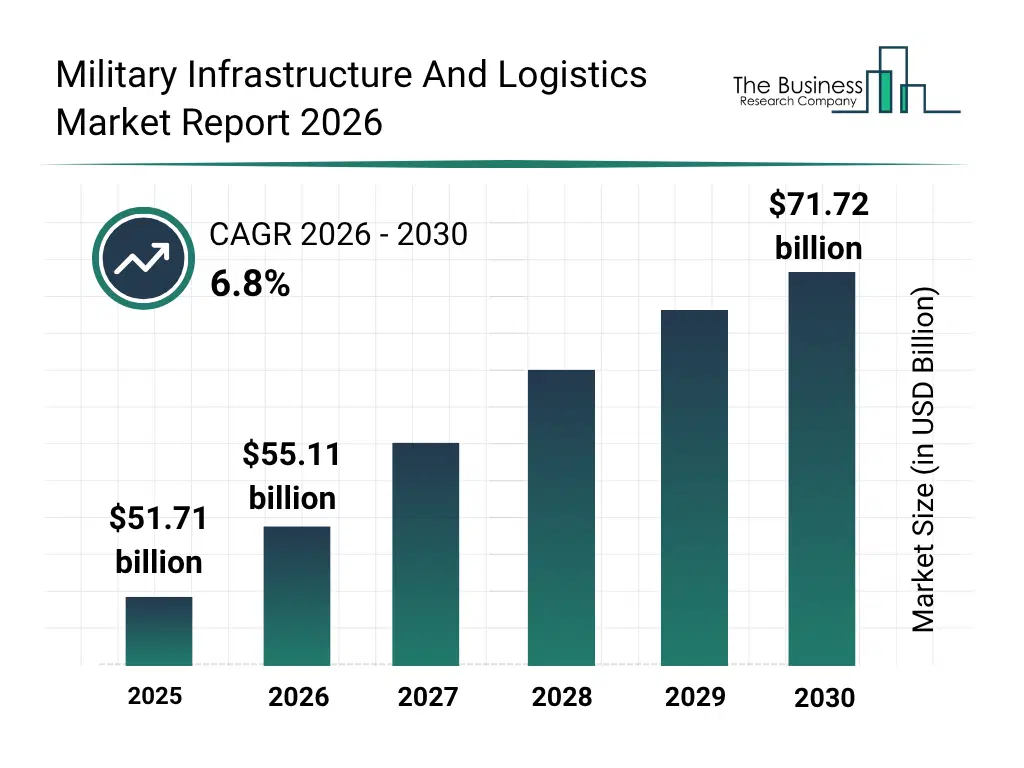
What Is The Military Infrastructure And Logistics Market Size and Share 2026?
The military infrastructure and logistics market size has grown strongly in recent years. It will grow from $51.71 billion in 2025 to $55.11 billion in 2026 at a compound annual growth rate (CAGR) of 6.6%. The growth in the historic period can be attributed to rising geopolitical tensions driving defense infrastructure expansion, increasing military spending on base modernization programs, growing need for secure transportation and logistics networks, expansion of traditional supply chain systems for defense operations, increasing development of permanent military bases and facilities.What Is The Military Infrastructure And Logistics Market Growth Forecast?
The military infrastructure and logistics market size is expected to see strong growth in the next few years. It will grow to $71.72 billion in 2030 at a compound annual growth rate (CAGR) of 6.8%. The growth in the forecast period can be attributed to growth in autonomous defense logistics and unmanned transportation systems, increasing investment in smart military bases and connected infrastructure, rising adoption of predictive analytics for defense readiness and asset management, expansion of cross border defense cooperation and logistics integration, increasing modernization of aging military infrastructure globally. Major trends in the forecast period include increasing adoption of autonomous logistics systems for battlefield and base supply chain efficiency, rising deployment of modular and rapidly deployable military infrastructure solutions, growing focus on energy efficient and sustainable defense facility operations, expansion of predictive maintenance systems for military assets and equipment readiness, increasing integration of advanced supply chain visibility solutions for defense logistics optimization.
Global Military Infrastructure And Logistics Market Segmentation
1) By Solution: Infrastructure Construction; Facilities Management; Logistics 2) By Funding: Government Contracts; Private Investment; International Aid; Defense Spending; Infrastructure Bonds 3) By Technology Integration: Unmanned Aerial Vehicles; Robotic Systems; Artificial Intelligence; Command And Control Systems; Cybersecurity Measures 4) By End Users: Military Forces; Government Defense Agencies; Private Military Contractors; Defense Industry Suppliers; International Organizations Subsegments: 1) By Infrastructure Construction: Airbase Infrastructure; Naval Base Infrastructure; Military Housing Facilities; Command And Control Centers; Border Security Infrastructure 2) By Facilities Management: Asset Maintenance Services; Energy And Utility Management; Security And Surveillance Management; Waste And Environmental Management; Building Operations And Maintenance 3) By Logistics: Transportation And Distribution; Inventory And Warehouse Management; Fleet Management; Supply Chain Management; Ammunition And Fuel LogisticsWhat Is The Driver Of The Military Infrastructure And Logistics Market?
The growing adoption of AI and automation technologies is expected to propel the growth of the government procurement tool market going forward. AI and automation technologies in procurement refer to the integration of artificial intelligence, machine learning, and robotic process automation to streamline, optimize, and manage government purchasing and acquisition processes. The rising adoption of AI and automation technologies is largely driven by government agencies' increasing need to handle complex procurement workflows more efficiently, as mounting administrative burdens and resource constraints push agencies to replace manual processes with intelligent, automated systems. This growing reliance on AI and automation directly boosts demand for advanced government procurement tools, as agencies require sophisticated platforms capable of supporting AI-driven workflows, compliance management, and data-driven decision-making. For instance, in July 2025, according to the U.S. Government Accountability Office (GAO), a US-based federal agency, the total number of reported AI use cases across 11 selected federal agencies nearly doubled from 571 in 2023 to 1,110 in 2024, while generative AI use cases specifically increased approximately ninefold, from 32 to 282 over the same period. Therefore, the growing adoption of AI and automation technologies is driving the growth of the government procurement tool market.Key Players In The Global Military Infrastructure And Logistics Market
Major companies operating in the military infrastructure and logistics market are The Boeing Company; RTX Corporation; Northrop Grumman Corporation; General Dynamics Corporation; BAE Systems plc; KBR Inc.; AECOM; Rolls-Royce Holdings plc; Thales S.A.; Fluor Corporation; Leidos Holdings Inc.; Huntington Ingalls Industries Inc.; Booz Allen Hamilton Holding Corporation; Serco Group; Babcock International Group; Oshkosh Corporation; Science Applications International Corporation; CACI International Inc.; Parsons Corporation; V2X Inc.; Kongsberg Gruppen ASA; CAE Inc.Global Military Infrastructure And Logistics Market Trends and Insights
Major companies operating in the military infrastructure and logistics market are focusing on developing advanced indigenous drone technologies, such as defense-focused brands, to enhance surveillance efficiency, border security, logistics support, and autonomous defense operations. A defense-focused brand is a company primarily dedicated to providing military technologies, equipment, and services designed to meet stringent defense standards, operational reliability, and national security requirements. For instance, in May 2026, SPH Aviation Pvt. Ltd., an India-based company, launched iQuantara, its dedicated defense-focused brand aimed at advancing indigenous drone technologies for India’s evolving security and surveillance needs. The company introduced next-generation integrated unmanned aerial systems tailored for defense applications, including surveillance and intelligence collection, swarm-based operational missions, border monitoring, GIS-based mapping, logistics support, emergency management, and autonomous UAV operations. The initiative also includes expanding drone manufacturing capacity and strengthening research and development capabilities in telemetry, remote controls, and autopiloting technologies to support India’s self-reliance in defense infrastructure and logistics systems.What Are Latest Mergers And Acquisitions In The Military Infrastructure And Logistics Market?
In May 2024, Cerberus Capital Management, a US-based alternative investment and private equity firm, acquired a controlling interest in M1 Support Services for an undisclosed amount. Through this acquisition, Cerberus aims to expand M1’s aviation support infrastructure and enhance its mission-critical logistics capabilities while supporting increasing aircraft maintenance and supply chain requirements for United States and allied government aviation programs. M1 Support Services is a US-based company that operates in the military infrastructure and logistics, particularly within aviation logistics and defense support services.Regional Outlook
North America was the largest region in the military infrastructure and logistics market in 2025. Asia-Pacific is expected to be the fastest-growing region in the forecast period. The regions covered in this market report are Asia-Pacific, South East Asia, Western Europe, Eastern Europe, North America, South America, Middle East, Africa. The countries covered in this market report are Australia, Brazil, China, France, Germany, India, Indonesia, Japan, Taiwan, Russia, South Korea, UK, USA, Canada, Italy, Spain.What Defines the Military Infrastructure And Logistics Market?
The military infrastructure and logistics market consists of revenues earned by entities by providing services such as base operations support, defense facility engineering, asset lifecycle management, and emergency response coordination. The market value includes the value of related goods sold by the service provider or included within the service offering. The military infrastructure and logistics market also includes sales of armored transport vehicles, portable military shelters, tactical communication systems, and mobile command centers. Values in this market are ‘factory gate’ values, that is, the value of goods sold by the manufacturers or creators of the goods, whether to other entities (including downstream manufacturers, wholesalers, distributors, and retailers) or directly to end customers. The value of goods in this market includes related services sold by the creators of the goods.How is Market Value Defined and Measured?
The market value is defined as the revenues that enterprises gain from the sale of goods and/or services within the specified market and geography through sales, grants, or donations in terms of the currency (in USD unless otherwise specified). The revenues for a specified geography are consumption values that are revenues generated by organizations in the specified geography within the market, irrespective of where they are produced. It does not include revenues from resales along the supply chain, either further along the supply chain or as part of other products.What Key Data and Analysis Are Included in the Military Infrastructure And Logistics Market Report 2026?
The military infrastructure and logistics market research report is one of a series of new reports from The Business Research Company that provides market statistics, including industry global market size, regional shares, competitors with the market share, detailed market segments, market trends and opportunities, and any further data you may need to thrive in the military infrastructure and logistics industry. The market research report delivers a complete perspective of everything you need, with an in-depth analysis of the current and future state of the industry.Military Infrastructure And Logistics Market Report Forecast Analysis
| Report Attribute | Details |
|---|---|
| Market Size Value In 2026 | $55.11 billion |
| Revenue Forecast In 2030 | $71.72 billion |
| Growth Rate | CAGR of 6.8% from 2026 to 2030 |
| Base Year For Estimation | 2025 |
| Actual Estimates/Historical Data | 2020-2025 |
| Forecast Period | 2026 - 2030 |
| Market Representation | Revenue in USD Billion and CAGR from 2026 to 2030 |
| Segments Covered | Solution, Funding, Technology Integration, End Users |
| Regional Scope | Asia-Pacific, Western Europe, Eastern Europe, North America, South America, Middle East, Africa |
| Country Scope | The countries covered in the report are Australia, Brazil, China, France, Germany, India, ... |
| Key Companies Profiled | The Boeing Company; RTX Corporation; Northrop Grumman Corporation; General Dynamics Corporation; BAE Systems plc; KBR Inc.; AECOM; Rolls-Royce Holdings plc; Thales S.A.; Fluor Corporation; Leidos Holdings Inc.; Huntington Ingalls Industries Inc.; Booz Allen Hamilton Holding Corporation; Serco Group; Babcock International Group; Oshkosh Corporation; Science Applications International Corporation; CACI International Inc.; Parsons Corporation; V2X Inc.; Kongsberg Gruppen ASA; CAE Inc. |
| Customization Scope | Request for Customization |
| Pricing And Purchase Options | Explore Purchase Options |