
Military Infrastructure Market Report 2026
Global Outlook – By Type (Harbor, Proving Ground, Range, Training Course), By Size (Small, Medium, Large), By Application (Army, Navy, Air Force) – Market Size, Trends, Strategies, and Forecast to 2030
Military Infrastructure Market Overview
• Military Infrastructure market size has reached to $11.17 billion in 2025 • Expected to grow to $15.74 billion in 2030 at a compound annual growth rate (CAGR) of 7.1% • Growth Driver: Rising Global Terrorism Threats Fueling The Military Infrastructure Market Growth • Market Trend: Innovative Products In The Mobile Communication Network Systems Market • North America was the largest region in 2025.What Is Covered Under Military Infrastructure Market?
Military infrastructure refers to the physical and organizational structures, facilities, and systems that support the operations and activities of a nation's armed forces. They assist in the logistics, communication, intelligence, training, deployment, and general readiness of a country's armed forces. The main types of military infrastructure are harbors, proving grounds, ranges, and training courses. A harbor is an area of the sea near the shore that is partially surrounded by land or solid barriers so that vessels can be anchored there without risk. The various sizes, including small, medium, and large, are used by various applications, such as the army, navy, and air force.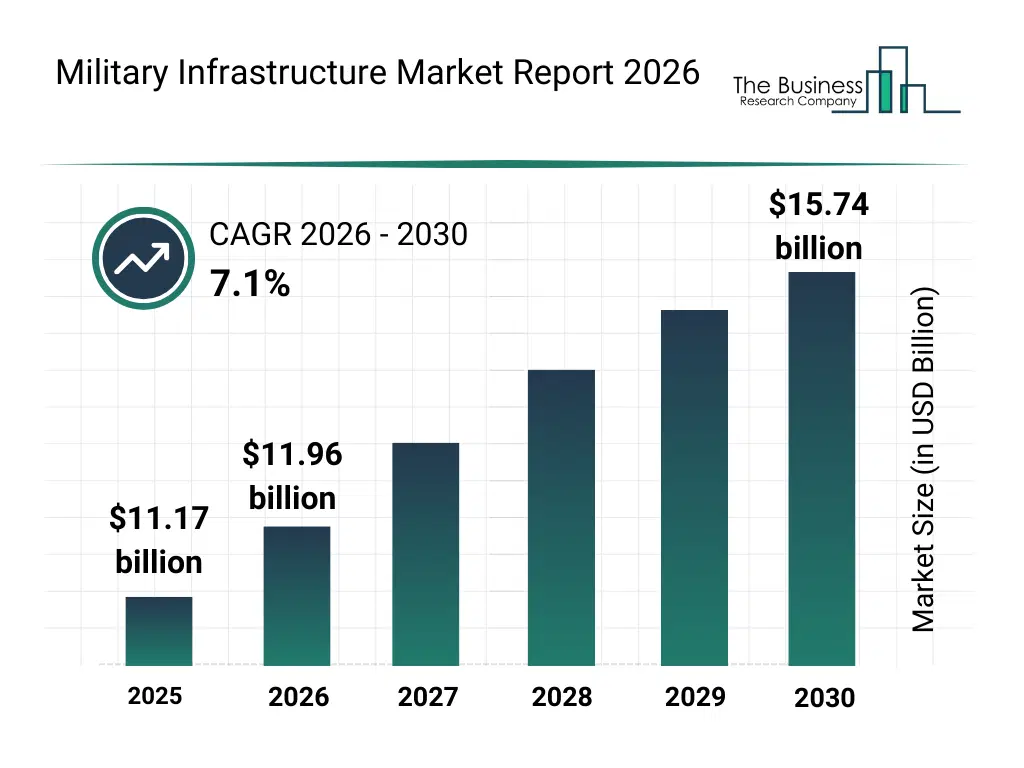
What Is The Military Infrastructure Market Size and Share 2026?
The military infrastructure market size has grown strongly in recent years. It will grow from $11.17 billion in 2025 to $11.96 billion in 2026 at a compound annual growth rate (CAGR) of 7.1%. The growth in the historic period can be attributed to modernization of armed forces facilities, growth in military base construction and expansion, investment in secure communication infrastructure, adoption of environmental protection and safety systems, increasing demand for airfield lighting and security fencing.What Is The Military Infrastructure Market Growth Forecast?
The military infrastructure market size is expected to see strong growth in the next few years. It will grow to $15.74 billion in 2030 at a compound annual growth rate (CAGR) of 7.1%. The growth in the forecast period can be attributed to rising investments in smart and resilient military infrastructure, adoption of advanced surveillance and monitoring systems, integration of sustainable and eco-friendly infrastructure solutions, increasing demand for modular and rapidly deployable facilities, growth in maintenance and repair service contracts for defense assets. Major trends in the forecast period include deployment of smart surveillance and security systems, modular and rapidly deployable military facilities, integration of advanced environmental protection systems, enhanced communication infrastructure for tactical operations, expansion of simulation and training centers.
Global Military Infrastructure Market Segmentation
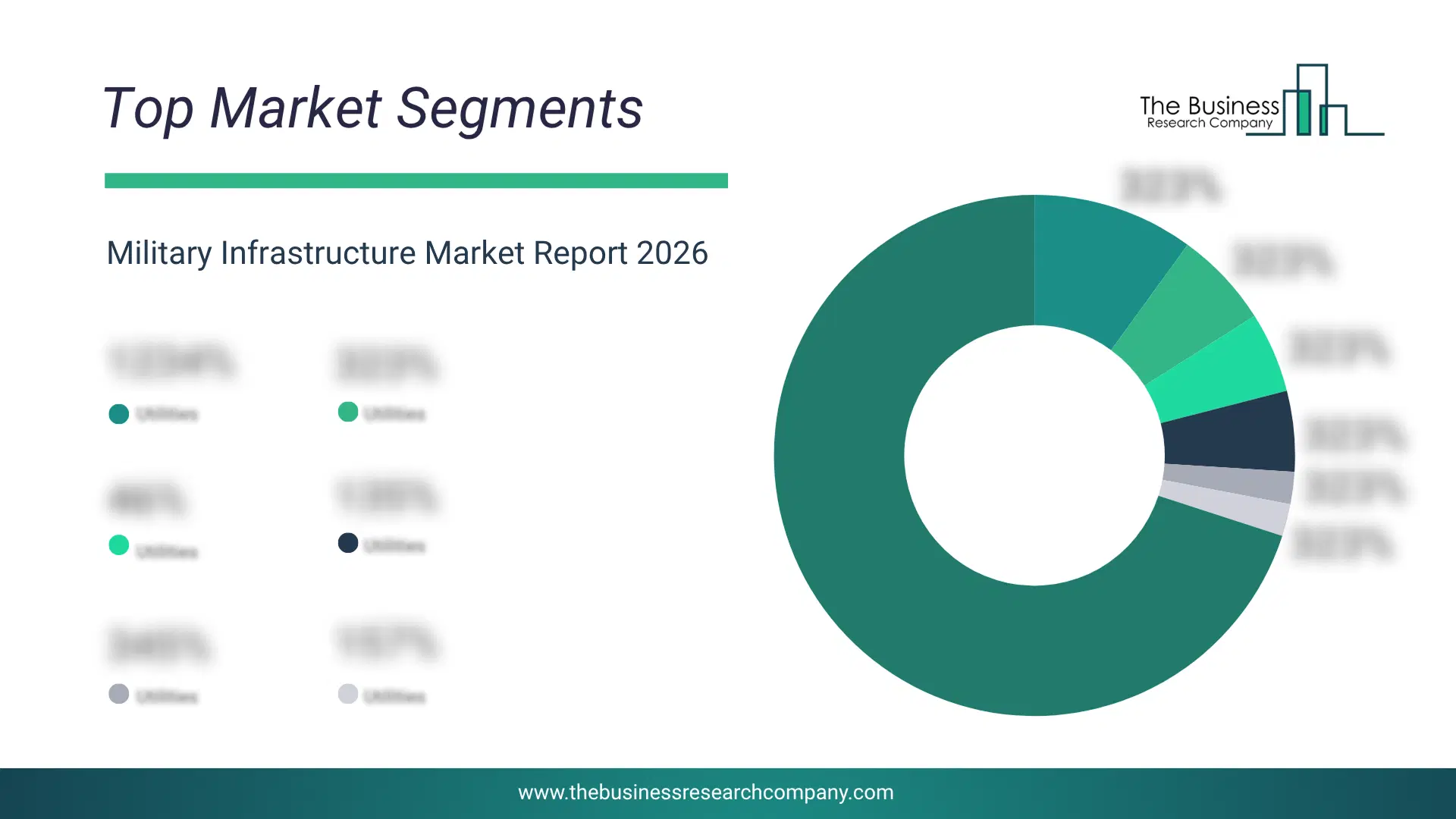
1) By Type: Harbor, Proving Ground, Range, Training Course 2) By Size: Small, Medium, Large 3) By Application: Army, Navy, Air Force Subsegments: 1) By Harbor: Naval Bases, Docking And Ship Maintenance Facilities, Supply And Logistics Harbors 2) By Proving Ground: Testing And Evaluation Centers, Weapon And Ammunition Testing Sites, Military Vehicle Testing Grounds 3) By Range: Air Defense Ranges, Land-Based Firing Ranges, Artillery And Ballistic Ranges 4) By Training Course: Combat Training Centers, Simulated Training Environments, Specialized Skill Development CoursesWhat Is Driver Of The Military Infrastructure Market?
The increasing risk of terrorism is expected to propel the growth of the military infrastructure market going forward. Terrorism refers to violent crimes that are committed by individuals, groups, or nations that have been classified as foreign terrorist organizations or countries. Terrorism is rising due to growing political and ideological extremism, with radical groups exploiting social and economic instability to recruit supporters and justify violence against authorities or rival communities. Military infrastructure is critical to counter-terrorism efforts by providing strategic resources, intelligence capabilities, and operational bases to prevent and respond to terrorist activities. For instance, in April 2024, according to the U.S. Department of State, a US-based federal government agency, the number of global terrorist incidents rose from 7,351 in 2022 to 7,382 in 2023, reflecting an increase of 31 incidents. Therefore, the increasing risk of terrorism is driving the growth of the military infrastructure industry.Key Players In The Global Military Infrastructure Market
Major companies operating in the military infrastructure market are Dell Inc., General Electric Company, Raytheon Technologies Corporation, Boeing Company, Lockheed Martin Corporation, Airbus SE, General Dynamics Corporation, Northrop Grumman Corporation, Honeywell International Inc., BAE Systems, L3Harris Technologies Inc., Safran SA, Leonardo S.p.A., Thales Group, AECOM, Textron Inc., Oshkosh Corporation, Rheinmetall AG, KBR Inc., Saab AB, General Atomics Aeronautical Systems Inc., ManTech International Corporation, Aselsan AS, Anham Fzco, Minrav Holdings Ltd., American International Contractors Inc., ArmourWorks International Ltd., Dewey Electronics Corporation, Dencrypt A/S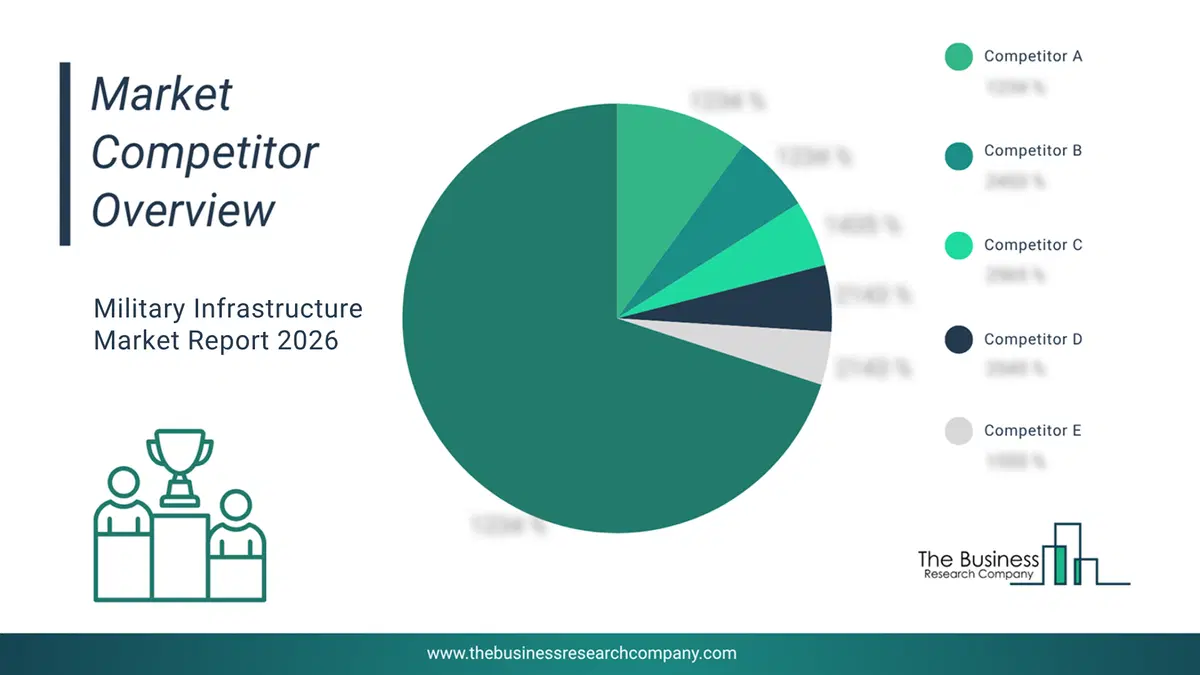
This chart is for illustrative purposes; the full report includes a detailed competitor analysis and comprehensive overview of the top 10 companies in the market.
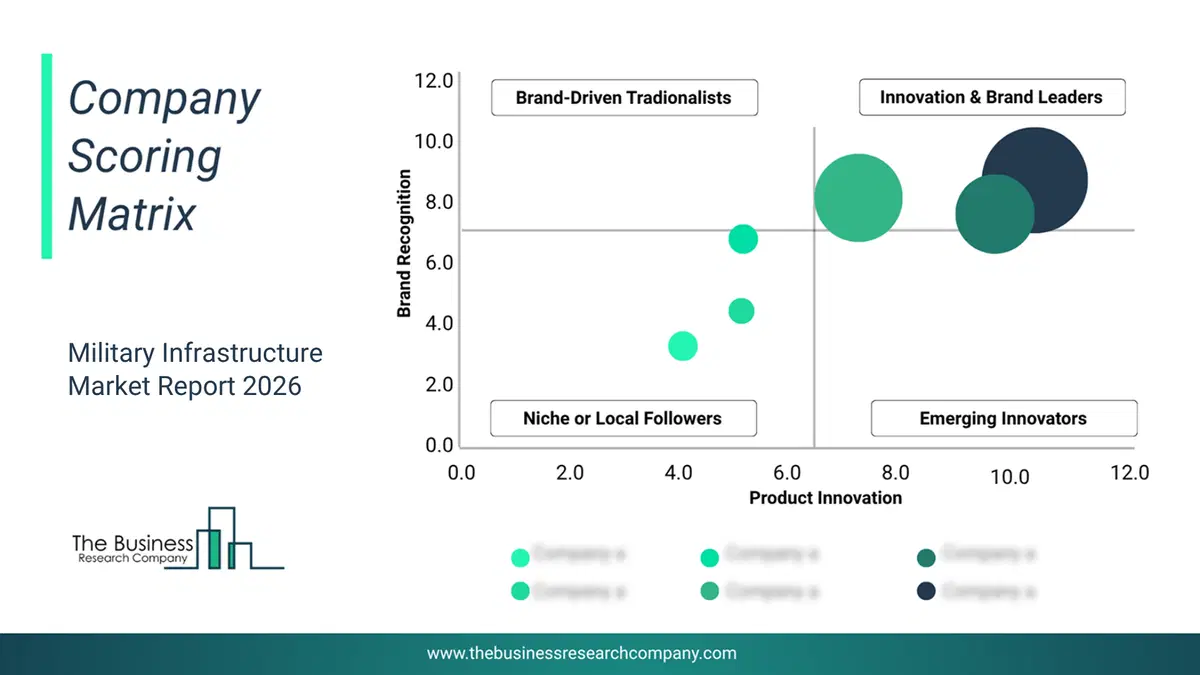
This chart maps companies by product innovation and brand strength, with bubble size indicating relative revenue, helping identify market leaders, challengers, and niche players. This is an illustrative chart; the full report provides a complete and accurate competitive analysis.
Global Military Infrastructure Market Trends and Insights
Major companies operating in the military infrastructure market are focused on developing innovative products such as mobile communication network systems to enhance battlefield connectivity, enable real-time data exchange, and ensure secure and resilient communications. A mobile communication network system refers to a wireless infrastructure that enables seamless voice, data, and video communication between users and devices across various locations through cellular or radio-based connectivity. For instance, in May 2025, Nokia Corporation, a Finland-based telecommunications equipment company, partnered with Blackned GmbH, a Germany-based defense technology company, to develop next-gen tactical networks for the German army. It is deployable tactical communication networks that are mobile and rapid to set up, designed for battlefield operations in environments where standard infrastructure is unavailable. Its compatibility with the Battlesuite digital ecosystem enables integration across land, air, and other mission domains, with adaptability for Germany’s defense and allied use cases.What Are Latest Mergers And Acquisitions In The Military Infrastructure Market? Serco Acquires Northrop Grumman’s Mission Training & Satellite Ground Network Communications Software Business To Strengthen U.S. Defense Capabilities
In May 2025, Serco Inc., a US-based provider of professional, technology, engineering, and management services, acquired Northrop Grumman’s Mission Training & Satellite Ground Network Communications Software Business for $327 million. With this acquisition, Serco aims to enhance its technological capability and expand its footprint in U.S. defense and space mission-readiness solutions by integrating advanced satellite ground network communications software and training services. Northrop Grumman’s MT&S business is a US-based provider of military infrastructure-type capabilities.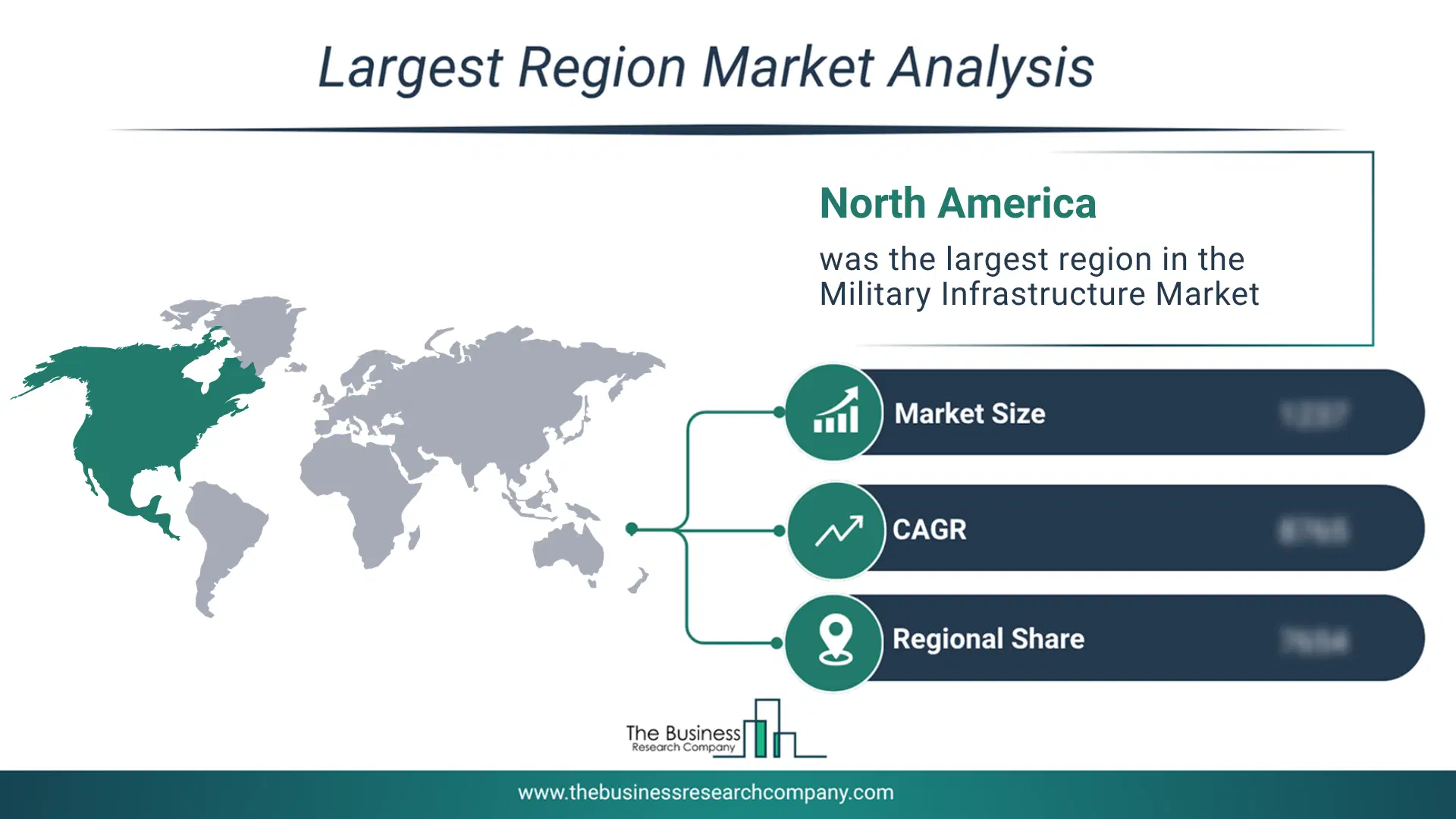
Regional Insights
North America was the largest region in the military infrastructure market in 2025. The regions covered in this market report are Asia-Pacific, South East Asia, Western Europe, Eastern Europe, North America, South America, Middle East, Africa. The countries covered in this market report are Australia, Brazil, China, France, Germany, India, Indonesia, Japan, Taiwan, Russia, South Korea, UK, USA, Canada, Italy, SpainWhat Defines the Military Infrastructure Market?
The military infrastructure market includes revenues earned by entities by providing services such as communication and information services, security and defense services, and maintenance and repair services. The market value includes the value of related goods sold by the service provider or included within the service offering. Only goods and services traded between entities or sold to end consumers are included. The military infrastructure market consists of sales of products such as security fencing, environmental protection systems, communications infrastructure, and airfield lighting systems. Values in this market are ‘factory gate’ values, that is the value of goods sold by the manufacturers or creators of the goods, whether to other entities (including downstream manufacturers, wholesalers, distributors and retailers) or directly to end customers. The value of goods in this market includes related services sold by the creators of the goods.How is Market Value Defined and Measured?
The market value is defined as the revenues that enterprises gain from the sale of goods and/or services within the specified market and geography through sales, grants, or donations in terms of the currency (in USD unless otherwise specified). The revenues for a specified geography are consumption values that are revenues generated by organizations in the specified geography within the market, irrespective of where they are produced. It does not include revenues from resales along the supply chain, either further along the supply chain or as part of other products.
This chart presents market attractiveness based on a quantitative evaluation of growth, competition, strategic alignment, and risk, offering a clear view of opportunity areas for decision-making. This chart is for illustrative purposes; the full report contains the complete analysis.

This chart highlights the Total Addressable Market (TAM) by estimating the maximum revenue opportunity using an assumption-driven approach, supporting strategic planning and opportunity sizing across markets. The chart is illustrative; the full report provides a more comprehensive analysis.
What Key Data and Analysis Are Included in the Military Infrastructure Market Report 2026?
The military infrastructure market research report is one of a series of new reports from The Business Research Company that provides market statistics, including industry global market size, regional shares, competitors with the market share, detailed market segments, market trends and opportunities, and any further data you may need to thrive in the military infrastructure industry. The market research report delivers a complete perspective of everything you need, with an in-depth analysis of the current and future state of the industry.Military Infrastructure Market Report Forecast Analysis
| Report Attribute | Details |
|---|---|
| Market Size Value In 2026 | $11.96 billion |
| Revenue Forecast In 2030 | $15.74 billion |
| Growth Rate | CAGR of 7.1% from 2026 to 2030 |
| Base Year For Estimation | 2025 |
| Actual Estimates/Historical Data | 2020-2025 |
| Forecast Period | 2026 - 2030 |
| Market Representation | Revenue in USD Billion and CAGR from 2026 to 2030 |
| Segments Covered | Type, Size, Application |
| Regional Scope | Asia-Pacific, Western Europe, Eastern Europe, North America, South America, Middle East, Africa |
| Country Scope | The countries covered in the military infrastructure market report are Australia, Brazil, China, France, Germany, India, Indonesia, Japan, Taiwan, Russia, South Korea, UK, USA, Canada, Italy, Spain |
| Key Companies Profiled | Dell Inc., General Electric Company, Raytheon Technologies Corporation, Boeing Company, Lockheed Martin Corporation, Airbus SE, General Dynamics Corporation, Northrop Grumman Corporation, Honeywell International Inc., BAE Systems, L3Harris Technologies Inc., Safran SA, Leonardo S.p.A., Thales Group, AECOM, Textron Inc., Oshkosh Corporation, Rheinmetall AG, KBR Inc., Saab AB, General Atomics Aeronautical Systems Inc., ManTech International Corporation, Aselsan AS, Anham Fzco, Minrav Holdings Ltd., American International Contractors Inc., ArmourWorks International Ltd., Dewey Electronics Corporation, Dencrypt A/S |
| Customization Scope | Request for Customization |
| Pricing And Purchase Options | Explore Purchase Options |