
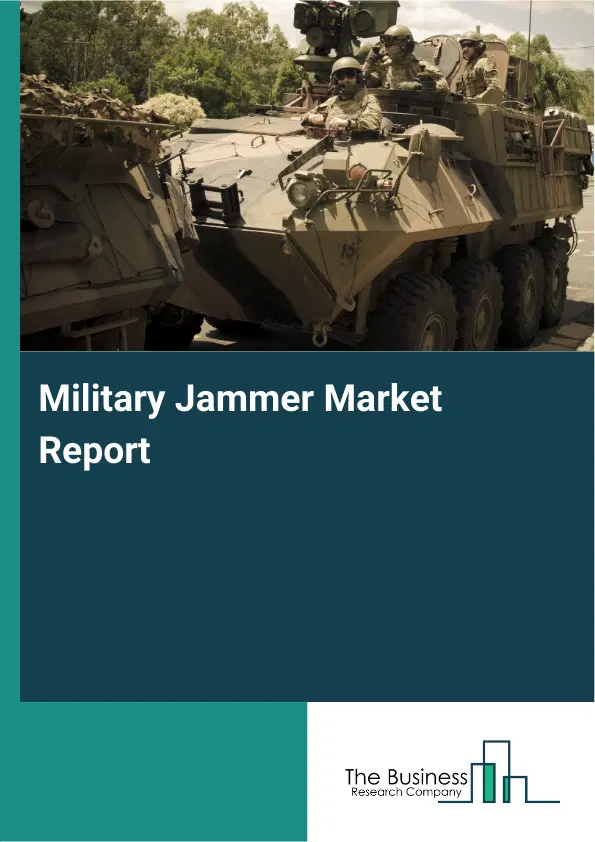
Military Jammer Market Report 2026
Global Outlook – By Type (Electronic Jamming, Communication Jamming, Radar Jamming, Inadvertent, Mechanical Jamming), By Technology (Gallium Arsenide (GaAs), Gallium Nitride (GaN)), By Deployment (Naval and Airborne-based, Ground-based), By Application (Counter-IED, Bomb Disposal, Military Convoy Protection, Anti-Riot and Law Enforcement, Other Applications) – Market Size, Trends, Strategies, and Forecast to 2030
Military Jammer Market Overview
• Military Jammer market size has reached to $6.24 billion in 2025 • Expected to grow to $9.05 billion in 2030 at a compound annual growth rate (CAGR) of 7.7% • Growth Driver: The Role Of Military Jammers In Combating Escalating Terrorist Activities • Market Trend: Mitigation Technologies Tailored For Military Deployment • Asia-Pacific was the largest region in 2025.What Is Covered Under Military Jammer Market?
Military jammers are unique devices designed to interfere with or destroy military communication and radar signals. It is utilized to transmit a strong signal that interferes with or disrupts the incoming threat signal, rendering it ineffective. The main types of the military jammer market include electronic jamming, communication jamming, radar jamming, and inadvertent jamming. Electronic jamming refers to the deliberate use of electronic signals to disrupt, degrade, or completely deny an adversary’s communication or sensor systems by interfering with radio frequencies, electromagnetic waves, and targeting channels, thereby weakening hostile situational awareness, command coordination, and battlefield responsiveness during military operations. There are different technologies, such as gallium arsenide (GaAs) and gallium nitride (GaN). The are deployed through naval and airborne-based platforms as well as ground-based units. The key applications of military jammers include counter-IED, bomb disposal, military convoy protection, anti-riot and law enforcement, and others.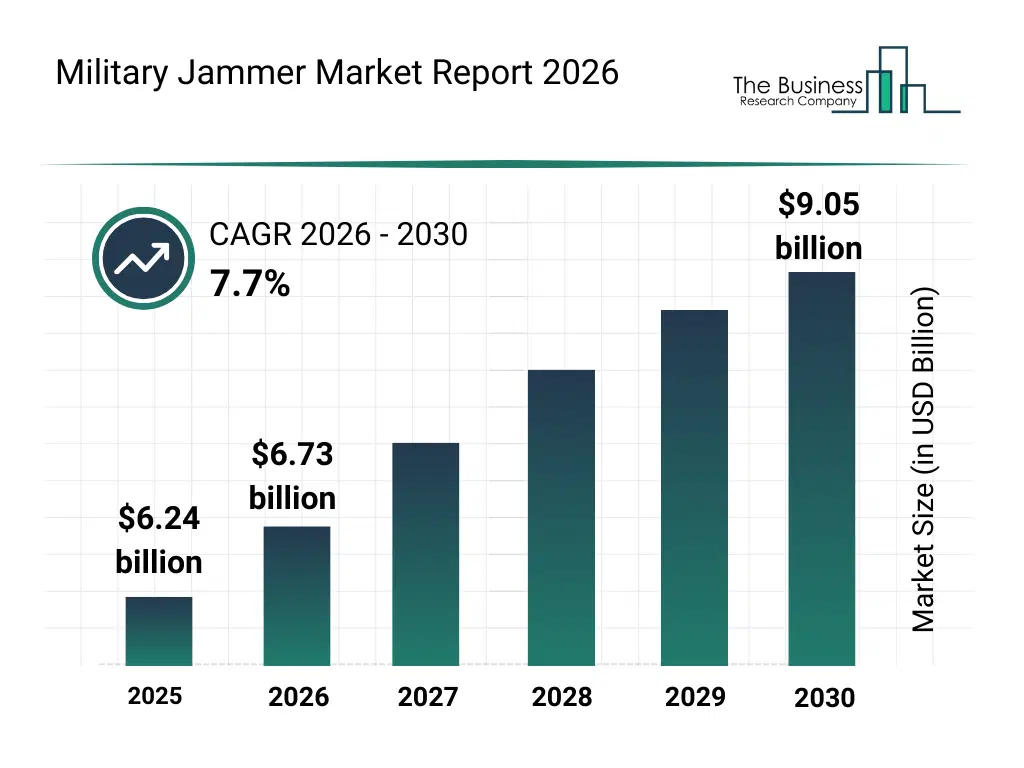
What Is The Military Jammer Market Size and Share 2026?
The military jammer market size has grown strongly in recent years. It will grow from $6.24 billion in 2025 to $6.73 billion in 2026 at a compound annual growth rate (CAGR) of 7.8%. The growth in the historic period can be attributed to increased deployment of communications jammers to counter adversary command-and-control capabilities, rising use of radar warning receivers enhancing situational awareness and threat detection, growth in signals intelligence operations driving adoption of advanced jamming systems, expansion of infrared jammer usage improving aircraft survivability against heat-seeking threats, increased procurement of drone jammers responding to the rise of unmanned aerial threats.What Is The Military Jammer Market Growth Forecast?
The military jammer market size is expected to see strong growth in the next few years. It will grow to $9.05 billion in 2030 at a compound annual growth rate (CAGR) of 7.7%. The growth in the forecast period can be attributed to development of next-generation adaptive jamming technologies improving effectiveness against evolving threats, rising emphasis on electronic warfare modernization boosting demand for integrated jammer solutions, increasing adoption of multi-domain jamming platforms enhancing operational flexibility, growth in counter-uas programs driving innovation in drone-focused jamming systems, expanding investment in cyber-resilient and software-defined jammers supporting future battlefield requirements. Major trends in the forecast period include rising demand for advanced electronic and communication jammers, integration of gallium nitride (gan) technology for high-efficiency jamming, expansion of naval, airborne, and ground-based deployment solutions, growth in counter-ied, bomb disposal, and convoy protection applications, development of compact, portable, and multi-band jamming systems.
Global Military Jammer Market Segmentation
1) By Type: Electronic Jamming, Communication Jamming, Radar Jamming, Inadvertent, Mechanical Jamming 2) By Technology: Gallium Arsenide (GaAs), Gallium Nitride (GaN) 3) By Deployment: Naval and Airborne-based, Ground-based 4) By Application: Counter-IED, Bomb Disposal, Military Convoy Protection, Anti-Riot and Law Enforcement, Other Applications Subsegments: 1) By Electronic Jamming: Jammers For GPS Signals, Jammers For Wi-Fi Signals, Jammers For Cellular Networks 2) By Communication Jamming: Voice Communication Jammers, Data Communication Jammers, Tactical Communication Jammers 3) By Radar Jamming: Ground-Based Radar Jammers, Airborne Radar Jammers, Shipborne Radar Jammers 4) By Inadvertent Jamming: Accidental Signal Interference, Unintentional Noise Generation 5) By Mechanical Jamming: Physical Disruption Devices, Signal Masking DevicesWhat Is Driver Of The Military Jammer Market?
The rising terrorist activities are expected to propel the growth of the military jammer market going forward. Terrorist activity is defined as the deliberate use of violent means or threats to achieve political, religious, or ideological goals by instilling fear or compulsion in citizens. The military employs jammers as a means to disrupt terrorist communications due to the susceptibility of wireless networks to different types of attacks, given their open nature. Terrorist activities have been on the rise globally in recent years, and this has led to an increase in demand for military jamming systems to help prevent attacks and protect against threats. For instance, in February 2024, according to The Institute for Economics and Peace, an Australia-based international think tank, terrorist attacks became more deadly in 2023, with 2.5 deaths per attack compared to 1.6 in 2022. Therefore, the rising terrorist activities are driving the growth of the military jammer industry.Key Players In The Global Military Jammer Market
Major companies operating in the military jammer market are Northrop Grumman Corporation, BAE Systems plc, Raytheon Technologies Corporation, Svenska Aeroplan Aktiebolaget, Israel Aerospace Industries Ltd., L3Harris Technologies Inc., Ultra Electronics Holdings plc, Thales Group, Mercury Systems Inc., Cobham plc, Chemring Group PLC, Allen-Vanguard Corporation, Airbus Defense and Space GmbH, Lockheed Martin Corporation, ASELSAN AS, Leonardo SpA, Elbit Systems Ltd., Rheinmetall AG, Terma A/S, SRC Inc., Elettronica SpA, Hertz Systems Ltd., Netline Communications Technologies Ltd., Norsat International Inc., Novator Systems Ltd., Plath GmbH, QuinetiQ Group plc, Rohde & Schwarz GmbH & Co KG
This chart is for illustrative purposes; the full report includes a detailed competitor analysis and comprehensive overview of the top 10 companies in the market.
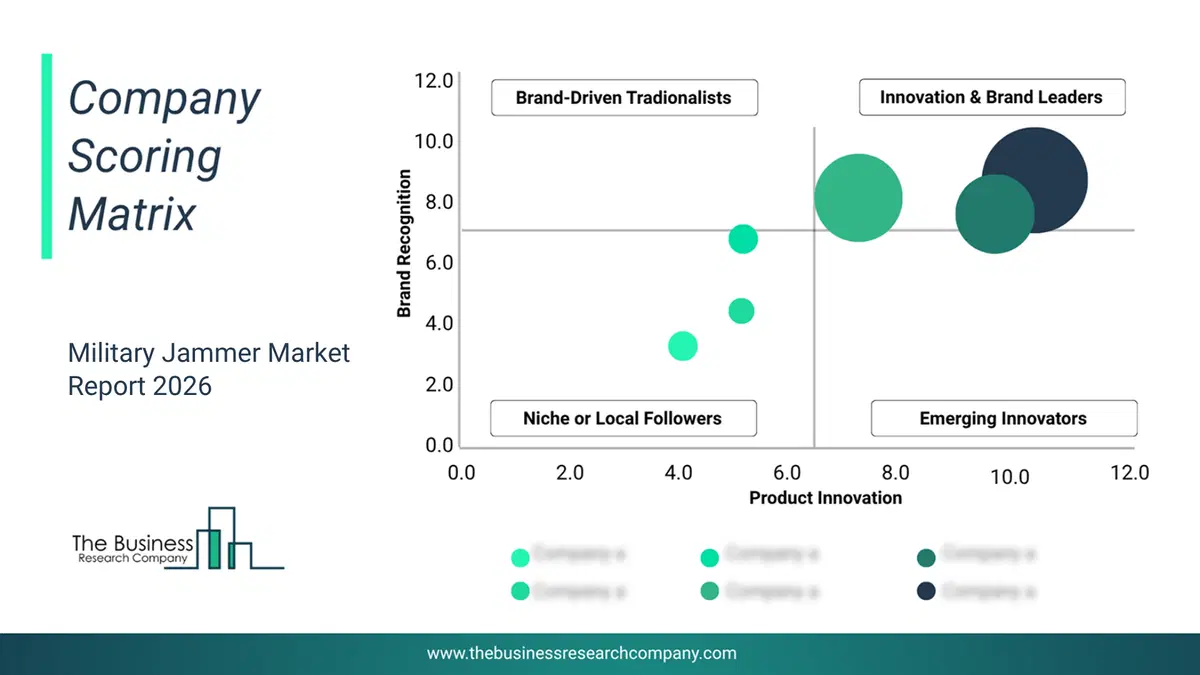
This chart maps companies by product innovation and brand strength, with bubble size indicating relative revenue, helping identify market leaders, challengers, and niche players. This is an illustrative chart; the full report provides a complete and accurate competitive analysis.
Global Military Jammer Market Trends and Insights
Major companies operating in the military jammer market are launching mitigation technologies specifically designed for military deployment to sustain their position in the market. For instance, in October 2024, Leonardo, an Italy -based defense technology company, launched the BriteStorm stand-in jammer. The system is lightweight (approximately 2.5 kg) and compact (3.5 liters), software-defined and mission-programmable, and designed for integration onto attritable UAVs and launched effects. BriteStorm enhances the military electronic warfare market by providing high-powered jamming and deception capabilities against modern integrated air defense systems.What Are Latest Mergers And Acquisitions In The Military Jammer Market? Rockaway Capital Expands Into Defense Sector With Acquisition Of Military Jamming Specialist URC Systems
In March 2024, Rockaway Capital, a Czech Republic-based investment firm, acquired URC Systems for an undisclosed amount. The acquisition aims to expand its portfolio into defense technologies, which is increasingly relevant in the current geopolitical climate. URC Systems is a Czech Republic-based manufacturer company specializing in military jamming technologies.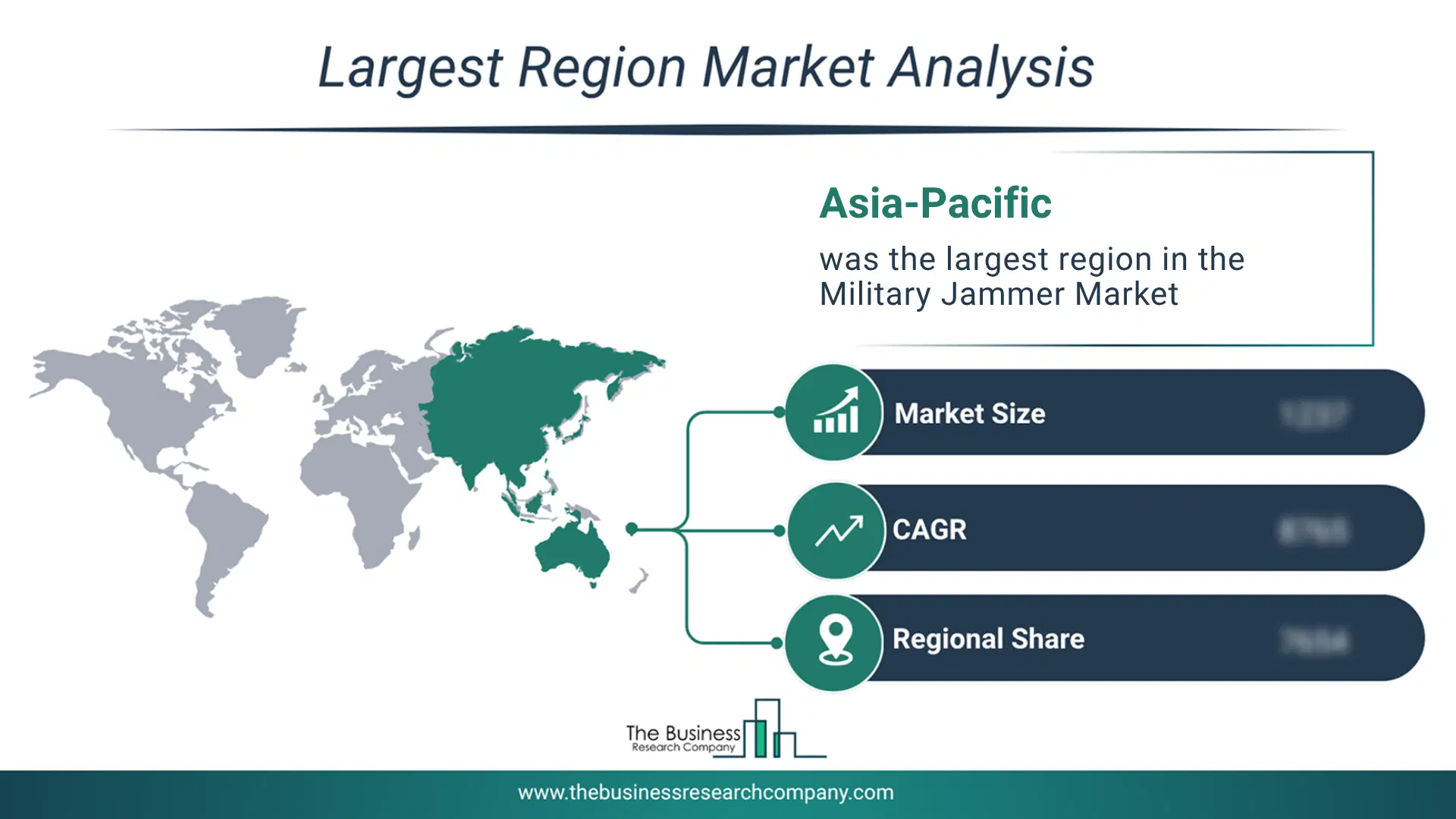
Regional Insights
Asia-Pacific is expected to be the fastest-growing region in the global military jammers market in 2025. The regions covered in this market report are Asia-Pacific, South East Asia, Western Europe, Eastern Europe, North America, South America, Middle East, Africa. The countries covered in this market report are Australia, Brazil, China, France, Germany, India, Indonesia, Japan, Taiwan, Russia, South Korea, UK, USA, Canada, Italy, SpainWhat Defines the Military Jammer Market?
The military jammer market consists of revenues earned by entities by providing communications jammer solutions, radar warning receivers solutions, communications intelligence, and signals intelligence. The market value includes the value of related goods sold by the service provider or included within the service offering. The military jammers market also includes sales of infrared jammers and drone jammers that are used in providing services related to military jammers. Values in this market are ‘factory gate’ values, that is the value of goods sold by the manufacturers or creators of the goods, whether to other entities (including downstream manufacturers, wholesalers, distributors and retailers) or directly to end customers. The value of goods in this market includes related services sold by the creators of the goods.How is Market Value Defined and Measured?
The market value is defined as the revenues that enterprises gain from the sale of goods and/or services within the specified market and geography through sales, grants, or donations in terms of the currency (in USD unless otherwise specified). The revenues for a specified geography are consumption values that are revenues generated by organizations in the specified geography within the market, irrespective of where they are produced. It does not include revenues from resales along the supply chain, either further along the supply chain or as part of other products.
This chart presents market attractiveness based on a quantitative evaluation of growth, competition, strategic alignment, and risk, offering a clear view of opportunity areas for decision-making. This chart is for illustrative purposes; the full report contains the complete analysis.

This chart highlights the Total Addressable Market (TAM) by estimating the maximum revenue opportunity using an assumption-driven approach, supporting strategic planning and opportunity sizing across markets. The chart is illustrative; the full report provides a more comprehensive analysis.
What Key Data and Analysis Are Included in the Military Jammer Market Report 2026?
The military jammer market research report is one of a series of new reports from The Business Research Company that provides market statistics, including industry global market size, regional shares, competitors with the market share, detailed market segments, market trends and opportunities, and any further data you may need to thrive in the military jammer industry. The market research report delivers a complete perspective of everything you need, with an in-depth analysis of the current and future state of the industry.Military Jammer Market Report Forecast Analysis
| Report Attribute | Details |
|---|---|
| Market Size Value In 2026 | $6.73 billion |
| Revenue Forecast In 2030 | $9.05 billion |
| Growth Rate | CAGR of 7.7% from 2026 to 2030 |
| Base Year For Estimation | 2025 |
| Actual Estimates/Historical Data | 2020-2025 |
| Forecast Period | 2026 - 2030 |
| Market Representation | Revenue in USD Billion and CAGR from 2026 to 2030 |
| Segments Covered | Type, Technology, Deployment, Application |
| Regional Scope | Asia-Pacific, Western Europe, Eastern Europe, North America, South America, Middle East, Africa |
| Country Scope | The countries covered in the military jammer market report are Australia, Brazil, China, France, Germany, India, Indonesia, Japan, Taiwan, Russia, South Korea, UK, USA, Canada, Italy, Spain |
| Key Companies Profiled | Northrop Grumman Corporation, BAE Systems plc, Raytheon Technologies Corporation, Svenska Aeroplan Aktiebolaget, Israel Aerospace Industries Ltd., L3Harris Technologies Inc., Ultra Electronics Holdings plc, Thales Group, Mercury Systems Inc., Cobham plc, Chemring Group PLC, Allen-Vanguard Corporation, Airbus Defense and Space GmbH, Lockheed Martin Corporation, ASELSAN AS, Leonardo SpA, Elbit Systems Ltd., Rheinmetall AG, Terma A/S, SRC Inc., Elettronica SpA, Hertz Systems Ltd., Netline Communications Technologies Ltd., Norsat International Inc., Novator Systems Ltd., Plath GmbH, QuinetiQ Group plc, Rohde & Schwarz GmbH & Co KG |
| Customization Scope | Request for Customization |
| Pricing And Purchase Options | Explore Purchase Options |