
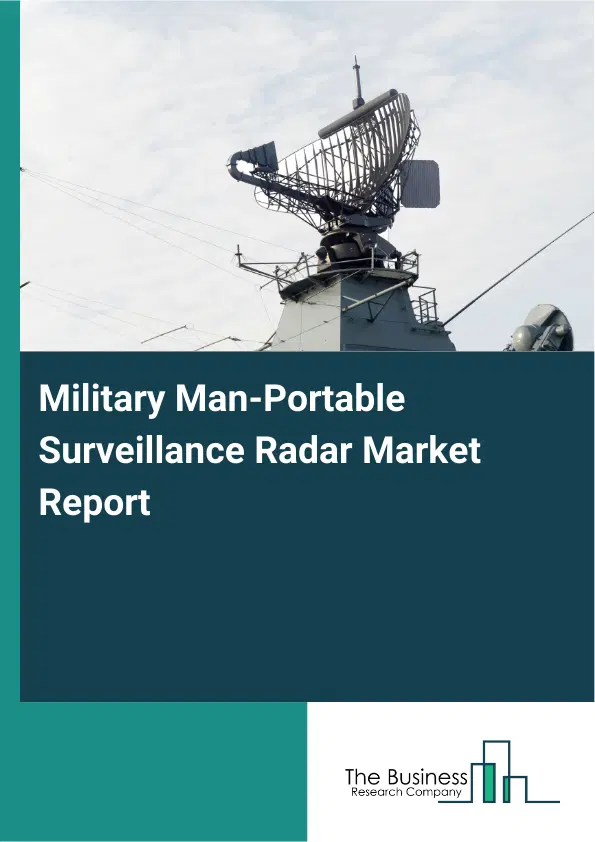
Military Man-Portable Surveillance Radar Market Report 2026
Global Outlook – By Component (Antenna, Transmitter, Receiver, Other Components), By Frequency Band (L-Band, S-Band, C-Band, X-Band, Other Frequency Bands), By Technology (Frequency Modulated Continuous Wave (FMCW) Radar, Pulsed Radar, Phased Array Radar, Moving Target Indication (MTI) Radar), By Application (Border Surveillance, Battlefield Surveillance, Coastal Surveillance, Critical Infrastructure Protection, Other Applications), By End-User (Military, Law Enforcement Agencies, Government Security Organizations, Commercial Security Firms, Non-Governmental Organizations (NGOs)) – Market Size, Trends, Strategies, and Forecast to 2030
Military Man-Portable Surveillance Radar Market Overview
• Military Man-Portable Surveillance Radar market size has reached to $1.77 billion in 2025 • Expected to grow to $2.68 billion in 2030 at a compound annual growth rate (CAGR) of 8.5% • Growth Driver: The Increasing Geopolitical Tensions Are Fueling The Growth Of The Market Due To Heightened Security Concerns • Market Trend: Advancement Of Man-Portable Counter-Drone Systems For Enhanced Force Protection • North America was the largest region in 2025 and Asia-Pacific is the fastest growing region.What Is Covered Under Military Man-Portable Surveillance Radar Market?
A military man-portable surveillance radar is a lightweight, transportable radar system designed to be carried and operated by dismounted troops for short- to medium-range detection and tracking of targets such as personnel, vehicles, and low-flying drones. It enhances situational awareness by providing continuous coverage in diverse environments. Military man-portable surveillance radar enables rapid deployment and flexible operation, ensuring reliable surveillance capabilities in dynamic conditions. The main component types of military man-portable surveillance radar are antenna, transmitter, receiver, and others. Antennas refer to the devices that transmit and receive electromagnetic signals for detecting and tracking targets. The frequency bands include L-band, S-band, C-band, X-band, and others with various technologies such as frequency modulated continuous wave (FMCW) radar, pulsed radar, phased array radar, and moving target indication (MTI) radar. It is applied in several applications, including border surveillance, battlefield surveillance, coastal surveillance, critical infrastructure protection, and others, and is used by various end-users such as the military, law enforcement agencies, government security organizations, commercial security firms, and non-governmental organizations (NGOs).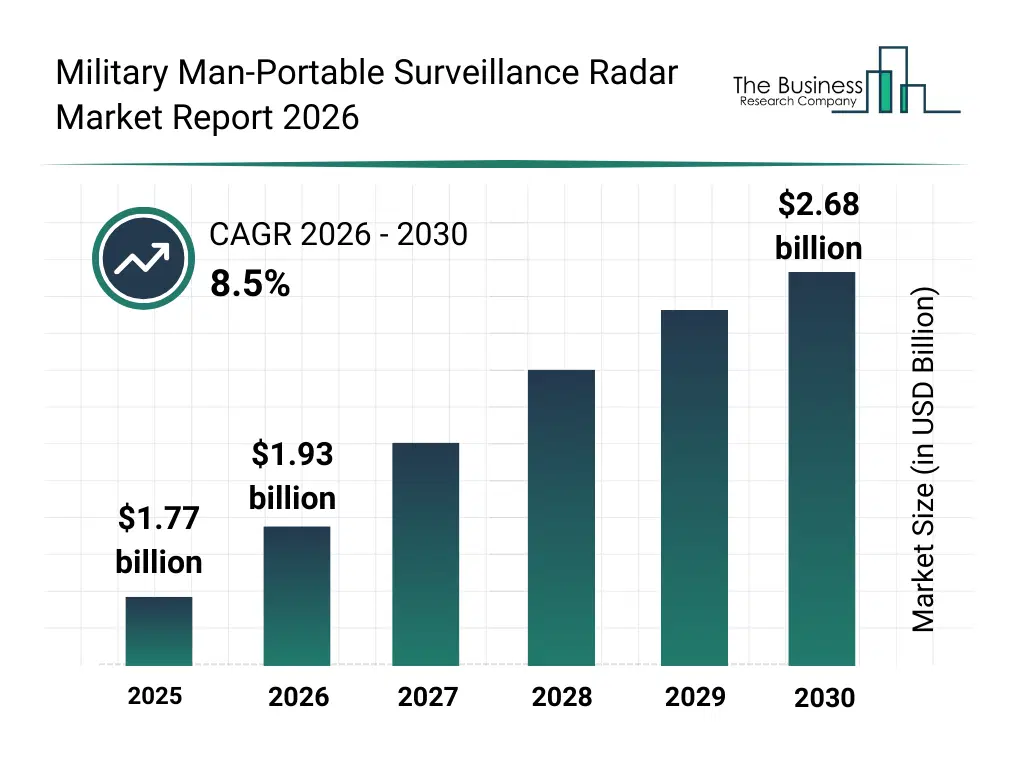
What Is The Military Man-Portable Surveillance Radar Market Size and Share 2026?
The military man-portable surveillance radar market size has grown strongly in recent years. It will grow from $1.77 billion in 2025 to $1.93 billion in 2026 at a compound annual growth rate (CAGR) of 8.8%. The growth in the historic period can be attributed to early deployment of ground surveillance radars, adoption of battlefield radar systems for troop protection, development of lightweight portable radar units, expansion of border surveillance radars, integration of low-power, high-sensitivity detection technologies.What Is The Military Man-Portable Surveillance Radar Market Growth Forecast?
The military man-portable surveillance radar market size is expected to see strong growth in the next few years. It will grow to $2.68 billion in 2030 at a compound annual growth rate (CAGR) of 8.5%. The growth in the forecast period can be attributed to technological improvements in multi-target tracking and identification, expansion of compact and ruggedized radar units, integration with real-time data analytics, growth in deployment by special operations forces, adoption of AI-enabled autonomous surveillance capabilities. Major trends in the forecast period include enhanced portability and lightweight design, multi-target tracking and identification, integration with command and control systems, low probability of intercept (lpi) and anti-jamming capabilities, expanded environmental and terrain adaptability.
Global Military Man-Portable Surveillance Radar Market Segmentation
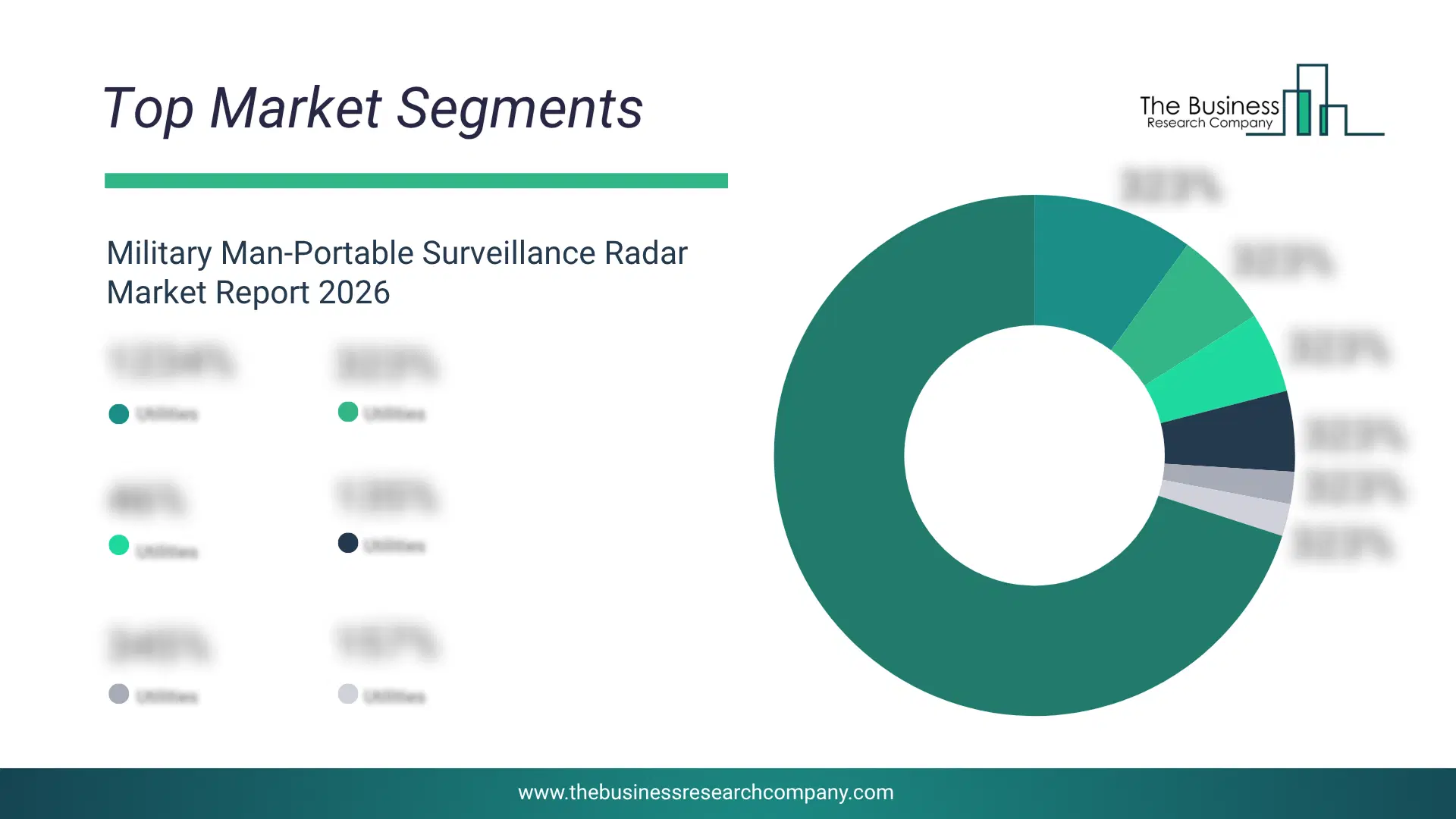
1) By Component: Antenna, Transmitter, Receiver, Other Components 2) By Frequency Band: L-Band, S-Band, C-Band, X-Band, Other Frequency Bands 3) By Technology: Frequency Modulated Continuous Wave (FMCW) Radar, Pulsed Radar, Phased Array Radar, Moving Target Indication (MTI) Radar 4) By Application: Border Surveillance, Battlefield Surveillance, Coastal Surveillance, Critical Infrastructure Protection, Other Applications 5) By End-User: Military, Law Enforcement Agencies, Government Security Organizations, Commercial Security Firms, Non-Governmental Organizations (NGOs) Subsegments: 1) By Antenna: Phased Array Antenna, Parabolic Antenna, Yagi-Uda Antenna, Horn Antenna, Microstrip Patch Antenna 2) By Transmitter: Solid-State Transmitter, Traveling Wave Tube (TWT) Transmitter, Magnetron Transmitter, Klystron Transmitter 3) By Receiver: Superheterodyne Receiver, Direct-Conversion Receiver, Digital Receiver, Coherent Receiver 4) By Other Components: Signal Processor, Power Supply Unit (PSU), Cooling System, Cables And Connectors, Display UnitWhat Is Driver Of The Military Man-Portable Surveillance Radar Market?
The increasing geopolitical tensions are expected to propel the growth of the military man-portable surveillance radar market going forward. Geopolitical tensions refer to political conflicts and diplomatic disputes between nations that create regional instability and heightened security concerns across international borders. Such tensions are driven by armed conflicts, border disputes, and strained relations between global and regional powers, prompting governments to strengthen defense preparedness and invest in technologies that enhance situational awareness. Man-portable surveillance radars are particularly valuable in this context, as they allow troops to detect and track the movements of personnel, vehicles, or drones in remote or contested areas, enabling early warning and rapid response. For instance, in July 2024, according to the Armed Conflict Location & Event Data Project (ACLED), a US-based non-profit organization, over 165,273 political violence events were recorded worldwide, marking a 15% increase from July 2023 to June 2024. Therefore, increasing geopolitical tensions are driving the growth of the military man-portable surveillance radar industry.Key Players In The Global Military Man-Portable Surveillance Radar Market
Major companies operating in the military man-portable surveillance radar market are Lockheed Martin Corporation, Northrop Grumman Corporation, BAE Systems plc, Thales Group, L3Harris Technologies Inc, Rheinmetall AG, Elbit Systems Ltd, Teledyne Technologies Incorporated, Israel Aerospace Industries Ltd, Indra Sistemas SA, Saab AB, ASELSAN AS, Leonardo SpA, Hensoldt AG, SRC Inc, Robin Radar Systems BV, Echodyne Corp, SpotterRF LLC, Blighter Surveillance Systems Ltd, China Electronics Technology Group Corporation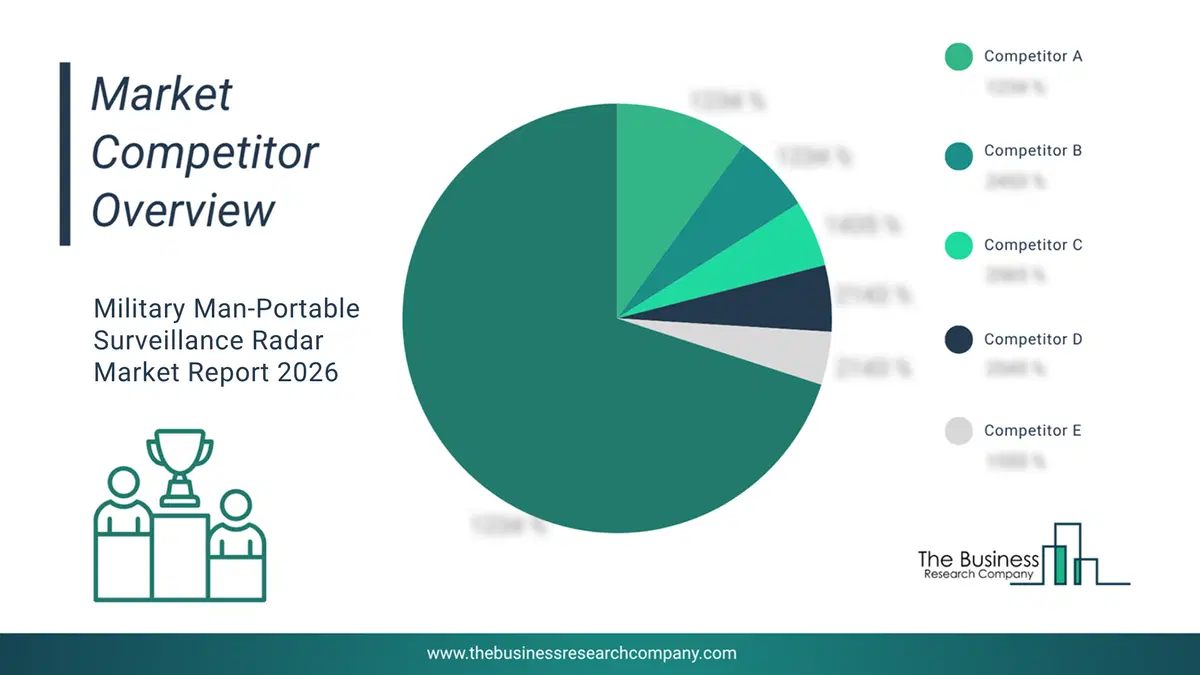
This chart is for illustrative purposes; the full report includes a detailed competitor analysis and comprehensive overview of the top 10 companies in the market.
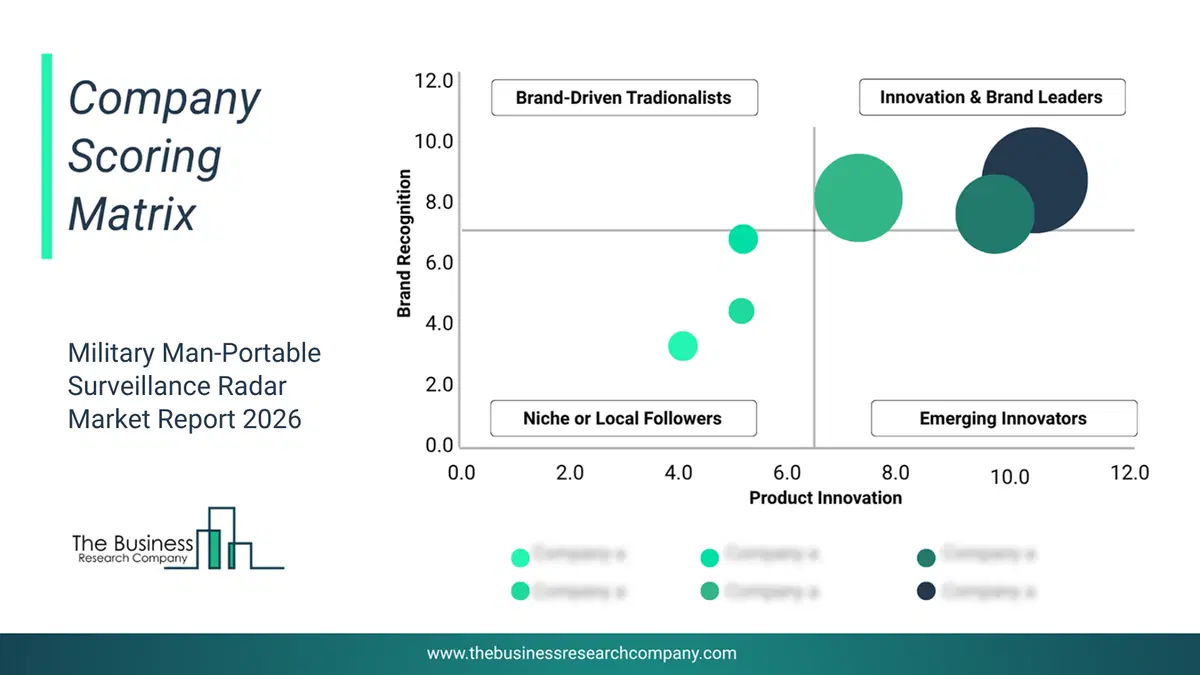
This chart maps companies by product innovation and brand strength, with bubble size indicating relative revenue, helping identify market leaders, challengers, and niche players. This is an illustrative chart; the full report provides a complete and accurate competitive analysis.
Global Military Man-Portable Surveillance Radar Market Trends and Insights
Major companies operating in the military man-portable surveillance radar market are focusing on developing innovative advancements such as miniature AI radar to enhance long-range detection and improve on-field situational awareness. A miniature AI radar is a compact radio sensing device that integrates artificial intelligence processing to provide real-time classification and tracking of objects with low power consumption. For instance, in April 2023, MatrixSpace, a Burlington, US-based radar and artificial intelligence sensing innovator, announced the MatrixSpace Radar. The radar offers kilometer-scale detection range, all-weather operation, ultra-low power consumption, and a phased-array architecture in a package weighing under one pound. Its integration of programmable waveforms, edge-based artificial intelligence processing, and four-dimensional tracking delivers a step-change in man-portable surveillance capability and significantly broadens potential deployment scenarios.What Are Latest Mergers And Acquisitions In The Military Man-Portable Surveillance Radar Market? Acquisition Strengthens Advanced Radar Capabilities And Expands Defense-Focused Technology Portfolio
In January 2025, Shee Atiká, a US-based provider of enterprise and cloud infrastructure services, cybersecurity solutions, and research and development across multiple technical domains, acquired Eikon Research for an undisclosed amount. With this acquisition, Shee Atiká aims to expand its advanced defense technology portfolio by scaling Eikon’s portable and adaptable radar innovations from research and development into full production to strengthen its position in defense-focused sensing and mission-support capabilities. Eikon Research is a US-based provider of cutting-edge radar systems, high-fidelity modeling and simulation tools, and modular mission-tailored user interfaces serving US Department of Defense requirements.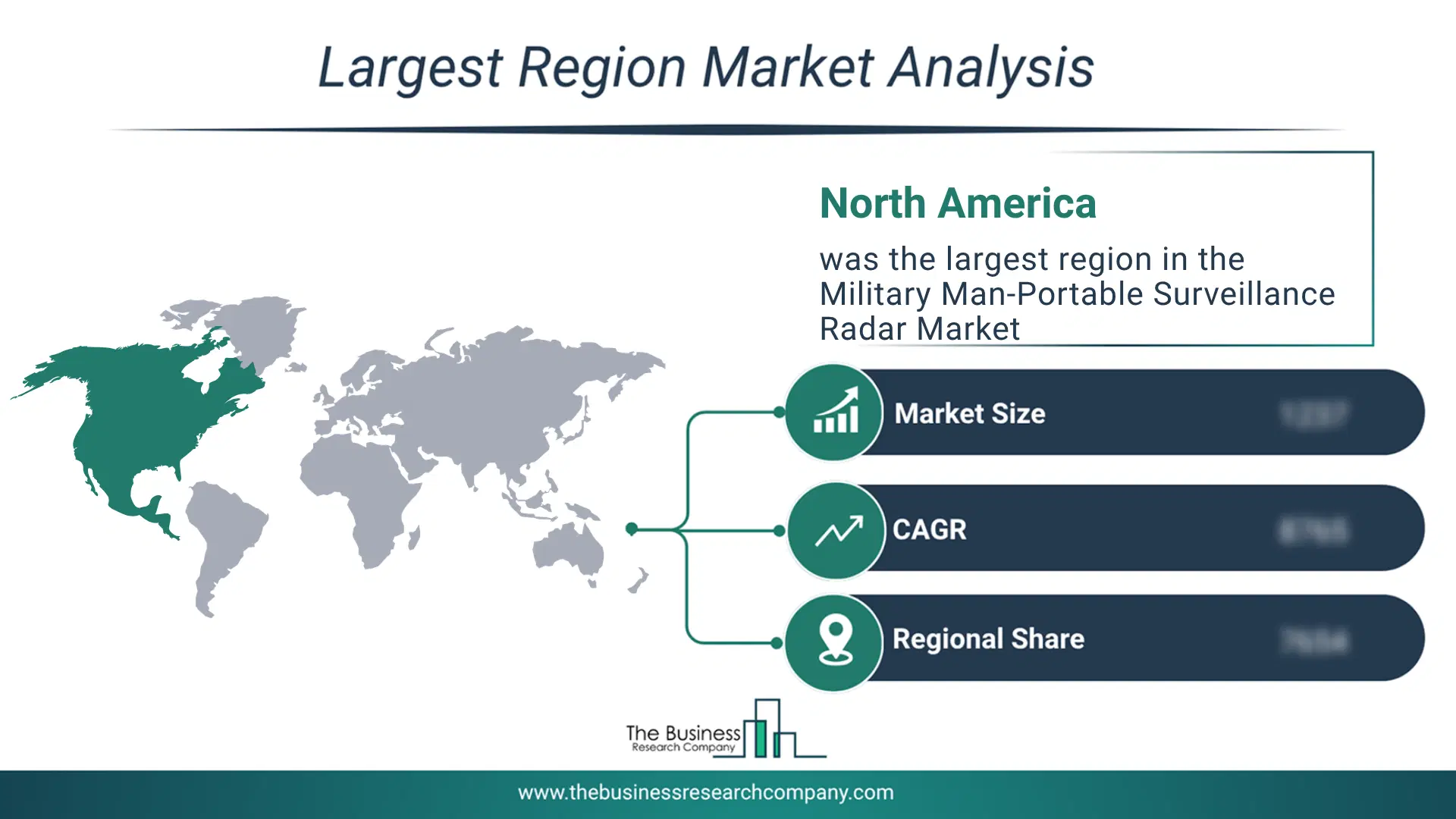
Regional Insights
North America was the largest region in the military man-portable surveillance radar market in 2025. Asia-Pacific is expected to be the fastest-growing region in the forecast period. The regions covered in the military man-portable surveillance radar market report are Asia-Pacific, South East Asia, Western Europe, Eastern Europe, North America, South America, Middle East, Africa. The countries covered in the military man-portable surveillance radar market report are Australia, Brazil, China, France, Germany, India, Indonesia, Japan, Taiwan, Russia, South Korea, UK, USA, Canada, Italy, SpainWhat Defines the Military Man-Portable Surveillance Radar Market?
The military man-portable surveillance radar market consists of sales of ground surveillance radars, battlefield surveillance radars, and border surveillance radars. Values in this market are ‘factory gate’ values, that is, the value of goods sold by the manufacturers or creators of the goods, whether to other entities (including downstream manufacturers, wholesalers, distributors, and retailers) or directly to end customers. The value of goods in this market includes related services sold by the creators of the goods.How is Market Value Defined and Measured?
The market value is defined as the revenues that enterprises gain from the sale of goods and/or services within the specified market and geography through sales, grants, or donations in terms of the currency (in USD unless otherwise specified). The revenues for a specified geography are consumption values that are revenues generated by organizations in the specified geography within the market, irrespective of where they are produced. It does not include revenues from resales along the supply chain, either further along the supply chain or as part of other products.
This chart presents market attractiveness based on a quantitative evaluation of growth, competition, strategic alignment, and risk, offering a clear view of opportunity areas for decision-making. This chart is for illustrative purposes; the full report contains the complete analysis.

This chart highlights the Total Addressable Market (TAM) by estimating the maximum revenue opportunity using an assumption-driven approach, supporting strategic planning and opportunity sizing across markets. The chart is illustrative; the full report provides a more comprehensive analysis.
What Key Data and Analysis Are Included in the Military Man-Portable Surveillance Radar Market Report 2026?
The military man-portable surveillance radar market research report is one of a series of new reports from The Business Research Company that provides market statistics, including industry global market size, regional shares, competitors with the market share, detailed market segments, market trends and opportunities, and any further data you may need to thrive in the military man-portable surveillance radar industry. The market research report delivers a complete perspective of everything you need, with an in-depth analysis of the current and future state of the industry.Military Man-Portable Surveillance Radar Market Report Forecast Analysis
| Report Attribute | Details |
|---|---|
| Market Size Value In 2026 | $1.93 billion |
| Revenue Forecast In 2030 | $2.68 billion |
| Growth Rate | CAGR of 8.5% from 2026 to 2030 |
| Base Year For Estimation | 2025 |
| Actual Estimates/Historical Data | 2020-2025 |
| Forecast Period | 2026 - 2030 |
| Market Representation | Revenue in USD Billion and CAGR from 2026 to 2030 |
| Segments Covered | Component, Frequency Band, Technology, Application, End-User |
| Regional Scope | Asia-Pacific, Western Europe, Eastern Europe, North America, South America, Middle East, Africa |
| Country Scope | The countries covered in the military man-portable surveillance radar market report are Australia, Brazil, China, France, Germany, India, Indonesia, Japan, Taiwan, Russia, South Korea, UK, USA, Canada, Italy, Spain |
| Key Companies Profiled | Lockheed Martin Corporation, Northrop Grumman Corporation, BAE Systems plc, Thales Group, L3Harris Technologies Inc, Rheinmetall AG, Elbit Systems Ltd, Teledyne Technologies Incorporated, Israel Aerospace Industries Ltd, Indra Sistemas SA, Saab AB, ASELSAN AŞ, Leonardo SpA, Hensoldt AG, SRC Inc, Robin Radar Systems BV, Echodyne Corp, SpotterRF LLC, Blighter Surveillance Systems Ltd, China Electronics Technology Group Corporation |
| Customization Scope | Request for Customization |
| Pricing And Purchase Options | Explore Purchase Options |