
Military Robotic and Autonomous System (RAS) Market Report 2026
Global Outlook – By Platform (Unmanned Aircraft Systems, Unmanned Ground And Robotic Systems, Unmanned Maritime Systems), By Operation (Remote Controlled, Semi-Autonomous, Fully Autonomous), By Application (Intelligence, Surveillance, And Reconnaissance (ISR), Combat Operation, Target Acquisition, Logistics, Mine Clearance, Explosive Ordnance Disposal (EOD), And Chemical, Biological, Radiological, And Nuclear (CBRN), Infantry Support, Other Applications) – Market Size, Trends, Strategies, and Forecast to 2030
Military Robotic and Autonomous System (RAS) Market Overview
• Military Robotic and Autonomous System (RAS) market size has reached to $19.25 billion in 2025 • Expected to grow to $20.79 billion in 2030 at a compound annual growth rate (CAGR) of 1.6% • Growth Driver: Rise in Defense Budget Fueling Growth in the Robotic and Autonomous Systems (RAS) Market • Market Trend: Advancements In Autonomous Engagement And Assessment Capabilities Strengthening Military RAS Operations • North America was the largest region in 2025.What Is Covered Under Military Robotic and Autonomous System (RAS) Market?
Military robotic and autonomous systems (RAS) refer to a broad category of technologies that involve the use of robotics and automation to perform tasks without direct human intervention. These systems are designed to operate independently or semi-independently, making decisions and executing actions based on pre-programmed instructions, artificial intelligence (AI), or sensor inputs. The main platforms of military robotic and autonomous systems (RAS) are unmanned aircraft systems, unmanned ground and robotic systems, and unmanned maritime systems. An unmanned aircraft system (UAS) is an aircraft and its associated equipment operated without a human pilot on board. The various operations include remote-controlled, semi-autonomous, and fully autonomous. They are used in various applications such as intelligence, surveillance, and reconnaissance (ISR), combat operation, target acquisition, logistics, mine clearance, explosive ordnance disposal (EOD), and chemical, biological, radiological, and nuclear (CBRN), infantry support, others.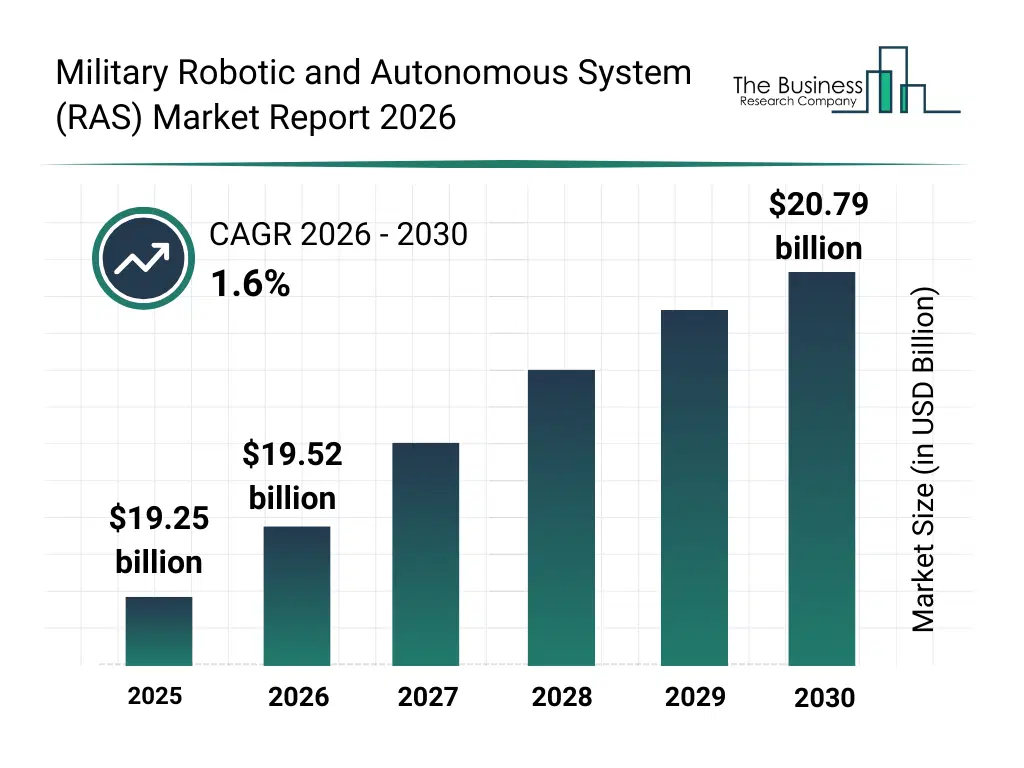
What Is The Military Robotic and Autonomous System (RAS) Market Size and Share 2026?
The military robotic and autonomous system (ras) market size has grown marginally in recent years. It will grow from $19.25 billion in 2025 to $19.52 billion in 2026 at a compound annual growth rate (CAGR) of 1.4%. The growth in the historic period can be attributed to increasing demand for unmanned vehicles in military operations, advancements in ai and sensor technologies for autonomous decision-making, rising investments in surveillance, reconnaissance, and combat robotics, growing adoption of teleoperated robotic systems for explosive ordnance disposal, government defense budgets driving r&d in military robotics and automation.What Is The Military Robotic and Autonomous System (RAS) Market Growth Forecast?
The military robotic and autonomous system (ras) market size is expected to see marginal growth in the next few years. It will grow to $20.79 billion in 2030 at a compound annual growth rate (CAGR) of 1.6%. The growth in the forecast period can be attributed to expanding use of autonomous systems in logistics and maintenance operations, integration of AI-driven target recognition and threat assessment, development of swarm robotics for coordinated military missions, rising adoption of lidar, radar, and advanced sensing devices in autonomous platforms, increasing focus on personnel management and operational efficiency through robotic systems. Major trends in the forecast period include rising demand for multi-role unmanned systems integrating isr and combat functions, increasing deployment of autonomous ground robots for logistics and support tasks, advancements in sensor fusion integrating lidar, radar, and visual systems, growth in maritime autonomous platforms for underwater reconnaissance, adoption of robotic eod systems for high-risk mine clearance and cbrn operations.
Global Military Robotic and Autonomous System (RAS) Market Segmentation
1) By Platform: Unmanned Aircraft Systems, Unmanned Ground And Robotic Systems, Unmanned Maritime Systems 2) By Operation: Remote Controlled, Semi-Autonomous, Fully Autonomous 3) By Application: Intelligence, Surveillance, And Reconnaissance (ISR), Combat Operation, Target Acquisition, Logistics, Mine Clearance, Explosive Ordnance Disposal (EOD), And Chemical, Biological, Radiological, And Nuclear (CBRN), Infantry Support, Other Applications Subsegments: 1) By Unmanned Aircraft Systems (UAS): Fixed-Wing Drones, Rotary-Wing Drones (Helicopters), Hybrid Systems, Surveillance And Reconnaissance Drones 2) By Unmanned Ground And Robotic Systems: Robotic Vehicles (UGVs), Bomb Disposal Robots, Tactical Ground Robots, Supply And Logistics Robots 3) By Unmanned Maritime Systems (UMS): Unmanned Surface Vehicles (USVs), Unmanned Underwater Vehicles (UUVs), Autonomous Naval Systems, Maritime Surveillance DronesWhat Is Driver Of The Military Robotic and Autonomous System (RAS) Market?
The rise in the defense budget is expected to propel the growth of the military robotic and autonomous systems (RAS) market going forward. A defense budget refers to the financial plan and resources allocated to a country's military forces for various purposes, such as research, development, acquisition, and sustainment of military equipment, technologies, and capabilities. The defense budget includes funding for the development, integration, and procurement of RAS technologies to enhance military capabilities and improve operational efficiency. For instance, in April 2024, according to the UK Defence in Numbers 2023 report published by the Ministry of Defence, a UK-based government ministry, in both 2022 and 2023, we allocated £2.3 billion in military support, with an increase to £2.5 billion planned for the following year, while defense spending rose from £52.8 billion in 2022/23 to £54.2 billion in 2023/24. Therefore, the defense budget is driving the growth of the military robotic and autonomous systems (RAS) market.Key Players In The Global Military Robotic and Autonomous System (RAS) Market
Major companies operating in the military robotic and autonomous system (ras) market are RTX Corporation, The Boeing Company, Lockheed Martin Corporation, Hanwha Group, General Dynamics Corporation, Northrop Grumman Corporation, BAE Systems plc, SZ DJI Technology Co. Ltd., Thales Group, L3Harris Technologies Inc., Leonardo SpA, Elbit Systems Ltd., Teledyne Technologies Inc., Israel Aerospace Industries Ltd., Saab AB, General Atomics, Cobham Ltd., QinetiQ Group PLC, iRobot Corporation, Kratos Defense & Security Solutions Inc., AeroVironment Inc., Exail Technologies- Groupe Gorge, Anduril Industries Inc., Parrot Drone SAS, Skydio Inc., Boston Dynamics, Milrem Robotics, Auterion AG, AutoNaut Ltd., Saildrone Inc.
This chart is for illustrative purposes; the full report includes a detailed competitor analysis and comprehensive overview of the top 10 companies in the market.
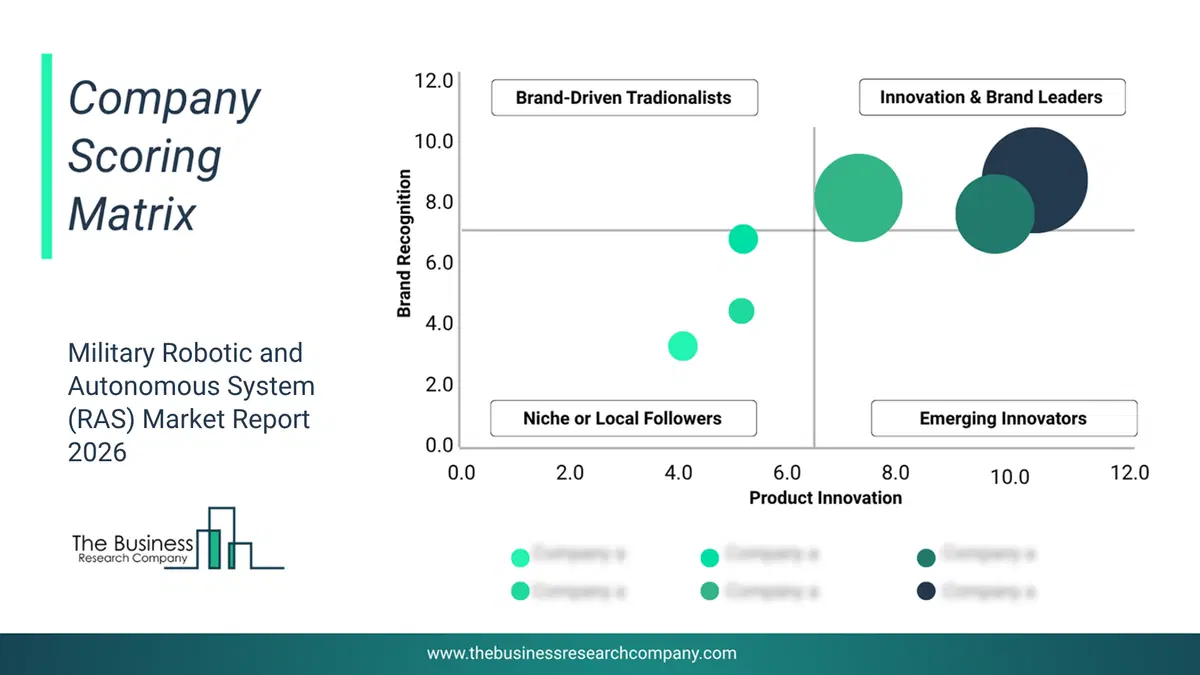
This chart maps companies by product innovation and brand strength, with bubble size indicating relative revenue, helping identify market leaders, challengers, and niche players. This is an illustrative chart; the full report provides a complete and accurate competitive analysis.
Global Military Robotic and Autonomous System (RAS) Market Trends and Insights
Major companies in the military robotic and autonomous systems (RAS) market are focusing on developing innovative solutions such as autonomous manned-unmanned teaming to enhance mission efficiency, situational awareness, and operational effectiveness in complex combat environments. Autonomous manned-unmanned teaming refers to the coordinated operation of human-controlled and autonomous robotic systems that work together to share data, execute missions, and enhance overall battlefield effectiveness. For instance, in October 2024, RTX Corp., a US-based aerospace and defense company, launched effects autonomy capabilities during the U.S. Army's Experimental Demonstration Gateway Event (EDGE). The demonstration featured collaborative solutions from its Collins Aerospace and Raytheon businesses: Collins' RapidEdge mission system acted as the brains for a team of UAVs, while Raytheon deployed autonomy based on its combat-proven Coyote unmanned aircraft system. The systems successfully shared data via a mesh network to find, fix, and track threats and notably continued their mission autonomously even when command links to human operators were severed.What Are Latest Mergers And Acquisitions In The Military Robotic and Autonomous System (RAS) Market? Defense Companies Acquire Stake To Advance Autonomous Robotic Solutions And Innovation
In July 2024, LIG Nex1, a South Korea-based military and defense weapon systems company, acquired a 60% control stake in Ghost Robotics for $0.240 billion. This acquisition aims to combine expertise and resources to advance autonomous robotic solutions, accelerating growth and innovation in both defense and industrial markets. Ghost Robotics is a US-based company that develops autonomous robots for a variety of applications, including defense, homeland, and enterprise.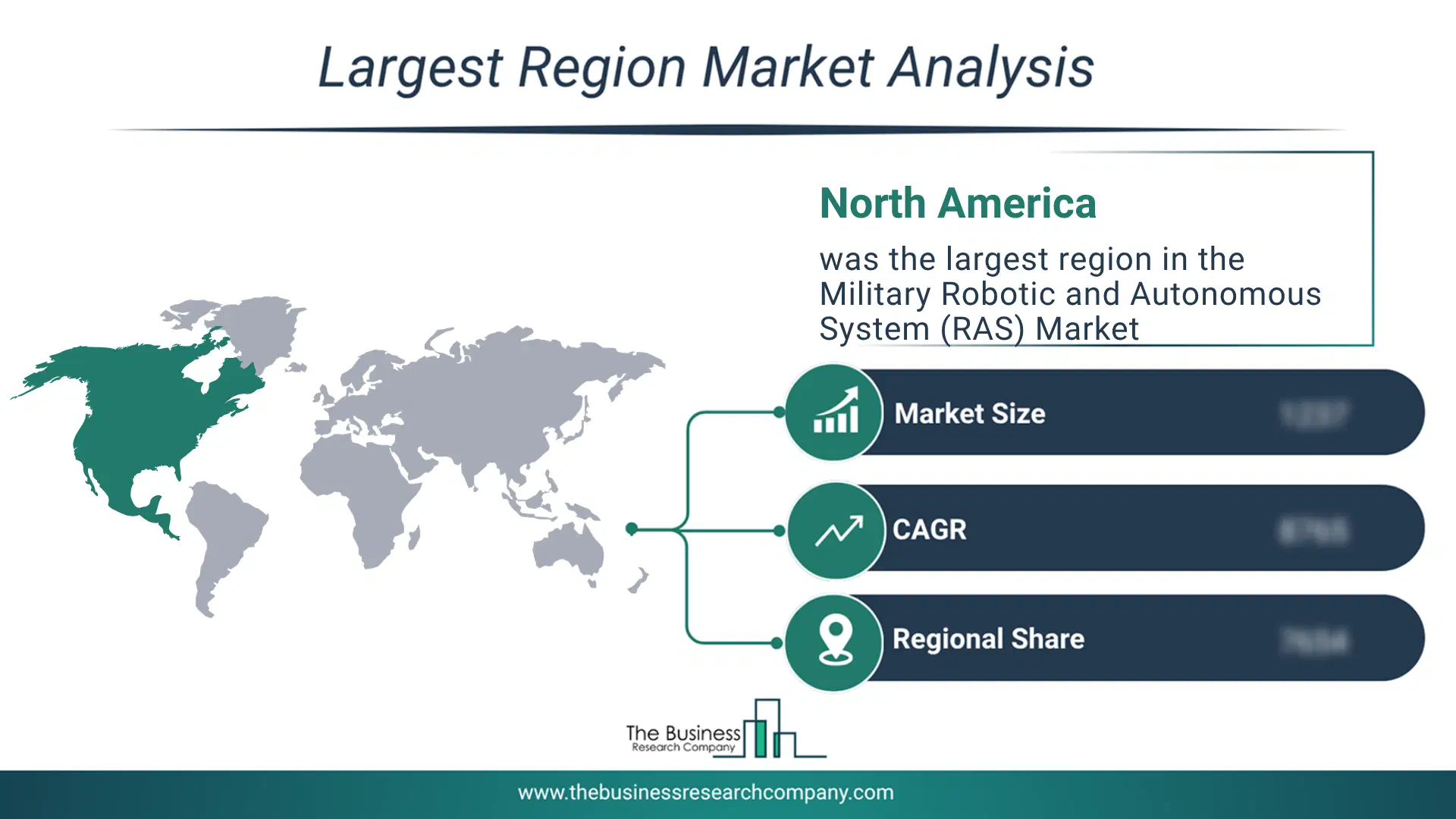
Regional Insights
North America was the largest region in the military robotic and autonomous system market in 2025. The regions covered in this market report are Asia-Pacific, South East Asia, Western Europe, Eastern Europe, North America, South America, Middle East, Africa. The countries covered in this market report are Australia, Brazil, China, France, Germany, India, Indonesia, Japan, Taiwan, Russia, South Korea, UK, USA, Canada, Italy, SpainWhat Defines the Military Robotic and Autonomous System (RAS) Market?
The military robotic and autonomous system (RAS) market consists of revenues earned by entities by providing intelligence, surveillance, and reconnaissance (ISR), combat operations, logistics and maintenance, mine clearance, explosive ordnance disposal (EOD), personnel management, unmanned vehicles, teleoperated robotic systems. The market value includes the value of related goods sold by the service provider or included within the service offering. The military robotic and autonomous system (RAS) market also consists of sales of cameras, lidar, radar, and other sensing devices. Values in this market are ‘factory gate’ values, that is the value of goods sold by the manufacturers or creators of the goods, whether to other entities (including downstream manufacturers, wholesalers, distributors, and retailers) or directly to end customers. The value of goods in this market includes related services sold by the creators of the goods.How is Market Value Defined and Measured?
The market value is defined as the revenues that enterprises gain from the sale of goods and/or services within the specified market and geography through sales, grants, or donations in terms of the currency (in USD unless otherwise specified). The revenues for a specified geography are consumption values that are revenues generated by organizations in the specified geography within the market, irrespective of where they are produced. It does not include revenues from resales along the supply chain, either further along the supply chain or as part of other products.
This chart presents market attractiveness based on a quantitative evaluation of growth, competition, strategic alignment, and risk, offering a clear view of opportunity areas for decision-making. This chart is for illustrative purposes; the full report contains the complete analysis.

This chart highlights the Total Addressable Market (TAM) by estimating the maximum revenue opportunity using an assumption-driven approach, supporting strategic planning and opportunity sizing across markets. The chart is illustrative; the full report provides a more comprehensive analysis.
What Key Data and Analysis Are Included in the Military Robotic and Autonomous System (RAS) Market Report 2026?
The military robotic and autonomous system (ras) market research report is one of a series of new reports from The Business Research Company that provides market statistics, including industry global market size, regional shares, competitors with the market share, detailed market segments, market trends and opportunities, and any further data you may need to thrive in the military robotic and autonomous system (ras) industry. The market research report delivers a complete perspective of everything you need, with an in-depth analysis of the current and future state of the industry.Military Robotic and Autonomous System (RAS) Market Report Forecast Analysis
| Report Attribute | Details |
|---|---|
| Market Size Value In 2026 | $19.52 billion |
| Revenue Forecast In 2030 | $20.79 billion |
| Growth Rate | CAGR of 1.6% from 2026 to 2030 |
| Base Year For Estimation | 2025 |
| Actual Estimates/Historical Data | 2020-2025 |
| Forecast Period | 2026 - 2030 |
| Market Representation | Revenue in USD Billion and CAGR from 2026 to 2030 |
| Segments Covered | Platform, Operation, Application |
| Regional Scope | Asia-Pacific, Western Europe, Eastern Europe, North America, South America, Middle East, Africa |
| Country Scope | The countries covered in the military robotic and autonomous system (ras) market report are Australia, Brazil, China, France, Germany, India, Indonesia, Japan, Taiwan, Russia, South Korea, UK, USA, Canada, Italy, Spain |
| Key Companies Profiled | RTX Corporation, The Boeing Company, Lockheed Martin Corporation, Hanwha Group, General Dynamics Corporation, Northrop Grumman Corporation, BAE Systems plc, SZ DJI Technology Co. Ltd., Thales Group, L3Harris Technologies Inc., Leonardo SpA, Elbit Systems Ltd., Teledyne Technologies Inc., Israel Aerospace Industries Ltd., Saab AB, General Atomics, Cobham Ltd., QinetiQ Group PLC, iRobot Corporation, Kratos Defense & Security Solutions Inc., AeroVironment Inc., Exail Technologies- Groupe Gorge, Anduril Industries Inc., Parrot Drone SAS, Skydio Inc., Boston Dynamics, Milrem Robotics, Auterion AG, AutoNaut Ltd., Saildrone Inc. |
| Customization Scope | Request for Customization |
| Pricing And Purchase Options | Explore Purchase Options |