
Military Satellite Communications Market Report 2026
Global Outlook – By Component (Transponders, Antennas, Modems, Receivers, Transmitters, Other Components), By Frequency Band (Ultra High Frequency, Super High Frequency, Extremely High Frequency, X Band, K A Band, Other Frequency Bands), By Platform (Airborne, Ground, Naval, Space), By Application (Navigation, Intelligence, Surveillance And Reconnaissance, Communication, Other Applications), By End User (Defense, Homeland Security, Other End Users) – Market Size, Trends, Strategies, and Forecast to 2030
Military Satellite Communications Market Overview
• Military Satellite Communications market size has reached to $20.51 billion in 2025 • Expected to grow to $29.58 billion in 2030 at a compound annual growth rate (CAGR) of 7.6% • Growth Driver: Surge In Defense Budgets Fueling The Growth Of The Market Due To Rising Demand For Long-Distance Military Connectivity • Market Trend: Advancements In High-Throughput Satellite Technologies Enhancing Secure And Flexible Connectivity • North America was the largest region in 2025 and Asia-Pacific is the fastest growing region.What Is Covered Under Military Satellite Communications Market?
Military satellite communications refers to advanced communication systems that utilize satellites to provide secure, reliable, and long-range connectivity for defense and military operations. these systems integrate satellites, ground stations, communication terminals, and encryption technologies to enable real-time data transmission, voice communication, navigation, surveillance, and command and control functions across air, land, sea, and space domains. this technology enhances operational efficiency, situational awareness, and secure information exchange in critical military missions. The main components of military satellite communications include transponders, antennas, modems, receivers, transmitters, and other components. Transponders refer to satellite communication devices that receive, amplify, and retransmit signals between ground stations and airborne platforms to ensure secure data transfer. These systems operate across frequency bands such as ultra high frequency, super high frequency, extremely high frequency, X band, K A band, and other frequency bands and are deployed across platforms including airborne, ground, naval, and space. The key applications of navigation, intelligence, surveillance and reconnaissance, communication, and others, while the end-use includes defense, homeland security, and others.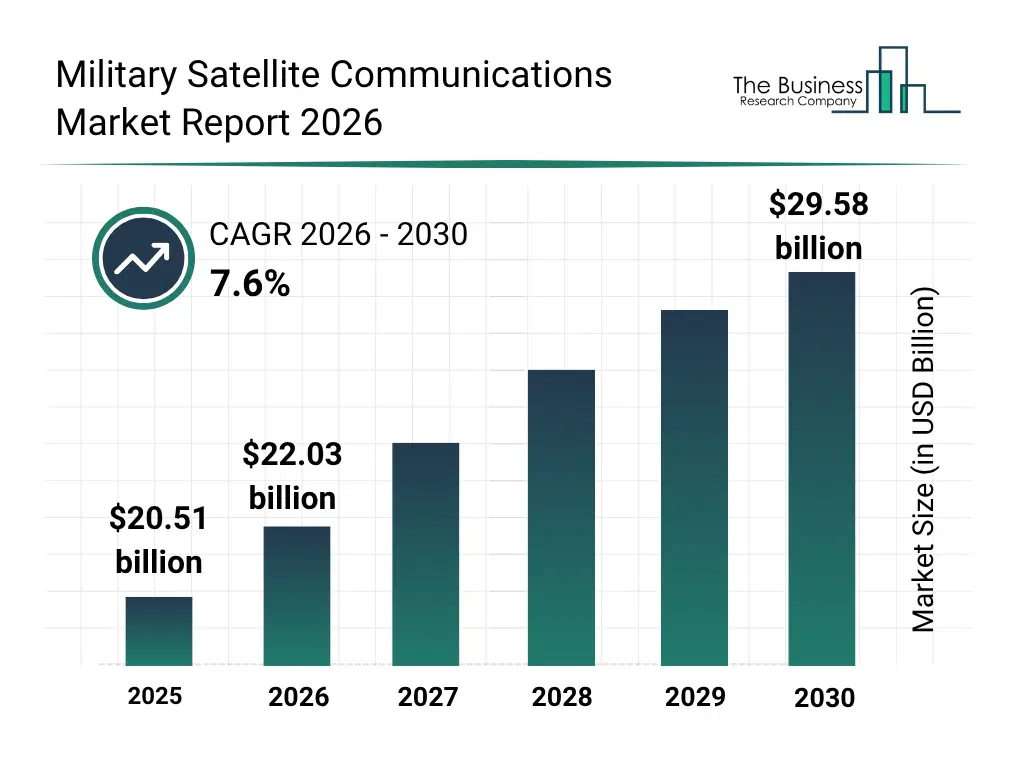
What Is The Military Satellite Communications Market Size and Share 2026?
The military satellite communications market size has grown strongly in recent years. It will grow from $20.51 billion in 2025 to $22.03 billion in 2026 at a compound annual growth rate (CAGR) of 7.4%. The growth in the historic period can be attributed to growth in defense communication modernization programs, increasing demand for global battlefield connectivity, expansion of military satellite deployment programs, rising need for secure command and control systems, development of encrypted tactical communication systems.What Is The Military Satellite Communications Market Growth Forecast?
The military satellite communications market size is expected to see strong growth in the next few years. It will grow to $29.58 billion in 2030 at a compound annual growth rate (CAGR) of 7.6%. The growth in the forecast period can be attributed to expansion of low earth orbit military satellite networks, increasing adoption of ai enabled communication optimization, rising demand for resilient multi domain connectivity, growth in space based defense infrastructure investment, advancement in quantum resistant encryption technologies. Major trends in the forecast period include secure multi domain satellite connectivity networks, ai driven adaptive bandwidth management systems, interoperable tactical satellite communication networks, low earth orbit military satellite constellation expansion, jam resistant encrypted communication protocols.
Global Military Satellite Communications Market Segmentation
1) By Component: Transponders, Antennas, Modems, Receivers, Transmitters, Other Components 2) By Frequency Band: Ultra High Frequency, Super High Frequency, Extremely High Frequency, X Band, K A Band, Other Frequency Bands 3) By Platform: Airborne, Ground, Naval, Space 4) By Application: Navigation, Intelligence, Surveillance And Reconnaissance, Communication, Other Applications 5) By End User: Defense, Homeland Security, Other End Users Subsegments: 1) By Transponders: Bent Pipe Transponder, Regenerative Transponder, Digital Transponder, High Throughput Transponder 2) By Antennas: Parabolic Antenna, Phased Array Antenna, Flat Panel Antenna, Deployable Antenna 3) By Modems: Satellite Communication Modem, Broadband Modem, Secure Communication Modem, Tactical Communication Modem 4) By Receivers: Radio Frequency Receiver, Digital Signal Receiver, Multi Band Receiver, Software Defined Receiver 5) By Transmitters: High Power Transmitter, Solid State Transmitter, Portable Transmitter, Secure Communication Transmitter 6) By Other Components: Power Supply Unit, Signal Processor, Control Unit, Encryption ModuleWhat Is The Driver Of The Military Satellite Communications Market?
The increasing defense budgets across countries are expected to propel the growth of the military satellite communications market going forward. Defense budgets refer to the financial resources allocated by governments for military and security-related expenditures, including communication infrastructure, surveillance, and advanced technologies. The rise in defense spending is driven by escalating geopolitical tensions, the need for secure communication systems, and modernization of defense capabilities. Higher defense budgets support military satellite communication by enabling governments to invest in advanced secure SATCOM infrastructure, including encrypted communication satellites, mobile ground terminals, anti-jamming technologies, and resilient network systems that enhance real-time battlefield coordination, intelligence sharing, and long-range defense operations. For instance, in April 2024, according to the Stockholm International Peace Research Institute, a Sweden-based institute, global military expenditure reached $2.44 trillion in 2023, increasing by 6.8% compared to 2022. Therefore, the increasing defense budgets across countries are driving the growth of the military satellite communications industry.Key Players In The Global Military Satellite Communications Market
Major companies operating in the military satellite communications market are Lockheed Martin Corporation, RTX Corporation, Northrop Grumman Corporation, Boeing Defense Space & Security, General Dynamics Corporation, BAE Systems plc, Airbus Defence and Space, Thales Group, L3Harris Technologies Inc., Honeywell International Inc., Leonardo S.p.A., SpaceX Corp., SES S.A., Viasat Inc., Eutelsat OneWeb, Israel Aerospace Industries (IAI), Elbit Systems Ltd., Kratos Defense & Security Solutions Inc., Cobham Satcom, Intellian Technologies Inc., Gilat Satellite Networks, ThinKom Solutions Inc., Kymeta Corporation, GomSpace Group AB, WORK Microwave GmbH, Satcube AB, C-COM Satellite Systems Inc.Global Military Satellite Communications Market Trends and Insights
Major companies operating in the military satellite communications market are focusing on technological advancement in high-throughput satellites, such as software-defined payload architectures, to increase bandwidth efficiency, enable flexible frequency allocation, and support high-speed secure data transmission. Software-defined payload architectures refer to advanced satellite communication systems that dynamically allocate bandwidth, frequency, and power across multiple beams using digital signal processing and reconfigurable transponders, allowing real-time adaptation to mission requirements and operational environments. For instance, in 2023, Boeing, a US-based aerospace and defense company, unveiled its Protected Wideband Satellite (PWS) design integrated with the Protected Tactical SATCOM Prototype (PTS-P) payload hosted on the WGS-11 military satellite, which features automated anti-jam capabilities, including real-time adaptive nulling and frequency hopping. It supports software-driven beamforming using the 702X digital satellite architecture and enables secure, high-capacity communication in contested battlefield environments.What Are Latest Mergers And Acquisitions In The Military Satellite Communications Market?
In May 2023, Viasat Inc., a US-based provider of satellite and wireless communication systems, acquired Inmarsat for $7.3 billion. With this acquisition, Viasat aims to expand its global satellite communications capabilities, including secure and resilient connectivity solutions for military, government, aviation, and maritime applications. Inmarsat is a UK-based provider of global mobile satellite communications services, widely used for defense and government communications.Regional Outlook
North America was the largest region in the military satellite communications market in 2025. Asia-Pacific is expected to be the fastest-growing region in the forecast period. The regions covered in this market report are Australia, Brazil, China, France, Germany, India, Indonesia, Japan, Taiwan, Russia, South Korea, UK, USA, Canada, Italy, Spain. The countries covered in this market report are Australia, Brazil, China, France, Germany, India, Indonesia, Japan, Taiwan, Russia, South Korea, UK, USA, Canada, Italy, Spain.What Defines the Military Satellite Communications Market?
The military satellite communications market consists of revenues earned by entities by providing services such as secure beyond-line-of-sight communication, real-time battlefield surveillance data transmission, encrypted navigation and positioning support, disaster response and emergency communication services. The market value includes the value of related goods sold by the service provider or included within the service offering. The military satellite communications also includes sales of satcom terminals, satellite modems, and airborne satcom antennas. Values in this market are ‘factory gate’ values, that is the value of goods sold by the manufacturers or creators of the goods, whether to other entities (including downstream manufacturers, wholesalers, distributors and retailers) or directly to end customers. The value of goods in this market includes related services sold by the creators of the goods.How is Market Value Defined and Measured?
The market value is defined as the revenues that enterprises gain from the sale of goods and/or services within the specified market and geography through sales, grants, or donations in terms of the currency (in USD unless otherwise specified). The revenues for a specified geography are consumption values that are revenues generated by organizations in the specified geography within the market, irrespective of where they are produced. It does not include revenues from resales along the supply chain, either further along the supply chain or as part of other products.What Key Data and Analysis Are Included in the Military Satellite Communications Market Report 2026?
The military satellite communications market research report is one of a series of new reports from The Business Research Company that provides military satellite communications market statistics, including military satellite communications industry global market size, regional shares, competitors with a military satellite communications market share, detailed military satellite communications market segments, market trends and opportunities, and any further data you may need to thrive in the military satellite communications industry. This military satellite communications market research report delivers a complete perspective of everything you need, with an in-depth analysis of the current and future scenario of the industry.Military Satellite Communications Market Report Forecast Analysis
| Report Attribute | Details |
|---|---|
| Market Size Value In 2026 | $22.03 billion |
| Revenue Forecast In 2030 | $29.58 billion |
| Growth Rate | CAGR of 7.6% from 2026 to 2030 |
| Base Year For Estimation | 2025 |
| Actual Estimates/Historical Data | 2020-2025 |
| Forecast Period | 2026 - 2030 |
| Market Representation | Revenue in USD Billion and CAGR from 2026 to 2030 |
| Segments Covered | Component, Frequency Band, Platform, Application, End User |
| Regional Scope | Asia-Pacific, Western Europe, Eastern Europe, North America, South America, Middle East, Africa |
| Country Scope | The countries covered in the military satellite communications market report are Australia, Brazil, China, France, Germany, India, Indonesia, Japan, Taiwan, Russia, South Korea, UK, USA, Canada, Italy, Spain. |
| Key Companies Profiled | Lockheed Martin Corporation, RTX Corporation, Northrop Grumman Corporation, Boeing Defense Space & Security, General Dynamics Corporation, BAE Systems plc, Airbus Defence and Space, Thales Group, L3Harris Technologies Inc., Honeywell International Inc., Leonardo S.p.A., SpaceX Corp., SES S.A., Viasat Inc., Eutelsat OneWeb, Israel Aerospace Industries (IAI), Elbit Systems Ltd., Kratos Defense & Security Solutions Inc., Cobham Satcom, Intellian Technologies Inc., Gilat Satellite Networks, ThinKom Solutions Inc., Kymeta Corporation, GomSpace Group AB, WORK Microwave GmbH, Satcube AB, C-COM Satellite Systems Inc. |
| Customization Scope | Request for Customization |
| Pricing And Purchase Options | Explore Purchase Options |