
Military Semiconductor Market Report 2026
Global Outlook – By Component ( Memory, Processor, Analog Integrated Circuit (IC), Logic Integrated Circuit (IC), Discrete Power Devices, Sensors, Other Components), By Platform ( Airborne, Naval, Land, Space), By Technology ( Gallium Nitride (GaN), Gallium Arsenide (GaAs), Silicon Carbide (Sic), Silicon), By Application ( Radar Systems, Communication Systems, Electronic Warfare, Navigation Systems, Power Management, Other Applications) – Market Size, Trends, Strategies, and Forecast to 2030
Military Semiconductor Market Overview
• Military Semiconductor market size has reached to $6.81 billion in 2025 • Expected to grow to $9.61 billion in 2030 at a compound annual growth rate (CAGR) of 7.2% • Growth Driver: Increasing Geopolitical Tensions Is Fueling The Market Growth Due To Territorial Dispute Escalations • Market Trend: Innovations In Military-Grade Semiconductor Protection Enhancing Reliability And System Performance • North America was the largest region in 2025 and Asia-Pacific is the fastest growing region.What Is Covered Under Military Semiconductor Market?
Military semiconductors refer to specialized electronic components designed for use in defense and aerospace systems, capable of operating reliably under extreme environmental conditions such as high temperature, radiation, vibration, and shock. These components are engineered to meet stringent military standards for performance, durability, and security, enabling critical functions such as communication, navigation, surveillance, and weapon system control. The main components of military semiconductor include memory, processor, analog integrated circuit (IC), logic integrated circuit (IC), discrete power devices, sensors, and other components. Memory refers to high-reliability semiconductor devices used for secure data storage and fast access in mission-critical military systems operating under extreme conditions. They are deployed across platforms including airborne, naval, land, and space. They are developed using technologies such as gallium nitride (GaN), gallium arsenide (GaAs), silicon carbide (SiC), and silicon and the various applications involved are radar systems, communication systems, electronic warfare, navigation systems, power management, and others.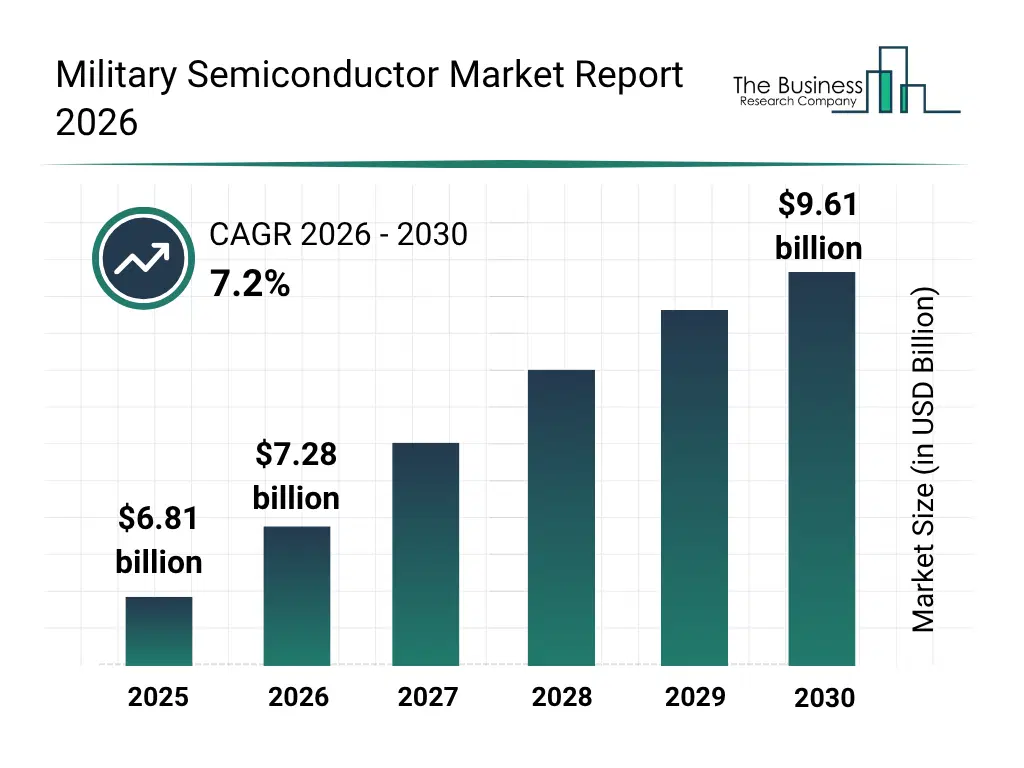
What Is The Military Semiconductor Market Size and Share 2026?
The military semiconductor market size has grown strongly in recent years. It will grow from $6.81 billion in 2025 to $7.28 billion in 2026 at a compound annual growth rate (CAGR) of 6.9%. The growth in the historic period can be attributed to rising demand for secure military communication systems, increasing use of conventional silicon-based defense electronics, early development of ruggedized aerospace-grade components, growth in radar and navigation system deployment, expansion of defense modernization programs across major economies.What Is The Military Semiconductor Market Growth Forecast?
The military semiconductor market size is expected to see strong growth in the next few years. It will grow to $9.61 billion in 2030 at a compound annual growth rate (CAGR) of 7.2%. The growth in the forecast period can be attributed to rising adoption of Ai-enabled defense semiconductor architectures, increasing demand for space-grade radiation hardened chips, growth in autonomous weapon and surveillance systems, expansion of hypersonic and advanced missile programs, integration of edge computing in battlefield electronics systems. Major trends in the forecast period include radiation-hardened semiconductor development for space and defense-grade mission critical systems, increasing adoption of gallium nitride and silicon carbide based high-performance military electronics for power efficiency and thermal stability, growing integration of Ai-enabled edge processing chips for real-time battlefield decision making, rising demand for miniaturized high-reliability chips for compact defense platforms and unmanned systems, expansion of secure and anti-tamper semiconductor architectures for defense communication and encryption systems.

Global Military Semiconductor Market Segmentation
2) By Platform: Airborne, Naval, Land, Space 3) By Technology: Gallium Nitride (GaN), Gallium Arsenide (GaAs), Silicon Carbide (Sic), Silicon 4) By Application: Radar Systems, Communication Systems, Electronic Warfare, Navigation Systems, Power Management, Other Applications Subsegments: 1) By Memory: Dynamic Random Access Memory, Static Random Access Memory, Flash Memory, Non Volatile Memory 2) By Processor: Microprocessors, Microcontrollers, Digital Signal Processors, Application Specific Processors 3) By Analog Integrated Circuit (IC): Operational Amplifiers, Power Management Integrated Circuits, Data Converters, Radio Frequency Integrated Circuits 4) By Logic Integrated Circuit (IC): Standard Logic Integrated Circuits, Programmable Logic Devices, Field Programmable Gate Arrays, Application Specific Integrated Circuits 5) By Discrete Power Devices: Power Diodes, Power Transistors, Thyristors, Insulated Gate Bipolar Transistors 6) By Sensors: Pressure Sensors, Temperature Sensors, Motion Sensors, Image Sensors 7) By Other Components: Optoelectronic Devices, Timing Devices, Interface Components, Mixed Signal ComponentsWhat Is The Driver Of The Military Semiconductor Market?
The growing geopolitical tensions and conflicts is expected to propel the growth of the military semiconductor market going forward. Geopolitical tensions and conflicts” refer to situations where countries or regions experience political disagreements, rivalry, or hostility that may lead to disputes, military standoffs, or armed clashes. The geopolitical tensions are rising due to territorial disputes, leading to increased military presence and strained diplomatic relations among the involved countries, while also fueling economic sanctions, disrupting trade routes, and heightening concerns over regional stability and security. Military semiconductor technologies enhance capabilities during geopolitical tensions and conflicts by enabling advanced defense systems, secure communications, precision-guided weapons, and real-time data processing that improve situational awareness and operational effectiveness. For instance, in July 2024, according to the Armed Conflict Location and Event Data, a US-based non-profit organization, between July 2023 and June 2024, over 165,273 incidents of political violence were reported worldwide, representing a 15% increase from the previous year. During this time, it is estimated that approximately one in seven people around the world were affected by conflict. Therefore, the increasing geopolitical tensions is driving the growth of the military semiconductor industry.Key Players In The Global Military Semiconductor Market
Major companies operating in the military semiconductor market are Intel Corporation, RTX Corporation, Broadcom Inc., Honeywell International Inc., AMD Advanced Micro Devices Inc., Texas Instruments Inc., Northrop Grumman Corporation, Infineon Technologies AG, Analog Devices Inc., STMicroelectronics N.V., NXP Semiconductors N.V., BAE Systems Plc, Renesas Electronics Corporation, ON Semiconductor Corporation, Marvell Technology Inc., Microchip Technology Inc., Skyworks Solutions Inc., Qorvo Inc., Teledyne Technologies Incorporated, MACOM Technology Solutions, Vishay Intertechnology Inc., Mercury Systems Inc., Frontgrade Technologies, Lattice Semiconductor Corporation.
This chart is for illustrative purposes; the full report includes a detailed competitor analysis and comprehensive overview of the top 10 companies in the market.

This chart maps companies by product innovation and brand strength, with bubble size indicating relative revenue, helping identify market leaders, challengers, and niche players. This is an illustrative chart; the full report provides a complete and accurate competitive analysis.
Global Military Semiconductor Market Trends and Insights
Major companies operating in the military semiconductor market are focusing on developing innovative component, such as military-qualified plastic transient voltage suppressors (TVS) to enhance circuit protection, improve reliability, and reduce weight and cost in aerospace and defense electronics. Military-qualified plastic TVS devices are semiconductor components designed to protect sensitive electronic circuits from voltage spikes and transient surges by rapidly clamping excess voltage, offering robust performance under extreme environmental and operational conditions compared to conventional commercial-grade protection devices. For instance, in January 2026, Microchip Technology Incorporated, a US-based semiconductor company, launched the JANPTX family of plastic transient voltage suppressors designed for aerospace and defense applications. These devices are the first to achieve MIL-PRF-19500 qualification in a plastic package and offer a high peak pulse power rating of 1.5kW, ensuring reliable protection against electrical transients. The product line supports a wide voltage range from 5V to 175V and includes multiple variants tailored for different system requirements, enabling engineers to design compact, durable, and high-performance electronic systems for mission-critical military operations.What Are Latest Mergers And Acquisitions In The Military Semiconductor Market?
In November 2024, MACOM Technology Solutions Holdings Inc., a US-based semiconductor company, acquired ENGIN-IC Inc. for an undisclosed amount. With this acquisition, MACOM aimed to strengthen its high-speed optical and RF semiconductor portfolio, enhancing its capabilities in next-generation data center connectivity, optical networking, and high-frequency signal processing applications used across telecom, defense, and computing infrastructure. ENGIN-IC Inc. is a US-based fabless semiconductor company that specializes in providing military semiconductor.
Regional Outlook
North America was the largest region in the military semiconductor market in 2025. Asia-Pacific is expected to be the fastest-growing region in the forecast period. The regions covered in this market report are Asia-Pacific, South East Asia, Western Europe, Eastern Europe, North America, South America, Middle East, Africa. The countries covered in this market report are Australia, Brazil, China, France, Germany, India, Indonesia, Japan, Taiwan, Russia, South Korea, UK, USA, Canada, Italy, Spain.How is Market Value Defined and Measured?
The market value is defined as the revenues that enterprises gain from the sale of goods and/or services within the specified market and geography through sales, grants, or donations in terms of the currency (in USD unless otherwise specified). The revenues for a specified geography are consumption values that are revenues generated by organizations in the specified geography within the market, irrespective of where they are produced. It does not include revenues from resales along the supply chain, either further along the supply chain or as part of other products.What Key Data and Analysis Are Included in the Military Semiconductor Market Report 2026?
The military semiconductor market research report is one of a series of new reports from The Business Research Company that provides market statistics, including industry global market size, regional shares, competitors with the market share, detailed market segments, market trends and opportunities, and any further data you may need to thrive in the military semiconductor industry. The market research report delivers a complete perspective of everything you need, with an in-depth analysis of the current and future state of the industry.
This chart presents market attractiveness based on a quantitative evaluation of growth, competition, strategic alignment, and risk, offering a clear view of opportunity areas for decision-making. This chart is for illustrative purposes; the full report contains the complete analysis.

This chart highlights the Total Addressable Market (TAM) by estimating the maximum revenue opportunity using an assumption-driven approach, supporting strategic planning and opportunity sizing across markets. The chart is illustrative; the full report provides a more comprehensive analysis.
Military Semiconductor Market Report Forecast Analysis
| Report Attribute | Details |
|---|---|
| Market Size Value In 2026 | $7.28 billion |
| Revenue Forecast In 2030 | $9.61 billion |
| Growth Rate | CAGR of 7.2% from 2026 to 2030 |
| Base Year For Estimation | 2025 |
| Actual Estimates/Historical Data | 2020-2025 |
| Forecast Period | 2026 - 2030 |
| Market Representation | Revenue in USD Billion and CAGR from 2026 to 2030 |
| Segments Covered | Component, Platform, Technology, Application |
| Regional Scope | Asia-Pacific, Western Europe, Eastern Europe, North America, South America, Middle East, Africa |
| Country Scope | The countries covered in the report are Australia, Brazil, China, France, Germany, India, Indonesia, Japan, Taiwan, Russia, South Korea, UK, USA, Canada, Italy, Spain. |
| Key Companies Profiled | Intel Corporation, RTX Corporation, Broadcom Inc., Honeywell International Inc., AMD Advanced Micro Devices Inc., Texas Instruments Inc., Northrop Grumman Corporation, Infineon Technologies AG, Analog Devices Inc., STMicroelectronics N.V., NXP Semiconductors N.V., BAE Systems Plc, Renesas Electronics Corporation, ON Semiconductor Corporation, Marvell Technology Inc., Microchip Technology Inc., Skyworks Solutions Inc., Qorvo Inc., Teledyne Technologies Incorporated, MACOM Technology Solutions, Vishay Intertechnology Inc., Mercury Systems Inc., Frontgrade Technologies, Lattice Semiconductor Corporation. |
| Customization Scope | Request for Customization |
| Pricing And Purchase Options | Explore Purchase Options |