
Military Simulation And Training Market Report 2026
Global Outlook – By Type (Live, Virtual, Constructive), By Environment (Synthetic, Gaming ), By Technology (IoT (Internet Of Things), 5G (5th Generation Mobile Network), Big Data Analytics, Artificial Intelligence, Cloud Computing And Master Data Management, AR (Augmented Reality) And VR (Virtual Reality), Digital Twin, Robotic Process Automation ), By Platform (Land, Maritime, Airborne ), By Application (Army, Aviation, Naval ) – Market Size, Trends, Strategies, and Forecast to 2030
Military Simulation And Training Market Overview
• Military Simulation And Training market size has reached to $14.06 billion in 2025 • Expected to grow to $19.58 billion in 2030 at a compound annual growth rate (CAGR) of 6.7% • Growth Driver: Increasing Defense Expenditure As A Catalyst For Growth In The Military Simulation And Training Market • Market Trend: Innovative Advancements In Military Simulation And Training • North America was the largest region in 2025.Market Gains By 2030 – Top Opportunities By Segment
Market Gain identifies the most promising market opportunities by highlighting the segments or products expected to generate the highest incremental revenue growth over the next five years.
What Is Covered Under Military Simulation And Training Market?
Military simulation and training refers to the handling of military equipment and weapons using simulation technology, which saves time and labor and potentially reduces technical wear on weapons and equipment and is widely used in many forms of military equipment training. The main types of military simulation and training are life, virtual, and constructive. Live refers to a simulation in which actual people use genuine systems. Live is used in military simulation and training with a massive and costly logistical effort, whereas simulation is safer and less expensive, but does not provide participants with a comparable experience. It is provided through synthetic and gaming environments using technologies such as IoT (internet of things), 5G (5th generation mobile network), big data analytics, artificial intelligence, cloud computing, master data management, AR (augmented reality) and VR (virtual reality), digital twin, and robotic process automation. It is performed on platforms such as land, maritime, and airborne, and used in applications such as the army, aviation, and naval.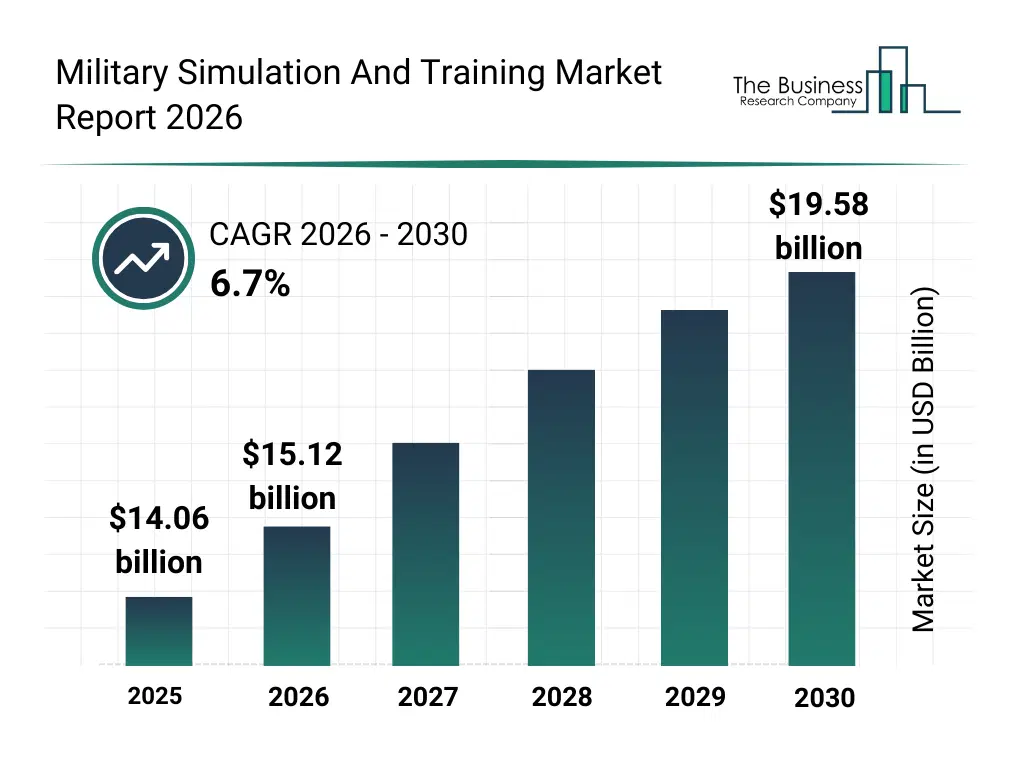
What Is The Military Simulation And Training Market Size and Share 2026?
The military simulation and training market size has grown strongly in recent years. It will grow from $14.06 billion in 2025 to $15.12 billion in 2026 at a compound annual growth rate (CAGR) of 7.5%. The growth in the historic period can be attributed to increasing adoption of virtual and constructive training environments by armed forces, rising need to reduce operational costs associated with live training exercises, advancement of simulation hardware and software enabling higher-fidelity military training, growth in procurement of complex military platforms requiring advanced simulation systems, early integration of simulation in pilot and vehicle crew training programs.What Is The Military Simulation And Training Market Growth Forecast?
The military simulation and training market size is expected to see strong growth in the next few years. It will grow to $19.58 billion in 2030 at a compound annual growth rate (CAGR) of 6.7%. The growth in the forecast period can be attributed to expansion of defense modernization programs driving demand for next-generation simulation solutions, increasing use of artificial intelligence and data analytics to enhance simulation realism and readiness assessment, rising focus on interoperability and joint-force training environments, growing adoption of cloud-based and distributed simulation architectures, increasing demand for immersive technologies such as augmented and virtual reality for mission rehearsal and operational training. Major trends in the forecast period include increased adoption of virtual battlefields for real-time training, integration of simulation technology in ab-initio training, focus on mission rehearsal and scenario-based training, demand for multi-domain training platforms (land, air, maritime), shift towards cost and labor efficient training solutions.
Global Military Simulation And Training Market Segmentation
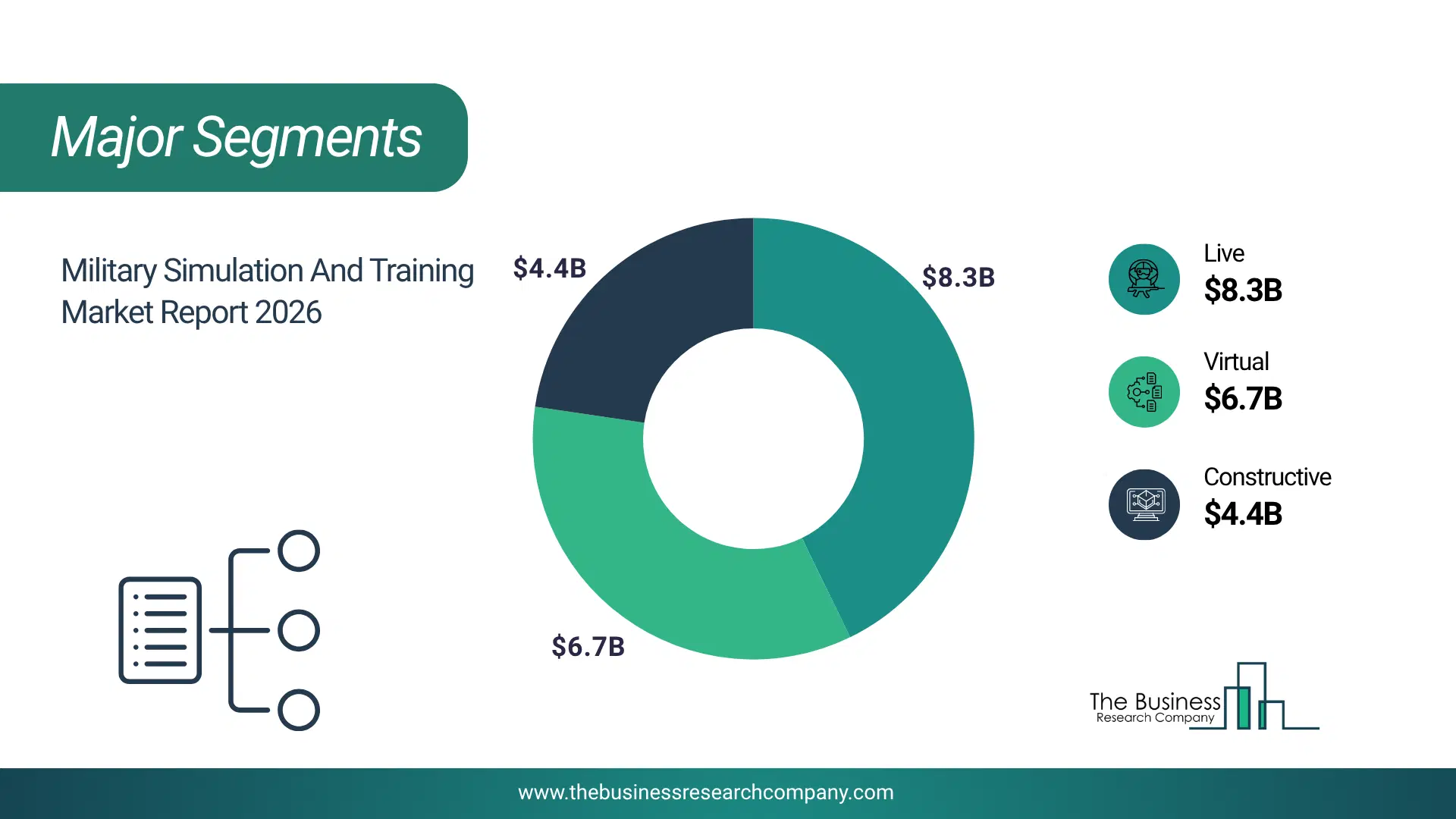
1) By Type: Live, Virtual, Constructive 2) By Environment: Synthetic, Gaming 3) By Technology: IoT (Internet Of Things), 5G (5th Generation Mobile Network), Big Data Analytics, Artificial Intelligence, Cloud Computing And Master Data Management, AR (Augmented Reality) And VR (Virtual Reality), Digital Twin, Robotic Process Automation 4) By Platform: Land, Maritime, Airborne 5) By Application: Army, Aviation, Naval Subsegments: 1) By Live: Field Training Exercises, Joint Exercises, Combat Training Centers 2) By Virtual: Desktop-Based Training, Full Mission Simulators-global-market-report" target="_blank">simulators, Virtual Environments And Serious Games 3) By Constructive: Command And Staff Training, Tactical Decision-Making Exercises, War Games And Operational Planning Simulations The top segments in the military simulation and training market will be: • Live will reach $8.2 billion by 2030. • Virtual will reach $6.69 billion by 2030. • Constructive will reach $4.33 billion by 2030.What Is Driver Of The Military Simulation And Training Market?
The increase in defense expenditure is expected to propel the growth of the military simulation and training market going forward. Defense expenditure refers to the amount of money spent by a government on military measures or resources. Defense expenditure is increasing due to rising security challenges, such as violent extremism and separatist insurgencies, which require effective military training with numerous advantages, synthetic or virtual training. For instance, in April 2024, according to the Stockholm International Peace Research Institute, a Sweden-based international institute, global military spending in 2023 increased by 6.8% in real terms to $2443 billion compared to 2022. Therefore, the increase in defense expenditure is expected to drive the growth of the military simulation and training industry.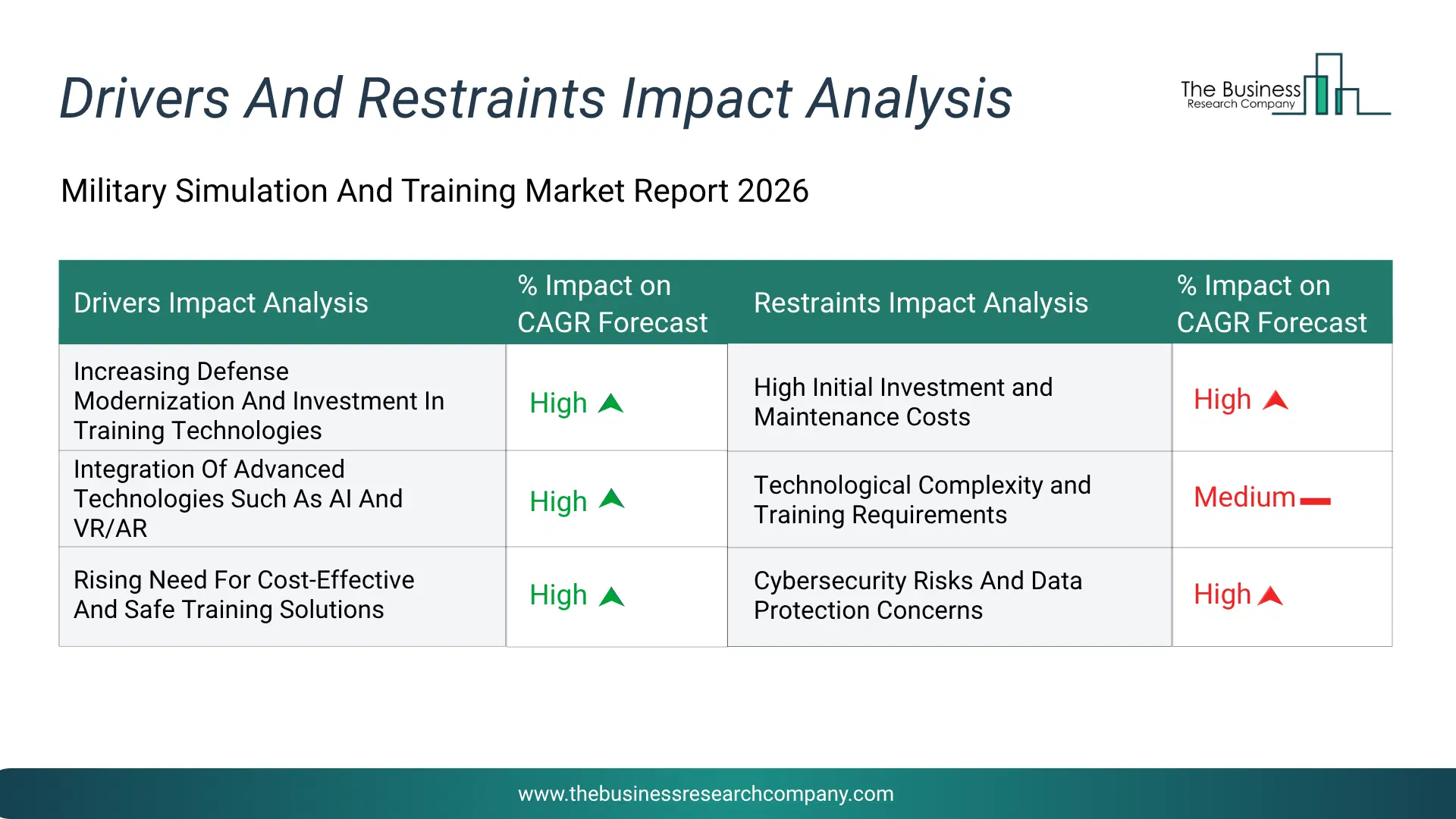
Infographic Chart Showing Key Market Drivers Analysis And Restraints For Military Simulation And Training Market
The chart presents an impact analysis of key drivers and restraints, quantifying their relative influence on the market's growth rate and helping assess the balance between growth enablers and limiting factors. This chart offers a high-level perspective; the full report contains more detailed insights.
How Will The Drivers Impact Growth In The Global Military Simulation And Training Market?
• Increasing Defense Modernization And Investment In Training Technologies (High) – During the forecast period, the increasing defense modernization and investment in training technologies is expected to become a key growth driver for the military simulation and training market by 2030. Defense modernization programs across the globe are driving demand for advanced military simulation and training solutions. Armed forces are prioritizing enhanced readiness, tactical decision making, and operational efficiency through realistic simulation environments that replicate combat scenarios without endangering personnel or equipment. Investments in advanced training infrastructure such as virtual and augmented reality simulators, flight trainers, and battlefield replication systems are facilitating more effective and repeatable training exercises. This emphasis on modern training technologies serves as a key growth driver for the military simulation and training market. • Integration Of Advanced Technologies Such As AI And VR/AR (High) – During the forecast period, the integration of advanced technologies such as ai and vr/ar is expected to emerge as a major factor driving the expansion of the military simulation and training market by 2030. The integration of artificial intelligence, virtual reality, augmented reality, and machine learning into military training is reshaping the simulation landscape. Artificial intelligence enables adaptive training scenarios, personalized feedback, and predictive performance analysis, while virtual and augmented reality provide immersive and interactive battlefield experiences. These technologies improve decision making, situational awareness, and mission preparedness, while reducing the time and cost of traditional live exercises, driving strong demand in the military simulation and training sector. • Rising Need For Cost-Effective And Safe Training Solutions (High) – During the forecast period, the rising need for cost-effective and safe training solutions is expected to act as a key growth catalyst for the military simulation and training market by 2030. Military exercises involving live ammunition and large-scale maneuvers are costly, resource-intensive, and carry significant risks. Simulation and training systems provide cost-effective alternatives that lower operational expenses while ensuring personnel safety. These solutions enable repeated practice in a controlled environment, deliver immediate performance feedback, and replicate high-risk scenarios that would be impractical in live exercises, making the reduction of training costs and enhancement of safety key drivers for adopting simulation technologies.How Will The Restraints Impact Growth In The Global Military Simulation And Training Market?
• High Initial Investment and Maintenance Costs (High) – During the forecast period, the military simulation and training systems require substantial investment in hardware, software, infrastructure, and skilled personnel. High procurement costs for advanced simulators, vr/ar devices, and ai-powered systems can limit adoption, particularly in developing nations or smaller defense forces. Additionally, ongoing maintenance, software updates, and system calibration contribute to operational expenses. This high cost barrier acts as a key restraint, slowing market penetration in cost-sensitive regions. • Technological Complexity and Training Requirements (Medium) – During the forecast period, the complexity of advanced simulation systems necessitates specialized training for operators and instructors. A lack of skilled personnel or inadequate technical expertise can hinder effective implementation and utilization of these systems. Additionally, integrating simulation platforms with existing military infrastructure requires careful planning and technical know-how. These challenges act as a restraint on the market, particularly in countries where defense personnel may lack exposure to sophisticated digital training environments. • Cybersecurity Risks And Data Protection Concerns (High) – During the forecast period, the cybersecurity risks and data protection concerns act as a restraint for the military simulation and training market by increasing vulnerability to data breaches, system intrusions, and unauthorized access to sensitive defense training information. Advanced simulation platforms often rely on interconnected digital networks, cloud-based systems, and real-time data exchange, which can be targeted by cyberattacks. Ensuring robust encryption, secure system architecture, and continuous monitoring increases implementation costs and complexity. These risks make defense organizations cautious about fully digitizing training environments, thereby slowing adoption and integration of advanced simulation solutions.Key Players In The Global Military Simulation And Training Market
Major companies operating in the military simulation and training market are BAE Systems PLC, Cubic Corporation, FAAC Incorporated, Israel Aerospace Industries Ltd., L-3 Communications Holdings Inc., Lockheed Martin Corporation, Meggitt PLC, Northrop Grumman Corporation, Raytheon Technologies, Rheinmetall AG, Rockwell Collins Inc., SAAB AB, Textron Inc., Thales Group, Aechelon Technology Inc., Antycip Simulation, Barco NV, Bohemia Interactive Simulations, CAE Inc., DiSTI Corporation, Elbit Systems Ltd., Epic Games Inc., General Dynamics Corporation, Intelligent Decisions Inc., Presagis Canada Inc., Quantum3D Inc., Scalable Display Technologies, SimCentric Technologies Pty Ltd., Unity Technologies, Virtual Heroes Inc., MAK Technologies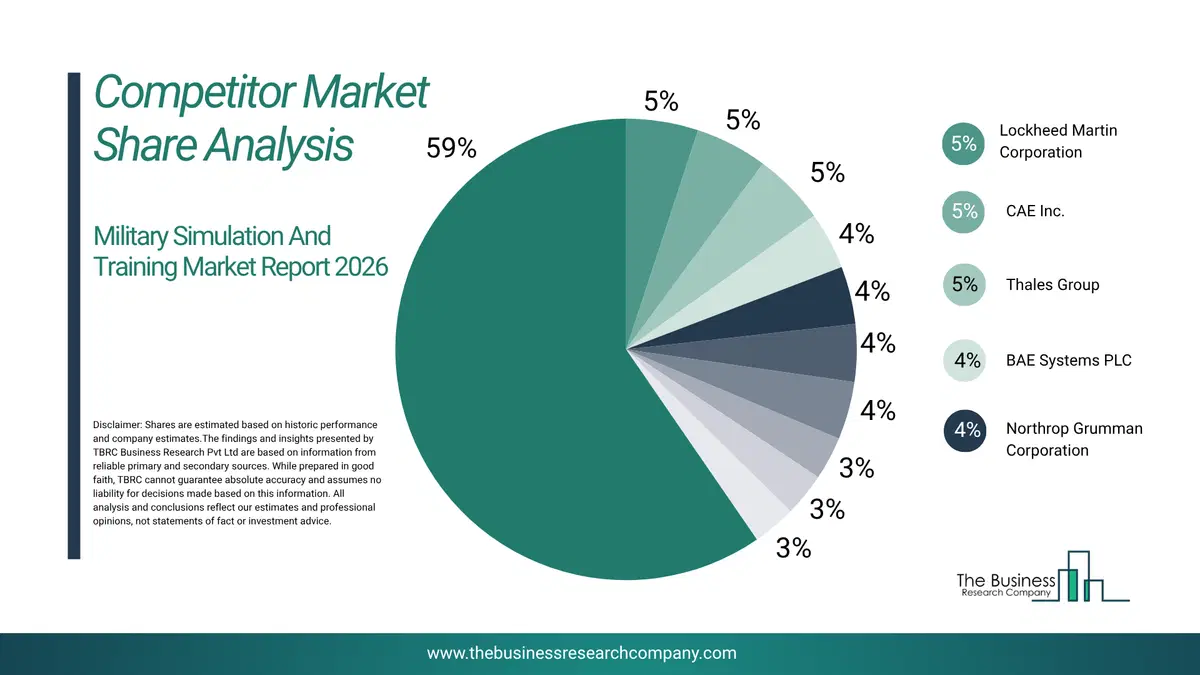
This chart is for illustrative purposes; the full report includes a detailed competitor analysis and comprehensive overview of the top 10 companies in the market.
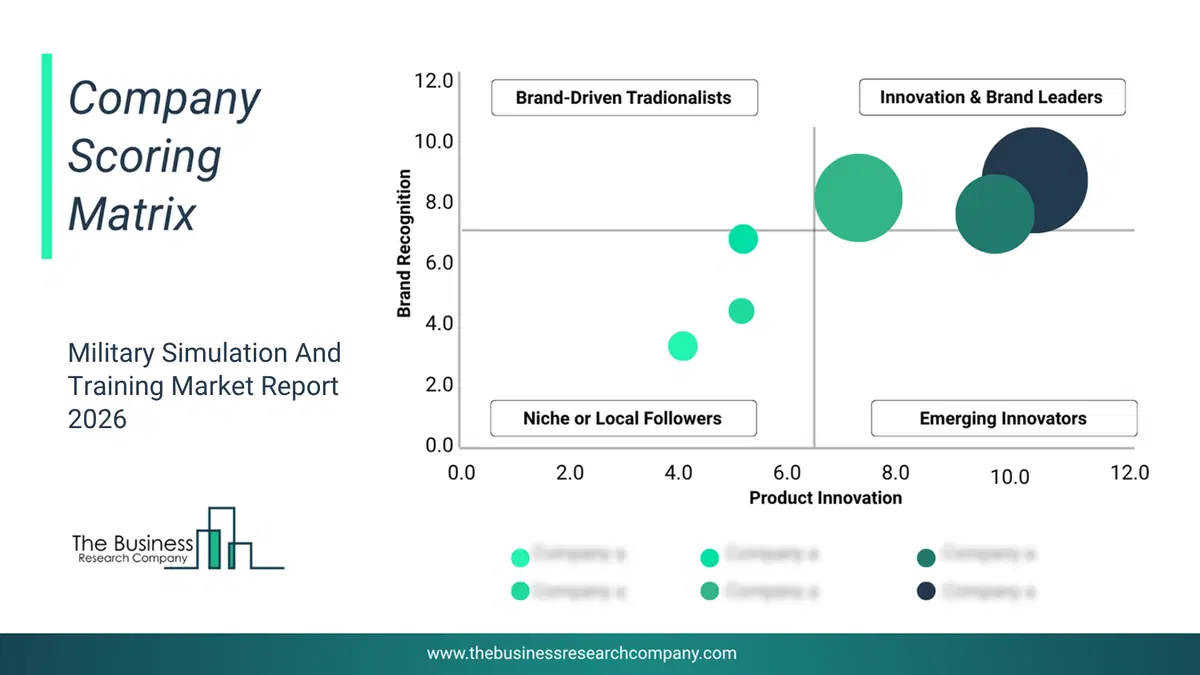
This chart maps companies by product innovation and brand strength, with bubble size indicating relative revenue, helping identify market leaders, challengers, and niche players. This is an illustrative chart; the full report provides a complete and accurate competitive analysis.
Global Military Simulation And Training Market Trends and Insights
Major companies operating in the military simulation and training market are developing innovative products such as virtual battle space (VBS) products to meet larger customer bases, more sales, and increase revenue. Virtual Battle Space (VBS) products refer to a suite of military simulation and training software. For instance, in June 2023, Bohemia Interactive Simulations (BISim), a US-based training and simulation software company, launched the VBS4 and VBS Blue IG. VBS4 stands out as an accessible and comprehensive virtual and constructive simulation host, offering seamless support for a diverse array of military-specific training and mission rehearsal applications across the entire globe. On the other hand, VBS Blue IG distinguishes itself as a high-performance, CIGI-compliant, 3D whole-earth image generator specifically crafted to cater to a wide spectrum of use cases, encompassing land, sea, air, and space scenarios. The latest versions, VBS4 and VBS Blue IG 23.1, come equipped with numerous new features, enhancements in user-friendliness, and performance improvements. These updates are readily accessible for download through the customer portal. Significant features introduced in VBS4 version 23.1 include customizable radio antennas, damage charring, a redesigned mission briefing, a fresh weather panel, and various other enhancements.What Are Latest Mergers And Acquisitions In The Military Simulation And Training Market? Indra Sistemas S.A. Acquired Global Training Aviation S.L. To Expand Its Presence Across The Full Value Chain Of Simulation And Training In Civil And Military Aviation
In February 2024, Indra Sistemas S.A., a Spain-based provider of consulting and technology services for aerospace, defense, transport, and mobility sectors, acquired Global Training Aviation S.L. (GTA) for an undisclosed amount. With this acquisition, Indra aimed to extend its offering along the full value chain of simulation and training, from manufacturing state-of-the-art simulators to delivering pilot and cabin-crew training services, thereby accelerating its growth in civil and military aviation training markets. Global Training Aviation S.L. is a Spain-based provider of pilot and cabin-crew training services.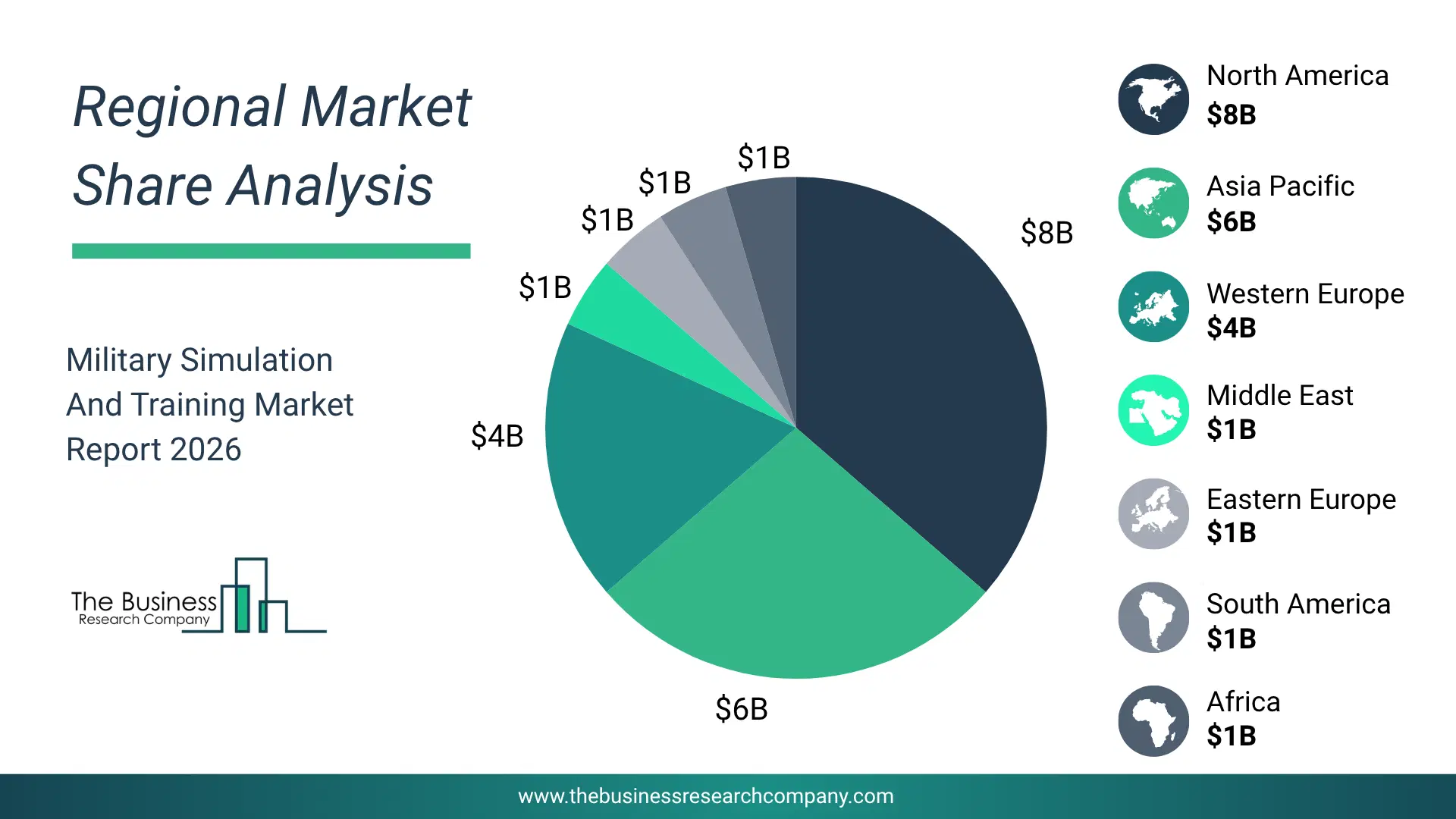
Regional Insights
North America was the largest region in the military simulation and training market in 2025. The regions covered in this market report are Asia-Pacific, South East Asia, Western Europe, Eastern Europe, North America, South America, Middle East, Africa. The countries covered in this market report are Australia, Brazil, China, France, Germany, India, Indonesia, Japan, Taiwan, Russia, South Korea, UK, USA, Canada, Italy, SpainWhat Defines the Military Simulation And Training Market?
The military simulation and training market consists of revenues earned by entities by providing training-related products and services such as virtual battlefield in real-time, enabling ab-initio training, mission rehearsal, and flight operations. The market value includes the value of related goods sold by the service provider or included within the service offering. Only goods and services traded between entities or sold to end consumers are included.How is Market Value Defined and Measured?
The market value is defined as the revenues that enterprises gain from the sale of goods and/or services within the specified market and geography through sales, grants, or donations in terms of the currency (in USD unless otherwise specified). The revenues for a specified geography are consumption values that are revenues generated by organizations in the specified geography within the market, irrespective of where they are produced. It does not include revenues from resales along the supply chain, either further along the supply chain or as part of other products.
This chart presents market attractiveness based on a quantitative evaluation of growth, competition, strategic alignment, and risk, offering a clear view of opportunity areas for decision-making. This chart is for illustrative purposes; the full report contains the complete analysis.

This chart highlights the Total Addressable Market (TAM) by estimating the maximum revenue opportunity using an assumption-driven approach, supporting strategic planning and opportunity sizing across markets. The chart is illustrative; the full report provides a more comprehensive analysis.
What Key Data and Analysis Are Included in the Military Simulation And Training Market Report 2026?
The military simulation and training market research report is one of a series of new reports from The Business Research Company that provides market statistics, including industry global market size, regional shares, competitors with the market share, detailed market segments, market trends and opportunities, and any further data you may need to thrive in the military simulation and training industry. The market research report delivers a complete perspective of everything you need, with an in-depth analysis of the current and future state of the industry.Military Simulation And Training Market Report Forecast Analysis
| Report Attribute | Details |
|---|---|
| Market Size Value In 2026 | $15.12 billion |
| Revenue Forecast In 2030 | $19.58 billion |
| Growth Rate | CAGR of 6.7% from 2026 to 2030 |
| Base Year For Estimation | 2025 |
| Actual Estimates/Historical Data | 2020-2025 |
| Forecast Period | 2026 - 2030 |
| Market Representation | Revenue in USD Billion and CAGR from 2026 to 2030 |
| Segments Covered | Type, Environment, Technology, Platform, Application |
| Regional Scope | Asia-Pacific, Western Europe, Eastern Europe, North America, South America, Middle East, Africa |
| Country Scope | The countries covered in the report are Australia, Brazil, China, France, Germany, India, ... |
| Key Companies Profiled | BAE Systems PLC, Cubic Corporation, FAAC Incorporated, Israel Aerospace Industries Ltd., L-3 Communications Holdings Inc., Lockheed Martin Corporation, Meggitt PLC, Northrop Grumman Corporation, Raytheon Technologies, Rheinmetall AG, Rockwell Collins Inc., SAAB AB, Textron Inc., Thales Group, Aechelon Technology Inc., Antycip Simulation, Barco NV, Bohemia Interactive Simulations, CAE Inc., DiSTI Corporation, Elbit Systems Ltd., Epic Games Inc., General Dynamics Corporation, Intelligent Decisions Inc., Presagis Canada Inc., Quantum3D Inc., Scalable Display Technologies, SimCentric Technologies Pty Ltd., Unity Technologies, Virtual Heroes Inc., MAK Technologies |
| Customization Scope | Request for Customization |
| Pricing And Purchase Options | Explore Purchase Options |