
Military Tactical Communications Market Report 2026
Global Outlook – By Component (Hardware, Software), By Communication Type (Airborne Communication, Ground Communication, Naval Communication, Underwater Communication), By Technology (Satellite Communication (SATCOM), Very High Frequency Or Ultra High Frequency Or L Band, High Frequency Communication), By Application (Command And Control, Intelligence Surveillance And Reconnaissance, Situational Awareness, Routine Operations), By End User (Army, Navy, Air Force, Special Forces) – Market Size, Trends, Strategies, and Forecast to 2030
Military Tactical Communications Market Overview
• Military Tactical Communications market size has reached to $23.7 billion in 2025 • Expected to grow to $32.97 billion in 2030 at a compound annual growth rate (CAGR) of 6.9% • Growth Driver: Surge In Geopolitical Tension Fueling The Growth Of The Market Due To Increasing Need For Secure Real-time Coordination And Enhanced Defense Communication Capabilities • Market Trend: Innovation In Secure Tactical Radio Communication Technologies • North America was the largest region in 2025 and Asia-Pacific is the fastest growing region.What Is Covered Under Military Tactical Communications Market?
Military tactical communications refer to secure and reliable communication systems used by armed forces to transmit voice, data, and video information in real time during operations. These systems are designed to operate in harsh and contested environments, ensuring interoperability, resilience against electronic warfare, and uninterrupted connectivity across diverse platforms. They play a critical role in enhancing situational awareness, enabling coordinated decision-making, and supporting mission success in dynamic battlefield conditions. The main components of military tactical communications include hardware and software. Hardware refers to physical communication devices such as radios, terminals, and networking equipment used to enable secure battlefield connectivity. These systems operate across communication types including airborne communication, ground communication, naval communication, and underwater communication and are built using technologies such as satellite communication (SATCOM), very high frequency or ultra high frequency or L band, and high frequency communication. The various applications involved are command and control, intelligence surveillance and reconnaissance, situational awareness, and routine operations, and they are used by several end users such as army, navy, air force, and special forces.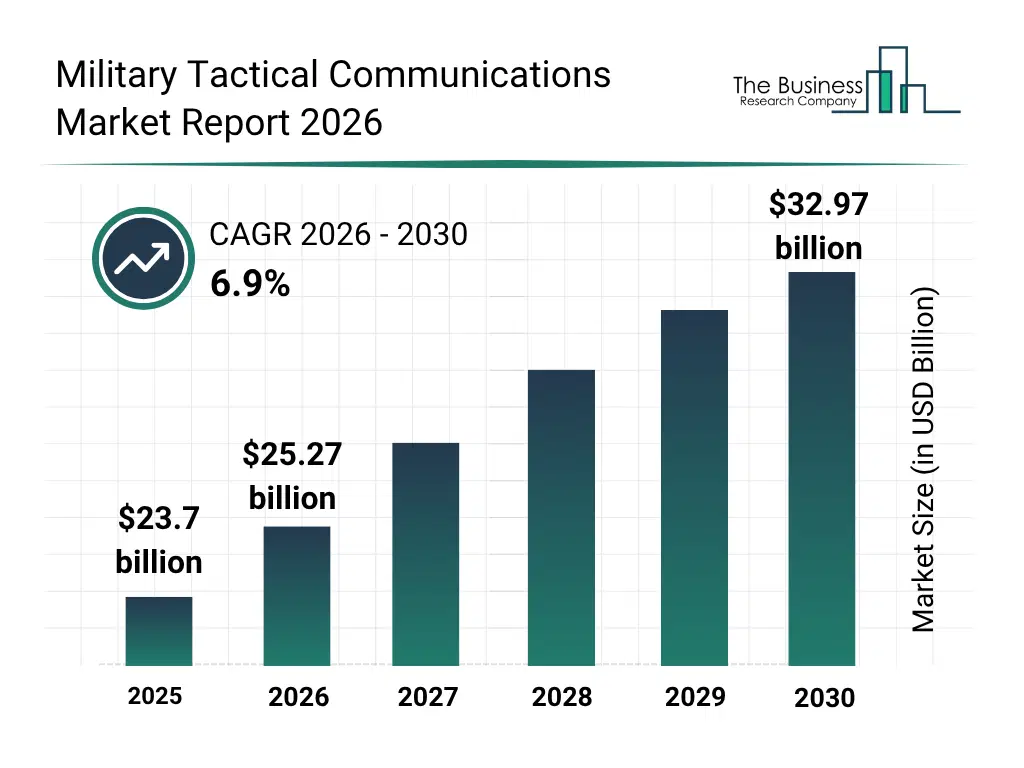
What Is The Military Tactical Communications Market Size and Share 2026?
The military tactical communications market size has grown strongly in recent years. It will grow from $23.7 billion in 2025 to $25.27 billion in 2026 at a compound annual growth rate (CAGR) of 6.6%. The growth in the historic period can be attributed to evolution from analog to digital radio systems, expansion of satellite based military communications, rise of network centric warfare strategies, increasing cross border security threats, modernization of command and control infrastructure.What Is The Military Tactical Communications Market Growth Forecast?
The military tactical communications market size is expected to see strong growth in the next few years. It will grow to $32.97 billion in 2030 at a compound annual growth rate (CAGR) of 6.9%. The growth in the forecast period can be attributed to adoption of ai driven battlefield communication optimization, expansion of low earth orbit (leo) satellite communication networks, growing demand for quantum resistant encryption systems, increasing investment in multi domain operational readiness, integration of autonomous defense communication systems. Major trends in the forecast period include secure multi-domain tactical communication interoperability, anti-jamming and electronic warfare resistant communication systems, low latency battlefield data transmission networks, ruggedized and portable communication terminals for field operations, encrypted real time voice data and video communication systems.
Global Military Tactical Communications Market Segmentation
1) By Component: Hardware, Software 2) By Communication Type: Airborne Communication, Ground Communication, Naval Communication, Underwater Communication 3) By Technology: Satellite Communication (SATCOM), Very High Frequency Or Ultra High Frequency Or L Band, High Frequency Communication 4) By Application: Command And Control, Intelligence Surveillance And Reconnaissance, Situational Awareness, Routine Operations 5) By End User: Army, Navy, Air Force, Special Forces Subsegments: 1) By Hardware: Communication Radios, Signal Processors, Antennas, Transceivers, Power Supply Units, Control Consoles, Encryption Devices, Network Interface Devices, Satellite Terminals, Routing Equipment 2) By Software: Network Management Software, Communication Security Software, Signal Processing Software, Data Encryption Software, Mission Planning Software, Spectrum Management Software, Interoperability Software, Command And Control Software, Communication Analytics SoftwareWhat Is The Driver Of The Military Tactical Communications Market?
The rising geopolitical tension is expected to propel the growth of the military tactical communications market going forward. Geopolitical tension refers to rising political, economic, or military conflicts and uncertainties between countries or regions that can impact global stability and security. The rise in geopolitical tension is driven by increasing regional power competition, as countries expand military capabilities and strategic alliances to strengthen security and influence. Military tactical communications help mitigate geopolitical tension by enabling secure, real-time coordination and information sharing among defence forces, improving situational awareness and reducing the risk of miscommunication or escalation during conflicts. For instance, in July 2024, according to the Armed Conflict Location and Event Data, a US-based non-profit organization, between July 2023 and June 2024, over 165,273 incidents of political violence were reported worldwide, representing a 15% increase from the previous year. During this time, it is estimated that approximately one in seven people around the world were affected by conflict. Therefore, rising geopolitical tension are driving the growth of the military tactical communications industry.Key Players In The Global Military Tactical Communications Market
Major companies operating in the military tactical communications market are Airbus Defence and Space GmbH, RTX Corporation, Lockheed Martin Corporation, General Dynamics Corporation, Northrop Grumman Corporation, Honeywell International Inc., BAE Systems plc, Collins Aerospace, Thales S.A., L3Harris Technologies Inc., Leonardo S.p.A., Elbit Systems Ltd., Israel Aerospace Industries Ltd., Saab AB, Rafael Advanced Defense Systems Ltd., ASELSAN A.Ş., Rohde & Schwarz GmbH & Co. KG, Curtiss-Wright Corporation, HENSOLDT AG, Bittium Corporation, Cisco Systems Inc., Viasat Inc., Kratos Defense & Security Solutions, Leonardo DRS Inc., Motorola Solutions Inc.Global Military Tactical Communications Market Trends and Insights
Major companies operating in the military tactical communications market are focusing on developing advanced communication solutions, such as next-generation secure radio communication systems, to enhance real-time data exchange, improve interoperability, and ensure reliable connectivity in complex and contested operational environments. Next-generation secure radio communication systems refer to advanced, software-defined wireless systems that enable encrypted, resilient, and interoperable voice and data transmission across multiple frequencies and operational environments. For instance, in May 2024, Spectra Group, a UK-based defense communications firm, launched GENSS, its new tactical radio communications system, at SOF Week 2024. It is a modular, software-defined tactical radio system designed to deliver high interoperability through simple and rapid software reprogramming. It operates across HF, VHF, UHF, and satellite bands, enabling reliable beyond-line-of-sight communications and supporting communications on the move across land, sea, and air domains. The system combines network-sensing capabilities with enhanced data transmission performance, supporting higher data rates over narrowband LTAC channels. Its flexible architecture allows it to adapt quickly to evolving mission requirements while maintaining secure voice and high-bandwidth data connectivity.What Are Latest Mergers And Acquisitions In The Military Tactical Communications Market?
In January 2023, L3Harris Technologies, a US-based aerospace and defence company, acquired Viasat Inc. for $1.96 billion. Through this acquisition, L3Harris Technologies aims to strengthen its military tactical communications portfolio by enhancing secure, interoperable, and real-time data exchange capabilities through the integration of Viasat Inc.’s Link 16 tactical data link systems. Viasat Inc. is a US-based provider of tactical SATCOM terminals, radios, and gateways.Regional Outlook
North America was the largest region in the military tactical communications market in 2025. Asia-Pacific is expected to be the fastest-growing region in the forecast period. The regions covered in this market report are Australia, Brazil, China, France, Germany, India, Indonesia, Japan, Taiwan, Russia, South Korea, UK, USA, Canada, Italy, Spain. The countries covered in this market report are Australia, Brazil, China, France, Germany, India, Indonesia, Japan, Taiwan, Russia, South Korea, UK, USA, Canada, Italy, Spain.What Defines the Military Tactical Communications Market?
The military tactical communications market consists of revenues earned by entities by providing services such as communication infrastructure management services, spectrum management services, and data encryption and security services. The market value includes the value of related goods sold by the service provider or included within the service offering. The military tactical communications market also includes sales of underwater acoustic communication devices, battlefield communication devices, and portable communication kits. Values in this market are ‘factory gate’ values, that is, the value of goods sold by the manufacturers or creators of the goods, whether to other entities (including downstream manufacturers, wholesalers, distributors, and retailers) or directly to end customers. The value of goods in this market includes related services sold by the creators of the goods.How is Market Value Defined and Measured?
The market value is defined as the revenues that enterprises gain from the sale of goods and/or services within the specified market and geography through sales, grants, or donations in terms of the currency (in USD unless otherwise specified). The revenues for a specified geography are consumption values that are revenues generated by organizations in the specified geography within the market, irrespective of where they are produced. It does not include revenues from resales along the supply chain, either further along the supply chain or as part of other products.What Key Data and Analysis Are Included in the Military Tactical Communications Market Report 2026?
The military tactical communications market research report is one of a series of new reports from The Business Research Company that provides military tactical communications market statistics, including military tactical communications industry global market size, regional shares, competitors with a military tactical communications market share, detailed military tactical communications market segments, market trends and opportunities, and any further data you may need to thrive in the military tactical communications industry. This military tactical communications market research report delivers a complete perspective of everything you need, with an in-depth analysis of the current and future scenario of the industry.Military Tactical Communications Market Report Forecast Analysis
| Report Attribute | Details |
|---|---|
| Market Size Value In 2026 | $25.27 billion |
| Revenue Forecast In 2030 | $32.97 billion |
| Growth Rate | CAGR of 6.9% from 2026 to 2030 |
| Base Year For Estimation | 2025 |
| Actual Estimates/Historical Data | 2020-2025 |
| Forecast Period | 2026 - 2030 |
| Market Representation | Revenue in USD Billion and CAGR from 2026 to 2030 |
| Segments Covered | Component, Communication Type, Technology, Application, End User |
| Regional Scope | Asia-Pacific, Western Europe, Eastern Europe, North America, South America, Middle East, Africa |
| Country Scope | The countries covered in the military tactical communications market report are Australia, Brazil, China, France, Germany, India, Indonesia, Japan, Taiwan, Russia, South Korea, UK, USA, Canada, Italy, Spain. |
| Key Companies Profiled | Airbus Defence and Space GmbH, RTX Corporation, Lockheed Martin Corporation, General Dynamics Corporation, Northrop Grumman Corporation, Honeywell International Inc., BAE Systems plc, Collins Aerospace, Thales S.A., L3Harris Technologies Inc., Leonardo S.p.A., Elbit Systems Ltd., Israel Aerospace Industries Ltd., Saab AB, Rafael Advanced Defense Systems Ltd., ASELSAN A.Ş., Rohde & Schwarz GmbH & Co. KG, Curtiss-Wright Corporation, HENSOLDT AG, Bittium Corporation, Cisco Systems Inc., Viasat Inc., Kratos Defense & Security Solutions, Leonardo DRS Inc., Motorola Solutions Inc. |
| Customization Scope | Request for Customization |
| Pricing And Purchase Options | Explore Purchase Options |