
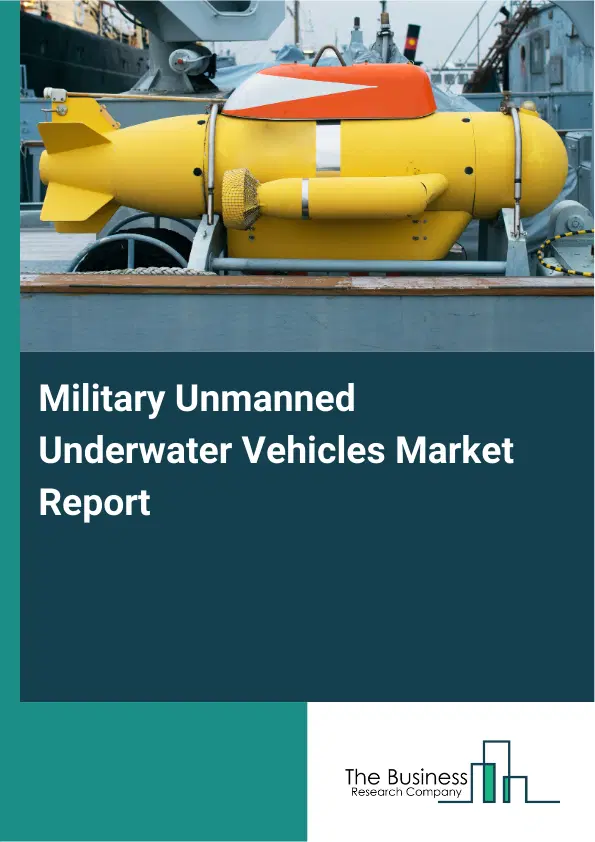
Military Unmanned Underwater Vehicles Market Report 2026
Global Outlook – By Product Type (Remotely Operated Vehicle, Autonomous Underwater Vehicle), By Propulsion System (Electric System, Mechanical System, Hybrid System), By Application (Search And Rescue, Defense) – Market Size, Trends, Strategies, and Forecast to 2030
Military Unmanned Underwater Vehicles Market Overview
• Military Unmanned Underwater Vehicles market size has reached to $4.28 billion in 2025 • Expected to grow to $6.23 billion in 2030 at a compound annual growth rate (CAGR) of 7.8% • Growth Driver: Defense Budget Surge Fuels Growth In Military Unmanned Underwater Vehicles Market • Market Trend: Next-Generation Underwater System Enhances Infrastructure Protection • North America was the largest region in 2025.Market Gains By 2030 – Top Opportunities By Segment
Market Gain identifies the most promising market opportunities by highlighting the segments or products expected to generate the highest incremental revenue growth over the next five years.
What Is Covered Under Military Unmanned Underwater Vehicles Market?
Military unmanned underwater vehicles refer refers to any vehicle that can function without a human operator underwater. These are used in oceanic research. The main products of military unmanned underwater vehicles are remotely operated vehicles and autonomous underwater vehicles. A remotely operated vehicle refers to a vehicle that is operated underwater and controlled by a remote from the surface. The propulsion systems involved are electric, mechanical, and hybrid used in various applications such as search and rescue and defense.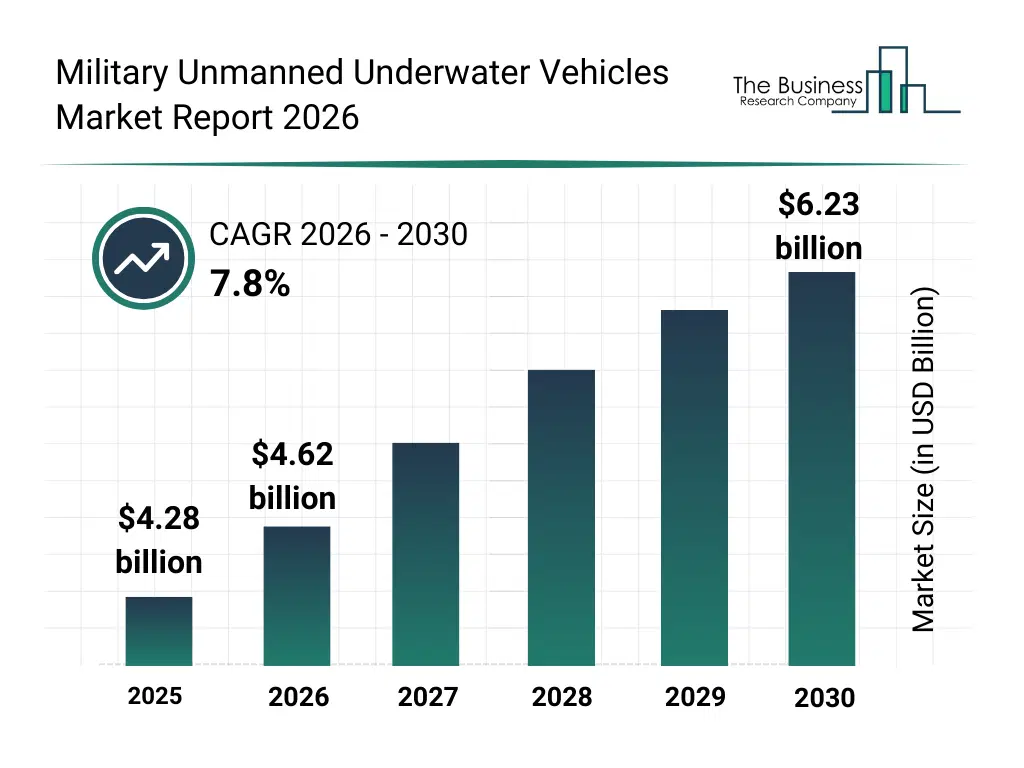
What Is The Military Unmanned Underwater Vehicles Market Size and Share 2026?
The military unmanned underwater vehicles market size has grown strongly in recent years. It will grow from $4.28 billion in 2025 to $4.62 billion in 2026 at a compound annual growth rate (CAGR) of 8.1%. The growth in the historic period can be attributed to increasing use of remotely operated vehicles for underwater reconnaissance missions, growth in naval modernization programs driving early adoption of unmanned underwater platforms, rising need for mine countermeasure operations using compact ROV systems, advancements in underwater acoustic communication technologies enabling better vehicle control, expansion of oceanic research activities requiring small and micro ROVs.What Is The Military Unmanned Underwater Vehicles Market Growth Forecast?
The military unmanned underwater vehicles market size is expected to see strong growth in the next few years. It will grow to $6.23 billion in 2030 at a compound annual growth rate (CAGR) of 7.8%. The growth in the forecast period can be attributed to growing demand for autonomous underwater vehicles for persistent surveillance and intelligence gathering, increased investment in unmanned systems to enhance naval capabilities and reduce human risk, rising focus on multi-mission uuv platforms supporting mine detection and anti-submarine warfare, technological advancements improving endurance navigation and payload capacity of underwater vehicles, expanding integration of uuvs in joint maritime security and seabed monitoring operations. Major trends in the forecast period include rising demand for light work-class rovs for tactical operations,, growth of observation and micro/ mini rov deployments,, expansion in underwater surveillance and oceanic research missions,, emphasis on long-endurance autonomous underwater vehicles (auvs),, focus on cost-efficient and multi-mission capable unmanned vehicles.
Global Military Unmanned Underwater Vehicles Market Segmentation
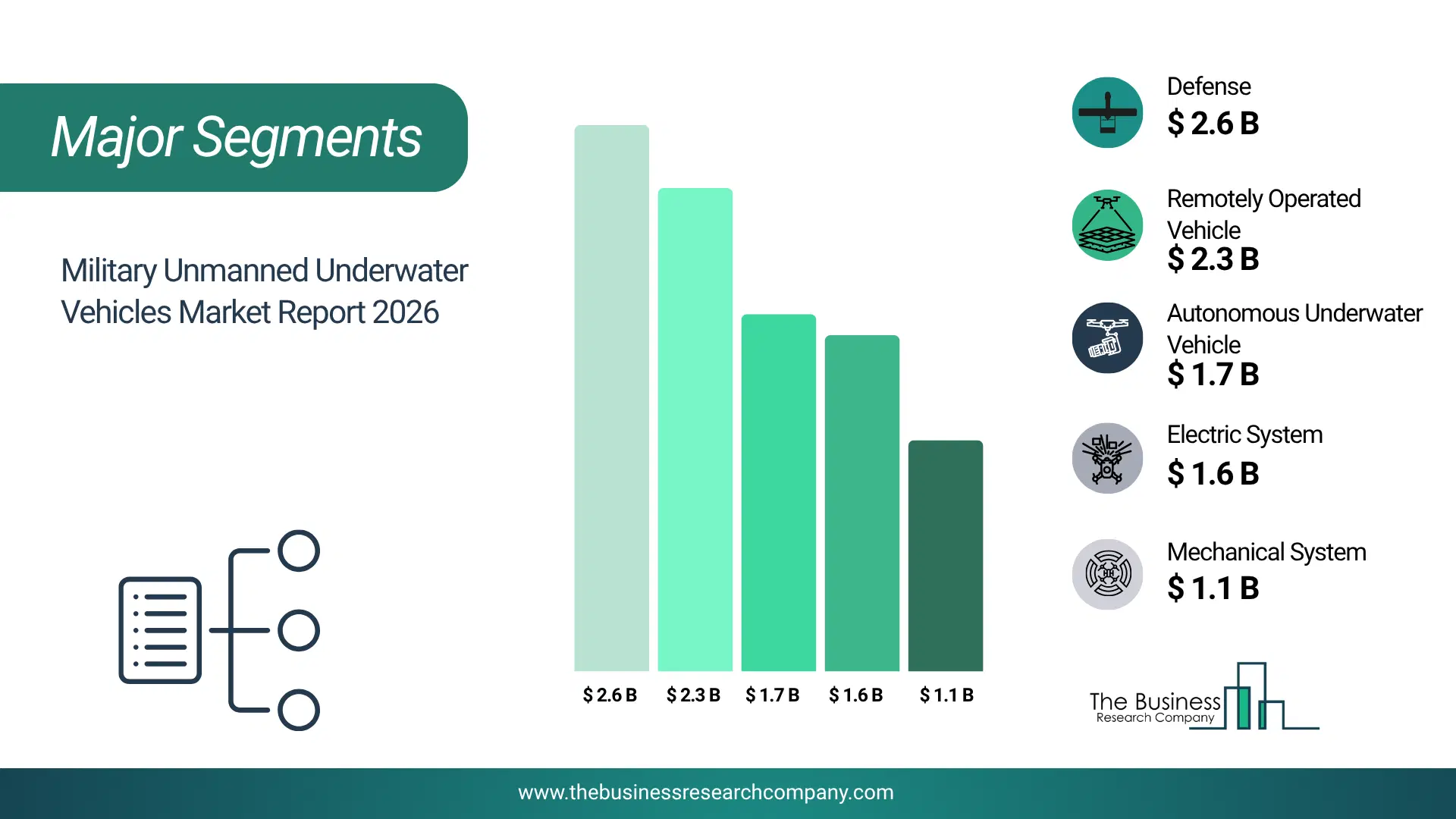
1) By Product Type: Remotely Operated Vehicle, Autonomous Underwater Vehicle 2) By Propulsion System: Electric System, Mechanical System, Hybrid System 3) By Application: Search And Rescue, Defense Subsegments: 1) By Remotely Operated Vehicle (ROV): Observation ROVs, Work-Class ROVs, Micro ROVs 2) By Autonomous Underwater Vehicle (AUV): Tactical AUVs, Survey AUVs, Long-Endurance AUVs The top segments in the military unmanned underwater vehicles market will be: • Defense will reach $2637.51 Million by 2025. • Remotely Operated Vehicle will reach $2326.15 Million by 2025. • Autonomous Underwater Vehicle will reach $1718.23 Million by 2025. • Electric System will reach $1657.81 Million by 2025. • Mechanical System will reach $1138.23 Million by 2025.What Is Driver Of The Military Unmanned Underwater Vehicles Market?
The rising defense budget is expected to boost the growth of the military unmanned underwater vehicles market going forward. A defense budget refers to a financial plan or allocation of funds set aside by a government or a nation to cover the costs associated with its military and defense-related activities. Growing defense budgets provide the financial means for nations to invest in the research, development, procurement, and integration of military unmanned underwater vehicles, thereby fueling the expansion of the UUV market. For instance, in October 2025, according to the UK Parliament's House of Commons Library, a UK-based government administration, Defense spending outlined in the 2025 Spending Review is expected to total USD 83.3 billion (£62.2 billion) in 2025/26, increasing to USD 98.2 billion (£73.5 billion) in 2028/29, which corresponds to an annual average real-terms growth rate of 3.8% over this period. Therefore, the rising defense budgets are driving the growth of the military unmanned underwater vehicles industry.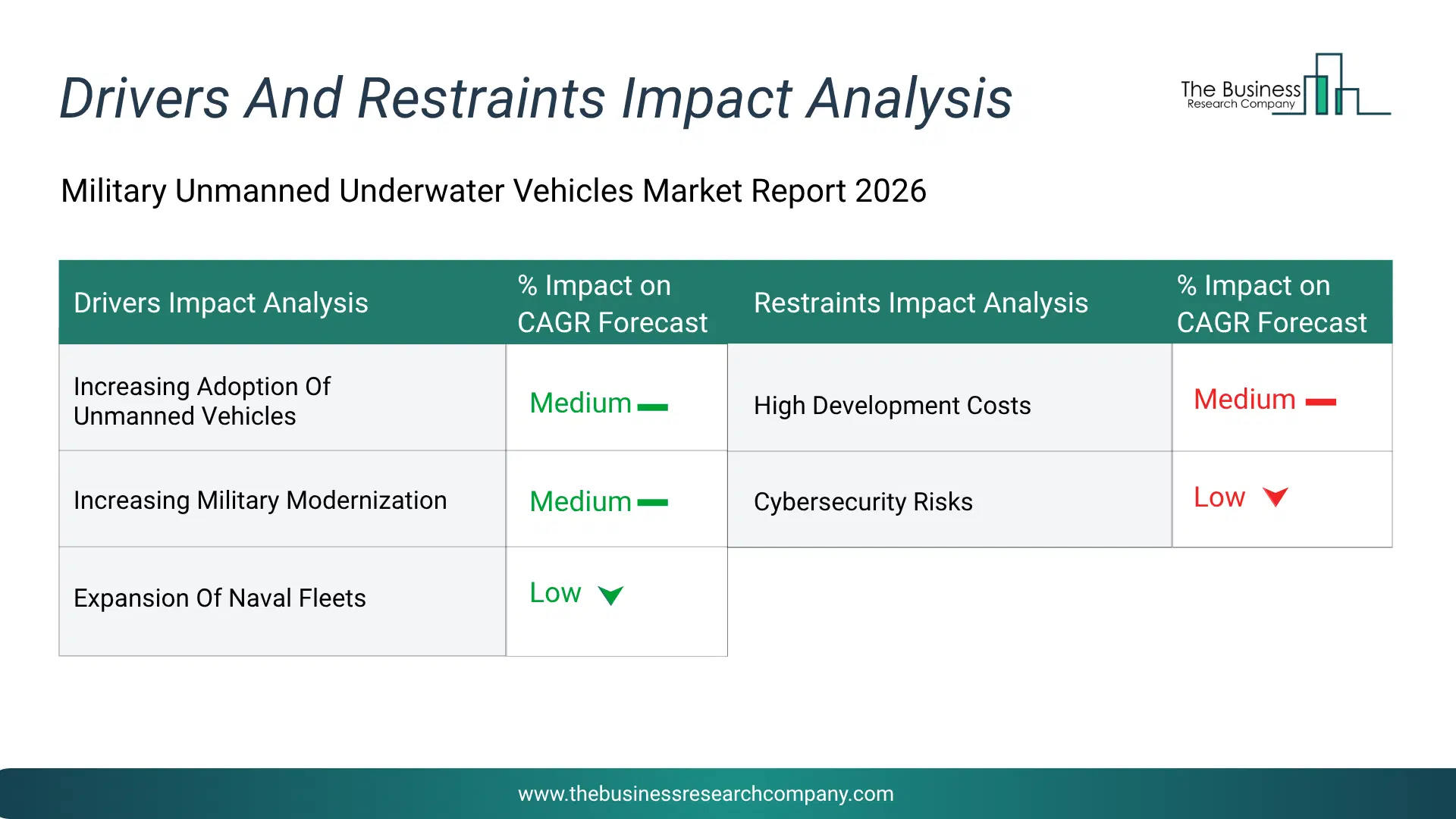
Infographic Chart Showing Key Market Drivers Analysis And Restraints For Military Unmanned Underwater Vehicles Market
The chart presents an impact analysis of key drivers and restraints, quantifying their relative influence on the market's growth rate and helping assess the balance between growth enablers and limiting factors. This chart offers a high-level perspective; the full report contains more detailed insights.
How Will The Drivers Impact Growth In The Global Military Unmanned Underwater Vehicles Market?
• Increasing Adoption Of Unmanned Vehicles (Medium) – The increasing adoption of unmanned vehicles will become a key driver of growth in the military unmanned underwater vehicles market by 2030. Defense forces are investing in UUVs for intelligence, surveillance, reconnaissance, and mine countermeasures to enhance operational efficiency and reduce risks to personnel. Advancements in autonomous navigation, artificial intelligence, and underwater communication are improving system effectiveness. As a result, the increasing adoption of unmanned vehicles is anticipated to contributing to a 2.0% annual growth in the market. • Increasing Military Modernization (Medium) – The increasing military modernization will emerge as a major factor driving the expansion of the military unmanned underwater vehicles market by 2030. The integration of AI, autonomous navigation, and advanced sensor technology will enhance UUV capabilities, driving market expansion. Consequently, the increasing military modernization capabilities is projected to contributing to a 1.5% annual growth in the market. • Expansion Of Naval Fleets (Low) – The expansion of naval fleets within digital manufacturing processes will serve as a key growth catalyst for the military unmanned underwater vehicles market by 2030. These fleets increasingly incorporate UUVs for intelligence gathering, mine countermeasures, and anti-submarine warfare, supporting market growth. Therefore, this expansion of naval fleets across digital manufacturing operations is projected to supporting to a 1.0% annual growth in the market. • Favorable Government Initiatives (Low) – The favorable government initiative will become a significant driver contributing to the growth of the military unmanned underwater vehicles market by 2030. Rising geopolitical tensions and maritime security threats are prompting increased government investments in autonomous underwater technologies. Policy support and funding for UUV development will accelerate market expansion. Consequently, favorable government initiative strategies is projected to contributing to a 0.5% annual growth in the market.How Will The Restraints Impact Growth In The Global Military Unmanned Underwater Vehicles Market?
• High Development Costs (Medium) – High Development Costs will restrict the growth of the Military Unmanned Underwater Vehicles market during the forecast period. The development of military UUVs involves substantial investment in advanced materials, sensors, autonomous systems, and propulsion technologies. High R&D costs create barriers for new entrants and limit the number of programs that can be pursued. Budget constraints can lead to program delays, cancellations, or reduced procurement quantities, affecting market growth. • Cybersecurity Risks (Medium) – Cybersecurity Risks will restrict the growth of the Military Unmanned Underwater Vehicles market during the forecast period. Military UUVs rely on complex software and communication systems that are vulnerable to cyber threats. Cybersecurity risks include hacking, communication interception, and autonomous system compromise. Security vulnerabilities can lead to operational failures, data breaches, and mission compromise, affecting confidence in UUV technology and limiting adoption for sensitive applications.Key Players In The Global Military Unmanned Underwater Vehicles Market
Major companies operating in the military unmanned underwater vehicles market are Kongsberg Maritime, Lockheed Martin Corporation, Saab AB, Atlas Elektronik, Teledyne Technologies Incorporated, Boeing, General Dynamics Corporation, Gabri SRL, Eca Group, International Submarine Engineering, L3 Harris Technologies inc, Fugro N.V, Oceaneering International Inc., Blue Robotics Inc., Riptide Autonomous Solutions LLC, Aquabotix Technology Corporation, Deep Ocean Engineering, Eelume AS, Epsilon Systems Solutions, Forum Energy Technologies, Greensea Systems Inc., Hydroid Inc., Kraken Robotics, Ocean Infinity, Planck Aerosystems, Sea Machines Robotics, Sonardyne International Ltd., Subsea 7, Thales Group, The Boeing Company, Liquid Robotics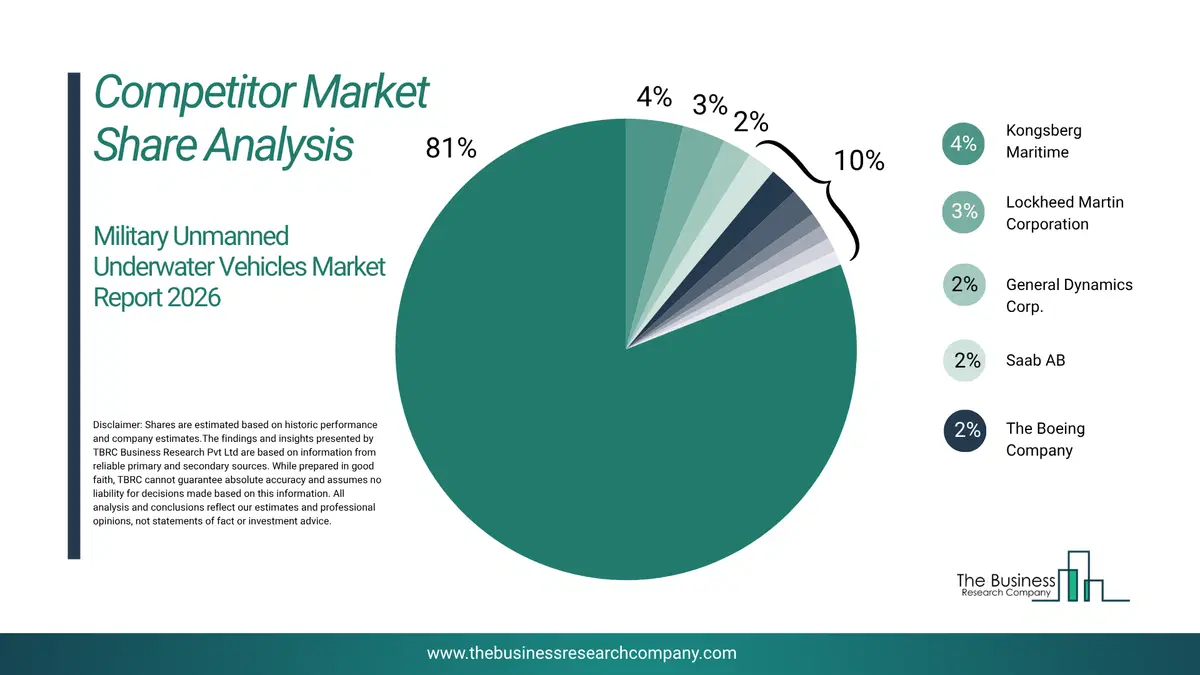
This chart is for illustrative purposes; the full report includes a detailed competitor analysis and comprehensive overview of the top 10 companies in the market.
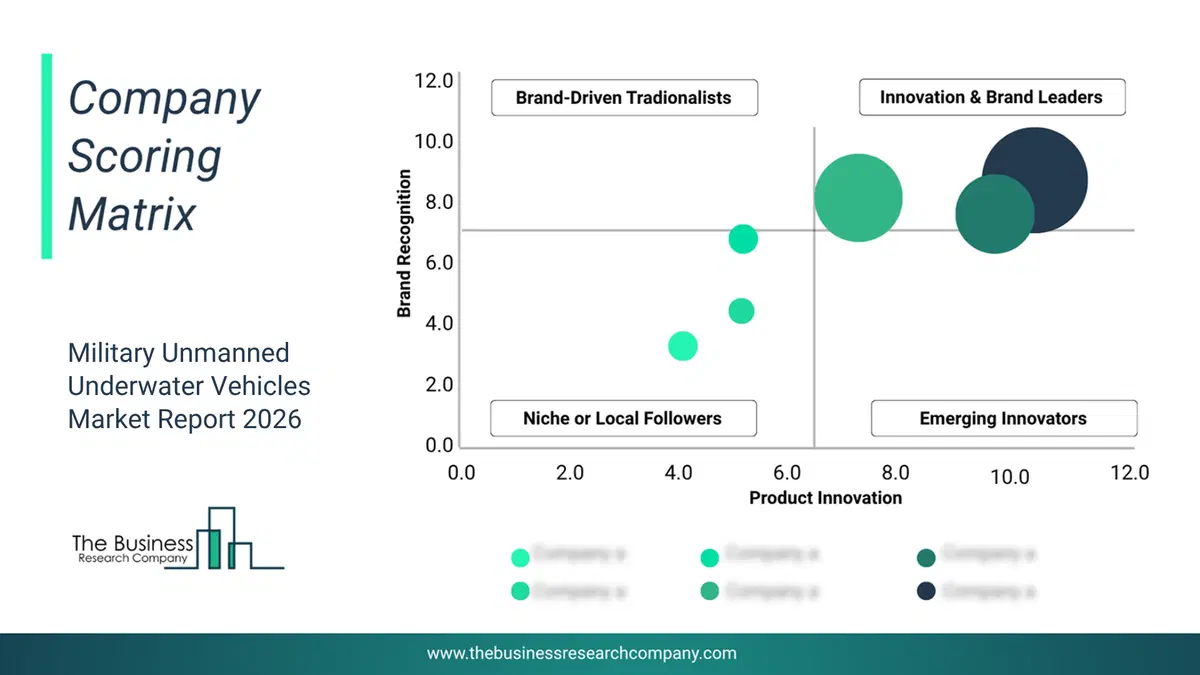
This chart maps companies by product innovation and brand strength, with bubble size indicating relative revenue, helping identify market leaders, challengers, and niche players. This is an illustrative chart; the full report provides a complete and accurate competitive analysis.
Global Military Unmanned Underwater Vehicles Market Trends and Insights
Major companies operating in the military unmanned underwater vehicles market are focusing on developing innovative solutions such as autonomous navigation to enhance mission efficiency, reduce human risk, and operate in complex underwater environments. Autonomous navigation is the ability of a vehicle to move and make decisions on its own without human control, helping UUVs perform missions efficiently, safely, and in complex underwater environments. For instance, in October 2025, Fincantieri S.p.A., an Italy-based shipbuilding and naval technology company, launched its first “DEEP” integrated underwater drone system at the Naval Support and Experimentation Center of La Spezia. The system is designed to protect and monitor critical underwater infrastructure and port areas, performing both civil and defense-related operations. It features a network of underwater sensors, a Command-and-Control Center, autonomous underwater vehicles (AUVs), and an AI-based platform for data analysis, representing a significant step forward in dual-use underwater technology and reinforcing Fincantieri S.p.A.’s position as a global leader in the underwater sector.What Are Latest Mergers And Acquisitions In The Military Unmanned Underwater Vehicles Market? Rheinmetall AG and DOK-ING d.o.o. Form Strategic Partnership to Develop Unmanned Ground Systems
In October 2024, Rheinmetall AG, a Germany-based technology group, partnered with DOK-ING d.o.o. to establish a joint venture for developing and marketing unmanned combat and combat support vehicles. With this partnership, Rheinmetall AG and DOK-ING d.o.o. aim to jointly create advanced European unmanned ground systems, including platforms for reconnaissance, mine-laying, and fire support, setting new technological standards and providing state-of-the-art solutions for military and support operations. DOK-ING d.o.o. is a Croatia-based technology company specializing in the development, production, and maintenance of unmanned, remote-controlled robotic systems.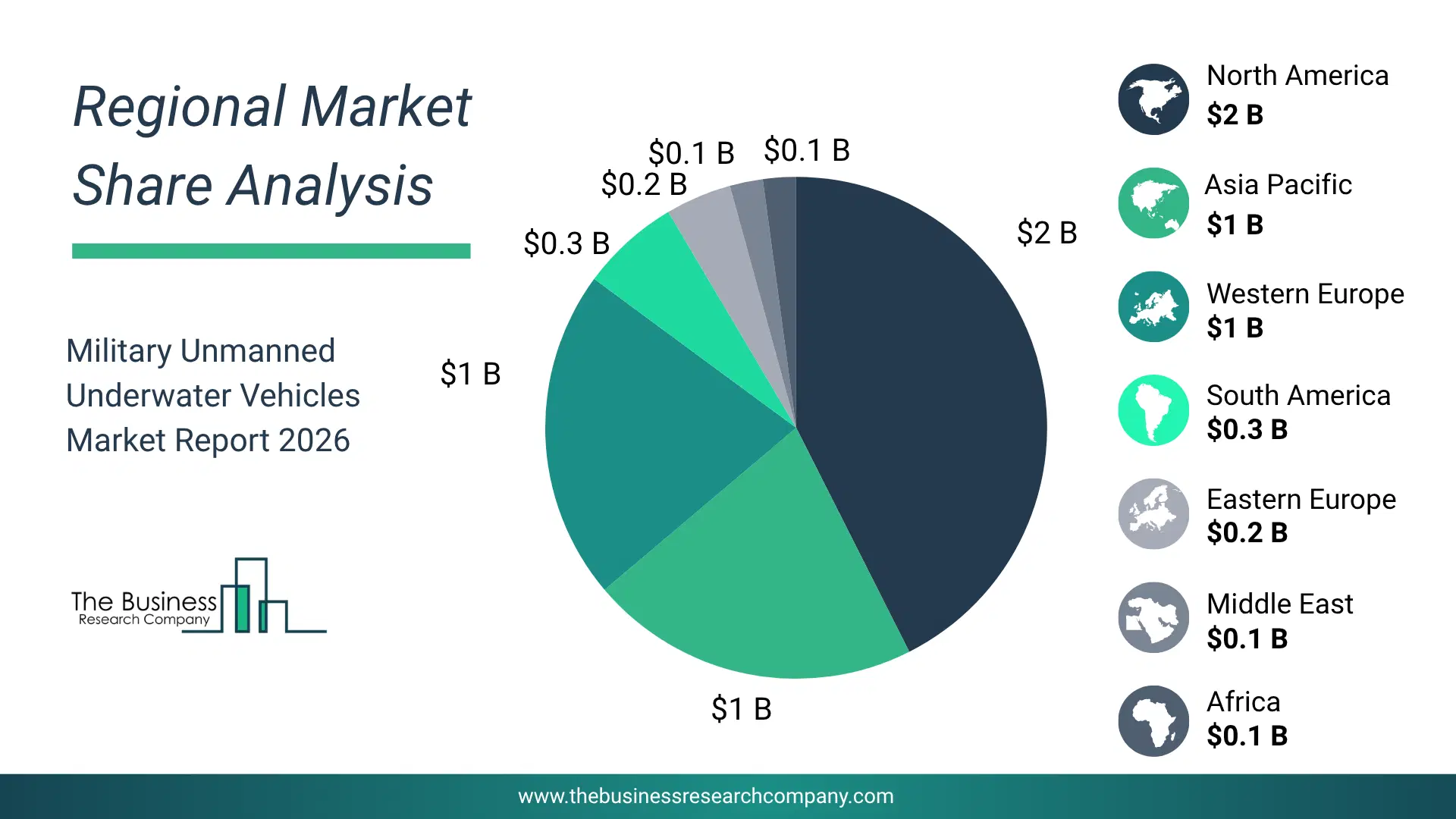
Regional Insights
North America was the largest region in the military unmanned underwater vehicles market in 2025. The regions covered in this market report are Asia-Pacific, South East Asia, Western Europe, Eastern Europe, North America, South America, Middle East, Africa. The countries covered in this market report are Australia, Brazil, China, France, Germany, India, Indonesia, Japan, Taiwan, Russia, South Korea, UK, USA, Canada, Italy, SpainWhat Defines the Military Unmanned Underwater Vehicles Market?
The military unmanned underwater vehicles market consists of sales of Light work class ROV, observation class ROV, micro or mini ROV, mobot, and other types. Values in this market are ‘factory gate’ values, that is the value of goods sold by the manufacturers or creators of the goods, whether to other entities (including downstream manufacturers, wholesalers, distributors, and retailers) or directly to end customers. The value of goods in this market includes related services sold by the creators of the goods.How is Market Value Defined and Measured?
The market value is defined as the revenues that enterprises gain from the sale of goods and/or services within the specified market and geography through sales, grants, or donations in terms of the currency (in USD unless otherwise specified). The revenues for a specified geography are consumption values that are revenues generated by organizations in the specified geography within the market, irrespective of where they are produced. It does not include revenues from resales along the supply chain, either further along the supply chain or as part of other products.
This chart presents market attractiveness based on a quantitative evaluation of growth, competition, strategic alignment, and risk, offering a clear view of opportunity areas for decision-making. This chart is for illustrative purposes; the full report contains the complete analysis.

This chart highlights the Total Addressable Market (TAM) by estimating the maximum revenue opportunity using an assumption-driven approach, supporting strategic planning and opportunity sizing across markets. The chart is illustrative; the full report provides a more comprehensive analysis.
What Key Data and Analysis Are Included in the Military Unmanned Underwater Vehicles Market Report 2026?
The military unmanned underwater vehicles market research report is one of a series of new reports from The Business Research Company that provides market statistics, including industry global market size, regional shares, competitors with the market share, detailed market segments, market trends and opportunities, and any further data you may need to thrive in the military unmanned underwater vehicles industry. The market research report delivers a complete perspective of everything you need, with an in-depth analysis of the current and future state of the industry.Military Unmanned Underwater Vehicles Market Report Forecast Analysis
| Report Attribute | Details |
|---|---|
| Market Size Value In 2026 | $4.62 billion |
| Revenue Forecast In 2030 | $6.23 billion |
| Growth Rate | CAGR of 8.1% from 2026 to 2030 |
| Base Year For Estimation | 2025 |
| Actual Estimates/Historical Data | 2020-2025 |
| Forecast Period | 2026 - 2030 |
| Market Representation | Revenue in USD Billion and CAGR from 2026 to 2030 |
| Segments Covered | Product Type, Propulsion System, Application |
| Regional Scope | Asia-Pacific, Western Europe, Eastern Europe, North America, South America, Middle East, Africa |
| Country Scope | The countries covered in the report are Australia, Brazil, China, France, Germany, India, Indonesia, Japan, Taiwan, Russia, South Korea, UK, USA, Canada, Italy, Spain. |
| Key Companies Profiled | Kongsberg Maritime, Lockheed Martin Corporation, Saab AB, Atlas Elektronik, Teledyne Technologies Incorporated, Boeing, General Dynamics Corporation, Gabri SRL, Eca Group, International Submarine Engineering, L3 Harris Technologies inc, Fugro N.V, Oceaneering International Inc., Blue Robotics Inc., Riptide Autonomous Solutions LLC, Aquabotix Technology Corporation, Deep Ocean Engineering, Eelume AS, Epsilon Systems Solutions, Forum Energy Technologies, Greensea Systems Inc., Hydroid Inc., Kraken Robotics, Ocean Infinity, Planck Aerosystems, Sea Machines Robotics, Sonardyne International Ltd., Subsea 7, Thales Group, The Boeing Company, Liquid Robotics |
| Customization Scope | Request for Customization |
| Pricing And Purchase Options | Explore Purchase Options |