
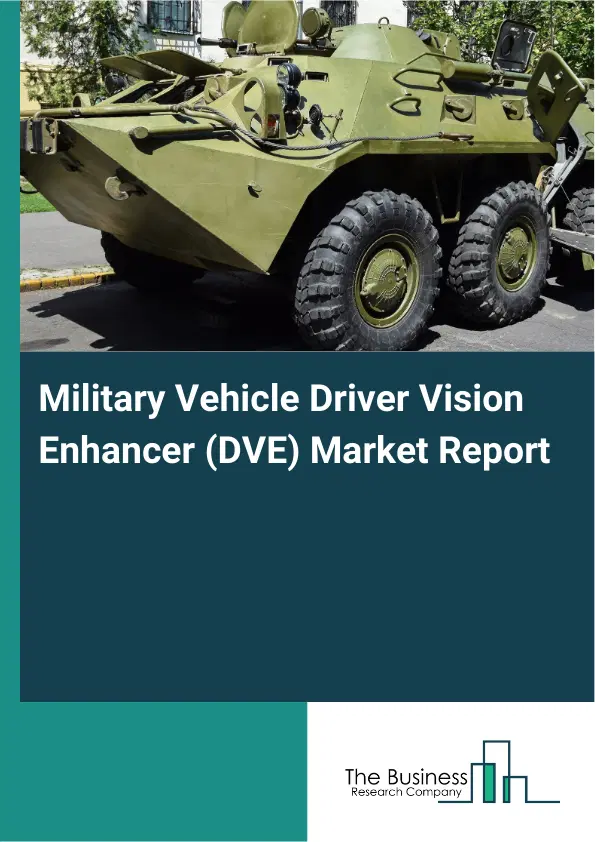
Military Vehicle Driver Vision Enhancer (DVE) Market Report 2026
Global Outlook – By Type (Dual Camera, Single Camera), By Technology (Thermal Imaging Systems, Night Vision Systems, Low-Light Cameras, Lidar Systems), By Application (Surveillance, Reconnaissance, Target Acquisition, Navigation, Driver Safety), By End User (Defense Forces, Law Enforcement Agencies, Border Security Forces) – Market Size, Trends, Strategies, and Forecast to 2030
Military Vehicle Driver Vision Enhancer (DVE) Market Overview
• Military Vehicle Driver Vision Enhancer (DVE) market size has reached to $1.23 billion in 2025 • Expected to grow to $1.82 billion in 2030 at a compound annual growth rate (CAGR) of 8.2% • Growth Driver: Increase In Military Modernization Programs Fueling The Growth Of The Market Due To Rising Geopolitical Tensions And Demand For Advanced Vehicle Systems • Market Trend: Integration Of Advanced Sensor Technologies Enhancing Visibility And Safety In Armored Vehicles • North America was the largest region in 2025 and Asia-Pacific is the fastest growing region.What Is Covered Under Military Vehicle Driver Vision Enhancer (DVE) Market?
The military vehicle driver vision enhancer (DVE) is an advanced imaging system designed to improve a driver's ability to see and operate military vehicles in low-visibility conditions. This system detects heat signatures and provides clear visuals of the terrain, obstacles, and other vehicles, even in complete darkness, smoke, dust, fog, or other challenging environments. The military vehicle driver vision enhancer (DVE) enhances situational awareness and operational safety, allowing military personnel to navigate effectively during day and night missions. The main types of military vehicle driver vision enhancer (DVE) are dual cameras and single cameras. Dual camera systems in military vehicle driver vision enhancers use two integrated cameras to provide enhanced visibility in challenging environments. It uses various technologies such as thermal imaging systems, night vision systems, low-light cameras, and lidar systems and is applied for surveillance, reconnaissance, target acquisition, navigation, and driver safety. It is used by several end users, including defense forces, law enforcement agencies, and border security forces.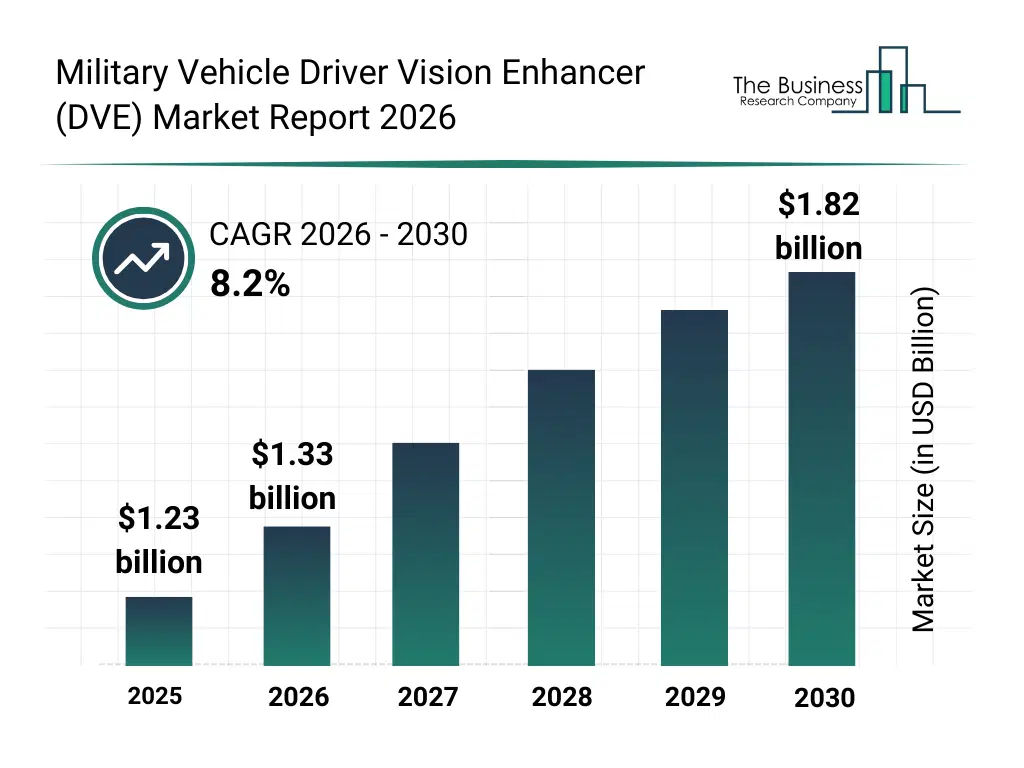
What Is The Military Vehicle Driver Vision Enhancer (DVE) Market Size and Share 2026?
The military vehicle driver vision enhancer (dve) market size has grown strongly in recent years. It will grow from $1.23 billion in 2025 to $1.33 billion in 2026 at a compound annual growth rate (CAGR) of 8.1%. The growth in the historic period can be attributed to increasing deployment of armored and tactical vehicles requiring enhanced night-driving capability, rising adoption of thermal imaging systems to improve visibility in dust, smoke, and fog, advancements in infrared sensors enhancing clarity and detection range, growth in modernization programs upgrading legacy vehicles with dv e solutions, expanding use of dv e systems in convoy protection and battlefield mobility operations.What Is The Military Vehicle Driver Vision Enhancer (DVE) Market Growth Forecast?
The military vehicle driver vision enhancer (dve) market size is expected to see strong growth in the next few years. It will grow to $1.82 billion in 2030 at a compound annual growth rate (CAGR) of 8.2%. The growth in the forecast period can be attributed to growing integration of dv e systems with advanced driver-assist and autonomous navigation technologies, rising demand for lightweight and ruggedized displays and control units, increasing investment in high-resolution uncooled thermal sensors to improve performance and reduce cost, expansion of lifecycle support and maintenance services as fleets adopt next-generation dv e platforms, accelerating development of network-enabled dv e systems enabling shared situational awareness across vehicles. Major trends in the forecast period include increasing demand for all-weather and all-terrain driving capability in armored and tactical vehicles, growing retrofit and modernization programs for legacy military vehicle fleets with advanced dve kits, shift toward compact, rugged, and low-swap thermal camera modules for driver viewing, rising adoption of multi-spectral driver viewing (thermal, low-light visible, and near-ir) to expand usable scenarios, enhanced focus on crew safety and ergonomics through better display layouts, intuitive controls, and minimal driver distraction.
Global Military Vehicle Driver Vision Enhancer (DVE) Market Segmentation
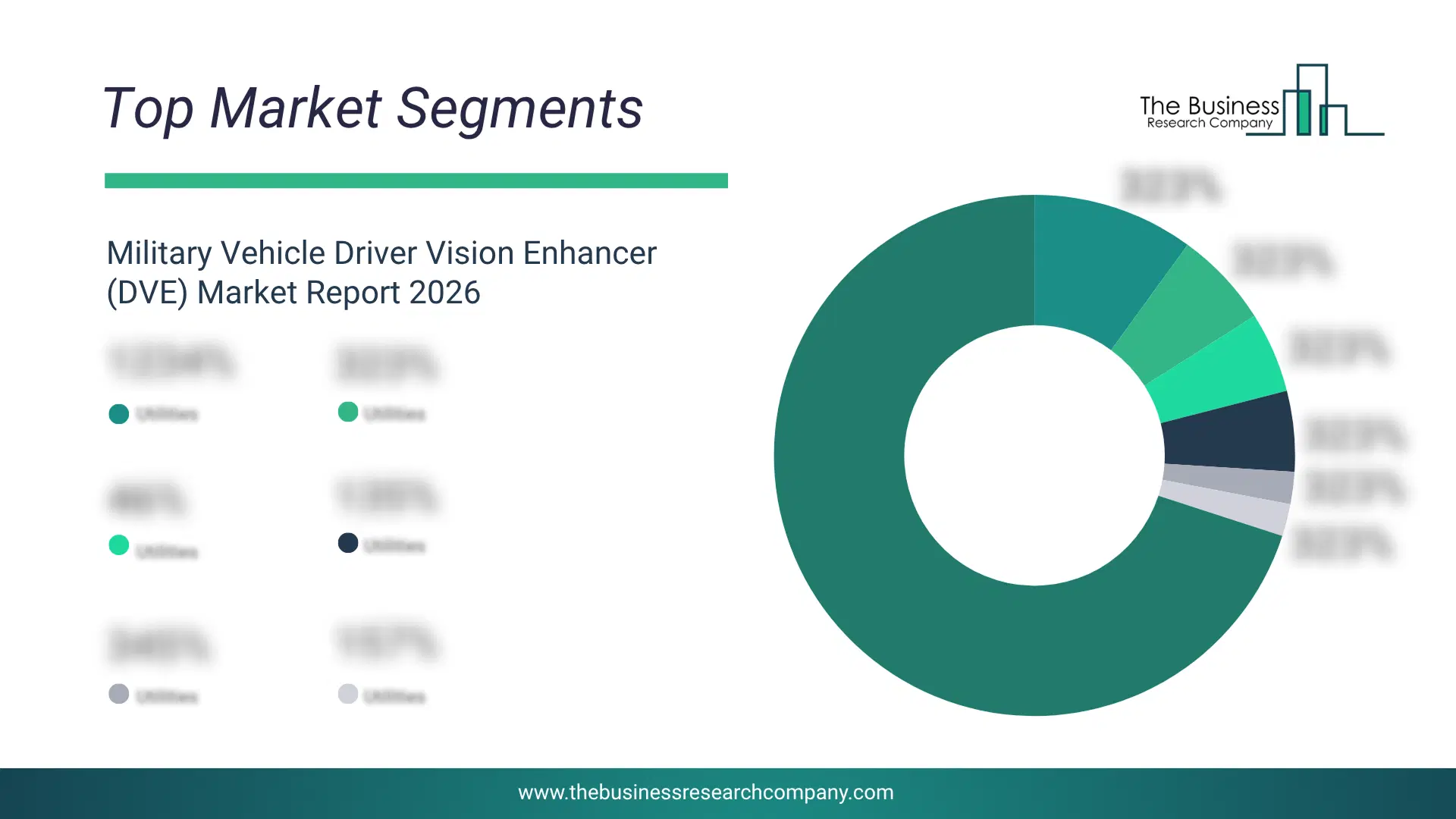
1) By Type: Dual Camera, Single Camera 2) By Technology: Thermal Imaging Systems, Night Vision Systems, Low-Light Cameras, Lidar Systems 3) By Application: Surveillance, Reconnaissance, Target Acquisition, Navigation, Driver Safety 4) By End User: Defense Forces, Law Enforcement Agencies, Border Security Forces Subsegments: 1) By Dual Camera: Long-Range Infrared Camera, Short-Range Infrared Camera, Thermal Imaging Camera, Visible Light Camera 2) By Single Camera: Monocular Thermal Camera, Night Vision Camera, Low-Light Visible Camera, Fused Sensor CameraWhat Is Driver Of The Military Vehicle Driver Vision Enhancer (DVE) Market?
The increasing military modernization programs are expected to drive growth in the military vehicle driver vision enhancer (DVE) market going forward. Military modernization programs are initiatives by governments to strengthen armed forces by incorporating advanced technology, modern equipment, and updated strategies to address present and future security challenges. Military modernization programs are rising due to increasing geopolitical tensions, prompting nations to strengthen their defense capabilities with advanced technologies to ensure national security and maintain strategic advantage. Increasing military modernization programs support military vehicle driver vision enhancers (DVE) by driving investment in advanced situational awareness systems, ensuring that military vehicles are equipped to operate effectively in low-visibility and high-risk environments. For instance, in December 2024, a report published by the Department of Defense, a US-based executive department, stated that China’s public defense budget increased to $220 billion in 2023, in inflation-adjusted terms, aligning with its 2027 and 2035 military modernization goals. Therefore, the increasing military modernization programs are driving the growth of the military vehicle driver vision enhancer (DVE) industry.Key Players In The Global Military Vehicle Driver Vision Enhancer (DVE) Market
Major companies operating in the military vehicle driver vision enhancer (dve) market are Raytheon Company, BAE Systems plc, Safran S.A., Thales Group, L3Harris Technologies Inc., Rheinmetall AG, Elbit Systems Ltd., Leonardo DRS, Curtiss-Wright Corporation, ASELSAN A.S., Hensoldt AG, Excelitas Technologies Corp., Bertin Technologies SAS, Kappa optronics GmbH, Opgal Optronic Industries Ltd., Nedinsco B.V., Digital Systems Engineering Inc., Copenhagen Sensor Technology A/S, Allwan Security France, NVTS Night Vision Technology Solutions Inc.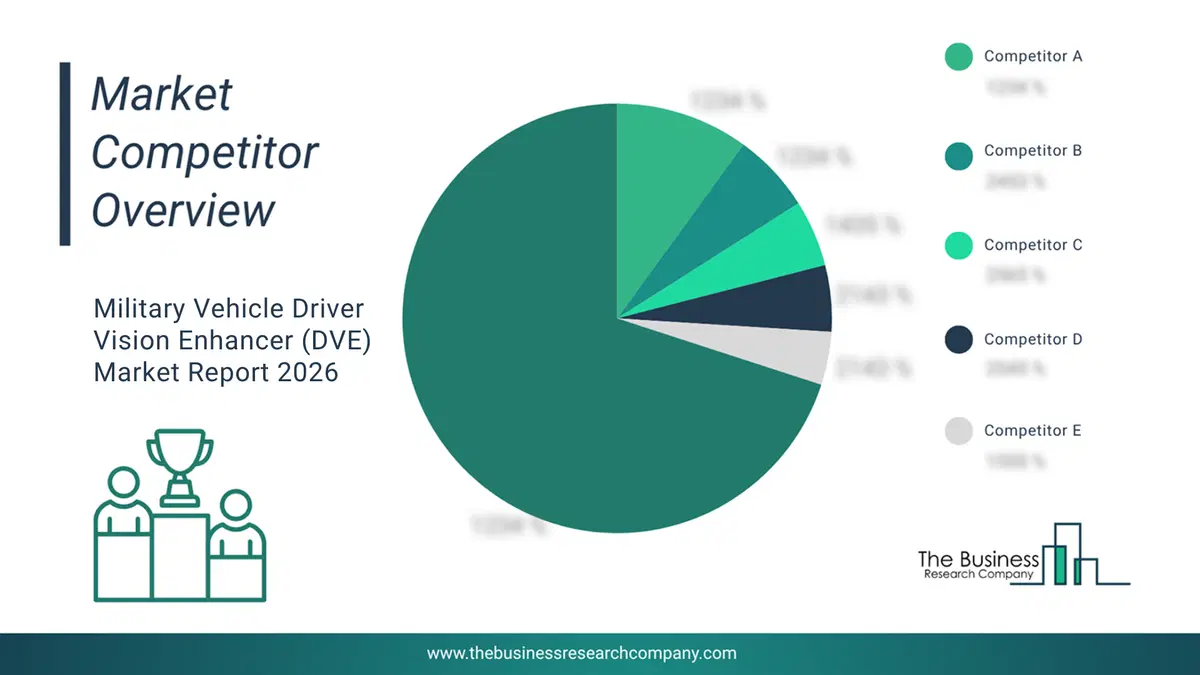
This chart is for illustrative purposes; the full report includes a detailed competitor analysis and comprehensive overview of the top 10 companies in the market.
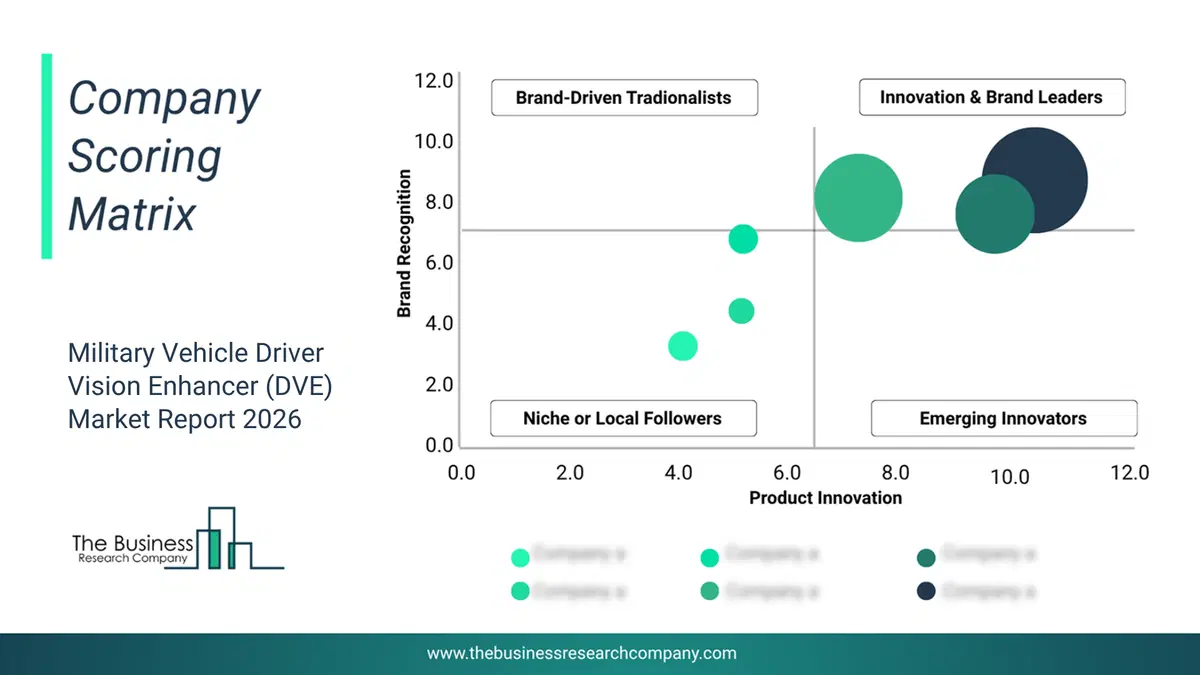
This chart maps companies by product innovation and brand strength, with bubble size indicating relative revenue, helping identify market leaders, challengers, and niche players. This is an illustrative chart; the full report provides a complete and accurate competitive analysis.
Global Military Vehicle Driver Vision Enhancer (DVE) Market Trends and Insights
Major companies operating in the military vehicle driver vision enhancer (DVE) market are focusing on developing advanced solutions, such as day sight sensor-integrated DVEs, to improve operational safety and efficiency. Day sight sensors-integrated DVEs are systems that use optical sensors to enhance driver visibility and situational awareness in military vehicles during daylight conditions. For instance, in May 2023, Nedinsco BV, a Netherlands-based developer of opto-mechatronical systems, launched the SCOPUS Driver Vision Enhancement camera solution for armored military vehicles. A key feature of the SCOPUS system is its wide 106-degree field of view combined with day sight and LWIR thermal sensors, which deliver enhanced image fusion to support better situational awareness and navigation in challenging visibility conditions. Designed to endure shocks up to 150G and meet various military standards, it offers dependable performance and smooth integration into armored vehicles such as main battle tanks and tracked howitzers.What Are Latest Mergers And Acquisitions In The Military Vehicle Driver Vision Enhancer (DVE) Market? Rheinmetall And Honeywell Collaborate On Advanced Vision Systems And Power Units For Military Vehicles
In September 2024, Rheinmetall AG, a Germany-based technology company, partnered with Honeywell to create innovative vision systems and auxiliary power units for use in various vehicles, including those used by the military. Through their partnership, the companies aim to create next-generation visual systems based on the Honeywell 360 Display, using a network of thermal and daylight cameras along with augmented and mixed reality to offer drivers complete situational awareness without relying on traditional sightlines. Honeywell International Inc. is a US-based manufacturer of military vehicle driver vision enhancer (DVE) systems.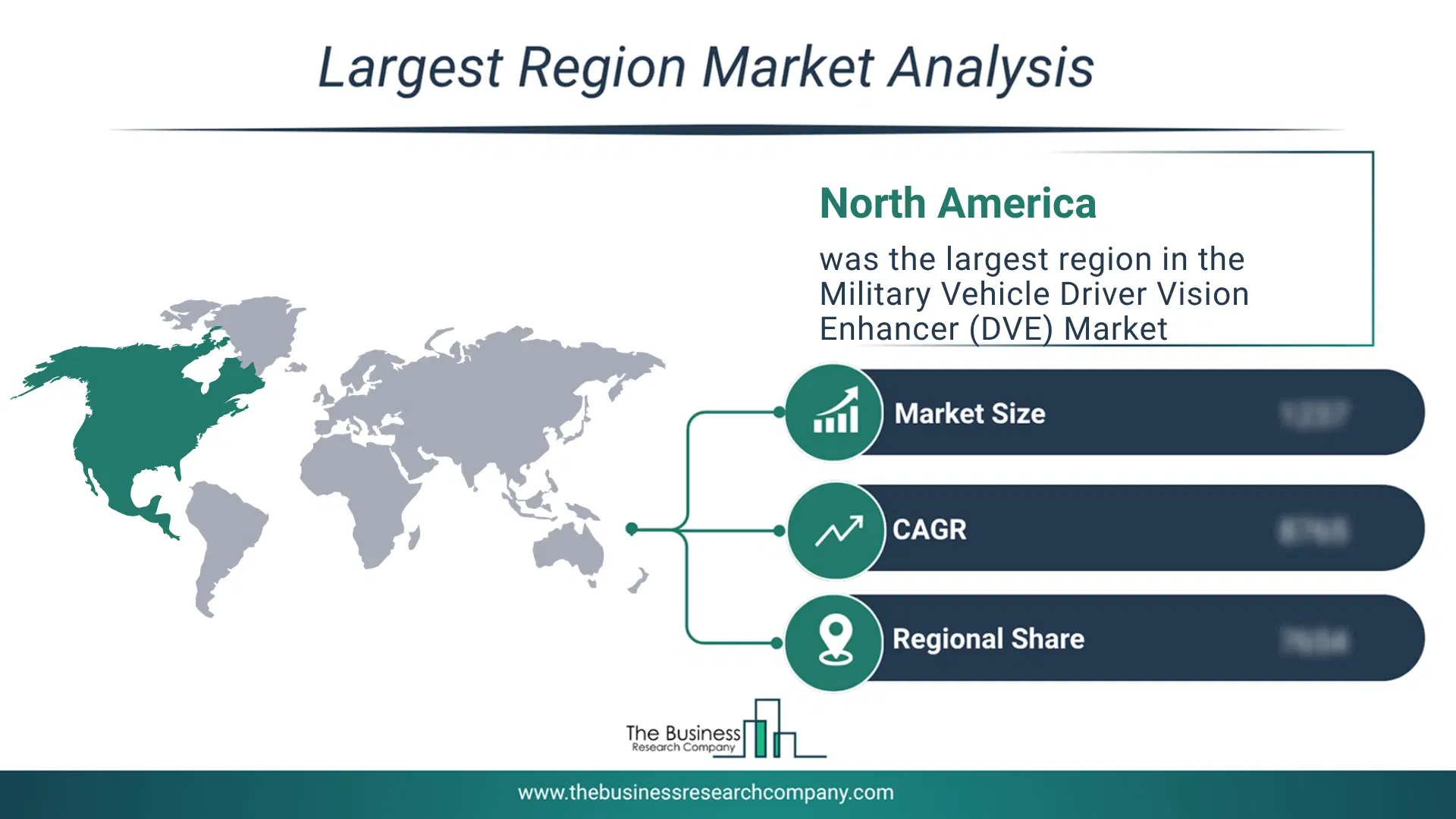
Regional Insights
North America was the largest region in the military vehicle driver vision enhancer (DVE) market in 2025. Asia-Pacific is expected to be the fastest-growing region in the forecast period. The regions covered in this market report are Asia-Pacific, South East Asia, Western Europe, Eastern Europe, North America, South America, Middle East, Africa. The countries covered in this market report are Australia, Brazil, China, France, Germany, India, Indonesia, Japan, Taiwan, Russia, South Korea, UK, USA, Canada, Italy, SpainWhat Defines the Military Vehicle Driver Vision Enhancer (DVE) Market?
The military vehicle driver vision enhancer (DVE) market consists of revenues earned by entities by providing services such as system integration services, repair services, field technical assistance, and lifecycle management. The market value includes the value of related goods sold by the service provider or included within the service offering. The military vehicle driver vision enhancer (DVE) market also includes sales of display monitors, control units, wiring harnesses, mounting brackets, and protective lens covers. Values in this market are ‘factory gate’ values, that is the value of goods sold by the manufacturers or creators of the goods, whether to other entities (including downstream manufacturers, wholesalers, distributors and retailers) or directly to end customers. The value of goods in this market includes related services sold by the creators of the goods.How is Market Value Defined and Measured?
The market value is defined as the revenues that enterprises gain from the sale of goods and/or services within the specified market and geography through sales, grants, or donations in terms of the currency (in USD unless otherwise specified). The revenues for a specified geography are consumption values that are revenues generated by organizations in the specified geography within the market, irrespective of where they are produced. It does not include revenues from resales along the supply chain, either further along the supply chain or as part of other products.
This chart presents market attractiveness based on a quantitative evaluation of growth, competition, strategic alignment, and risk, offering a clear view of opportunity areas for decision-making. This chart is for illustrative purposes; the full report contains the complete analysis.

This chart highlights the Total Addressable Market (TAM) by estimating the maximum revenue opportunity using an assumption-driven approach, supporting strategic planning and opportunity sizing across markets. The chart is illustrative; the full report provides a more comprehensive analysis.
What Key Data and Analysis Are Included in the Military Vehicle Driver Vision Enhancer (DVE) Market Report 2026?
The military vehicle driver vision enhancer (dve) market research report is one of a series of new reports from The Business Research Company that provides market statistics, including industry global market size, regional shares, competitors with the market share, detailed market segments, market trends and opportunities, and any further data you may need to thrive in the military vehicle driver vision enhancer (dve) industry. The market research report delivers a complete perspective of everything you need, with an in-depth analysis of the current and future state of the industry.Military Vehicle Driver Vision Enhancer (DVE) Market Report Forecast Analysis
| Report Attribute | Details |
|---|---|
| Market Size Value In 2026 | $1.33 billion |
| Revenue Forecast In 2030 | $1.82 billion |
| Growth Rate | CAGR of 8.2% from 2026 to 2030 |
| Base Year For Estimation | 2025 |
| Actual Estimates/Historical Data | 2020-2025 |
| Forecast Period | 2026 - 2030 |
| Market Representation | Revenue in USD Billion and CAGR from 2026 to 2030 |
| Segments Covered | Type, Technology, Application, End User |
| Regional Scope | Asia-Pacific, Western Europe, Eastern Europe, North America, South America, Middle East, Africa |
| Country Scope | The countries covered in the military vehicle driver vision enhancer (dve) market report are Australia, Brazil, China, France, Germany, India, Indonesia, Japan, Taiwan, Russia, South Korea, UK, USA, Canada, Italy, Spain |
| Key Companies Profiled | Raytheon Company, BAE Systems plc, Safran S.A., Thales Group, L3Harris Technologies Inc., Rheinmetall AG, Elbit Systems Ltd., Leonardo DRS, Curtiss-Wright Corporation, ASELSAN A.Ş., Hensoldt AG, Excelitas Technologies Corp., Bertin Technologies SAS, Kappa optronics GmbH, Opgal Optronic Industries Ltd., Nedinsco B.V., Digital Systems Engineering Inc., Copenhagen Sensor Technology A/S, Allwan Security France, NVTS Night Vision Technology Solutions Inc. |
| Customization Scope | Request for Customization |
| Pricing And Purchase Options | Explore Purchase Options |