
Milk Protein Market Report 2026
Global Outlook – By Type (Milk Protein Concentrate, Milk Protein Isolate [MPI], Milk Protein Hydrolysates, Casein And Caseinates, Whey Protein Concentrate, Whey Protein Isolate, Other Types), By Form (Dry, Liquid), By Livestock (Cow, Buffalo, Goat), By Application (Dairy Products, Frozen Desserts, Infant Formula, Dietary Supplements, Bakery, Confectionery, Beverages, Sweet, Savory Snacks), By Distribution Channel (Online, Offline ) – Market Size, Trends, Strategies, and Forecast to 2030
Milk Protein Market Overview
• Milk Protein market size has reached to $13.61 billion in 2025 • Expected to grow to $18.97 billion in 2030 at a compound annual growth rate (CAGR) of 6.9% • Growth Driver: Surge In Food And Beverage Industry Fuels Expansion Of The Milk Protein Market • Market Trend: Revolutionizing Milk Protein Processing • North America was the largest region in 2025.What Is Covered Under Milk Protein Market?
Milk protein is a natural component of milk, mainly comprising casein and whey, both rich in essential amino acids. It supports muscle repair and immune health, making it a popular ingredient in foods, supplements, and beverages for its nutritional benefits and ability to boost muscle growth and provide lasting energy. The main types of milk protein are milk protein concentrate, milk protein isolate, milk protein hydrolysates, casein and caseinates, whey protein concentrate, whey protein isolate, and other types. Milk protein concentrate is a concentrated milk product that contains milk protein content. These are available in dry and liquid forms. The livestock involved are cows, buffalo, and goats. These are used in various applications such as dairy products, frozen desserts, infant formula, dietary supplements, bakery, confectionery, beverages, sweet snacks, and savory snacks, and other applications and are distributed online and offline.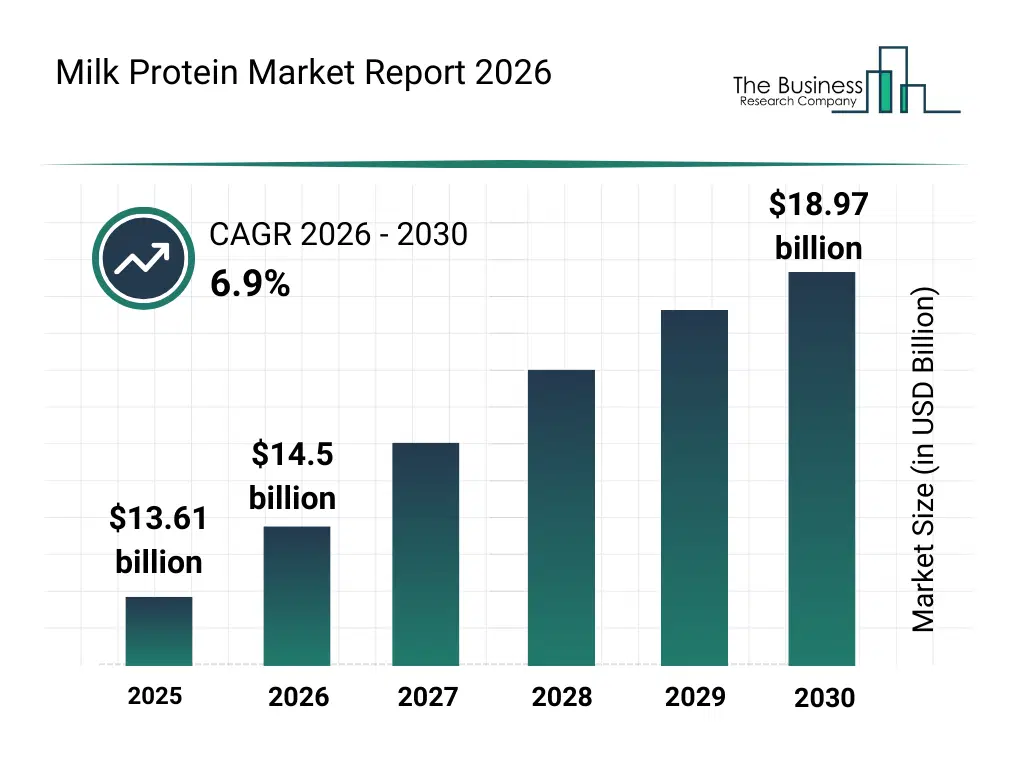
What Is The Milk Protein Market Size and Share 2026?
The milk protein market size has grown strongly in recent years. It will grow from $13.61 billion in 2025 to $14.5 billion in 2026 at a compound annual growth rate (CAGR) of 6.6%. The growth in the historic period can be attributed to growth of dairy processing industries, increasing consumption of protein-rich diets, expansion of sports nutrition markets, availability of advanced dairy fractionation technologies, rising use of milk proteins in packaged foods.What Is The Milk Protein Market Growth Forecast?
The milk protein market size is expected to see strong growth in the next few years. It will grow to $18.97 billion in 2030 at a compound annual growth rate (CAGR) of 6.9%. The growth in the forecast period can be attributed to increasing demand for personalized nutrition products, growing focus on muscle health and aging populations, expansion of ready-to-drink protein beverages, rising innovation in protein hydrolysates, increasing penetration of online nutrition channels. Major trends in the forecast period include increasing demand for high-protein functional foods, rising use of milk proteins in sports nutrition, expansion of infant formula applications, growing adoption of protein-enriched beverages, enhanced focus on clean-label dairy proteins.
Global Milk Protein Market Segmentation
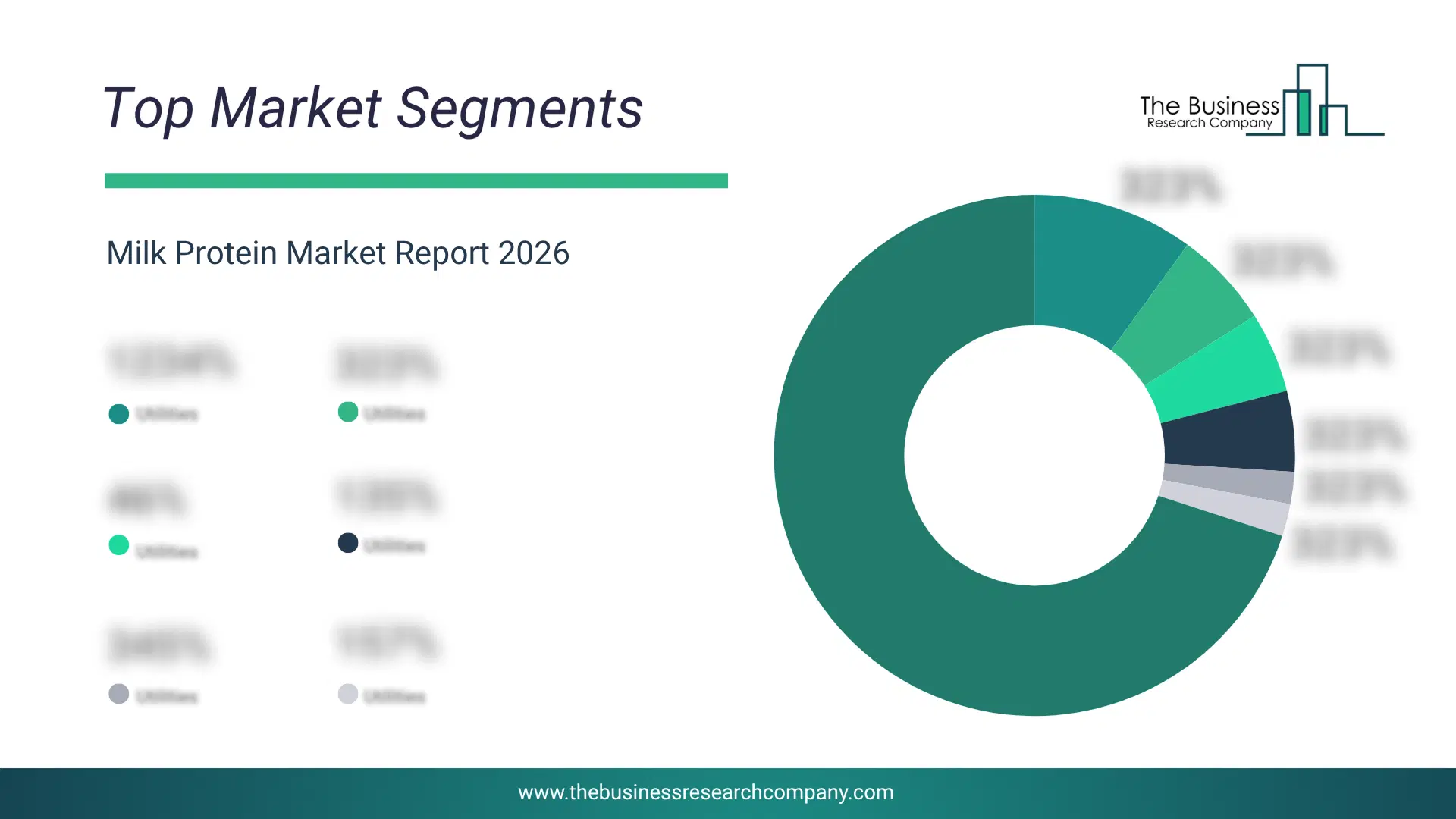
1) By Type: Milk Protein Concentrate, Milk Protein Isolate [MPI], Milk Protein Hydrolysates, Casein And Caseinates, Whey Protein Concentrate, Whey Protein Isolate, Other Types 2) By Form: Dry, Liquid 3) By Livestock: Cow, Buffalo, Goat 4) By Application: Dairy Products, Frozen Desserts, Infant Formula, Dietary Supplements, Bakery, Confectionery, Beverages, Sweet, Savory Snacks 5) By Distribution Channel: Online, Offline Subsegments: 1) By Milk Protein Concentrate (MPC): MPC 40% Protein, MPC 70% Protein 2) By Milk Protein Isolate (MPI): MPI With 90% Protein, MPI With 95% Protein 3) By Milk Protein Hydrolysates: Low-Degree Hydrolysates, High-Degree Hydrolysates 4) By Casein And Caseinates: Sodium Caseinate, Calcium Caseinate, Acid Casein 5) By Whey Protein Concentrate (WPC): WPC 34%, WPC 80% 6) By Whey Protein Isolate (WPI): WPI With 90% Protein, Hydrolyzed WPI 7) By Other Types: Milk Peptides, Blends Of Milk ProteinsWhat Is The Driver Of The Milk Protein Market?
The increasing food and beverage industry is expected to propel the growth of the milk protein market going forward. The food and beverage industry is a vast and complex sector that encompasses the production, processing, distribution, and sale of food and beverages. Milk protein is increasingly being used in the food and beverage industry due to its unique functional and nutritional properties to enhance the texture, flavor, and nutritional value of a wide range of products. For instance, in July 2025, according to the Agriculture and Agri-Food Department Canada, a Canada-based government department, in 2024, the food and beverage processing sector remained Canada’s largest manufacturing industry by production value, generating $173.4 billion in goods. This represented 20.3% of all manufacturing sales and contributed 1.6% to the national GDP. Exports of processed food and beverage products reached a record $59.8 billion, an increase of 3.8% from 2023, and accounted for 34.5% of the industry’s total production value. Therefore, the increasing food and beverage industry is driving the growth of the milk protein industry going forward.Key Players In The Global Milk Protein Market
Major companies operating in the milk protein market are Royal FrieslandCampina N.V., Fonterra Co-operative Group Limited, Arla Foods amba, Amco Proteins Company, Saputo Inc., Glanbia plc, Kerry Group plc, Havero Hoogwegt Group B.V., Lactalis Ingredients, Sachsenmilch Leppersdorf GmbH, Charotar Casein Company, Hilmar Ingredients, Milk Specialties Global, Idaho Milk Products, Agropur Dairy Cooperative, Carbery Group Limited, Davisco Foods International Inc., Leprino Foods Company, Lactose Limited, Erie Foods International Inc., Grande Custom Ingredients Group, Milkaut S.A., Armor Proteines, Agri-Mark Inc., Arion Dairy Products B.V.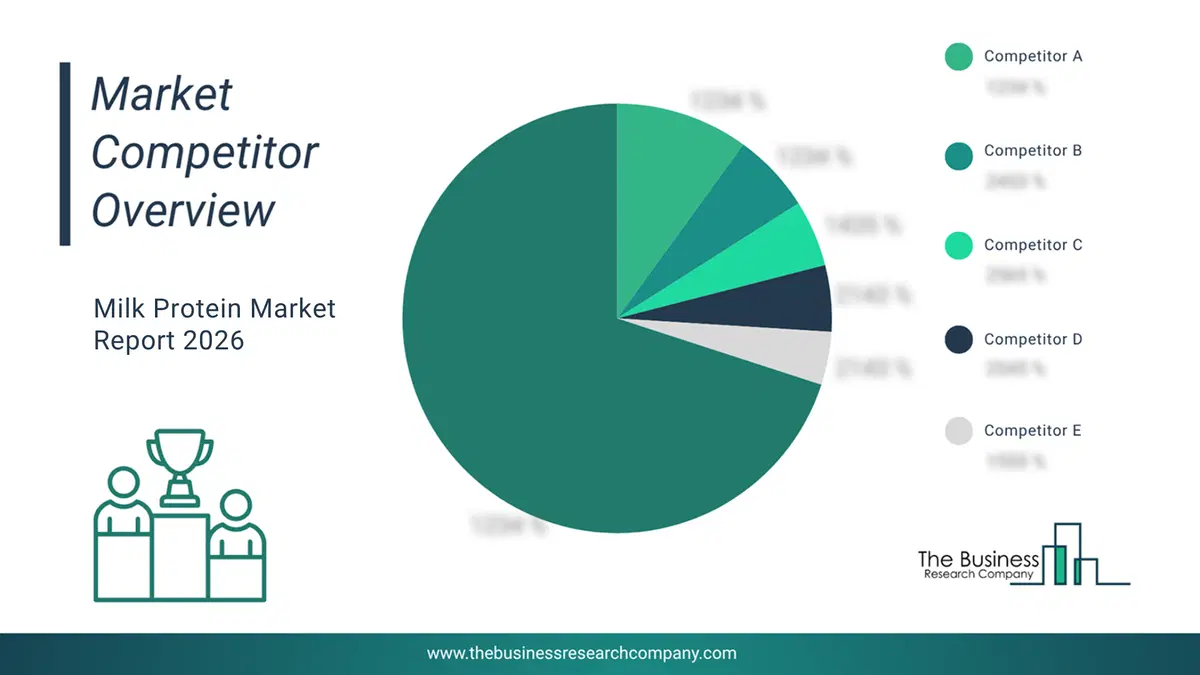
This chart is for illustrative purposes; the full report includes a detailed competitor analysis and comprehensive overview of the top 10 companies in the market.
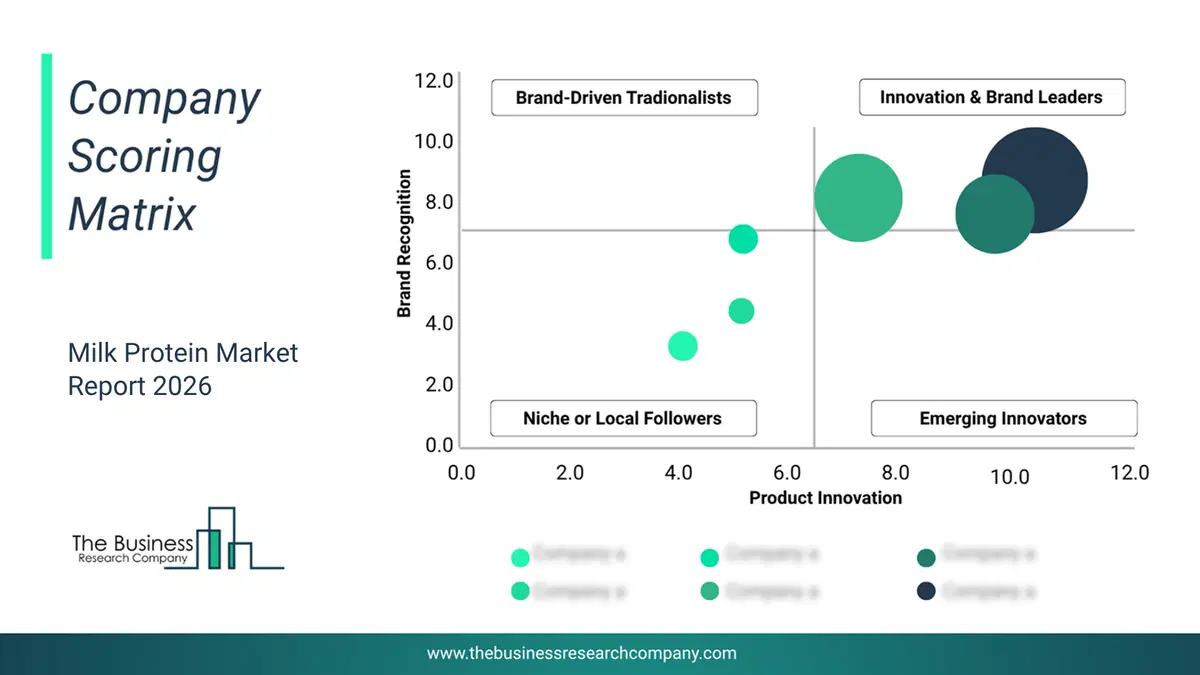
This chart maps companies by product innovation and brand strength, with bubble size indicating relative revenue, helping identify market leaders, challengers, and niche players. This is an illustrative chart; the full report provides a complete and accurate competitive analysis.
Global Milk Protein Market Trends and Insights
Major players in the milk protein market are concentrating on creating new technological advancements, such as fractionation process, to improve their competitiveness. Fractionation is a separation process that involves separating a mixture into its component parts based on their differences in physical or chemical properties. For instance, In November 2023, Valio Ltd, a Finland-based manufacturer of dairy products launched Valio Eila MPC 65. Valio Eila MPC 65 is an innovative concentrate designed to enhance the flavor and texture of high-protein foods, addressing common issues such as gritty textures and unpleasant flavors often associated with protein powders. This versatile ingredient is applicable in various products, including protein puddings, shakes, ice creams, and drinks. It allows manufacturers to create high-protein offerings that are both fresh-tasting and enjoyable to consume. Ultimately, this concentrate improves the overall quality of protein-rich food products. Valio Eila MPC 65 stands out as a solution for enhancing consumer satisfaction in high-protein options.What Are Latest Mergers And Acquisitions In The Milk Protein Market?
In December 2023, Butterfly, a US- based private equity firm specializing in the food sector, acquired Milk Specialties for an undisclosed amount. With this acquisition, Butterfly seeks to expand its portfolio in both human and animal nutrition. Milk Specialties, known as the world's largest producer of whey protein isolate, complements Butterfly's emphasis on high-quality nutrition products. Milk Specialties, a U.S.-based manufacturer of nutritional ingredients, specializes in processing raw dairy inputs into high-quality functional ingredients for both human and animal nutrition.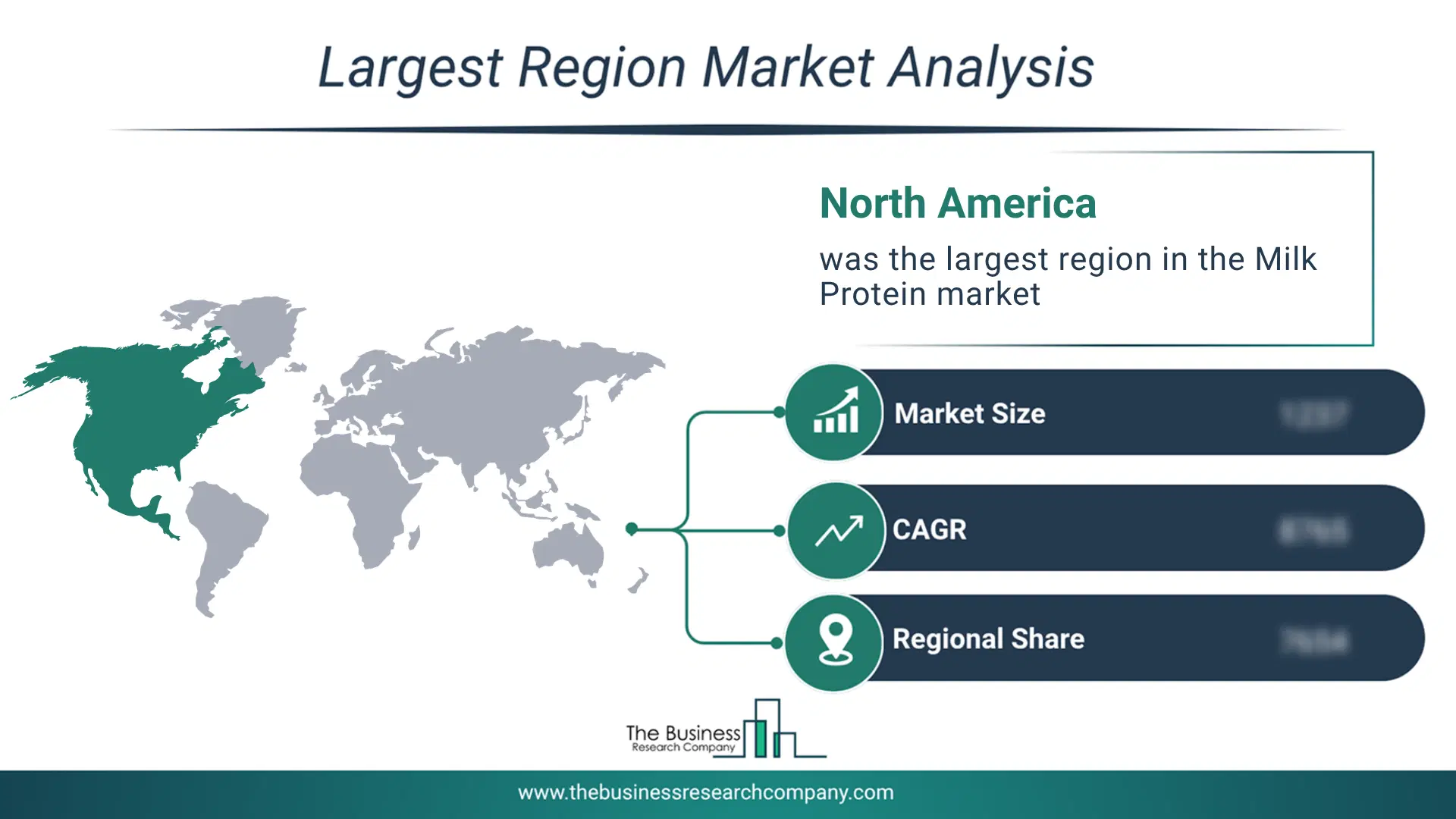
Regional Outlook
North America was the largest region in the milk protein market share in 2025. The regions covered in this market report are Asia-Pacific, South East Asia, Western Europe, Eastern Europe, North America, South America, Middle East and Africa. The countries covered in this market report are Australia, Brazil, China, France, Germany, India, Indonesia, Japan, Taiwan, Russia, South Korea, UK, USA, Italy, Spain, CanadaWhat Defines the Milk Protein Market?
The milk protein market consists of sales of protein powder, protein bars, and protein milk. Values in this market are ‘factory gate’ values, that is the value of goods sold by the manufacturers or creators of the goods, whether to other entities (including downstream manufacturers, wholesalers, distributors and retailers) or directly to end customers. The value of goods in this market includes related services sold by the creators of the goods.How is Market Value Defined and Measured?
The market value is defined as the revenues that enterprises gain from the sale of goods and/or services within the specified market and geography through sales, grants, or donations in terms of the currency (in USD unless otherwise specified). The revenues for a specified geography are consumption values that are revenues generated by organizations in the specified geography within the market, irrespective of where they are produced. It does not include revenues from resales along the supply chain, either further along the supply chain or as part of other products.
This chart presents market attractiveness based on a quantitative evaluation of growth, competition, strategic alignment, and risk, offering a clear view of opportunity areas for decision-making. This chart is for illustrative purposes; the full report contains the complete analysis.

This chart highlights the Total Addressable Market (TAM) by estimating the maximum revenue opportunity using an assumption-driven approach, supporting strategic planning and opportunity sizing across markets. The chart is illustrative; the full report provides a more comprehensive analysis.
What Key Data and Analysis Are Included in the Milk Protein Market Report 2026?
The milk protein market research report is one of a series of new reports from The Business Research Company that provides market statistics, including industry global market size, regional shares, competitors with the market share, detailed market segments, market trends and opportunities, and any further data you may need to thrive in the milk protein industry. The market research report delivers a complete perspective of everything you need, with an in-depth analysis of the current and future state of the industry.Milk Protein Market Report Forecast Analysis
| Report Attribute | Details |
|---|---|
| Market Size Value In 2026 | $14.5 billion |
| Revenue Forecast In 2030 | $18.97 billion |
| Growth Rate | CAGR of 6.6% from 2026 to 2030 |
| Base Year For Estimation | 2025 |
| Actual Estimates/Historical Data | 2020-2025 |
| Forecast Period | 2026 - 2030 |
| Market Representation | Revenue in USD Billion and CAGR from 2026 to 2030 |
| Segments Covered | Type, Form, Livestock, Application, Distribution Channel |
| Regional Scope | Asia-Pacific, Western Europe, Eastern Europe, North America, South America, Middle East, Africa |
| Country Scope | The countries covered in the report are Australia, Brazil, China, France, Germany, India, Indonesia, Japan, Taiwan, Russia, South Korea, UK, USA, Canada, Italy, Spain. |
| Key Companies Profiled | Royal FrieslandCampina N.V., Fonterra Co-operative Group Limited, Arla Foods amba, Amco Proteins Company, Saputo Inc., Glanbia plc, Kerry Group plc, Havero Hoogwegt Group B.V., Lactalis Ingredients, Sachsenmilch Leppersdorf GmbH, Charotar Casein Company, Hilmar Ingredients, Milk Specialties Global, Idaho Milk Products, Agropur Dairy Cooperative, Carbery Group Limited, Davisco Foods International Inc., Leprino Foods Company, Lactose Limited, Erie Foods International Inc., Grande Custom Ingredients Group, Milkaut S.A., Armor Proteines, Agri-Mark Inc., Arion Dairy Products B.V. |
| Customization Scope | Request for Customization |
| Pricing And Purchase Options | Explore Purchase Options |