
Mineral-Oil-Based Lubricants Market Report 2026
Global Outlook – By Product Type (Engine Oil, Gear Oil, Hydraulic Oil, Compressor Oil, Turbine Oil, Transformer Oil), By Additive Technology (Anti Wear Additives, Detergents And Dispersants, Viscosity Modifiers, Corrosion Inhibitors, Foam Inhibitors), By Distribution Channel (Direct Sales, Distributors And Wholesalers, Retail Stores, Online Sales), By Application (Automotive, Industrial Machinery, Power Generation, Marine, Metalworking, Railways), By End Use Industry (Transportation, Manufacturing And Heavy Industry, Mining And Construction, Agriculture And Forestry) – Market Size, Trends, Strategies, and Forecast to 2030
Mineral-Oil-Based Lubricants Market Overview
• Mineral-Oil-Based Lubricants market size has reached to $33.66 billion in 2025 • Expected to grow to $42.25 billion in 2030 at a compound annual growth rate (CAGR) of 4.6% • Growth Driver: Growth In Vehicle Ownership And Automotive Production Fueling The Growth Of The Market Due To Increasing Demand For Engine Protection And Equipment Performance Enhancement Solutions • Market Trend: Adoption Of Eco-friendly Packaging In Lubricant Product Development Enhancing Sustainability And Reducing Environmental Impact • Asia-Pacific was the largest region and fastest growing region.What Is Covered Under Mineral-Oil-Based Lubricants Market?
Mineral-oil-based lubricants are lubricating fluids derived from refined crude oil that are used to reduce friction and wear between moving mechanical parts. They are formulated by processing base mineral oils and blending them with additives to improve properties such as viscosity stability, oxidation resistance, and thermal performance. The main product types of mineral-oil-based lubricants include engine oil, gear oil, hydraulic oil, compressor oil, turbine oil, and transformer oil. Engine oil refers to a mineral-oil-based lubricant formulated to reduce friction, minimize wear, dissipate heat, and protect internal engine components during operation. These lubricants incorporate additive technologies such as anti wear additives, detergents and dispersants, viscosity modifiers, corrosion inhibitors, and foam inhibitors and are distributed through direct sales, distributors and wholesalers, retail stores, and online sales. The various applications involved are automotive, industrial machinery, power generation, marine, metalworking, and railways and they are utilized by end use industries including transportation, manufacturing and heavy industry, mining and construction, and agriculture and forestry.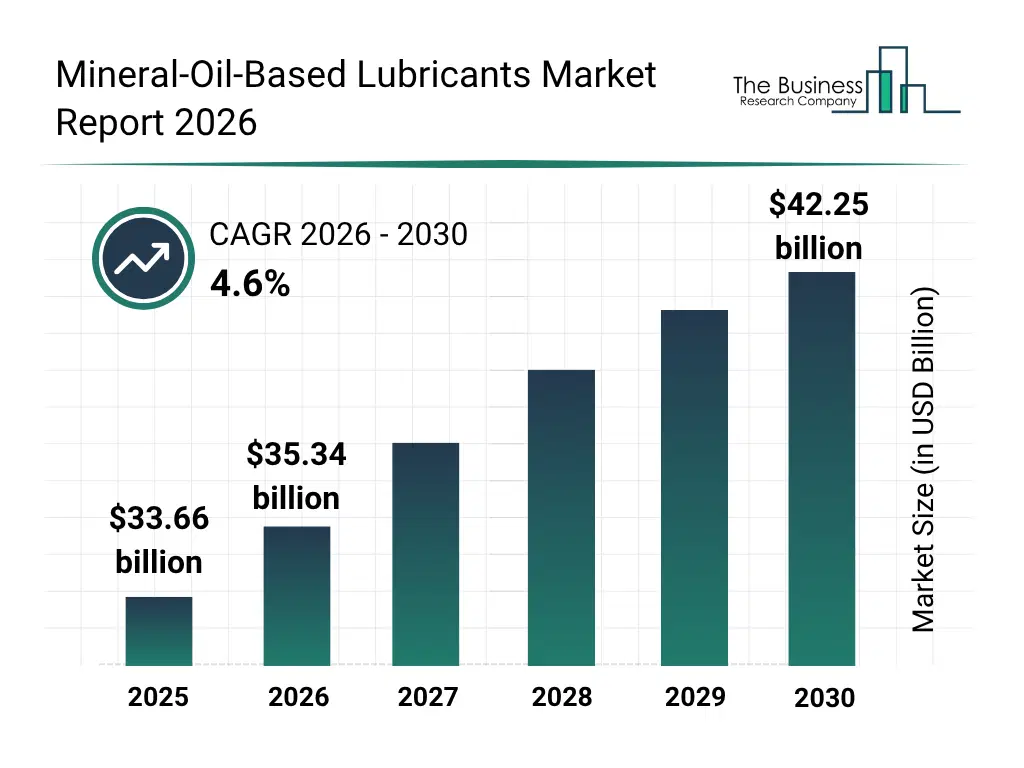
What Is The Mineral-Oil-Based Lubricants Market Size and Share 2026?
The mineral-oil-based lubricants market size has grown steadily in recent years. It will grow from $33.66 billion in 2025 to $35.34 billion in 2026 at a compound annual growth rate (CAGR) of 5.0%. The growth in the historic period can be attributed to increasing automotive production and vehicle ownership, rising industrial machinery deployment, growing demand for equipment maintenance and lubrication solutions, expanding manufacturing and heavy industry activities, increasing adoption of mineral oil lubricants across industrial applications.What Is The Mineral-Oil-Based Lubricants Market Growth Forecast?
The mineral-oil-based lubricants market size is expected to see steady growth in the next few years. It will grow to $42.25 billion in 2030 at a compound annual growth rate (CAGR) of 4.6%. The growth in the forecast period can be attributed to growing demand for high efficiency lubrication systems, rising need for improved equipment lifespan and reliability, increasing adoption of advanced additive technologies, expanding industrial automation and machinery usage, growing demand for specialized lubricants for extreme operating conditions. Major trends in the forecast period include increasing demand for high performance mineral oil lubricant formulations, growing adoption of advanced lubricant additive technologies, rising focus on extended drain interval lubricant solutions, increasing development of low viscosity and fuel efficient lubricants, growing demand for enhanced thermal and oxidation stability in lubricants.
Global Mineral-Oil-Based Lubricants Market Segmentation
2) By Additive Technology: Anti Wear Additives, Detergents And Dispersants, Viscosity Modifiers, Corrosion Inhibitors, Foam Inhibitors 3) By Distribution Channel: Direct Sales, Distributors And Wholesalers, Retail Stores, Online Sales 4) By Application: Automotive, Industrial Machinery, Power Generation, Marine, Metalworking, Railways 5) By End Use Industry: Transportation, Manufacturing And Heavy Industry, Mining And Construction, Agriculture And Forestry Subsegments: 1) By Engine Oil: Semi Synthetic Engine Oil, Mineral Engine Oil, High Mileage Engine Oil, Bio Based Engine Oil 2) By Gear Oil: Automotive Gear Oil, Industrial Gear Oil, Mineral Gear Oil, Extreme Pressure Gear Oil 3) By Hydraulic Oil: Anti Wear Hydraulic Oil, Fire Resistant Hydraulic Oil, Zinc Free Hydraulic Oil, Mineral Hydraulic Oil 4) By Compressor Oil: Rotary Compressor Oil, Reciprocating Compressor Oil, Screw Compressor Oil, Mineral Compressor Oil 5) By Turbine Oil: Steam Turbine Oil, Gas Turbine Oil, Industrial Turbine Oil, Mineral Turbine Oil 6) By Transformer Oil: Mineral Transformer Oil, Natural Ester Transformer Oil, Silicone Based Transformer OilWhat Is The Driver Of The Mineral-Oil-Based Lubricants Market?
The growth in vehicle ownership and automotive production is expected to propel the growth of the mineral-oil-based lubricants market going forward. Vehicle ownership refers to the number of privately and commercially operated vehicles in use, while automotive production refers to the manufacturing output of passenger and commercial vehicles that require lubrication across engines, transmissions, and associated mechanical systems. The growth in vehicle ownership and automotive production is increasing due to rising urban mobility demand and expanding logistics activity supported by higher disposable income and industrialization. Mineral-oil-based lubricants are used in vehicle ownership and automotive production to reduce friction, minimize engine and component wear, improve operational efficiency, and extend the service life of vehicles and manufacturing equipment. For instance, in April 2026, according to the the Department for Transport, a UK-based government department responsible for developing and overseeing transportation policies and infrastructure, the number of licensed vehicles in the United Kingdom reached 42.3 million at the end of 2025, representing a 1% increase compared to 2024. Therefore, the growth in vehicle ownership and automotive production is driving the growth of the mineral-oil-based lubricants industry.Key Players In The Global Mineral-Oil-Based Lubricants Market
Major companies operating in the mineral-oil-based lubricants market are China Petroleum & Chemical Corporation, Shell plc, Exxon Mobil Corporation, BP plc, TotalEnergies SE, Chevron Corporation, PJSC LUKOIL, Petróleo Brasileiro S.A., Indian Oil Corporation Limited, Fuchs Petrolub SE, Phillips 66 Company, Eni S.p.A., ENEOS Corporation, Idemitsu Kosan Co. Ltd., Petroliam Nasional Berhad, PTT Public Company Limited, Repsol S.A., SK Enmove, GS Caltex, Cosmo Energy Holdings Co. Ltd., Quaker Houghton, PT Pertamina Lubricants, Motul S.A., Oman Oil Marketing Company SAOG, Bangchak Corporation Public Company Limited
This chart is for illustrative purposes; the full report includes a detailed competitor analysis and comprehensive overview of the top 10 companies in the market.
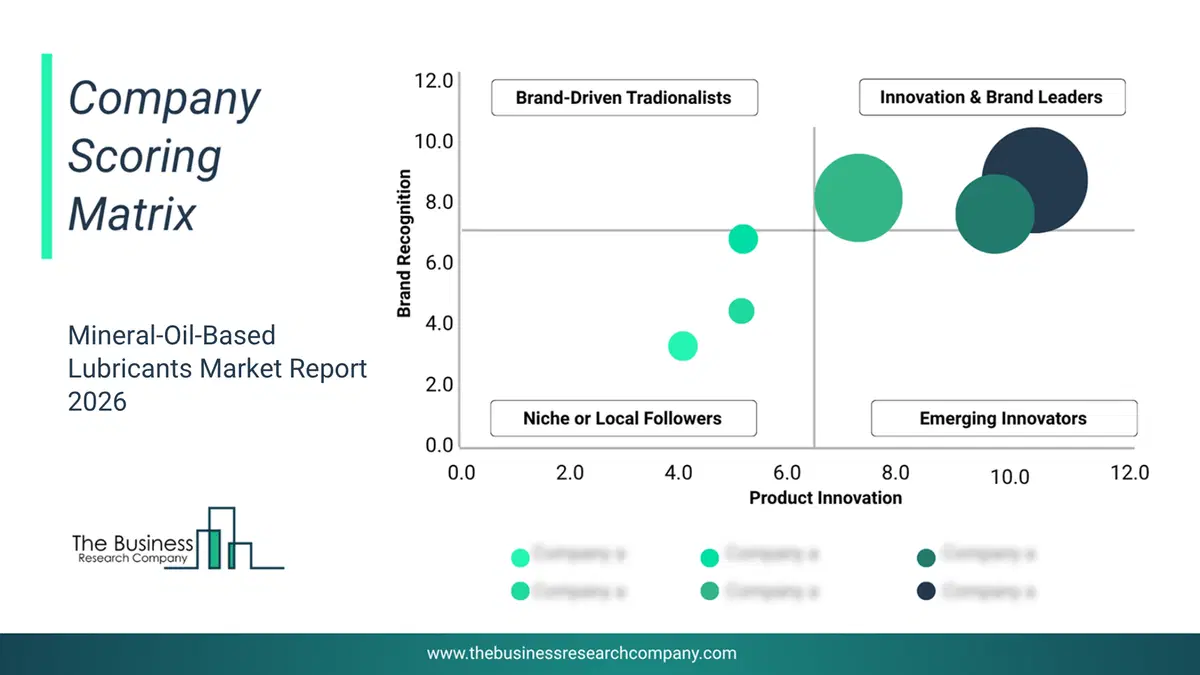
This chart maps companies by product innovation and brand strength, with bubble size indicating relative revenue, helping identify market leaders, challengers, and niche players. This is an illustrative chart; the full report provides a complete and accurate competitive analysis.
Global Mineral-Oil-Based Lubricants Market Trends and Insights
Major companies operating in the mineral-oil-based lubricants market are focusing on developing technological advancements, such as eco-friendly packaging to enhance sustainability and reduce environmental impact. Eco-friendly packaging refers to packaging materials and systems designed to minimize environmental impact by reducing waste, pollution, and the use of non-renewable resources through recyclable, biodegradable, or reusable materials. For instance, in March 2023, Uno Minda, an India-based automotive components company, launched BS-VI-compliant automotive engine oils for two-wheelers, expanding its aftermarket lubricants portfolio with mineral, semi-synthetic, and fully synthetic variants. Designed to improve engine performance, wear protection, and fuel efficiency, the product range supports BS-VI emission standards and follows a tiered formulation strategy for different engine capacities, while also incorporating eco-friendly packaging to reduce environmental impact.What Are Latest Mergers And Acquisitions In The Mineral-Oil-Based Lubricants Market?
In March 2024, Saudi Aramco, a Saudi Arabia-based integrated energy and chemicals company, acquired 100% equity stake in Esmax Distribución SpA for an undisclosed amount. Through this acquisition, Aramco aims to strengthen its downstream value chain, expand its global retail presence, and establish its first downstream retail investment in South America. Esmax Distribución SpA is a Chile-based company that operates retail fuel stations, airport fuel operations, fuel distribution terminals, and a lubricant blending plant across the country.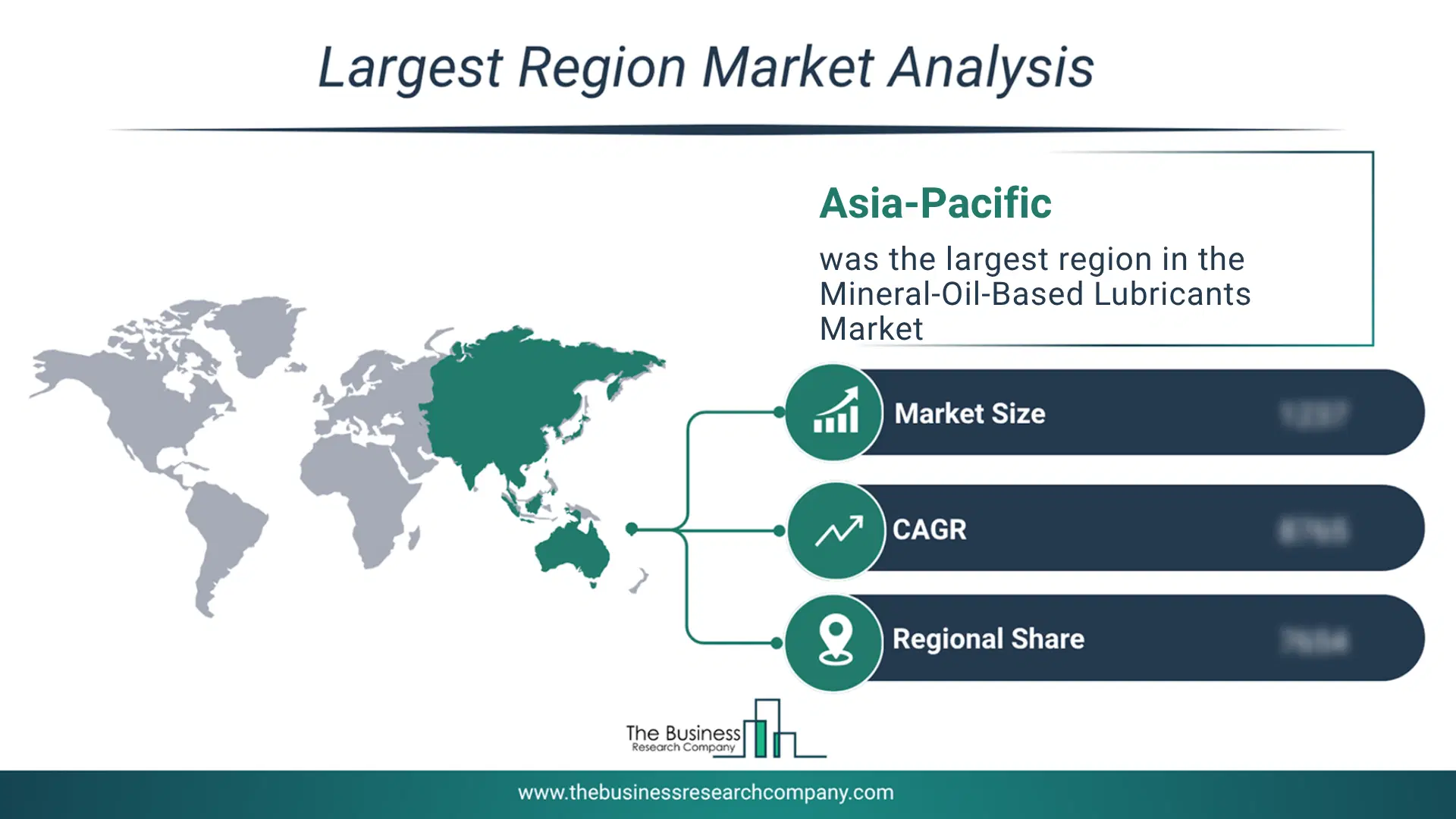
Regional Outlook/Insights
Asia-Pacific was the largest region in the mineral-oil-based lubricants market in 2025. Asia-Pacific is expected to be the fastest-growing region in the forecast period. The regions covered in this market report are Asia-Pacific, South East Asia, Western Europe, Eastern Europe, North America, South America, Middle East, Africa. The countries covered in this market report are Australia, Brazil, China, France, Germany, India, Indonesia, Japan, Taiwan, Russia, South Korea, UK, USA, Canada, Italy, Spain.What Defines the Mineral-Oil-Based Lubricants Market?
The mineral-oil-based lubricants market consists of sales of engine oils, hydraulic oils, gear oils, compressor oils and circulating oils. Values in this market are ‘factory gate’ values, that is the value of goods sold by the manufacturers or creators of the goods, whether to other entities (including downstream manufacturers, wholesalers, distributors and retailers) or directly to end customers. The value of goods in this market includes related services sold by the creators of the goods.How is Market Value Defined and Measured?
The market value is defined as the revenues that enterprises gain from the sale of goods and/or services within the specified market and geography through sales, grants, or donations in terms of the currency (in USD unless otherwise specified). The revenues for a specified geography are consumption values that are revenues generated by organizations in the specified geography within the market, irrespective of where they are produced. It does not include revenues from resales along the supply chain, either further along the supply chain or as part of other products.
This chart presents market attractiveness based on a quantitative evaluation of growth, competition, strategic alignment, and risk, offering a clear view of opportunity areas for decision-making. This chart is for illustrative purposes; the full report contains the complete analysis.

This chart highlights the Total Addressable Market (TAM) by estimating the maximum revenue opportunity using an assumption-driven approach, supporting strategic planning and opportunity sizing across markets. The chart is illustrative; the full report provides a more comprehensive analysis.
What Key Data and Analysis Are Included in the Mineral-Oil-Based Lubricants Market Report 2026?
The mineral-oil-based lubricants market research report is one of a series of new reports from The Business Research Company that provides mineral-oil-based lubricants market statistics, including mineral-oil-based lubricants industry global market size, regional shares, competitors with a mineral-oil-based lubricants market share, detailed mineral-oil-based lubricants market segments, market trends and opportunities, and any further data you may need to thrive in the mineral-oil-based lubricants industry. This mineral-oil-based lubricants market research report delivers a complete perspective of everything you need, with an in-depth analysis of the current and future scenario of the industry.Mineral-Oil-Based Lubricants Market Report Forecast Analysis
| Report Attribute | Details |
|---|---|
| Market Size Value In 2026 | $35.34 billion |
| Revenue Forecast In 2030 | $42.25 billion |
| Growth Rate | CAGR of 4.6% from 2026 to 2030 |
| Base Year For Estimation | 2025 |
| Actual Estimates/Historical Data | 2020-2025 |
| Forecast Period | 2026 - 2030 |
| Market Representation | Revenue in USD Billion and CAGR from 2026 to 2030 |
| Segments Covered | Product Type, Additive Technology, Distribution Channel, Application, End Use Industry |
| Regional Scope | Asia-Pacific, Western Europe, Eastern Europe, North America, South America, Middle East, Africa |
| Country Scope | The countries covered in the report are Australia, Brazil, China, France, Germany, India, Indonesia, Japan, Taiwan, Russia, South Korea, UK, USA, Canada, Italy, Spain. |
| Key Companies Profiled | China Petroleum & Chemical Corporation, Shell plc, Exxon Mobil Corporation, BP plc, TotalEnergies SE, Chevron Corporation, PJSC LUKOIL, Petróleo Brasileiro S.A., Indian Oil Corporation Limited, Fuchs Petrolub SE, Phillips 66 Company, Eni S.p.A., ENEOS Corporation, Idemitsu Kosan Co. Ltd., Petroliam Nasional Berhad, PTT Public Company Limited, Repsol S.A., SK Enmove, GS Caltex, Cosmo Energy Holdings Co. Ltd., Quaker Houghton, PT Pertamina Lubricants, Motul S.A., Oman Oil Marketing Company SAOG, Bangchak Corporation Public Company Limited |
| Customization Scope | Request for Customization |
| Pricing And Purchase Options | Explore Purchase Options |