

Minimally Invasive Neurosurgical Devices Market Report 2026
Global Outlook – By Product Type (Miniature Video Cameras, Fiber Optics Cables, External Video Monitors, Special Surgical Instruments), By Technology (Image-Guided Surgery, Robotic Surgery, Navigation Systems, Optical Coherence Tomography, Endoscopic Techniques), By Surgery (Neurosurgical Endoscopic Procedures, Vascular Surgery, Cerebrovascular Surgery, Skull Base Surgery, Spine Surgery, Functional Neurosurgery, Neuroendoscopic Ventricular Surgery, Neuroplastic And Reconstructive Surgery, Bariatric Surgery, Neurovascular Access Procedures), By Application (Brain Tumor Resection, Spinal Surgery, Aneurysm Repair, Epilepsy Surgery, Trauma And Fracture Repair), By End-User (Hospitals, Ambulatory Surgical Centers) – Market Size, Trends, Strategies, and Forecast to 2030
Minimally Invasive Neurosurgical Devices Market Overview
• Minimally Invasive Neurosurgical Devices market size has reached to $3.04 billion in 2025 • Expected to grow to $4.32 billion in 2030 at a compound annual growth rate (CAGR) of 7.2% • Growth Driver: The Rise In Neurological Disorders Is Driving The Growth Of The Market Due To Lifestyle Changes And Aging Population • Market Trend: Revolutionizing Neurovascular Care Through Next Gen Image Guided Therapy • North America was the largest region in 2025 and Asia-Pacific is the fastest growing region.What Is Covered Under Minimally Invasive Neurosurgical Devices Market?
Minimally invasive neurosurgical devices are specialized medical instruments and technologies designed to perform neurosurgical procedures through small incisions or natural openings, minimizing damage to surrounding tissues. These devices enable greater precision, reduced recovery times, and lower surgical risks compared to traditional open brain or spinal surgeries. The main product types of minimally invasive neurosurgical devices are miniature video cameras, fiber optic cables, external video monitors, and special surgical instruments. Miniature video cameras refer to small, compact imaging devices designed to capture video footage in tight or hard-to-reach spaces, often used in medical, surveillance, or industrial applications. These devices utilize advanced technologies such as image-guided surgery, robotic surgery, navigation systems, optical coherence tomography, and endoscopic techniques, and are utilized across multiple surgical disciplines, including urological surgery, vascular surgery, cardiac surgery, breast surgery, orthopedic surgery, gynecological surgery, gastrointestinal surgery, cosmetic surgery, bariatric surgery, and thoracic surgery. These are used in various applications, including brain tumor resection, spinal surgery, aneurysm repair, epilepsy surgery, and trauma and fracture repair, and cater to various end users, including hospitals, ambulatory surgical centers, neurology clinics, research institutions, and outpatient surgical centers.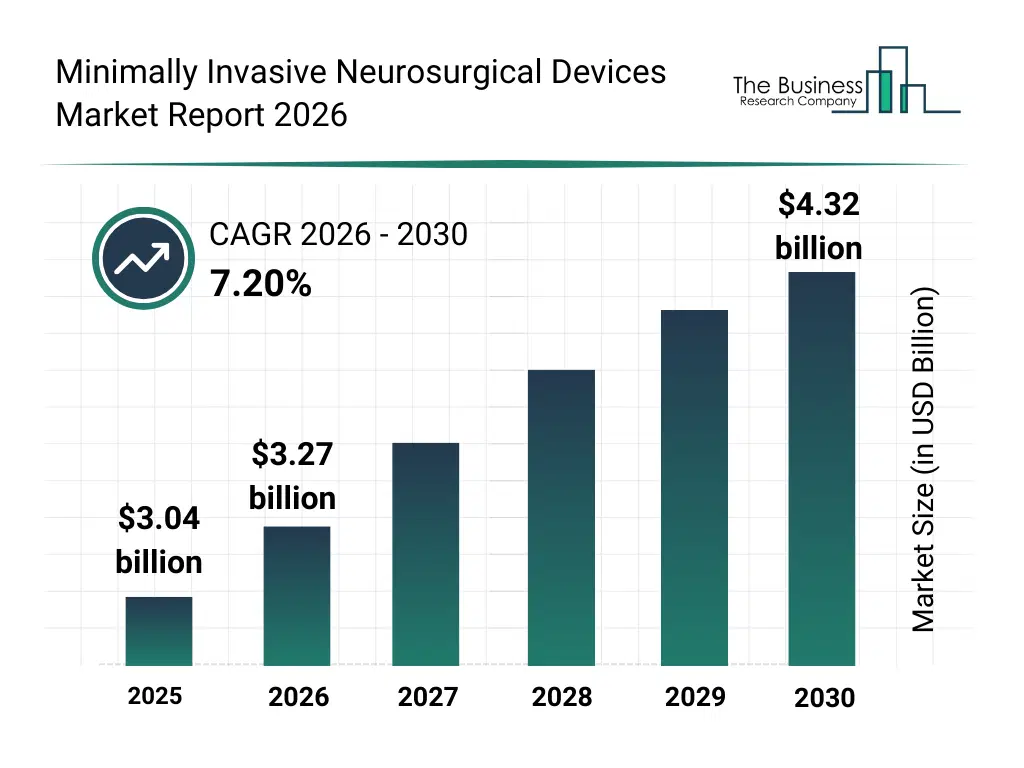
What Is The Minimally Invasive Neurosurgical Devices Market Size and Share 2026?
The minimally invasive neurosurgical devices market size has grown strongly in recent years. It will grow from $3.04 billion in 2025 to $3.27 billion in 2026 at a compound annual growth rate (CAGR) of 7.6%. The growth in the historic period can be attributed to rising prevalence of neurological disorders, increasing neurosurgical procedure volumes, advancements in endoscopic imaging technologies, growing availability of skilled neurosurgeons, hospital investments in advanced surgical infrastructure.What Is The Minimally Invasive Neurosurgical Devices Market Growth Forecast?
The minimally invasive neurosurgical devices market size is expected to see strong growth in the next few years. It will grow to $4.32 billion in 2030 at a compound annual growth rate (CAGR) of 7.2%. The growth in the forecast period can be attributed to integration of AI-driven surgical navigation, expanding adoption of robotic neurosurgery systems, increasing demand for minimally invasive spinal procedures, technological improvements in real-time intraoperative imaging, growth of ambulatory surgical centers. Major trends in the forecast period include increased adoption of image-guided minimally invasive neurosurgery, growing use of robotic-assisted neurosurgical procedures, rising demand for miniaturized and high-precision surgical instruments, shift toward outpatient and short-stay neurosurgical procedures, expanding clinical use of endoscopic and keyhole neurosurgery.

Global Minimally Invasive Neurosurgical Devices Market Segmentation
1) By Product Type: Miniature Video Cameras, Fiber Optics Cables, External Video Monitors, Special Surgical Instruments 2) By Technology: Image-Guided Surgery, Robotic Surgery, Navigation Systems, Optical Coherence Tomography, Endoscopic Techniques 3) By Surgery: Neurosurgical Endoscopic Procedures, Vascular Surgery, Cerebrovascular Surgery, Skull Base Surgery, Spine Surgery, Functional Neurosurgery, Neuroendoscopic Ventricular Surgery, Neuroplastic And Reconstructive Surgery, Bariatric Surgery, Neurovascular Access Procedures 4) By Application: Brain Tumor Resection, Spinal Surgery, Aneurysm Repair, Epilepsy Surgery, Trauma And Fracture Repair 5) By End-User: Hospitals, Ambulatory Surgical Centers, Neurology Clinics, Research Institutions, Outpatient Surgical Centers Subsegments: 1) By Miniature Video Cameras: High-Definition Cameras, 4K Ultra-HD Cameras, Wireless Endoscopic Cameras, Integrated Camera Systems, Disposable Or Single-Use Cameras 2) By Fiber Optic Cables: Light Transmission Cables, Imaging Fiber Bundles, Laser Fiber Cables, Reusable VS Disposable Fiber Cables, Sterilizable Fiber Optics 3) By External Video Monitors: Standard Definition Monitors, High-Definition Monitors, 4K Surgical Monitors, Touchscreen-Controlled Monitors 4) By Special Surgical Instruments: Neuroendoscopes, Microforceps And Microscissors, Biopsy Needles, Suction-Irrigation Devices, Navigation-Enabled InstrumentsWhat Is The Driver Of The Minimally Invasive Neurosurgical Devices Market?
The increasing prevalence of neurological disorders is expected to propel the growth of the minimally invasive neurosurgical devices market going forward. Neurological disorders refer to medical conditions that affect the brain, spinal cord, or nerves, leading to problems with movement, sensation, behavior, or cognitive function. The increasing prevalence of neurological disorders is primarily due to lifestyle changes such as poor diet, lack of physical activity, chronic stress, and prolonged exposure to environmental toxins, which negatively impact brain health over time. Minimally invasive neurosurgical devices help neurological disorders by enabling precise, less traumatic procedures that reduce recovery time, minimize complications, and improve patient outcomes. For instance, in March 2023, according to the Alzheimer's Association, a US-based nonprofit voluntary health organization, in 2023, about 6.7 million Americans aged 65 and older are living with Alzheimer's dementia, with projections indicating an increase to 13.8 million by 2060. Therefore, the increasing prevalence of neurological disorders is driving the growth of the minimally invasive neurosurgical devices industry.Key Players In The Global Minimally Invasive Neurosurgical Devices Market
Major companies operating in the minimally invasive neurosurgical devices market are Medtronic Plc, Fujifilm Holdings Corporation, Koninklijke Philips N.V., Stryker Corporation, Olympus Corporation, Karl Storz GmbH And Co. KG, Integra LifeSciences Holdings Corporation, Elekta AB, Penumbra Inc., KLS Martin Group, B. Braun Melsungen AG, Ackermann Instrumente GmbH, Scanlan International Inc., OmniGuide Holdings Inc., Biolitec AG, Adeor Medical AG, Vycor Medical Inc., Brainlab AG, Leica Microsystems GmbH, Zeiss Meditec AG, Natus Medical Incorporated, Mizuho Medical Co. Ltd., Adept Medical Ltd.
This chart is for illustrative purposes; the full report includes a detailed competitor analysis and comprehensive overview of the top 10 companies in the market.
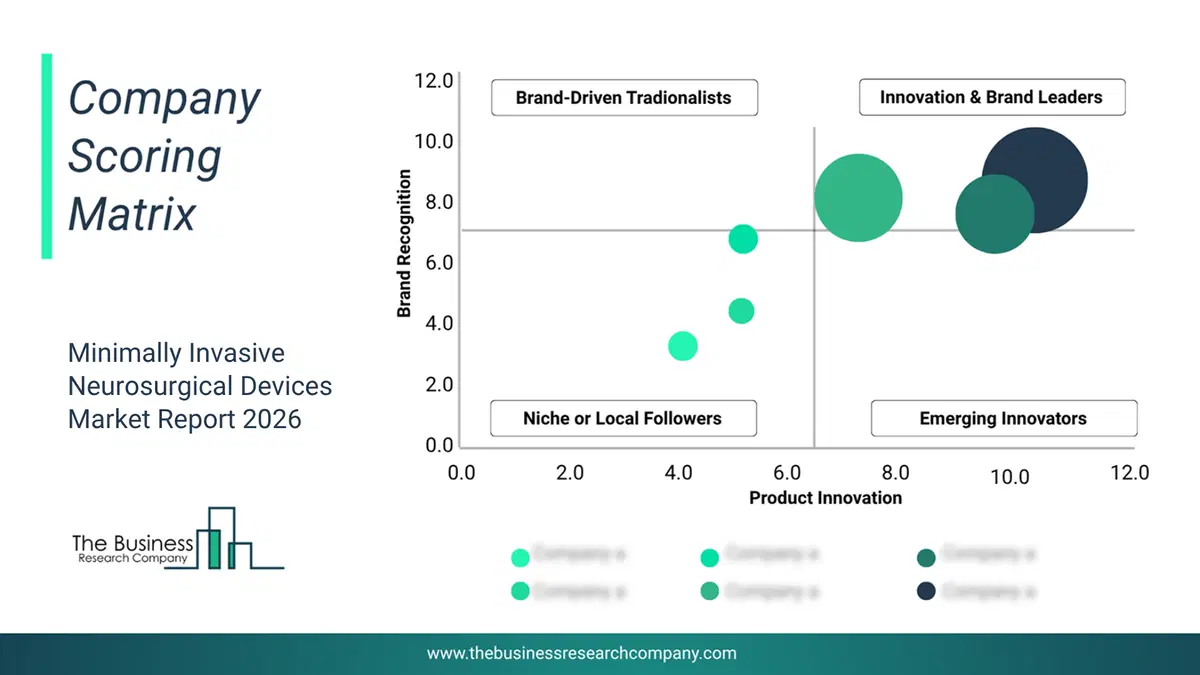
This chart maps companies by product innovation and brand strength, with bubble size indicating relative revenue, helping identify market leaders, challengers, and niche players. This is an illustrative chart; the full report provides a complete and accurate competitive analysis.
Global Minimally Invasive Neurosurgical Devices Market Trends and Insights
Major companies operating in the minimally invasive neurosurgical devices market are focusing on developing advanced technologies such as image-guided therapy systems to enhance precision and safety during complex neuro procedures. Image-guided therapy systems are advanced medical technologies that use real-time imaging to help surgeons accurately navigate and treat targeted areas in the brain during minimally invasive neurosurgical procedures. For instance, in February 2024, Koninklijke Philips N.V., a Netherlands-based health technology company, launched the Azurion neuro biplane system. This advanced system is designed to improve and streamline the diagnosis and treatment of neurovascular conditions. It offers high-quality 2D and 3D imaging, flexible X-ray detector positioning, and full table-side control. The system also features enhanced C-arm rotation and angulation for quick imaging transitions, automatic beam rotation for properly oriented images, a new head immobilizer tailored for stroke care, and AI-powered remote monitoring to help ensure maximum system availability.What Are Latest Mergers And Acquisitions In The Minimally Invasive Neurosurgical Devices Market?
In September 2024, Stryker Corporation, a US-based medical device company, acquired NICO Corporation for an undisclosed amount. With this acquisition, Stryker Corporation aims to expand its minimally invasive neurotechnology portfolio to improve outcomes in brain tumor removal and intracerebral hemorrhage treatment. NICO Corporation is a US-based medical device company that specializes in minimally invasive neurosurgical devices.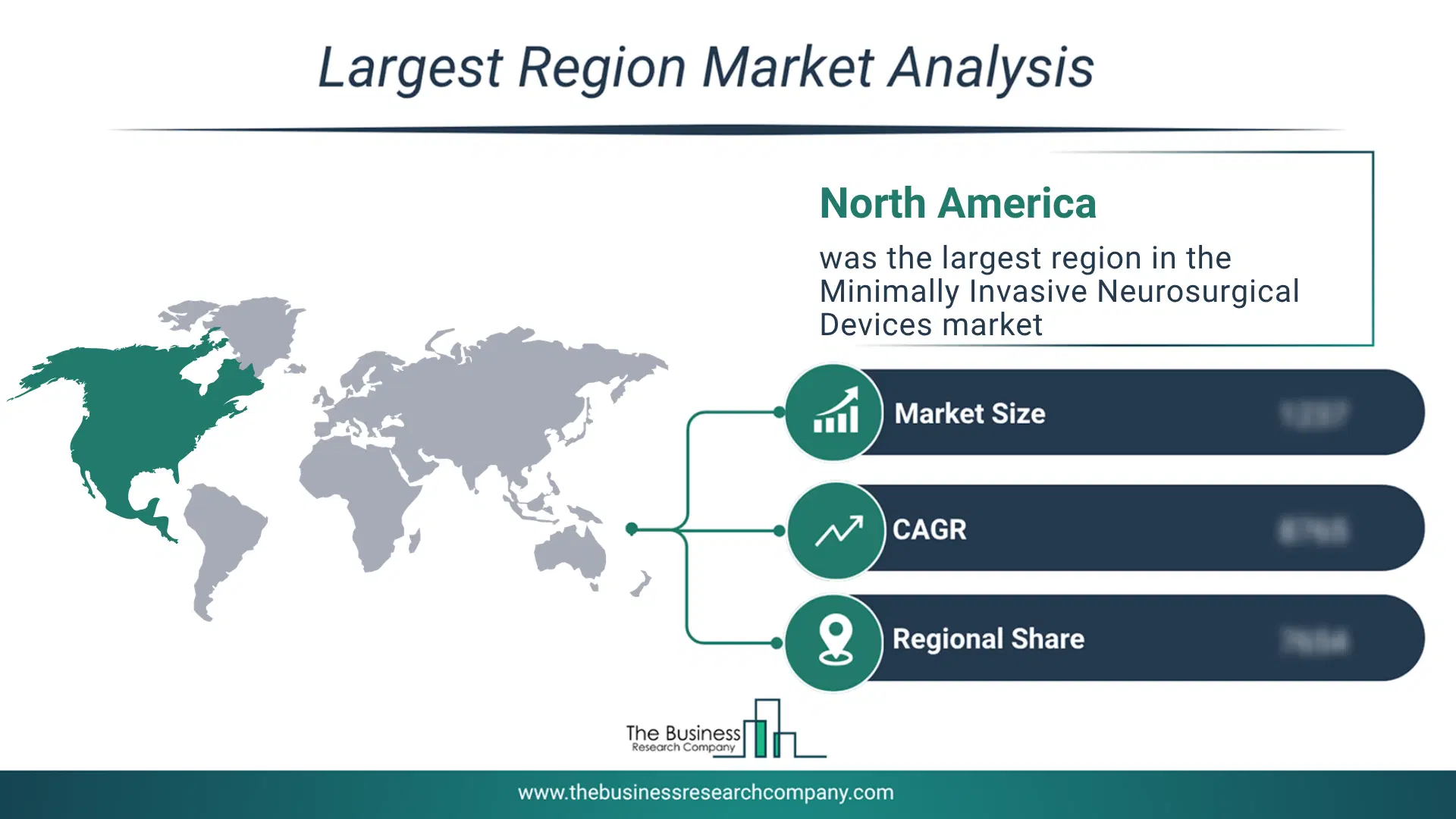
Regional Outlook
North America was the largest region in the minimally invasive neurosurgical devices market in 2025. Asia-Pacific is expected to be the fastest-growing region in the forecast period. The regions covered in this market report are Asia-Pacific, South East Asia, Western Europe, Eastern Europe, North America, South America, Middle East, Africa. The countries covered in this market report are Australia, Brazil, China, France, Germany, India, Indonesia, Japan, Taiwan, Russia, South Korea, UK, USA, Canada, Italy, SpainWhat Defines the Minimally Invasive Neurosurgical Devices Market?
The minimally invasive neurosurgical devices market consists of revenues earned by entities by providing services such as image-guided surgical navigation, robotic-assisted neurosurgery solutions, intraoperative monitoring services, customized surgical toolkits and implants, and maintenance and technical support services. The market value includes the value of related goods sold by the service provider or included within the service offering. The minimally invasive neurosurgical devices market also includes sales of ablation devices, retractor systems, external video monitors, biopsy needles and cannulas, and ultrasonic aspirators. Values in this market are ‘factory gate’ values; that is, the value of goods sold by the manufacturers or creators of the goods, whether to other entities (including downstream manufacturers, wholesalers, distributors, and retailers) or directly to end customers. The value of goods in this market includes related services sold by the creators of the goods.How is Market Value Defined and Measured?
The market value is defined as the revenues that enterprises gain from the sale of goods and/or services within the specified market and geography through sales, grants, or donations in terms of the currency (in USD unless otherwise specified). The revenues for a specified geography are consumption values that are revenues generated by organizations in the specified geography within the market, irrespective of where they are produced. It does not include revenues from resales along the supply chain, either further along the supply chain or as part of other products.
This chart presents market attractiveness based on a quantitative evaluation of growth, competition, strategic alignment, and risk, offering a clear view of opportunity areas for decision-making. This chart is for illustrative purposes; the full report contains the complete analysis.

This chart highlights the Total Addressable Market (TAM) by estimating the maximum revenue opportunity using an assumption-driven approach, supporting strategic planning and opportunity sizing across markets. The chart is illustrative; the full report provides a more comprehensive analysis.
What Key Data and Analysis Are Included in the Minimally Invasive Neurosurgical Devices Market Report 2026?
The minimally invasive neurosurgical devices market research report is one of a series of new reports from The Business Research Company that provides market statistics, including industry global market size, regional shares, competitors with the market share, detailed market segments, market trends and opportunities, and any further data you may need to thrive in the minimally invasive neurosurgical devices industry. The market research report delivers a complete perspective of everything you need, with an in-depth analysis of the current and future state of the industry.Minimally Invasive Neurosurgical Devices Market Report Forecast Analysis
| Report Attribute | Details |
|---|---|
| Market Size Value In 2026 | $3.27 billion |
| Revenue Forecast In 2030 | $4.32 billion |
| Growth Rate | CAGR of 7.2% from 2026 to 2030 |
| Base Year For Estimation | 2025 |
| Actual Estimates/Historical Data | 2020-2025 |
| Forecast Period | 2026 - 2030 |
| Market Representation | Revenue in USD Billion and CAGR from 2026 to 2030 |
| Segments Covered | Product Type, Technology, Surgery, Application, End-User |
| Regional Scope | Asia-Pacific, Western Europe, Eastern Europe, North America, South America, Middle East, Africa |
| Country Scope | The countries covered in the report are Australia, Brazil, China, France, Germany, India, Indonesia, Japan, Taiwan, Russia, South Korea, UK, USA, Canada, Italy, Spain. |
| Key Companies Profiled | Medtronic Plc, Fujifilm Holdings Corporation, Koninklijke Philips N.V., Stryker Corporation, Olympus Corporation, Karl Storz GmbH And Co. KG, Integra LifeSciences Holdings Corporation, Elekta AB, Penumbra Inc., KLS Martin Group, B. Braun Melsungen AG, Ackermann Instrumente GmbH, Scanlan International Inc., OmniGuide Holdings Inc., Biolitec AG, Adeor Medical AG, Vycor Medical Inc., Brainlab AG, Leica Microsystems GmbH, Zeiss Meditec AG, Natus Medical Incorporated, Mizuho Medical Co. Ltd., Adept Medical Ltd. |
| Customization Scope | Request for Customization |
| Pricing And Purchase Options | Explore Purchase Options |