
Missile Seekers Market Report 2026
Global Outlook – By Missile Type (Cruise Missile, Ballistic Missile, Interceptor Missile, Conventional), By Technology (Active Radar, Semi-Active Radar, Passive Radar, Infrared, laser, multimode), By Launch Mode (Surface-To-Surface, Surface-To-Air, Air-To-Surface, Air-To-Air) – Market Size, Trends, Strategies, and Forecast to 2030
Missile Seekers Market Overview
• Missile Seekers market size has reached to $5.64 billion in 2025 • Expected to grow to $7.94 billion in 2030 at a compound annual growth rate (CAGR) of 7% • Growth Driver: Rising Global Tensions Fuel Growth In The Missile Seekers Market • Market Trend: Bae Systems And Leonardo UK Forge Alliance For Advanced Aircraft Survivability Interoperable Missile Seeker Technologies Enhance Defense Capabilities • North America was the largest region in 2025.Market Gains By 2030 – Top Opportunities By Segment
Market Gain identifies the most promising market opportunities by highlighting the segments or products expected to generate the highest incremental revenue growth over the next five years.
What Is Covered Under Missile Seekers Market?
Missile seekers are small systems that are used in missiles to keep them on a fixed trajectory towards the target. Missile seekers locate a target and guide the missile towards it using radar technology as it picks up heat emissions and radar radio reflections from the target. The main types of missile seekers are cruise missiles, ballistic missiles, interceptor missiles, and conventional missiles. The term cruise missiles refer to a type of missile that travels at lower altitudes and remains in the earth’s atmosphere throughout its journey. Cruise missiles are used to deliver lethal payloads rapidly to the target while destroying them from a remote location. The technologies adopted are active radar, semi-active radar, passive radar, infrared, laser, and multi-mode that have launch modes such as surface-to-surface, surface-to-air, air-to-surface, and air-to-air.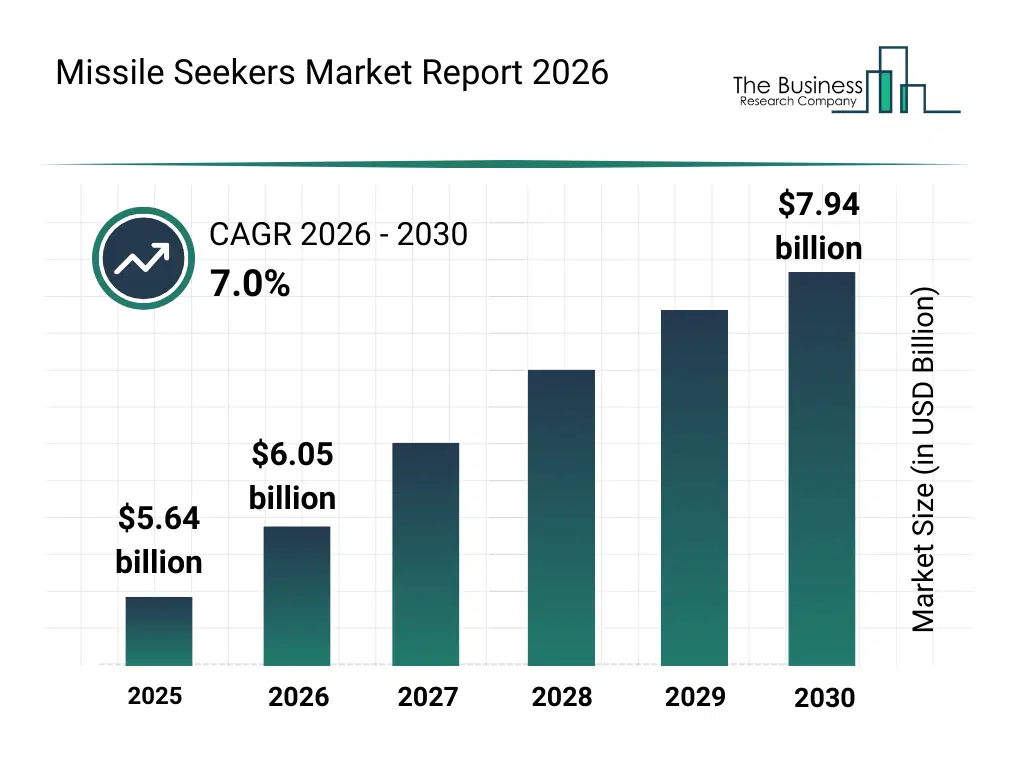
What Is The Missile Seekers Market Size and Share 2026?
The missile seekers market size has grown strongly in recent years. It will grow from $5.64 billion in 2025 to $6.05 billion in 2026 at a compound annual growth rate (CAGR) of 7.3%. The growth in the historic period can be attributed to increasing deployment of guided missile systems requiring reliable seeker technologies, advancements in infrared and radar-based sensing enabling higher target acquisition accuracy, rising demand for precision-strike capabilities in defense operations, growth in military procurement of missiles with enhanced guidance systems, development of dual-mode seekers to improve performance in complex combat environments.What Is The Missile Seekers Market Growth Forecast?
The missile seekers market size is expected to see strong growth in the next few years. It will grow to $7.94 billion in 2030 at a compound annual growth rate (CAGR) of 7.0%. The growth in the forecast period can be attributed to growing adoption of multi-sensor fusion seekers for improved tracking and target discrimination, rising investment in next-generation missile guidance technologies to counter evolving threats, increasing demand for seekers with enhanced resistance to electronic warfare and countermeasures, development of compact and lightweight seekers to support advanced missile miniaturization, expansion of defense modernization programs driving procurement of upgraded seeker-equipped missile systems. Major trends in the forecast period include increasing adoption of advanced active and passive radar seekers, growth in infrared and multimode missile guidance systems, rising development of hypersonic and supersonic cruise missiles, expansion in air-to-air and surface-to-air missile deployments, focus on cost-effective and high-precision missile guidance solutions.
Global Missile Seekers Market Segmentation
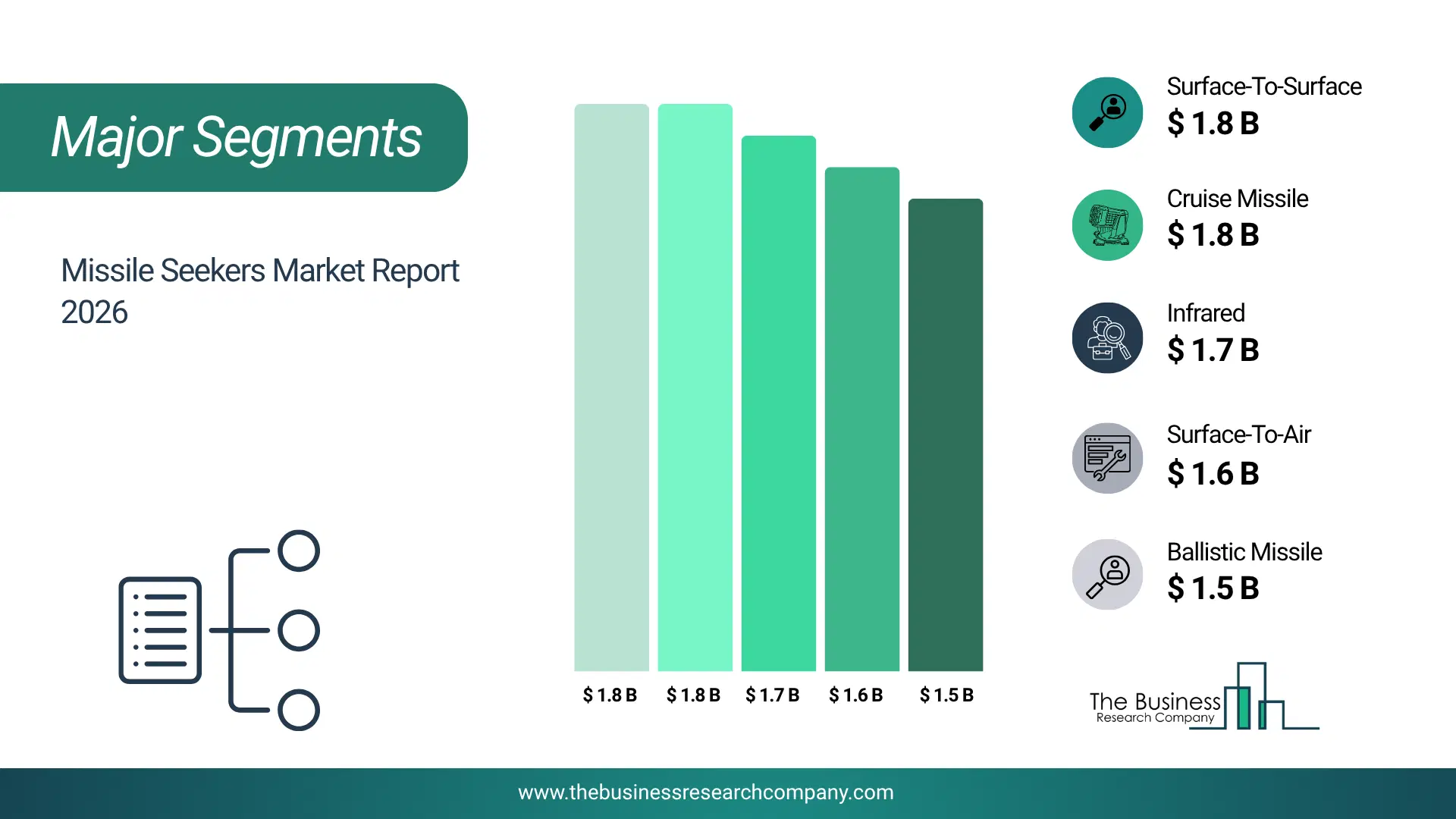
1) By Missile Type: Cruise Missile, Ballistic Missile, Interceptor Missile, Conventional 2) By Technology: Active Radar, Semi-Active Radar, Passive Radar, Infrared, laser, multimode 3) By Launch Mode: Surface-To-Surface, Surface-To-Air, Air-To-Surface, Air-To-Air Subsegments: 1) By Cruise Missile: Subsonic Cruise Missiles, Supersonic Cruise Missiles, Hypersonic Cruise Missiles 2) By Ballistic Missile: Short-Range Ballistic Missiles (SRBM), Medium-Range Ballistic Missiles (MRBM), Intercontinental Ballistic Missiles (ICBM) 3) By Interceptor Missile: Ground-Based Interceptors, Sea-Based Interceptors, Airborne Interceptors 4) By Conventional: Surface-To-Surface Missiles, Air-To-Surface Missiles, Surface-To-Air Missiles The top segments in the missile seekers market will be: • Surface-To-Surface will reach $1878.27 Million by 2025. • Cruise Missile will reach $1876.51 Million by 2025. • Infrared will reach $1701.79 Million by 2025. • Surface-To-Air will reach $1653.62 Million by 2025. • Ballistic Missile will reach $1582.76 Million by 2025.What Is Driver Of The Missile Seekers Market?
The increasing international conflicts are expected to propel the growth of the missile seekers market in the coming years. International conflicts refer to disputes, disagreements, or hostilities that arise between two or more sovereign states or international countries and can manifest in various forms, including diplomatic tensions, economic disputes, trade conflicts, or, in more severe cases, military confrontations. Missile seekers play a crucial role in international conflicts by serving as key components in guided missile systems and are designed to locate, track, and guide missiles to their intended targets with precision. For instance, in July 2024, according to the Armed Conflict Location and Event Data, a US-based non-profit organization, between July 2023 and June 2024, over 165,273 incidents of political violence were reported worldwide, representing a 15% increase from the previous year. During this time, it is estimated that approximately one in seven people around the world were affected by conflict. Therefore, the increasing international conflicts are driving the market for missile seekers industry.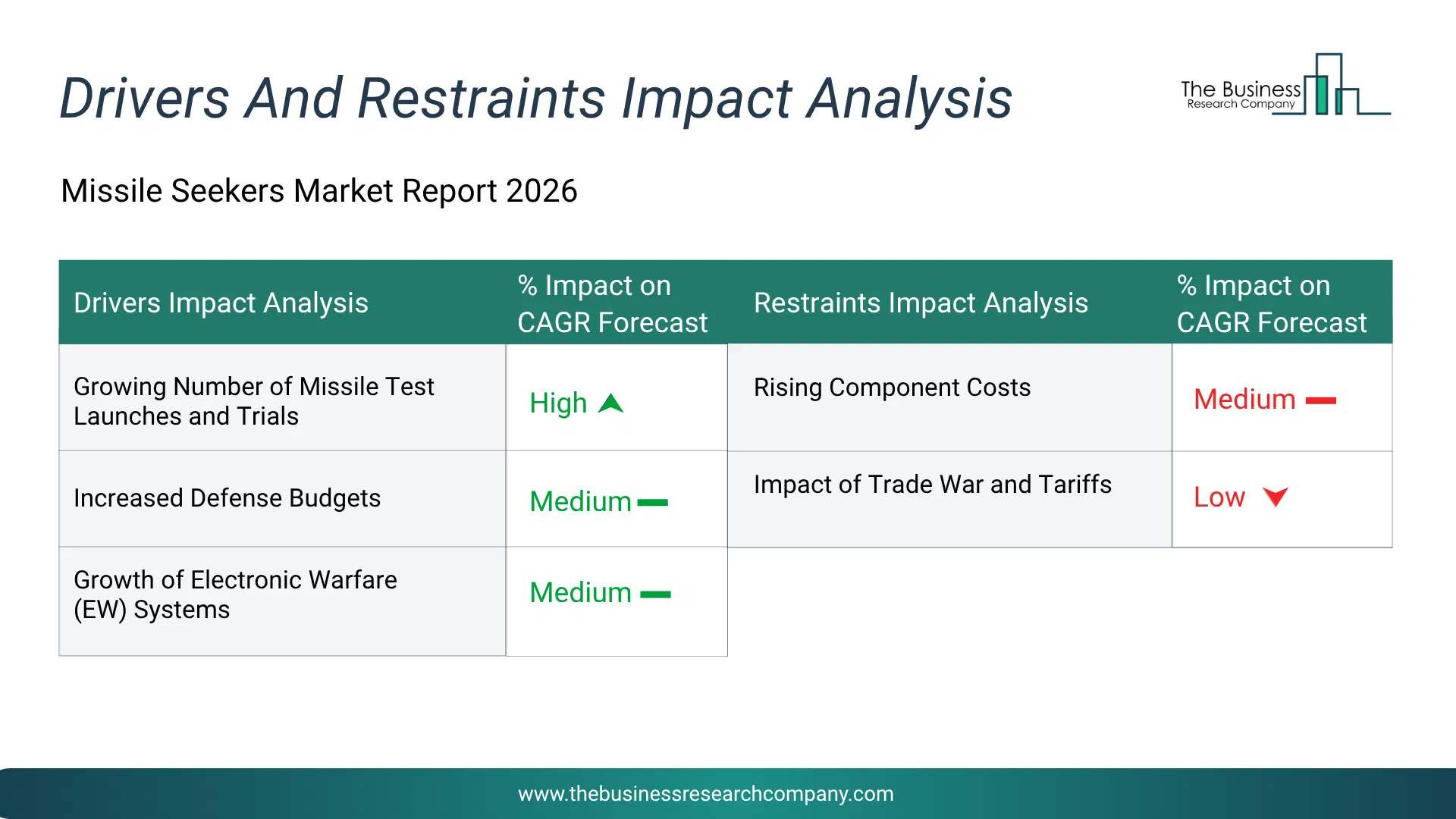
Infographic Chart Showing Key Market Drivers Analysis And Restraints For Missile Seekers Market
The chart presents an impact analysis of key drivers and restraints, quantifying their relative influence on the market's growth rate and helping assess the balance between growth enablers and limiting factors. This chart offers a high-level perspective; the full report contains more detailed insights.
How Will The Drivers Impact Growth In The Global Missile Seekers Market?
• Growing Number of Missile Test Launches and Trials (High) – The growing number of missile test launches and trials will become a key driver of growth in the missile seekers market by 2030. Missile test launches and trials play a critical role in validating and refining missile seeker technologies. They allow developers to assess the seeker’s real-time performance in detecting, tracking and engaging targets under various environmental and operational conditions. These trials help identify weaknesses, improve algorithm accuracy, and enhance resistance to countermeasures like jamming or decoys. Ultimately, testing ensures the missile seeker meets mission-specific requirements and achieves high reliability in actual combat scenarios. As a result, the growing number of missile test launches and trials is anticipated to contributing to a 2.3% annual growth in the market. • Increased Defense Budgets (Medium) – The increased defense budgets support will emerge as a major factor driving the expansion of the missile seekers market by 2030. Increased defense budgets enable governments to invest more heavily in advanced military technologies, including missile systems with sophisticated seekers. These funds support the research, development, testing and deployment of next-generation missile seekers that offer improved accuracy, tracking and target discrimination capabilities. Higher budgets also allow for the procurement of a larger number of missiles equipped with cutting-edge seeker technologies. Ultimately, this strengthens national defense capabilities and fosters innovation in the defense industry. Consequently, the increased defense budgets are projected to contributing to a 1.6% annual growth in the market. • Growth of Electronic Warfare (EW) Systems (Medium) – The growth of electronic warfare systems as a major factor driving the expansion of the missile seekers market by 2030. This is driving the demand for more advanced and resilient missile seekers. As EW technologies become more sophisticated, capable of jamming, deceiving, or disabling traditional guidance systems, missile seekers must evolve with enhanced electronic counter-countermeasures (ECCM) to maintain accuracy and reliability. This has led to innovations in multi-mode seekers, AI-enabled target discrimination, and hardened sensors. Overall, the synergy between electronic warfare threats and seeker development is pushing the missile industry toward smarter, more adaptive guidance solutions. Consequently, growth of electronic warfare systems solutions is projected to contributing to a 1.3% annual growth in the market. • Government Incentives (Low) – The government incentives will emerge as a major factor driving the expansion of the missile seekers market by 2030. These play a crucial role in advancing missile seeker technologies by providing funding, subsidies and tax benefits to defense contractors and research institutions. These incentives encourage innovation and accelerate the development of cutting-edge guidance and targeting systems. By reducing the financial burden on manufacturers, governments help foster domestic production and technological self-reliance. Additionally, incentives often support collaborative defense R&D programs, boosting industry growth and global competitiveness. Consequently, the government incentives are projected to contributing to a 0.8% annual growth in the market.How Will The Restraints Impact Growth In The Global Missile Seekers Market?
• Cybersecurity Risks (Medium) – Cybersecurity Risks will restrict the growth of the Missile Seekers market during the forecast period. Missile seeker systems rely on software and electronics that are vulnerable to cyber threats. Cybersecurity risks including hacking and data manipulation can compromise system integrity and mission effectiveness. Security vulnerabilities can affect confidence in seeker technology and limit adoption for sensitive applications. • Rising Component Costs (Medium) – Rising Component Costs will restrict the growth of the Missile Seekers market during the forecast period. Missile seeker production depends on specialized electronic components and sensors with rising costs. Component cost increases affect overall seeker system pricing and program affordability. Cost pressures can lead to reduced procurement quantities and affect market growth. • Impact of Trade War and Tariffs (Low) – Impact of Trade War and Tariffs will restrict the growth of the Missile Seekers market during the forecast period. Missile seeker production relies on imported electronic components and specialized materials. Trade tariffs and restrictions can increase component costs and affect supply chain reliability. Trade barriers may also impact defense cooperation and technology transfer, limiting market growth.Key Players In The Global Missile Seekers Market
Major companies operating in the missile seekers market are BAE Systems PLC, Leonardo SpA, Raytheon Technologies Corporation, Northrop Grumman Corporation, The Boeing Company, Safran SA, Thales Group, Diehl Defence GmbH & Co. KG, Rafael Advanced Defense Systems Limited, Adani Defence And Aerospace, Defence Research & Development Organisation, Koda Technologies Inc., Vem Technologies Private Limited, Analog Devices Inc., Bharat Electronics Limited, Excelitas Technologies Corp., Marotta Controls Inc., Lockheed Martin Corporation, L3Harris Technologies Inc., Honeywell International Inc., Collins Aerospace Systems, Israel Aerospace Industries Ltd., Roxel Group, Rheinmetall AG, Saab AB, MBDA Italia SpA, Roketsan A.S., Taurus Systems GmbH, QinetiQ Group PLC, Aerojet Rocketdyne Holdings Inc., Orbital ATK Inc., AeroVironment Inc., Textron Inc., General Dynamics Corporation, Kratos Defense & Security Solutions Inc., LIG Nex1 Co. Ltd., Hanwha Corporation, Mitsubishi Electric Corporation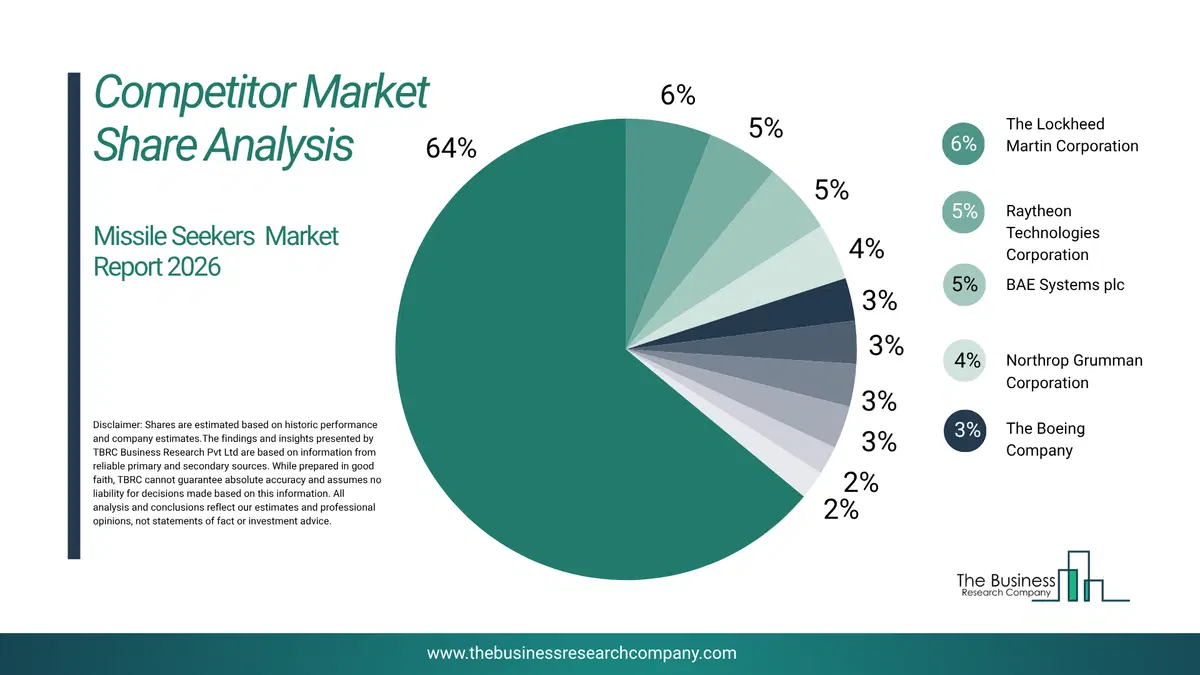
This chart is for illustrative purposes; the full report includes a detailed competitor analysis and comprehensive overview of the top 10 companies in the market.
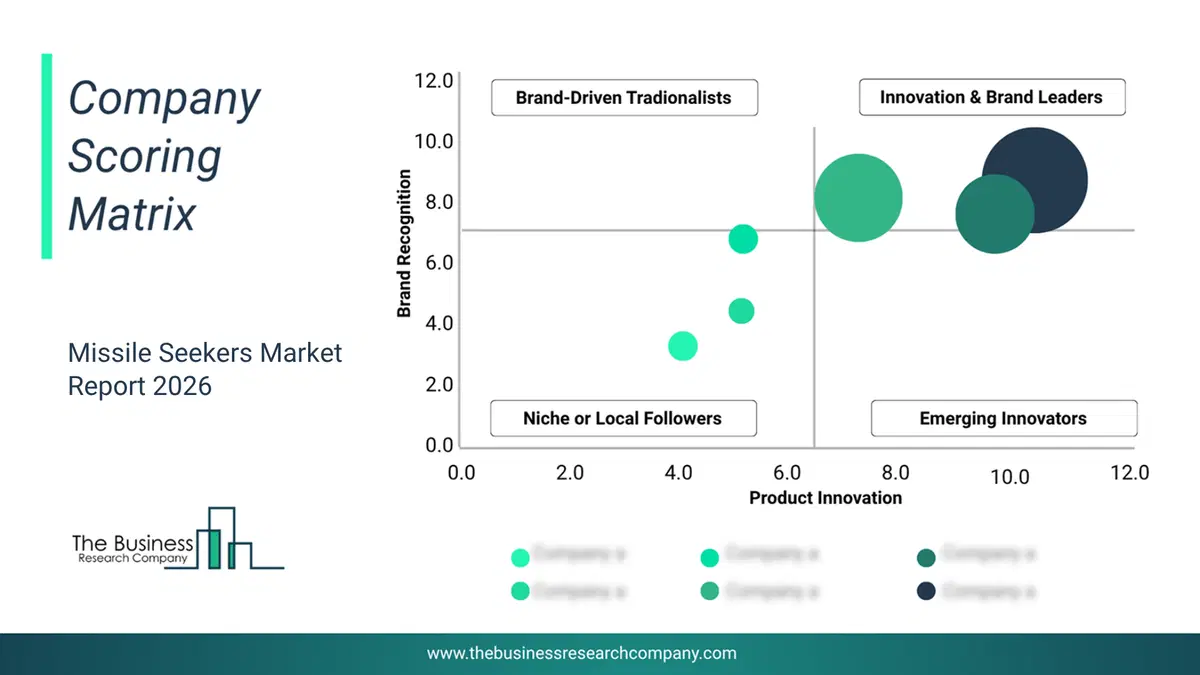
This chart maps companies by product innovation and brand strength, with bubble size indicating relative revenue, helping identify market leaders, challengers, and niche players. This is an illustrative chart; the full report provides a complete and accurate competitive analysis.
Global Missile Seekers Market Trends and Insights
Major companies operating in the missile seeker market are adopting a strategic partnership approach to develop an interoperable aircraft survivability suite. Strategic partnerships refer to a process in which companies leverage each other's strengths and resources to achieve mutual benefits and success. For instance, in February 2023, BAE Systems, Inc., a UK-based aerospace and defense company, announced a collaboration with Leonardo UK. The U.S. government has granted authority to BAE Systems, Inc., and Leonardo UK to create an interoperable aircraft survivability suite that includes Leonardo's Miysis Directed Infrared Countermeasure (DIRCM) System and BAE Systems' AN/AAR-57 Common Missile Warning System (CMWS). The combined power will greatly improve an aircraft's capacity to withstand sophisticated attacks. The Miysis DIRCM system, designed and manufactured by Leonardo in Edinburgh, UK, and selected by several foreign clients, provides a very dependable, consistent defense against Infrared man-portable air Defense Systems (IR MANPADS). It overpowers a missile seeker's head with an unexpected and enormous flood of coded laser light capable of defeating several threats at once. Leonardo UK is a UK-based aerospace and missile manufacturing company.What Are Latest Mergers And Acquisitions In The Missile Seekers Market? L3Harris Completes Aerojet Rocketdyne Acquisition
In July 2023, L3Harris Technologies, an US-based aerospace and defense technology, acquired Aerojet Rocketdyne for an undisclosed amount. The aim of the acquisition is to bolster L3Harris Technologies propulsion system capabilities and reinforce its role in the defense industrial sector, thereby fostering innovation and enhancing competition for essential national security and space mission requirements. Aerojet Rocketdyne is a US-based aerospace and defense company that specializes in developing and manufacturing advanced propulsion systems including space launch vehicles, and tactical missiles.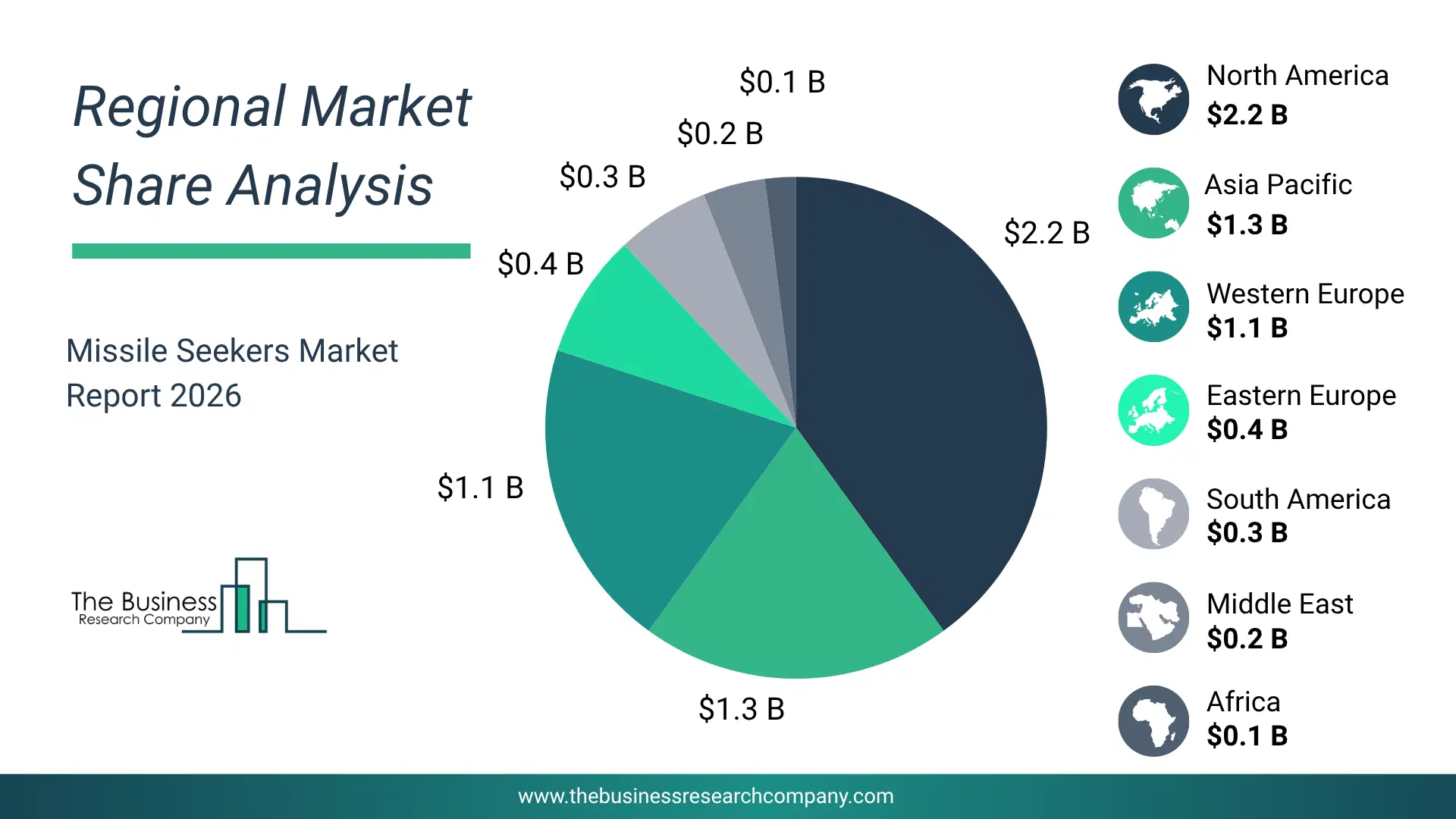
Regional Insights
North America was the largest region in the missile seekers market in 2025. The regions covered in this market report are Asia-Pacific, South East Asia, Western Europe, Eastern Europe, North America, South America, Middle East, Africa. The countries covered in this market report are Australia, Brazil, China, France, Germany, India, Indonesia, Japan, Taiwan, Russia, South Korea, UK, USA, Canada, Italy, SpainWhat Defines the Missile Seekers Market?
The missile seekers market consists of sales of missile seekers that are used to guide the missile on the right path of the target. Values in this market are ‘factory gate’ values, that is, the value of goods sold by the manufacturers or creators of the goods, whether to other entities (including downstream manufacturers, wholesalers, distributors, and retailers) or directly to end customers. The value of goods in this market includes related services sold by the creators of the goods.How is Market Value Defined and Measured?
The market value is defined as the revenues that enterprises gain from the sale of goods and/or services within the specified market and geography through sales, grants, or donations in terms of the currency (in USD unless otherwise specified). The revenues for a specified geography are consumption values that are revenues generated by organizations in the specified geography within the market, irrespective of where they are produced. It does not include revenues from resales along the supply chain, either further along the supply chain or as part of other products.
This chart presents market attractiveness based on a quantitative evaluation of growth, competition, strategic alignment, and risk, offering a clear view of opportunity areas for decision-making. This chart is for illustrative purposes; the full report contains the complete analysis.

This chart highlights the Total Addressable Market (TAM) by estimating the maximum revenue opportunity using an assumption-driven approach, supporting strategic planning and opportunity sizing across markets. The chart is illustrative; the full report provides a more comprehensive analysis.
What Key Data and Analysis Are Included in the Missile Seekers Market Report 2026?
The missile seekers market research report is one of a series of new reports from The Business Research Company that provides market statistics, including industry global market size, regional shares, competitors with the market share, detailed market segments, market trends and opportunities, and any further data you may need to thrive in the missile seekers industry. The market research report delivers a complete perspective of everything you need, with an in-depth analysis of the current and future state of the industry.Missile Seekers Market Report Forecast Analysis
| Report Attribute | Details |
|---|---|
| Market Size Value In 2026 | $6.05 billion |
| Revenue Forecast In 2030 | $7.94 billion |
| Growth Rate | CAGR of 7.3% from 2026 to 2030 |
| Base Year For Estimation | 2025 |
| Actual Estimates/Historical Data | 2020-2025 |
| Forecast Period | 2026 - 2030 |
| Market Representation | Revenue in USD Billion and CAGR from 2026 to 2030 |
| Segments Covered | Missile Type, Technology, Launch Mode |
| Regional Scope | Asia-Pacific, Western Europe, Eastern Europe, North America, South America, Middle East, Africa |
| Country Scope | The countries covered in the report are Australia, Brazil, China, France, Germany, India, Indonesia, Japan, Taiwan, Russia, South Korea, UK, USA, Canada, Italy, Spain. |
| Key Companies Profiled | BAE Systems PLC, Leonardo SpA, Raytheon Technologies Corporation, Northrop Grumman Corporation, The Boeing Company, Safran SA, Thales Group, Diehl Defence GmbH & Co. KG, Rafael Advanced Defense Systems Limited, Adani Defence And Aerospace, Defence Research & Development Organisation, Koda Technologies Inc., Vem Technologies Private Limited, Analog Devices Inc., Bharat Electronics Limited, Excelitas Technologies Corp., Marotta Controls Inc., Lockheed Martin Corporation, L3Harris Technologies Inc., Honeywell International Inc., Collins Aerospace Systems, Israel Aerospace Industries Ltd., Roxel Group, Rheinmetall AG, Saab AB, MBDA Italia SpA, Roketsan A.S., Taurus Systems GmbH, QinetiQ Group PLC, Aerojet Rocketdyne Holdings Inc., Orbital ATK Inc., AeroVironment Inc., Textron Inc., General Dynamics Corporation, Kratos Defense & Security Solutions Inc., LIG Nex1 Co. Ltd., Hanwha Corporation, Mitsubishi Electric Corporation |
| Customization Scope | Request for Customization |
| Pricing And Purchase Options | Explore Purchase Options |