

Mixed Reality Capture Card Market Report 2026
Global Outlook – By Product Type (Internal Capture Cards, External Capture Cards), By Platform (Personal Computer (PC), Console, Mobile Devices), By Application (Gaming, Live Streaming, Virtual Events, Education, Healthcare, Other Applications), By Distribution Channel (Online, Offline), By End-User (Individual, Commercial, Enterprise) – Market Size, Trends, Strategies, and Forecast to 2030
Mixed Reality Capture Card Market Overview
• Mixed Reality Capture Card market size has reached to $2.74 billion in 2025 • Expected to grow to $6.05 billion in 2030 at a compound annual growth rate (CAGR) of 17.2% • Growth Driver: Rising Popularity Of Video Streaming Driving The Market Growth Due To Improved Broadband Infrastructure • Market Trend: Innovations In High-Bandwidth Video Capture Cards Enable Scalable And Low-Latency Mixed Reality Workflows • North America was the largest region in 2025 and Asia-Pacific is the fastest growing region.What Is Covered Under Mixed Reality Capture Card Market?
A mixed reality capture card is a specialized hardware device that captures, synchronizes, and processes video streams from physical cameras and virtual environments in mixed reality setups. It enables real-time compositing of real-world footage with digital 3D content generated by game engines or XR platforms. It helps to deliver seamless, real-time mixed reality video capture for applications such as virtual production, live broadcasting, gaming, training, and immersive content creation. The main product types of mixed reality capture cards include internal capture cards and external capture cards. Internal capture cards refer to hardware devices installed inside personal computers to capture, record, and transmit mixed reality content for high-performance applications. These capture cards are compatible with platforms such as personal computers, consoles, and mobile devices. They are used for applications including gaming, live streaming, virtual events, education, healthcare, and other applications and they are distributed through several channels including online and offline channels. The end users of mixed reality capture cards include individuals, commercial organizations such as studios and content creators, and enterprises utilizing mixed reality for training, events, or simulations.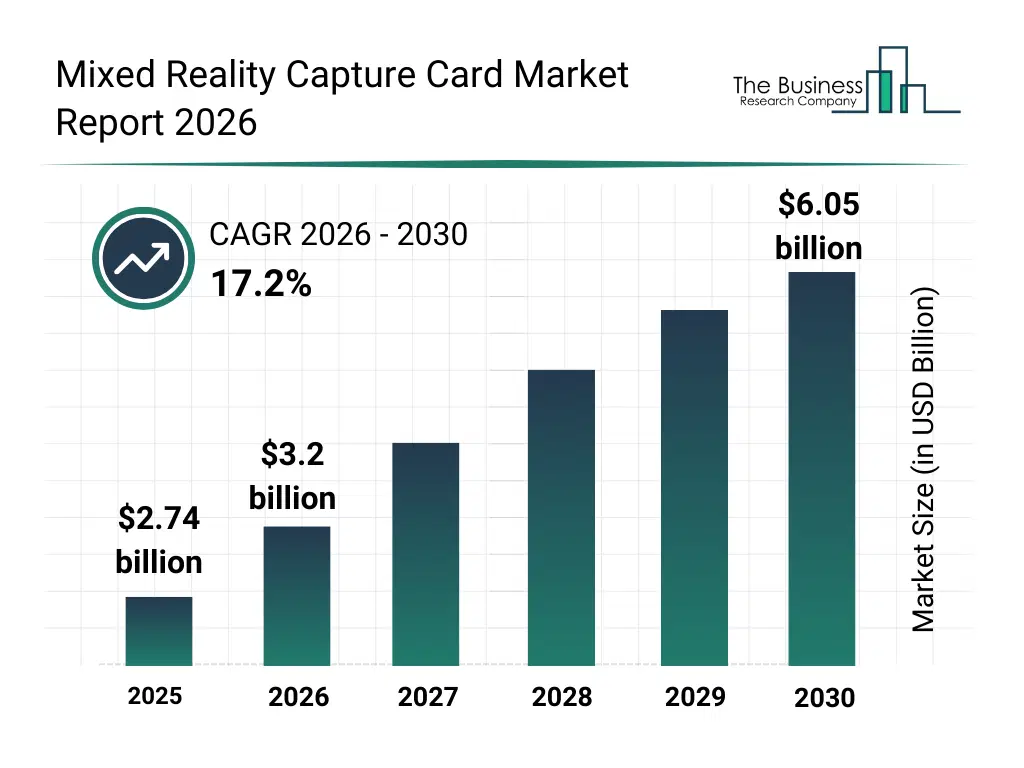
What Is The Mixed Reality Capture Card Market Size and Share 2026?
The mixed reality capture card market size has grown rapidly in recent years. It will grow from $2.74 billion in 2025 to $3.2 billion in 2026 at a compound annual growth rate (CAGR) of 17.0%. The growth in the historic period can be attributed to growth of game streaming, rise in vr content creation, expansion of virtual production studios, early capture card adoption, increase in live streaming platforms.What Is The Mixed Reality Capture Card Market Growth Forecast?
The mixed reality capture card market size is expected to see rapid growth in the next few years. It will grow to $6.05 billion in 2030 at a compound annual growth rate (CAGR) of 17.2%. The growth in the forecast period can be attributed to growth in virtual production demand, expansion of xr broadcasting, rising immersive training content, higher creator economy activity, increased mixed reality events. Major trends in the forecast period include real time xr video compositing hardware, multi channel mixed reality capture, low latency capture processing, engine synchronized video capture, portable xr capture devices.
Global Mixed Reality Capture Card Market Segmentation
1) By Product Type: Internal Capture Cards; External Capture Cards 2) By Platform: Personal Computer (PC); Console; Mobile Devices 3) By Application: Gaming; Live Streaming; Virtual Events; Education; Healthcare; Other Applications 4) By Distribution Channel: Online; Offline 5) By End-User: Individual; Commercial; Enterprise Subsegments: 1) By Internal Capture Cards: Full Height Expansion Cards; Low Profile Expansion Cards; Multi Channel Capture Cards; Single Channel Capture Cards; High Bandwidth Video Capture Cards 2) By External Capture Cards: Universal Serial Bus (USB) Capture Devices; Thunderbolt Interface Capture Devices; Portable Capture Boxes; Rack Mounted Capture Systems; Standalone Video Capture UnitsWhat Are The Drivers Of The Mixed Reality Capture Card Market?
The rising popularity of video streaming is expected to propel the growth of the mixed reality capture card market going forward. Video streaming refers to the continuous transmission of video content over the internet that allows users to watch media in real-time without downloading complete files. The growing demand for video streaming is driven by improved broadband infrastructure, as expanded high-speed internet access enables seamless delivery of high-quality streaming content to more households. The increasing consumption of video streaming content drives demand for mixed reality capture cards, as they enable content creators to capture and broadcast immersive gaming and virtual experiences for streaming platforms. For instance, in January 2024, according to Nielsen, a US-based media measurement and analytics company, U.S. audiences streamed 21 million years' worth of video content in 2023, representing a 21% increase from the 17 million years' worth of content streamed in 2022. Therefore, the rising popularity of video streaming is driving the growth of the mixed reality capture card industry. The growing demand for immersive content creation is expected to propel the growth of the mixed reality capture card market going forward. Immersive content creation refers to the development of digital experiences that fully engage users through technologies such as virtual reality, augmented reality, and 360-degree video. The demand for immersive content is rising as businesses and consumers seek more engaging and interactive digital experiences that go beyond traditional media formats. This immersive content creation directly contributes to growth by enabling content creators to produce high-quality virtual and augmented reality experiences that require specialized capture and processing hardware. For instance, in an August 2024 report by the United States Government Accountability Office (GAO), a US-based federal agency, 17 of 23 U.S. federal civilian agencies reported activities involving immersive technologies (including AR and VR) in fiscal years 2022–2023, with 16 agencies planning to expand their use through 2028, demonstrating growing governmental reliance on wearable AR systems for real-world applications. Therefore, the growing demand for immersive content creation is driving the growth of the mixed reality capture card industry.Key Players In The Global Mixed Reality Capture Card Market
Major companies operating in the mixed reality capture card market are ASUSTeK Computer Inc., IO Industries Inc., Razer Inc., Kaijet Technology International Limited Inc, INOGENI Inc., AVerMedia Technologies Inc., AJA Video Systems Inc., Yuan High-Tech Development Co. Ltd., Nanjing Magewell Electronics Co. Ltd., Blackmagic Design Pty Ltd, Datapath Limited, StarTech.com Limited, Epiphan Systems Inc., Advantech Co. Ltd., Matrox Electronic Systems Ltd., Bluefish Technologies Pty Ltd, Teradek LLC, Creative Solutions Division Inc, ADLINK Technology Inc., and Atomos Limited.
This chart is for illustrative purposes; the full report includes a detailed competitor analysis and comprehensive overview of the top 10 companies in the market.
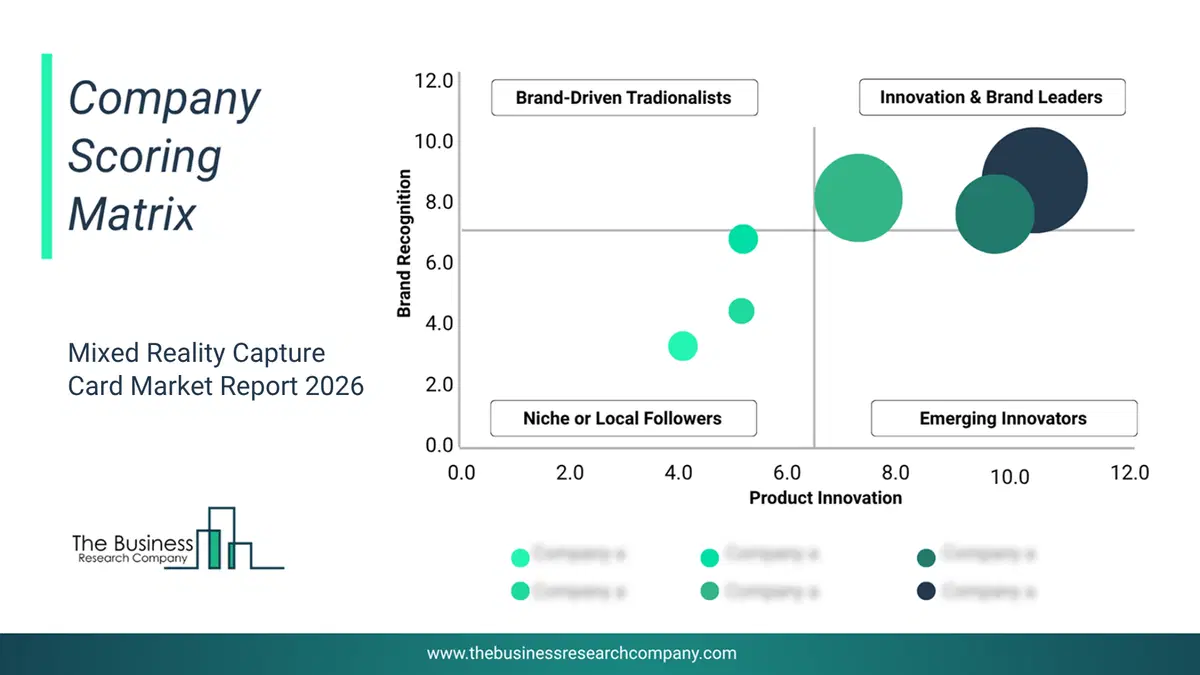
This chart maps companies by product innovation and brand strength, with bubble size indicating relative revenue, helping identify market leaders, challengers, and niche players. This is an illustrative chart; the full report provides a complete and accurate competitive analysis.
Global Mixed Reality Capture Card Market Trends and Insights
Major companies operating in the mixed reality capture card market are focusing on developing advanced capture and playback cards to support synchronized and enhanced performance for immersive content creation. Capture and playback cards are dedicated hardware components that allow high-quality video and audio inputs to be captured by a computer and accurately delivered to external displays or broadcast systems that provide low-latency, synchronized, and dependable processing of multiple high-resolution media streams for professional production and immersive applications. For instance, in April 2025, Blackmagic Design, a US-based broadcast and video hardware company, launched the DeckLink IP 100G, a new PCIe Gen 4 capture and playback card, which supports up to eight channels of HD and Ultra HD video capture with dual 100G Ethernet ports for redundancy. The card integrates GPUDirect RDMA technology to allow direct GPU memory transfers, significantly reducing latency and delivering scalable performance for immersive mixed reality video workflows that require synchronized, high-bandwidth inputs, while being offered at a competitive price point of approximately US$1,795.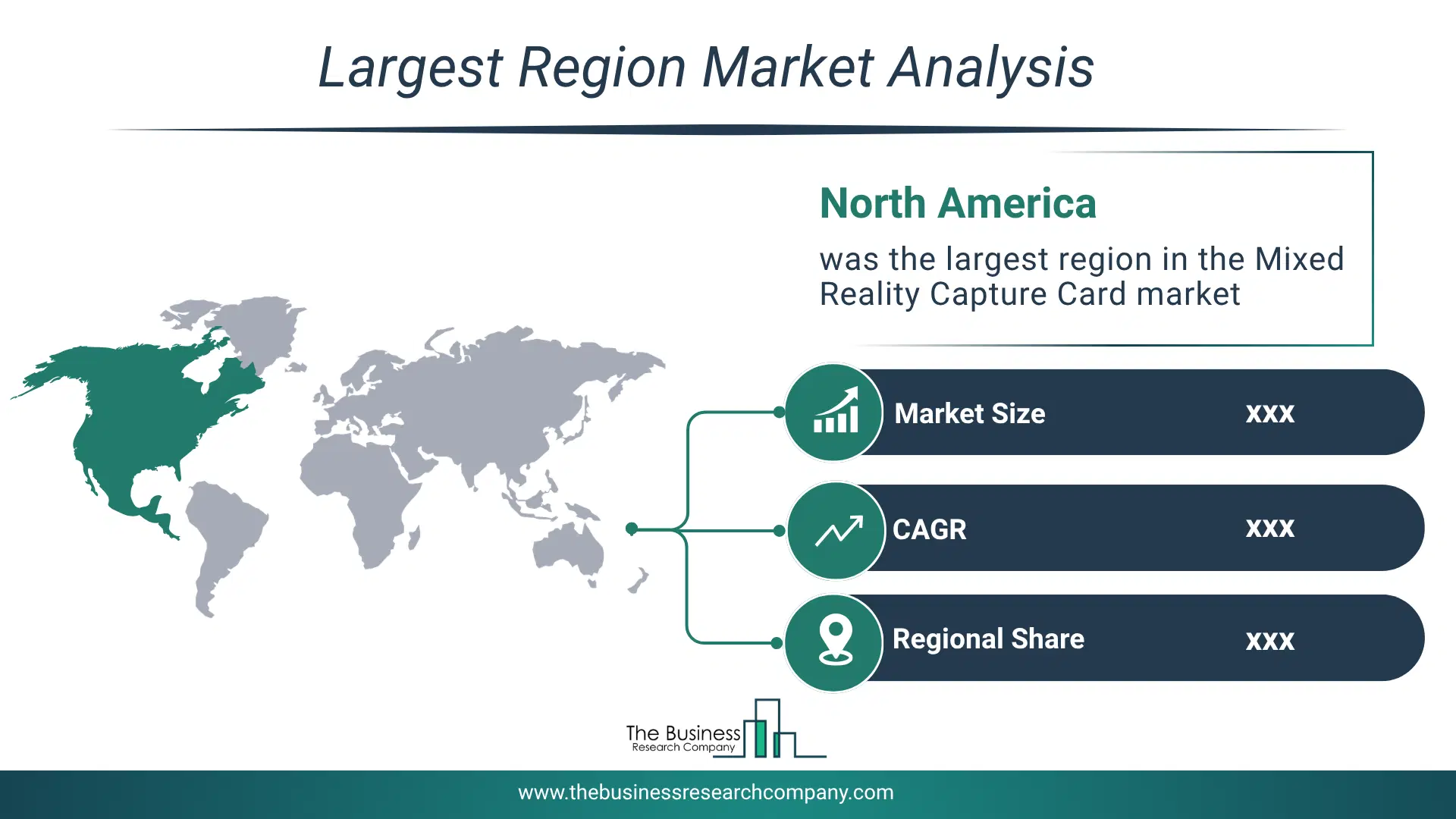
Regional Insights
North America was the largest region in the mixed reality capture card market in 2025. Asia-Pacific is expected to be the fastest-growing region in the forecast period. The regions covered in this market report are Asia-Pacific, South East Asia, Western Europe, Eastern Europe, North America, South America, Middle East, Africa. The countries covered in this market report are Australia, Brazil, China, France, Germany, India, Indonesia, Japan, Taiwan, Russia, South Korea, UK, USA, Canada, Italy, Spain.What Defines the Mixed Reality Capture Card Market?
The mixed reality capture card market consists of sales of mixed reality capture cards, video capture cards, express capture cards, universal serial bus (USB) capture cards, high-definition multimedia interface (HDMI) capture cards, multi-channel capture cards, audio video capture cards, and real time video capture hardware. Values in this market are ‘factory gate’ values, that is, the value of goods sold by the manufacturers or creators of the goods, whether to other entities (including downstream manufacturers, wholesalers, distributors, and retailers) or directly to end customers. The value of goods in this market includes related services sold by the creators of the goods.How is Market Value Defined and Measured?
The market value is defined as the revenues that enterprises gain from the sale of goods and/or services within the specified market and geography through sales, grants, or donations in terms of the currency (in USD unless otherwise specified). The revenues for a specified geography are consumption values that are revenues generated by organizations in the specified geography within the market, irrespective of where they are produced. It does not include revenues from resales along the supply chain, either further along the supply chain or as part of other products.
This chart presents market attractiveness based on a quantitative evaluation of growth, competition, strategic alignment, and risk, offering a clear view of opportunity areas for decision-making. This chart is for illustrative purposes; the full report contains the complete analysis.

This chart highlights the Total Addressable Market (TAM) by estimating the maximum revenue opportunity using an assumption-driven approach, supporting strategic planning and opportunity sizing across markets. The chart is illustrative; the full report provides a more comprehensive analysis.
What Key Data and Analysis Are Included in the Mixed Reality Capture Card Market Report 2026?
The mixed reality capture card market research report is one of a series of new reports from The Business Research Company that provides market statistics, including industry global market size, regional shares, competitors with the market share, detailed market segments, market trends and opportunities, and any further data you may need to thrive in the mixed reality capture card industry. The market research report delivers a complete perspective of everything you need, with an in-depth analysis of the current and future state of the industry.Mixed Reality Capture Card Market Report Forecast Analysis
| Report Attribute | Details |
|---|---|
| Market Size Value In 2026 | $3.2 billion |
| Revenue Forecast In 2030 | $6.05 billion |
| Growth Rate | CAGR of 17.0% from 2026 to 2030 |
| Base Year For Estimation | 2025 |
| Actual Estimates/Historical Data | 2020-2025 |
| Forecast Period | 2026 - 2030 |
| Market Representation | Revenue in USD Billion and CAGR from 2026 to 2030 |
| Segments Covered | Product Type, Platform, Application, Distribution Channel, End-User |
| Regional Scope | Asia-Pacific, Western Europe, Eastern Europe, North America, South America, Middle East, Africa |
| Country Scope | The countries covered in the report are Australia, Brazil, China, France, Germany, India, Indonesia, Japan, Taiwan, Russia, South Korea, UK, USA, Canada, Italy, Spain. |
| Key Companies Profiled | ASUSTeK Computer Inc., IO Industries Inc., Razer Inc., Kaijet Technology International Limited Inc, INOGENI Inc., AVerMedia Technologies Inc., AJA Video Systems Inc., Yuan High-Tech Development Co. Ltd., Nanjing Magewell Electronics Co. Ltd., Blackmagic Design Pty Ltd, Datapath Limited, StarTech.com Limited, Epiphan Systems Inc., Advantech Co. Ltd., Matrox Electronic Systems Ltd., Bluefish Technologies Pty Ltd, Teradek LLC, Creative Solutions Division Inc, ADLINK Technology Inc., and Atomos Limited. |
| Customization Scope | Request for Customization |
| Pricing And Purchase Options | Explore Purchase Options |