
Mobile Cancer Screening Devices Market Report 2026
Global Outlook – By Device Type (Imaging Devices, Diagnostic And Detection Devices, Endoscopy Devices, Biopsy Devices), By Cancer Type (Breast Cancer, Lung Cancer, Colorectal Cancer, Cervical Cancer, Prostate Cancer, Skin Cancer), By Technology (Ultrasound Technology, Computed Tomography Technology, Magnetic Resonance Imaging Technology, Molecular Diagnostics Technology, Artificial Intelligence Based Screening Technology), By End User (Hospitals, Diagnostic Centers, Mobile Screening Clinics, Ambulatory Care Centers, Community Healthcare Programs) – Market Size, Trends, Strategies, and Forecast to 2030
Mobile Cancer Screening Devices Market Overview
• Mobile Cancer Screening Devices market size has reached to $4.88 billion in 2025 • Expected to grow to $9.05 billion in 2030 at a compound annual growth rate (CAGR) of 13.1% • Growth Driver: The Increasing Incidence Of Cancer Driving The Growth Of The Market Due To Rise In Aging Population • Market Trend: Ai-Powered Portable Screening Innovation Advancing Early Lung Cancer Detection • North America was the largest region in 2025 and Asia-Pacific is the fastest growing region.What Is Covered Under Mobile Cancer Screening Devices Market?
Mobile cancer screening devices refer to portable or transportable medical equipment designed to detect early signs of cancer outside of traditional hospital or laboratory settings. These devices enable on-site screening in remote, rural, or underserved areas, improving early diagnosis and access to preventive healthcare services. The main device types of mobile cancer screening devices include imaging devices, diagnostic and detection devices, endoscopy devices, and biopsy devices. Imaging devices refer to portable systems used to visualize internal structures of the body for early cancer detection. These devices are used for cancer types including breast cancer, lung cancer, colorectal cancer, cervical cancer, prostate cancer, and skin cancer. They are based on technologies such as ultrasound technology, computed tomography technology, magnetic resonance imaging technology, molecular diagnostics technology, and artificial intelligence based screening technology and are utilized by end users including hospitals, diagnostic centers, mobile screening clinics, ambulatory care centers, and community healthcare programs.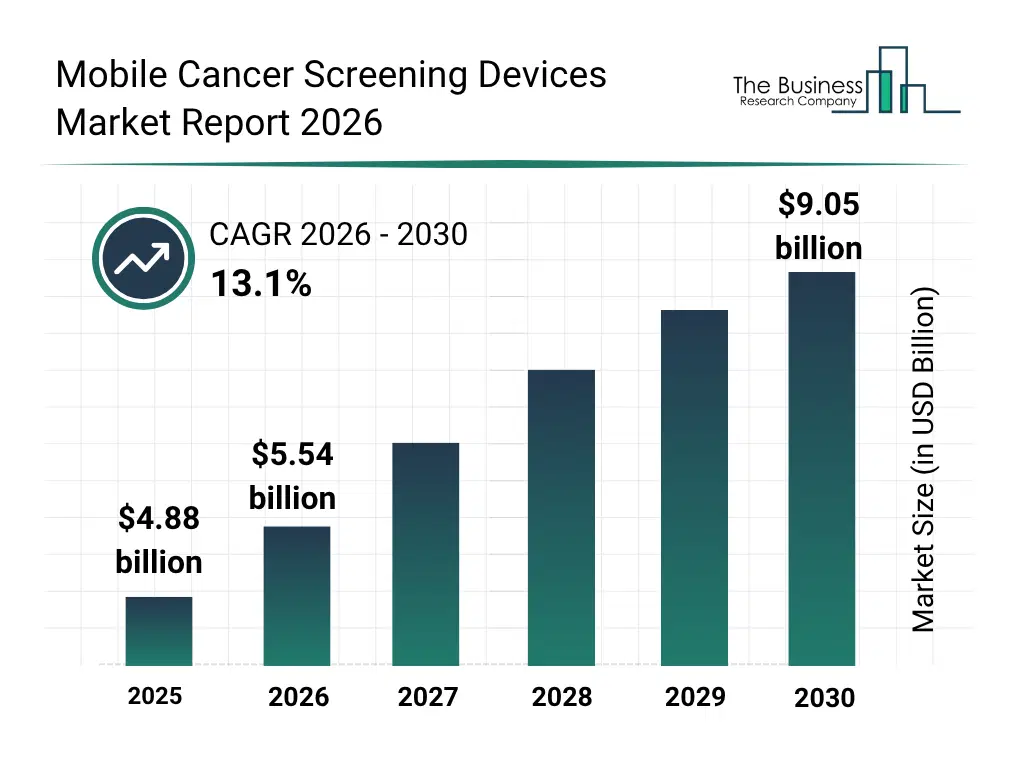
What Is The Mobile Cancer Screening Devices Market Size and Share 2026?
The mobile cancer screening devices market size has grown rapidly in recent years. It will grow from $4.88 billion in 2025 to $5.54 billion in 2026 at a compound annual growth rate (CAGR) of 13.5%. The growth in the historic period can be attributed to increasing global cancer prevalence rates, growth in government cancer awareness initiatives, rising demand for early diagnosis programs, expansion of healthcare access in underserved regions, increasing healthcare infrastructure investments.What Is The Mobile Cancer Screening Devices Market Growth Forecast?
The mobile cancer screening devices market size is expected to see rapid growth in the next few years. It will grow to $9.05 billion in 2030 at a compound annual growth rate (CAGR) of 13.1%. The growth in the forecast period can be attributed to increasing investment in portable diagnostic technologies, rising adoption of AI based screening platforms, growing demand for decentralized healthcare services, expansion of preventive healthcare programs, increasing development of advanced molecular diagnostic solutions. Major trends in the forecast period include increasing adoption of portable cancer screening solutions, rising demand for early cancer detection technologies, growing deployment of community based screening programs, increasing focus on point of care diagnostic capabilities, expanding use of remote healthcare screening services.
Global Mobile Cancer Screening Devices Market Segmentation
1) By Device Type: Imaging Devices; Diagnostic And Detection Devices; Endoscopy Devices; Biopsy Devices 2) By Cancer Type: Breast Cancer; Lung Cancer; Colorectal Cancer; Cervical Cancer; Prostate Cancer; Skin Cancer 3) By Technology: Ultrasound Technology; Computed Tomography Technology; Magnetic Resonance Imaging Technology; Molecular Diagnostics Technology; Artificial Intelligence Based Screening Technology 4) By End User: Hospitals; Diagnostic Centers; Mobile Screening Clinics; Ambulatory Care Centers; Community Healthcare Programs Subsegments: 1) By Imaging Devices: Portable Mammography Systems; Mobile Computed Tomography Scanners; Portable Magnetic Resonance Imaging Systems; Handheld Ultrasound Devices; Mobile Positron Emission Tomography Systems 2) By Diagnostic And Detection Devices: Liquid Biopsy Devices; Molecular Diagnostic Devices; Biomarker Detection Devices; Point Of Care Diagnostic Analyzers; Cancer Screening Test Kits 3) By Endoscopy Devices: Portable Gastrointestinal Endoscopy Devices; Mobile Bronchoscopy Systems; Capsule Endoscopy Devices; Flexible Endoscopy Systems; Wireless Endoscopy Devices 4) By Biopsy Devices: Needle Biopsy Devices; Vacuum Assisted Biopsy Devices; Image Guided Biopsy Systems; Core Needle Biopsy Devices; Fine Needle Aspiration DevicesWhat Is The Driver Of The Mobile Cancer Screening Devices Market?
The increasing incidence of cancer is expected to propel the growth of the mobile cancer screening devices market going forward. Cancer incidence refers to the number of new cancer cases diagnosed within a specific population during a certain period. The increasing incidence of cancer is due to an aging population, with older age leading to the accumulation of genetic mutations and a decline in the body’s ability to repair damaged cells, which raises cancer risk over time. Mobile cancer screening devices help cancer detection by enabling early, accessible, and on-the-spot diagnosis, which improves timely treatment initiation and significantly increases the chances of better patient outcomes. For instance, in January 2026, according to the Centers for Disease Control and Prevention, a US-based government agency in the United States, 1,851,238 new cancer cases were recorded in 2022, and 613,349 deaths due to cancer occurred in 2023. Therefore, the increasing incidence of cancer is driving the growth of the mobile cancer screening devices industry.Key Players In The Global Mobile Cancer Screening Devices Market
Major companies operating in the mobile cancer screening devices market are Siemens Healthineers AG; GE HealthCare Technologies Inc.; Philips Healthcare; FUJIFILM Holdings Corporation; Hologic Inc.; Canon Medical Systems Corporation; Shimadzu Corporation; Shenzhen Mindray Bio-Medical Electronics Co. Ltd.; Konica Minolta Inc.; Samsung Medison Co. Ltd.; SonoSite (Fujifilm); Carestream Health Inc.; Neusoft Medical Systems; Esaote S.p.A.; Samsung NeuroLogica; Butterfly Network Inc.; Trivitron Healthcare Pvt. Ltd.; Planmed Oy; BPL Medical Technologies Private Limited; UE LifeSciences Inc.; Niramai Health Analytix Private Limited; Forward Science LLCGlobal Mobile Cancer Screening Devices Market Trends and Insights
Major companies operating in the mobile cancer screening devices market are focusing on developing innovative solutions, such as AI-enabled mobile diagnostic screening units to enable early and accurate cancer detection, improve diagnostic access in remote areas, and enhance overall screening efficiency. AI-enabled mobile diagnostic screening units are portable healthcare systems equipped with artificial intelligence tools that analyze medical data on the spot to enable fast, accurate, and early disease screening in remote or underserved areas. For instance, in February 2026, Kamala Nehru Memorial Hospital, a India-based not-for-profit, multi-specialty institution, in collaboration with Lenek Technologies, a India-based health-tech startup, launched a project to develop a portable AI-enabled device for early lung cancer detection. The initiative aims to integrate artificial intelligence with clinical diagnostics to improve the speed and accuracy of lung cancer screening, particularly in early-stage cases. This portable solution is also designed to expand access to advanced diagnostic capabilities in remote and resource-limited healthcare settings.What Are Latest Mergers And Acquisitions In The Mobile Cancer Screening Devices Market?
In March 2026, Lord’s Mark Industries Limited, an India-based healthcare and medical technology company, partnered with the Centre for Materials for Electronic Technology (CMET) to develop an AI-based breast cancer detection device. This partnership aims to advance early and accessible breast cancer screening by combining Lord’s Mark Industries’ expertise in healthcare technology development and commercialization with CMET’s capabilities in advanced electronic materials research and sensor technologies. The collaboration focuses on creating a portable, radiation-free screening system that uses AI-driven thermal imaging to detect early abnormalities. The Center for Materials for Electronics Technology is an India-based government research organization specializing in electronic materials and related technology development for advanced applications.Regional Outlook
North America was the largest region in the mobile cancer screening devices market in 2025. Asia-Pacific is expected to be the fastest-growing region in the forecast period. The regions covered in this market report are Asia-Pacific, South East Asia, Western Europe, Eastern Europe, North America, South America, Middle East, Africa. The countries covered in this market report are Australia, Brazil, China, France, Germany, India, Indonesia, Japan, Taiwan, Russia, South Korea, UK, USA, Canada, Italy, Spain.What Defines the Mobile Cancer Screening Devices Market?
The mobile cancer screening devices market consists of revenues earned by entities by providing services such as on-site cancer screening services, mobile diagnostic imaging services, early detection and screening program management services, tele-diagnostic and remote reporting services, and equipment leasing and maintenance services. The market value includes the value of related goods sold by the service provider or included within the service offering. The mobile cancer screening devices market also includes sales of sample collection kits, liquid biopsy assay kits, molecular diagnostic reagents, and sample preservation and transport media kits. Values in this market are ‘factory gate’ values, that is the value of goods sold by the manufacturers or creators of the goods, whether to other entities (including downstream manufacturers, wholesalers, distributors and retailers) or directly to end customers. The value of goods in this market includes related services sold by the creators of the goods.How is Market Value Defined and Measured?
The market value is defined as the revenues that enterprises gain from the sale of goods and/or services within the specified market and geography through sales, grants, or donations in terms of the currency (in USD unless otherwise specified). The revenues for a specified geography are consumption values that are revenues generated by organizations in the specified geography within the market, irrespective of where they are produced. It does not include revenues from resales along the supply chain, either further along the supply chain or as part of other products.What Key Data and Analysis Are Included in the Mobile Cancer Screening Devices Market Report 2026?
The mobile cancer screening devices market research report is one of a series of new reports from The Business Research Company that provides market statistics, including industry global market size, regional shares, competitors with the market share, detailed market segments, market trends and opportunities, and any further data you may need to thrive in the mobile cancer screening devices industry. The market research report delivers a complete perspective of everything you need, with an in-depth analysis of the current and future state of the industry.Mobile Cancer Screening Devices Market Report Forecast Analysis
| Report Attribute | Details |
|---|---|
| Market Size Value In 2026 | $5.54 billion |
| Revenue Forecast In 2030 | $9.05 billion |
| Growth Rate | CAGR of 13.1% from 2026 to 2030 |
| Base Year For Estimation | 2025 |
| Actual Estimates/Historical Data | 2020-2025 |
| Forecast Period | 2026 - 2030 |
| Market Representation | Revenue in USD Billion and CAGR from 2026 to 2030 |
| Segments Covered | Device Type, Cancer Type, Technology, End User |
| Regional Scope | Asia-Pacific, Western Europe, Eastern Europe, North America, South America, Middle East, Africa |
| Country Scope | The countries covered in the report are Australia, Brazil, China, France, Germany, India, ... |
| Key Companies Profiled | Siemens Healthineers AG; GE HealthCare Technologies Inc.; Philips Healthcare; FUJIFILM Holdings Corporation; Hologic Inc.; Canon Medical Systems Corporation; Shimadzu Corporation; Shenzhen Mindray Bio-Medical Electronics Co. Ltd.; Konica Minolta Inc.; Samsung Medison Co. Ltd.; SonoSite (Fujifilm); Carestream Health Inc.; Neusoft Medical Systems; Esaote S.p.A.; Samsung NeuroLogica; Butterfly Network Inc.; Trivitron Healthcare Pvt. Ltd.; Planmed Oy; BPL Medical Technologies Private Limited; UE LifeSciences Inc.; Niramai Health Analytix Private Limited; Forward Science LLC |
| Customization Scope | Request for Customization |
| Pricing And Purchase Options | Explore Purchase Options |