
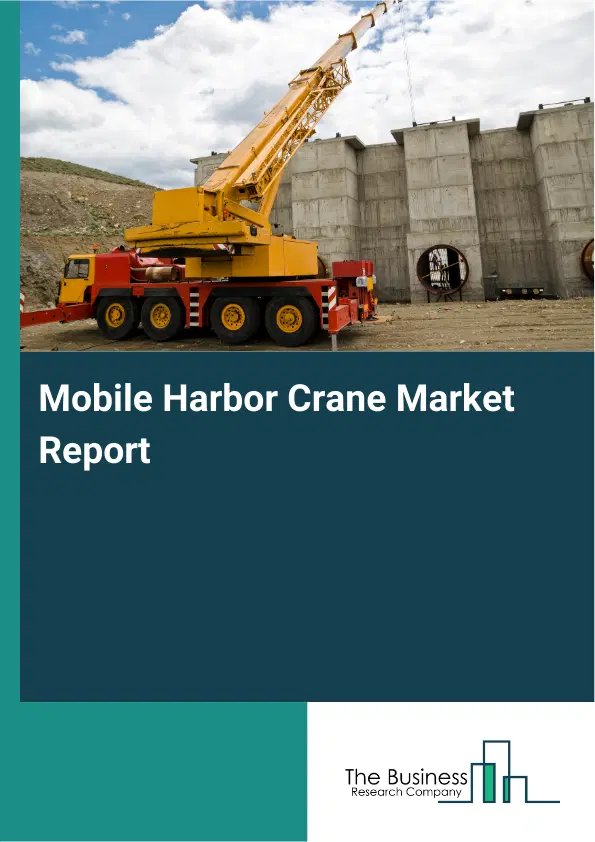
Mobile Harbor Crane Market Report 2026
Global Outlook – By Type (Floating Cranes, Telescopic Cranes, Articulated Cranes, Container Handling Cranes), By Design Configuration (Standard Design, Customized Solutions, Electrically Powered Cranes, Hybrid Cranes), By Power Source (Electric, Diesel, Hybrid), By Application (Container Handling, Bulk Handling, Scrap Handling, Other Applications), By End-User (Shipping And Logistics, Construction, Mining, Infrastructure Development, Aerospace And Defense) – Market Size, Trends, Strategies, and Forecast to 2030
Mobile Harbor Crane Market Overview
• Mobile Harbor Crane market size has reached to $3.06 billion in 2025 • Expected to grow to $4.32 billion in 2030 at a compound annual growth rate (CAGR) of 7.1% • Growth Driver: Increasing Trade Activities Fueling The Growth Of The Market Due To Rising Demand For Efficient Cargo Handling And Port Infrastructure • Market Trend: New Electric Dual-Drive Crane Marks Major Step Toward Sustainable Port Operations • Asia-Pacific was the largest region and fastest growing region.What Is Covered Under Mobile Harbor Crane Market?
Mobile harbor crane is a versatile, self-propelled crane mounted on rubber tires or rails, designed for loading and unloading cargo at ports and terminals. Its primary purpose is to handle a wide range of goods, including containers, bulk materials, and heavy project cargo, directly from ships to shore or vice versa. It provides high flexibility, mobility, and cost-efficiency in port operations. The main types of mobile harbor crane are floating cranes, telescopic cranes, articulated cranes, and container handling cranes. Floating cranes refer to crane systems mounted on barges or pontoons, designed to lift and move heavy loads on water. It is available in different design configurations such as standard design, customized solutions, electrically powered cranes, and hybrid cranes and categorized based on the power sources as electric, diesel, or hybrid. Port cranes are widely applied for container handling, bulk handling, scrap handling operations and others, serving end-users including shipping and logistics, construction, mining, infrastructure development, and aerospace and defense industries.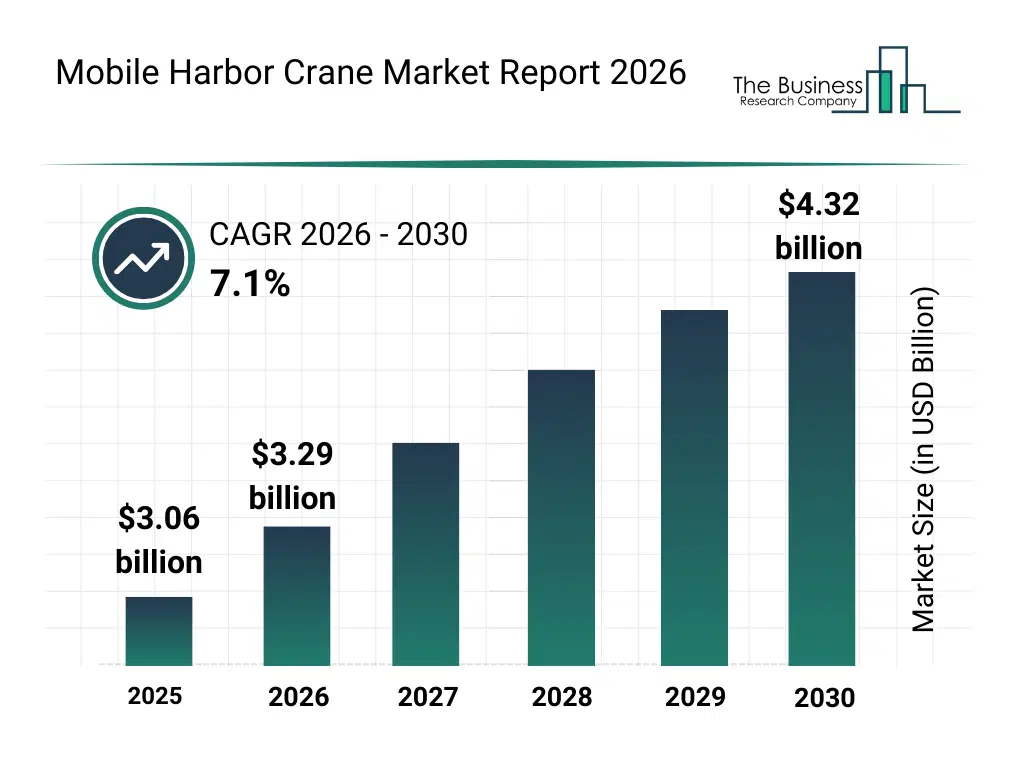
What Is The Mobile Harbor Crane Market Size and Share 2026?
The mobile harbor crane market size has grown strongly in recent years. It will grow from $3.06 billion in 2025 to $3.29 billion in 2026 at a compound annual growth rate (CAGR) of 7.4%. The growth in the historic period can be attributed to expansion of global seaborne trade, modernization of port infrastructure, rising containerization trends, demand for versatile cargo handling equipment, investments in port efficiency improvement.What Is The Mobile Harbor Crane Market Growth Forecast?
The mobile harbor crane market size is expected to see strong growth in the next few years. It will grow to $4.32 billion in 2030 at a compound annual growth rate (CAGR) of 7.1%. The growth in the forecast period can be attributed to growth of smart port initiatives, increasing adoption of low-emission port equipment, expansion of global logistics hubs, rising focus on automation in terminals, increasing infrastructure investments in emerging economies. Major trends in the forecast period include increasing adoption of electrically powered harbor cranes, rising integration of remote monitoring and automation systems, growing demand for flexible port handling solutions, expansion of hybrid crane technologies, enhanced focus on operational efficiency.Tariff Impact On Mobile Harbor Crane Market
Tariffs are impacting the mobile harbor crane market by raising costs of imported steel structures, heavy-duty hydraulic systems, electric drives, control electronics, and large fabricated components. Ports and terminals in North America and Europe are most affected due to reliance on imported crane systems from Asia-Pacific manufacturers. These tariffs are increasing capital investment costs and extending procurement timelines for port authorities. However, they are also stimulating regional crane assembly, localized fabrication partnerships, and innovation in modular and energy-efficient crane designs to improve long-term cost competitiveness.
Global Mobile Harbor Crane Market Segmentation
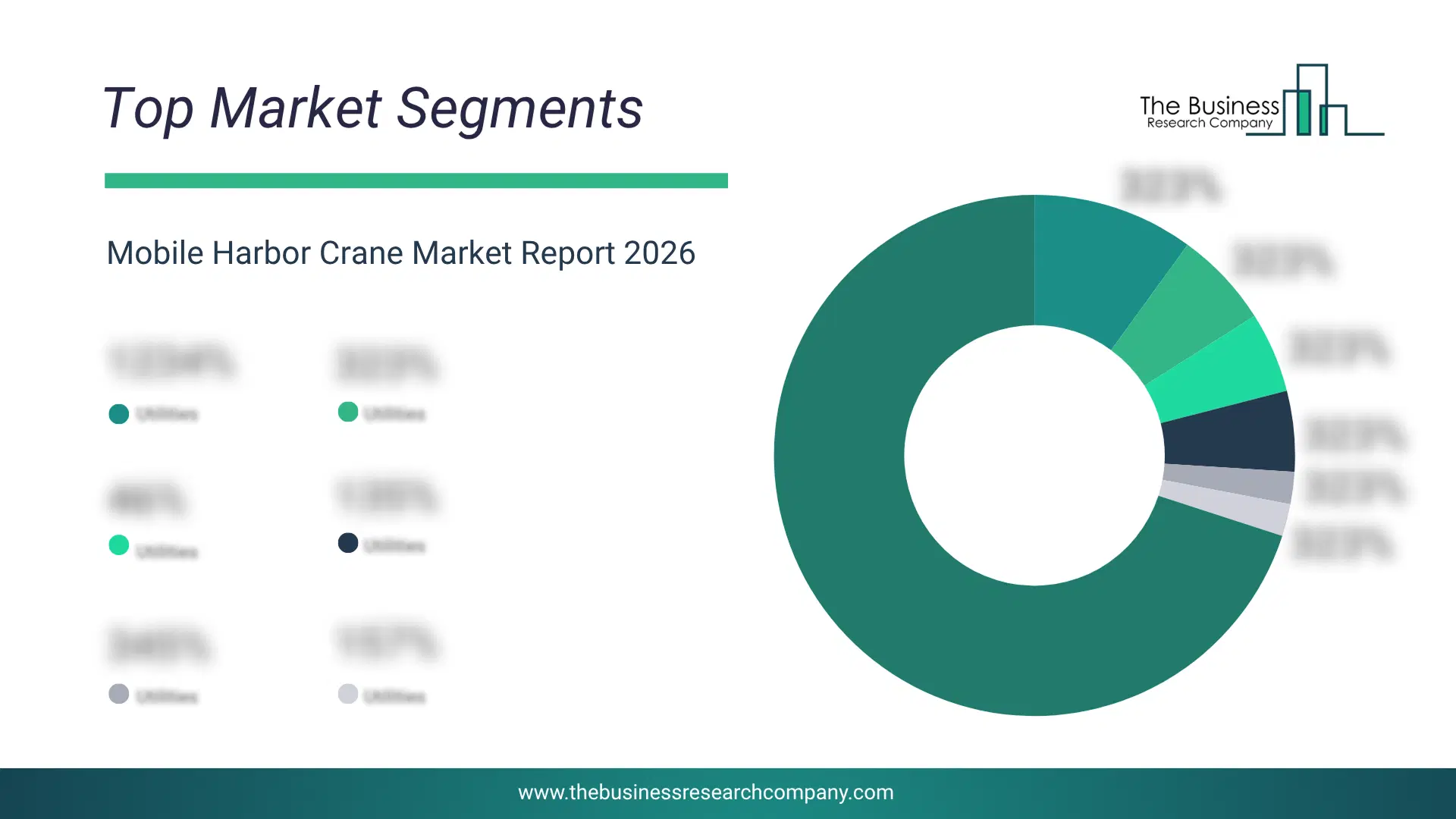
1) By Type: Floating Cranes, Telescopic Cranes, Articulated Cranes, Container Handling Cranes 2) By Design Configuration: Standard Design, Customized Solutions, Electrically Powered Cranes, Hybrid Cranes 3) By Power Source: Electric, Diesel, Hybrid 4) By Application: Container Handling, Bulk Handling, Scrap Handling, Other Applications 5) By End-User: Shipping And Logistics, Construction, Mining, Infrastructure Development, Aerospace And Defense Subsegments: 1) By Floating Cranes: Barge-Mounted Heavy Lift Units, Harbor Construction And Salvage Support, Ship-to-Ship Cargo Transfer Operations, Shallow Draft Riverine Deployment 2) By Telescopic Cranes: Rubber Tyred Telescopic Boom Units, Rail Mounted Telescopic Boom Units, Short Radius Urban Terminal Operations, Quick Setup Mobile Deployment 3) By Articulated Cranes: Knuckle Boom Shipboard Handling, Quayside Compact Reach Applications, Scrap And Timber Handling Attachments, Remote Control Precision Operations 4) By Container Handling Cranes: Ship To Shore Gantry Cranes, Rubber Tyred Gantry Cranes, Rail Mounted Gantry Cranes, Mobile Straddle Carrier HandlingWhat Is The Driver Of The Mobile Harbor Crane Market?
The increasing trade activities are expected to propel the growth of the mobile harbor crane market going forward. Trade activities refer to the exchange of goods and commodities between countries, which requires efficient cargo handling and port operations to support growing trade volumes. The rise in trade activities is due to increasing merchandise exports and imports, expanding international supply chains, and growth in emerging markets, which collectively create higher demand for advanced port infrastructure. Mobile harbor cranes support trade activities by enabling faster, safer, and more efficient handling of cargo, including bulk materials and containers, thereby enhancing overall port productivity. For instance, in April 2025, according to the World Trade Organization (WTO), a Switzerland-based trade organization, the value of global merchandise trade rose by 2% in 2024, rebounding from a 4% decline in 2023. Therefore, the increasing trade activities are driving the growth of the mobile harbor crane industry.Key Players In The Global Mobile Harbor Crane Market
Major companies operating in the mobile harbor crane market are Liebherr Group, Xuzhou Construction Machinery Group Co. Ltd., Sany Heavy Industry Co. Ltd., Shanghai Zhenhua Heavy Industries Co. Ltd., Konecranes Gottwald GmbH, Dalian Huarui Heavy Industry Group Co. Ltd., Huada Heavy Industry Technology Co. Ltd., Sennebogen Maschinenfabrik GmbH, MMantsinen Group Ltd Oy, Shandong Kaiyuan Heavy Machinery Co. Ltd., Henan Weihua Heavy Machinery Co. Ltd., FUWA Global Heavy Industry Co. Ltd., Deyuan Marine Co. Ltd., Henan Dowell Crane Co. Ltd., Henan Nucleon Crane Group Co. Ltd., Henan Mine Crane Co. Ltd., Zhendong Port Machinery Manufacturing Co. Ltd., Saintwah Inc., STONIMAGE Co. Ltd., Guangdong Yongtong Crane Machinery Co. Ltd.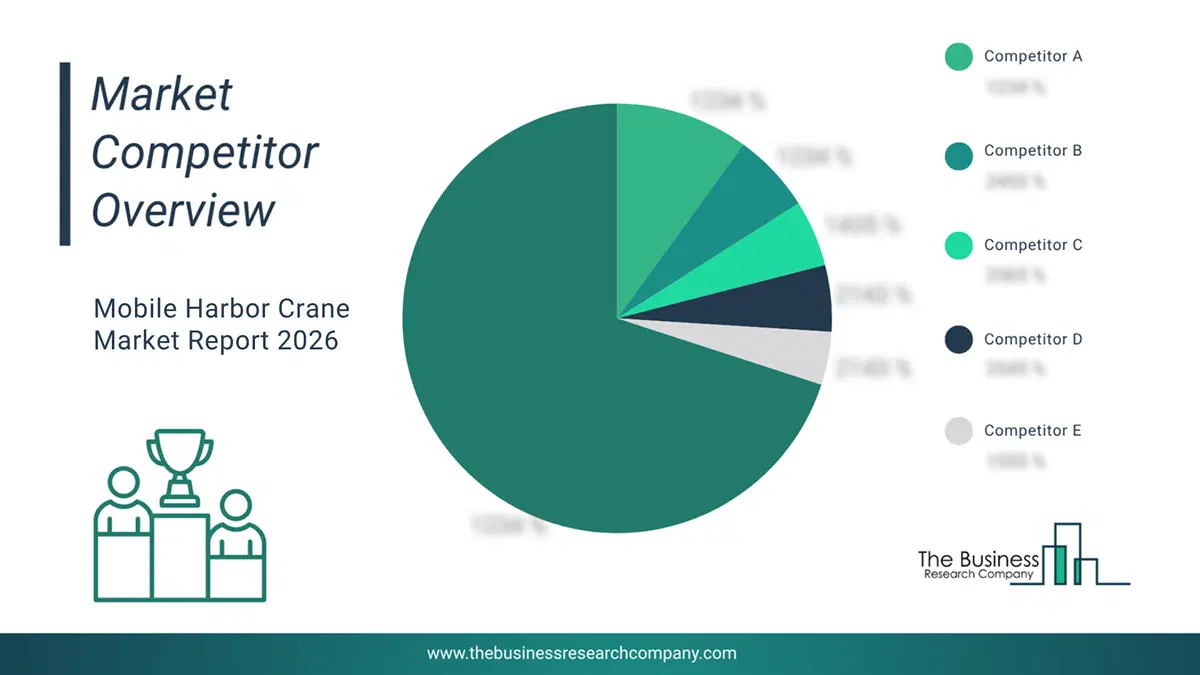
This chart is for illustrative purposes; the full report includes a detailed competitor analysis and comprehensive overview of the top 10 companies in the market.
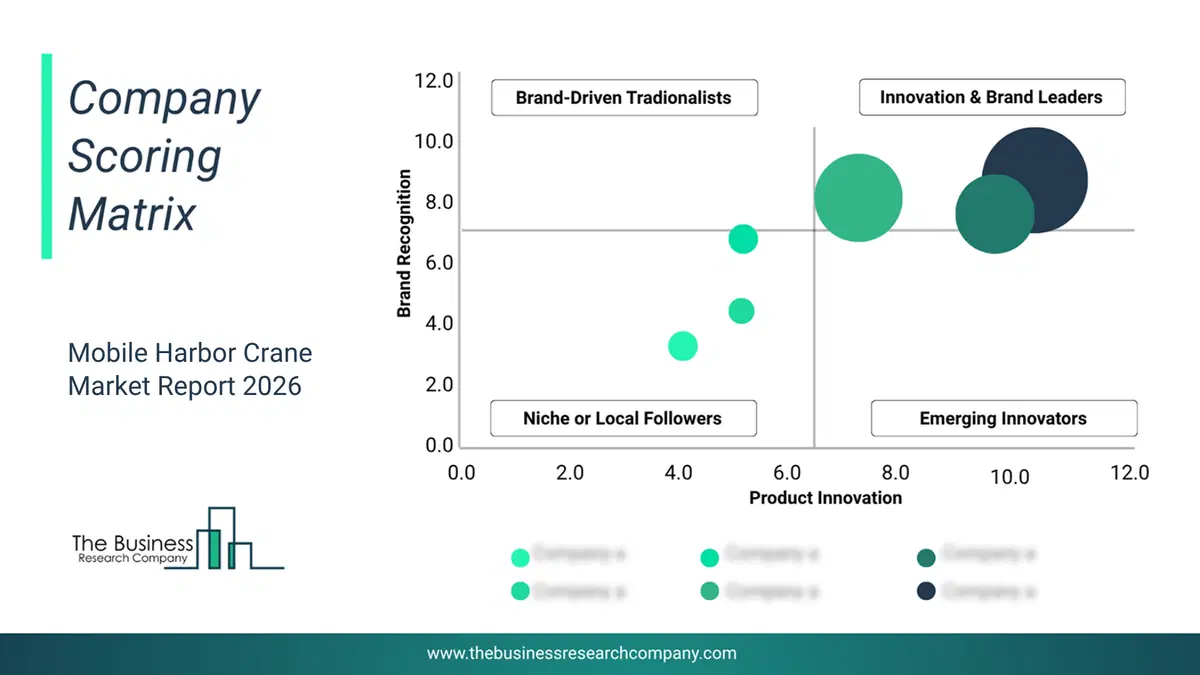
This chart maps companies by product innovation and brand strength, with bubble size indicating relative revenue, helping identify market leaders, challengers, and niche players. This is an illustrative chart; the full report provides a complete and accurate competitive analysis.
Global Mobile Harbor Crane Market Trends and Insights
Major companies operating in the mobile harbor crane market are focusing on developing advanced products, such as electric dual-drive mobile harbor cranes, to minimize fuel consumption, lower carbon emissions, and support the transition toward sustainable and eco-friendly port operations. Electric dual-drive mobile harbor cranes refer to cranes equipped with both electric and diesel power systems, allowing them to operate flexibly using electricity when available or diesel in off-grid conditions. For instance, in July 2025, Port Nelson Limited, a New Zealand-based port authority, launched the Liebherr LHM600E, an electric dual-drive mobile harbor crane. This innovative crane is capable of operating on electric power up to 85% of the time, reducing carbon emissions and contributing to the port’s broader electrification strategy. The LHM 600E represents a sustainable and high-performance solution for modern port cargo handling, combining advanced low-emission electric technology with enhanced operational efficiency and reduced environmental impact.What Are Latest Mergers And Acquisitions In The Mobile Harbor Crane Market?
In January 2025, Pilbara Ports Authority, an Australia-based port operator, partnered with Konecranes plc. This partnership aims to enhance port efficiency and sustainability through the implementation of advanced lifting technologies, digital solutions, and automated mobile harbor cranes to support safer and more energy-efficient cargo handling operations. Konecranes plc is a Finland-based manufacturer of mobile harbor cranes and port handling solutions.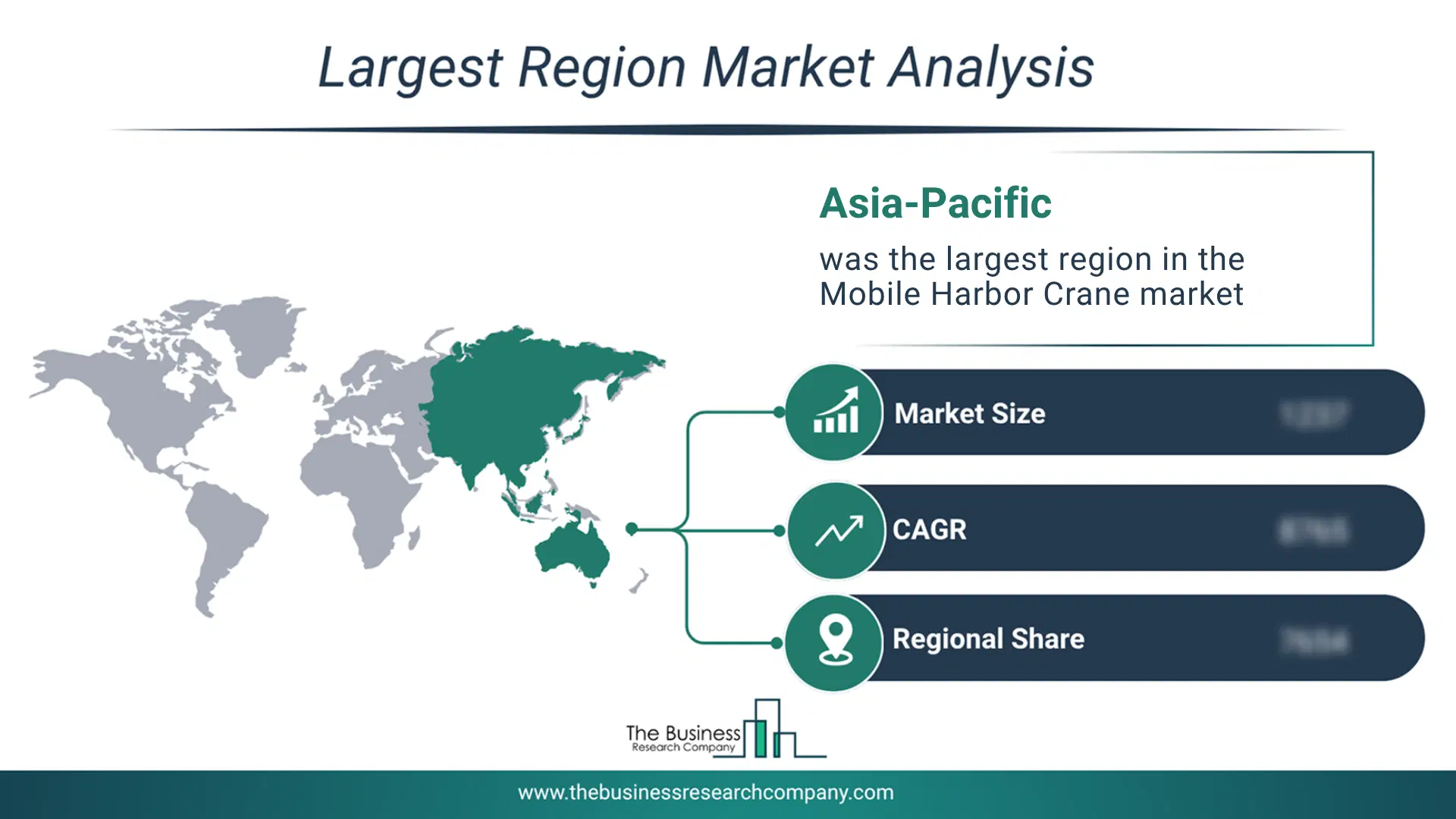
Regional Outlook
Asia-Pacific was the largest region in the mobile harbor crane market in 2025. Asia-Pacific is expected to be the fastest-growing region in the forecast period. The regions covered in this market report are Asia-Pacific, South East Asia, Western Europe, Eastern Europe, North America, South America, Middle East, Africa The countries covered in this market report are Australia, Brazil, China, France, Germany, India, Indonesia, Japan, Taiwan, Russia, South Korea, UK, USA, Canada, Italy, Spain.What Defines the Mobile Harbor Crane Market?
The mobile harbor crane market consists of sales of rubber-tired mobile harbor cranes, rail-mounted harbor cranes, lattice boom cranes, and portal harbor cranes. Values in this market are ‘factory gate’ values, that is, the value of cranes sold by the manufacturers or creators of the cranes, whether to other entities (including port operators, terminal operators, distributors, and leasing companies) or directly to customers. The value of goods in this market includes related services sold by the creators of the goods.How is Market Value Defined and Measured?
The market value is defined as the revenues that enterprises gain from the sale of goods and/or services within the specified market and geography through sales, grants, or donations in terms of the currency (in USD unless otherwise specified). The revenues for a specified geography are consumption values that are revenues generated by organizations in the specified geography within the market, irrespective of where they are produced. It does not include revenues from resales along the supply chain, either further along the supply chain or as part of other products.
This chart presents market attractiveness based on a quantitative evaluation of growth, competition, strategic alignment, and risk, offering a clear view of opportunity areas for decision-making. This chart is for illustrative purposes; the full report contains the complete analysis.

This chart highlights the Total Addressable Market (TAM) by estimating the maximum revenue opportunity using an assumption-driven approach, supporting strategic planning and opportunity sizing across markets. The chart is illustrative; the full report provides a more comprehensive analysis.
What Key Data and Analysis Are Included in the Mobile Harbor Crane Market Report 2026?
The mobile harbor crane market research report is one of a series of new reports from The Business Research Company that provides market statistics, including industry global market size, regional shares, competitors with the market share, detailed market segments, market trends and opportunities, and any further data you may need to thrive in the mobile harbor crane industry. The market research report delivers a complete perspective of everything you need, with an in-depth analysis of the current and future state of the industry.Mobile Harbor Crane Market Report Forecast Analysis
| Report Attribute | Details |
|---|---|
| Market Size Value In 2026 | $3.29 billion |
| Revenue Forecast In 2030 | $4.32 billion |
| Growth Rate | CAGR of 7.1% from 2026 to 2030 |
| Base Year For Estimation | 2025 |
| Actual Estimates/Historical Data | 2020-2025 |
| Forecast Period | 2026 - 2030 |
| Market Representation | Revenue in USD Billion and CAGR from 2026 to 2030 |
| Segments Covered | Type, Design Configuration, Power Source, Application, End-User |
| Regional Scope | Asia-Pacific, Western Europe, Eastern Europe, North America, South America, Middle East, Africa |
| Key Companies Profiled | Liebherr Group, Xuzhou Construction Machinery Group Co. Ltd., Sany Heavy Industry Co. Ltd., Shanghai Zhenhua Heavy Industries Co. Ltd., Konecranes Gottwald GmbH, Dalian Huarui Heavy Industry Group Co. Ltd., Huada Heavy Industry Technology Co. Ltd., Sennebogen Maschinenfabrik GmbH, MMantsinen Group Ltd Oy, Shandong Kaiyuan Heavy Machinery Co. Ltd., Henan Weihua Heavy Machinery Co. Ltd., FUWA Global Heavy Industry Co. Ltd., Deyuan Marine Co. Ltd., Henan Dowell Crane Co. Ltd., Henan Nucleon Crane Group Co. Ltd., Henan Mine Crane Co. Ltd., Zhendong Port Machinery Manufacturing Co. Ltd., Saintwah Inc., STONIMAGE Co. Ltd., Guangdong Yongtong Crane Machinery Co. Ltd. |
| Customization Scope | Request for Customization |
| Pricing And Purchase Options | Explore Purchase Options |