

Mobile Phone Memory Market Report 2026
Global Outlook – By Product (Mobile Dynamic Random Access Memory, Mobile Not And Flash Memory, Universal Flash Storage, Embedded MultiMedia Card, Mobile Memory Cards), By Memory Type (Volatile Memory, Non Volatile Memory), By Storage Capacity (Up To 64 Gigabytes, 64 Gigabytes To 128 Gigabytes, 128 Gigabytes To 256 Gigabytes, 256 Gigabytes To 512 Gigabytes, Above 512 Gigabytes), By Distribution Channel (Original Equipment Manufacturers, Aftermarket) – Market Size, Trends, Strategies, and Forecast to 2030
Mobile Phone Memory Market Overview
• Mobile Phone Memory market size has reached to $43.35 billion in 2025 • Expected to grow to $65.68 billion in 2030 at a compound annual growth rate (CAGR) of 8.6% • Growth Driver: Rising Proliferation Of Smartphones Driving The Market Growth Due To Increasing Demand For High-Speed Data Storage • Market Trend: Next-Generation Universal Flash Storage Technology Enhances On-Device AI Performance With Ultra-Fast Data Transfer And Improved Power Efficiency • Asia-Pacific was the largest region and fastest growing region.What Is Covered Under Mobile Phone Memory Market?
Mobile phone memory refers to the storage space inside a mobile device that is used to save data, applications, and system files. It includes both internal memory and external memory such as memory cards for additional storage. Mobile phone memory enables the device to store photos, videos, messages, and other digital content while also supporting smooth performance of applications. The main products of mobile phone memory include mobile dynamic random access memory, mobile not and flash memory, universal flash storage, embedded multimedia card, and mobile memory cards. Mobile dynamic random access memory refers to memory specifically designed for mobile devices to temporarily store and provide rapid access to data required for processing and application execution. These products include volatile memory and non volatile memory and are available in storage capacities of up to 64 gigabytes, 64 gigabytes to 128 gigabytes, 128 gigabytes to 256 gigabytes, 256 gigabytes to 512 gigabytes, and above 512 gigabytes. They are distributed through original equipment manufacturers and aftermarket channels.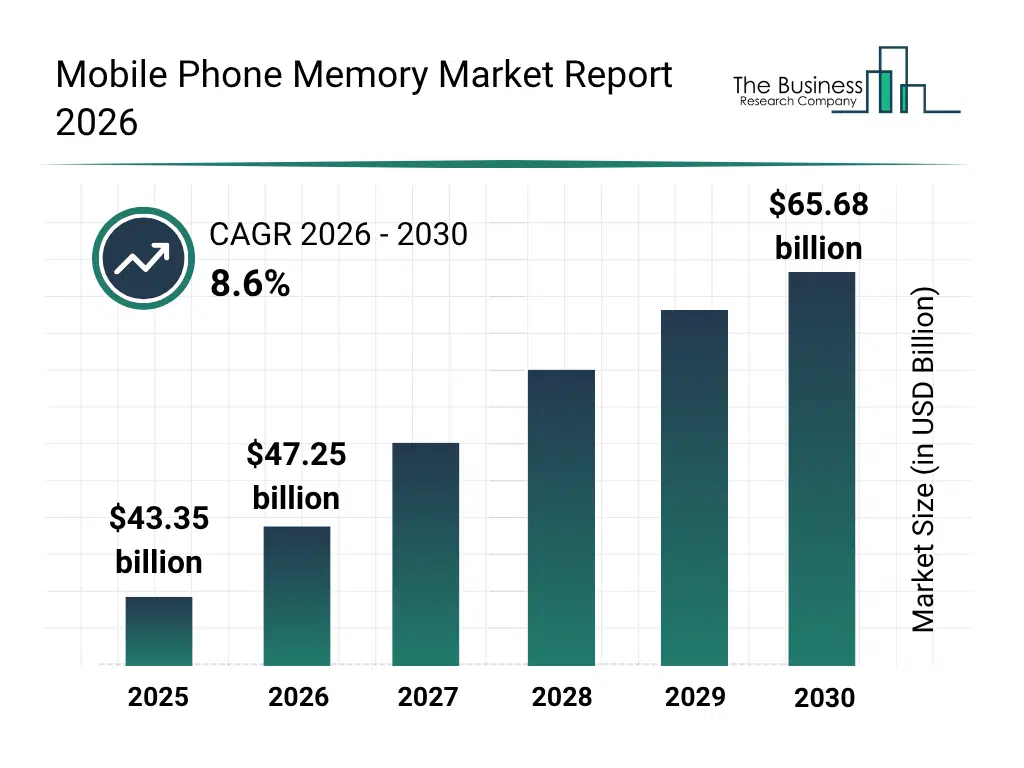
What Is The Mobile Phone Memory Market Size and Share 2026?
The mobile phone memory market size has grown strongly in recent years. It will grow from $43.35 billion in 2025 to $47.25 billion in 2026 at a compound annual growth rate (CAGR) of 9.0%. The growth in the historic period can be attributed to rising smartphone penetration, increasing mobile application usage, growing demand for multimedia content, increasing adoption of mobile gaming, rising demand for mobile photography and video storage.What Is The Mobile Phone Memory Market Growth Forecast?
The mobile phone memory market size is expected to see strong growth in the next few years. It will grow to $65.68 billion in 2030 at a compound annual growth rate (CAGR) of 8.6%. The growth in the forecast period can be attributed to increasing demand for AI-enabled smartphones, rising adoption of high-resolution video applications, growing demand for higher smartphone storage capacities, increasing adoption of advanced mobile memory standards, rising demand for faster mobile data access. Major trends in the forecast period include increasing adoption of higher-capacity mobile memory, rising demand for faster memory interfaces, growing integration of advanced memory technologies in smartphones, increasing demand for power-efficient mobile memory, rising adoption of high-capacity memory cards.
Global Mobile Phone Memory Market Segmentation
1) By Product: Mobile Dynamic Random Access Memory, Mobile Not And Flash Memory, Universal Flash Storage, Embedded MultiMedia Card, Mobile Memory Cards 2) By Memory Type: Volatile Memory, Non Volatile Memory 3) By Storage Capacity: Up To 64 Gigabytes, 64 Gigabytes To 128 Gigabytes, 128 Gigabytes To 256 Gigabytes, 256 Gigabytes To 512 Gigabytes, Above 512 Gigabytes 4) By Distribution Channel: Original Equipment Manufacturers, Aftermarket Subsegments: 1) By Mobile Dynamic Random Access Memory: Low Power Double Data Rate Third Generation, Low Power Double Data Rate Fourth Generation, Low Power Double Data Rate Fifth Generation, Low Power Double Data Rate Fifth Generation Extended 2) By Mobile Not And Flash Memory: Single Level Cell Not And Flash Memory, Multi Level Cell Not And Flash Memory, Triple Level Cell Not And Flash Memory, Quad Level Cell Not And Flash Memory 3) By Universal Flash Storage: Universal Flash Storage Version 2.1, Universal Flash Storage Version 3.1, Universal Flash Storage Version 4.0 4) By Embedded MultiMedia Card: Embedded MultiMedia Card Version 5.0, Embedded MultiMedia Card Version 5.1, Embedded MultiMedia Card Industrial Grade, Embedded MultiMedia Card Automotive Grade 5) By Mobile Memory Cards: Secure Digital High Capacity Memory Cards, Secure Digital Extended Capacity Memory Cards, Secure Digital Ultra Capacity Memory Cards, Micro Secure Digital Express Memory CardsWhat Is The Driver Of The Mobile Phone Memory Market?
The rising proliferation of smartphones is expected to propel the growth of the mobile phone memory market going forward. Smartphones are advanced mobile devices that combine communication, computing, and multimedia functionalities, requiring efficient memory solutions to support operating systems, applications, and data storage. The proliferation of smartphones is increasing due to growing internet penetration, which encourages more consumers to adopt smartphones for online connectivity and digital services. The rising proliferation of smartphones is driving demand for higher-capacity and faster mobile phone memory to support advanced applications, multitasking, and high-performance mobile experiences. For instance, in September 2025, according to the Global System for Mobile Communications Association (GSMA), a UK-based organization, around 1.5 billion people globally were using 5G smartphones for mobile internet access in approximately 2024. Therefore, the rising proliferation of smartphones is driving the growth of the mobile phone memory industry.Key Players In The Global Mobile Phone Memory Market
Major companies operating in the mobile phone memory market are Samsung Electronics Co Ltd, SK Hynix Inc, Micron Technology Inc, Kioxia Holdings Corporation, Western Digital Corporation, Winbond Electronics Corporation, Nanya Technology Corporation, Yangtze Memory Technologies Co Ltd, Powerchip Semiconductor Manufacturing Corporation, GigaDevice Semiconductor Inc, Macronix International Co Ltd, AP Memory Technology Corporation, BIWIN Storage Technology Co Ltd, Elite Semiconductor Microelectronics Technology Inc, Fidelix Co Ltd, Dosilicon Co Ltd, Etron Technology Inc, Zentel Electronics Corporation, Shenzhen Longsys Electronics Co Ltd, Kingston Technology Corporation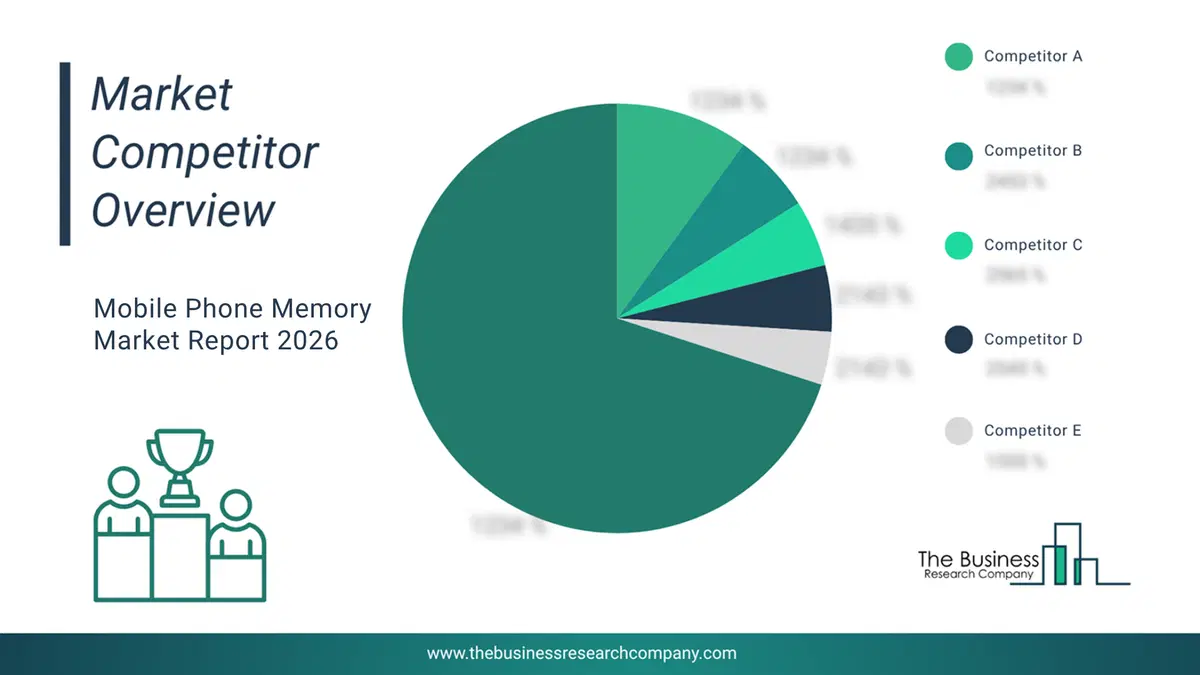
This chart is for illustrative purposes; the full report includes a detailed competitor analysis and comprehensive overview of the top 10 companies in the market.
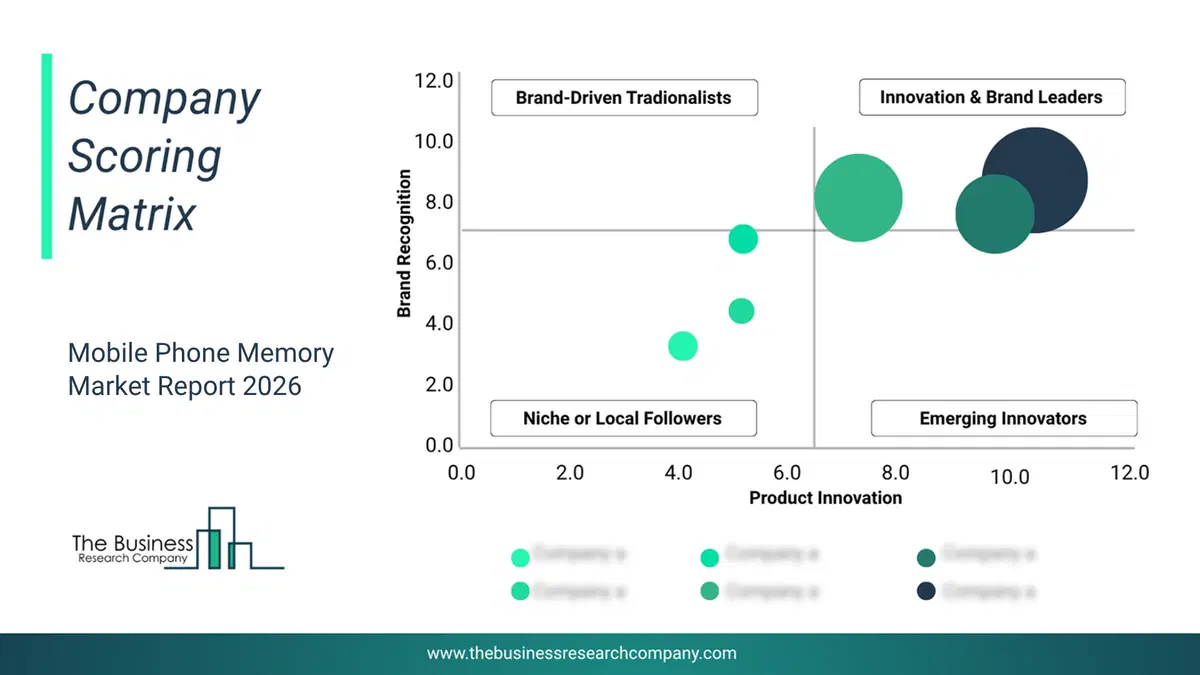
This chart maps companies by product innovation and brand strength, with bubble size indicating relative revenue, helping identify market leaders, challengers, and niche players. This is an illustrative chart; the full report provides a complete and accurate competitive analysis.
Global Mobile Phone Memory Market Trends and Insights
Major companies operating in the mobile phone memory market are focusing on developing innovative solutions, such as next-generation universal flash storage (UFS) architectures, to enhance data transfer speeds, improve power efficiency, and support advanced on-device computing capabilities such as mobile AI processing. Next-generation UFS architectures are advanced embedded storage solutions designed for smartphones that enable significantly faster read and write speeds, lower latency, and improved energy efficiency compared to earlier storage standards, helping overcome performance bottlenecks in high-performance mobile applications and AI-driven workloads. For instance, in June 2026, Samsung Electronics Co., Ltd., a South Korea-based consumer electronics corporation, launched its UFS 5.0 storage solution designed for next-generation on-device AI applications. The technology delivers data transfer speeds of up to 10.8 GB/s, significantly improving mobile storage performance for AI-driven tasks such as image processing, voice recognition, and real-time analytics. Additionally, the solution enhances power efficiency and reduces package size, enabling better thermal management and longer battery life in mobile devices while supporting increasingly complex AI workloads directly on smartphones without relying heavily on cloud computing.What Are Latest Mergers And Acquisitions In The Mobile Phone Memory Market?
In April 2026, Qualcomm Inc., a US-based semiconductor and wireless technology company, partnered with ChangXin Memory Technologies (CXMT) to develop custom DRAM chips specifically optimized for smartphones. With this collaboration, Qualcomm Inc. and ChangXin Memory Technologies aim to address the tightening global mobile memory supply by creating smartphone-focused DRAM solutions that improve availability, performance efficiency, and cost stability for Android device manufacturers. ChangXin Memory Technologies Inc. is a China-based semiconductor company specializing in manufacturing mobile phone memory, primarily through its mobile dynamic random access memory (mobile DRAM) products used in smartphones.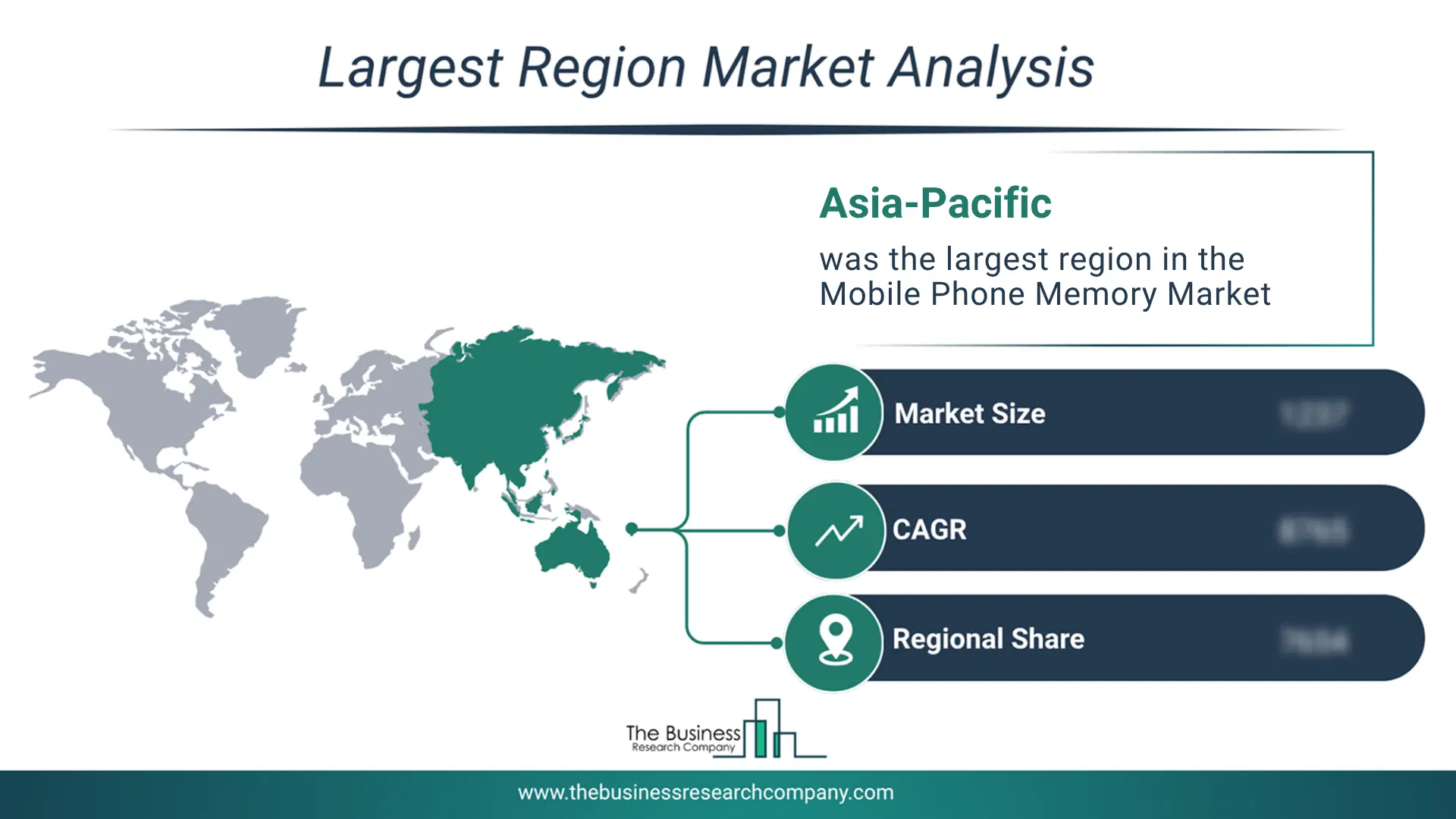
Regional Insights
Asia-Pacific was the largest region in the mobile phone memory market in 2025. Asia-Pacific is expected to be the fastest-growing region in the forecast period. The regions covered in this market report are Asia-Pacific, South East Asia, Western Europe, Eastern Europe, North America, South America, Middle East, Africa. The countries covered in this market report are Australia, Brazil, China, France, Germany, India, Indonesia, Japan, Taiwan, Russia, South Korea, UK, USA, Canada, Italy, Spain.What Defines the Mobile Phone Memory Market?
The mobile phone memory market consists of sales of managed NAND, package on package (POP) memory, low power double data rate (LPDDR) memory, and embedded universal flash storage (eUFS). Values in this market are ‘factory gate’ values, that is the value of goods sold by the manufacturers or creators of the goods, whether to other entities (including downstream manufacturers, wholesalers, distributors and retailers) or directly to end customers. The value of goods in this market includes related services sold by the creators of the goods.How is Market Value Defined and Measured?
The market value is defined as the revenues that enterprises gain from the sale of goods and/or services within the specified market and geography through sales, grants, or donations in terms of the currency (in USD unless otherwise specified). The revenues for a specified geography are consumption values that are revenues generated by organizations in the specified geography within the market, irrespective of where they are produced. It does not include revenues from resales along the supply chain, either further along the supply chain or as part of other products.
This chart presents market attractiveness based on a quantitative evaluation of growth, competition, strategic alignment, and risk, offering a clear view of opportunity areas for decision-making. This chart is for illustrative purposes; the full report contains the complete analysis.

This chart highlights the Total Addressable Market (TAM) by estimating the maximum revenue opportunity using an assumption-driven approach, supporting strategic planning and opportunity sizing across markets. The chart is illustrative; the full report provides a more comprehensive analysis.
What Key Data and Analysis Are Included in the Mobile Phone Memory Market Report 2026?
The mobile phone memory market research report is one of a series of new reports from The Business Research Company that provides market statistics, including industry global market size, regional shares, competitors with the market share, detailed market segments, market trends and opportunities, and any further data you may need to thrive in the mobile phone memory industry. The market research report delivers a complete perspective of everything you need, with an in-depth analysis of the current and future state of the industry.Mobile Phone Memory Market Report Forecast Analysis
| Report Attribute | Details |
|---|---|
| Market Size Value In 2026 | $47.25 billion |
| Revenue Forecast In 2030 | $65.68 billion |
| Growth Rate | CAGR of 8.6% from 2026 to 2030 |
| Base Year For Estimation | 2025 |
| Actual Estimates/Historical Data | 2020-2025 |
| Forecast Period | 2026 - 2030 |
| Market Representation | Revenue in USD Billion and CAGR from 2026 to 2030 |
| Segments Covered | Product, Memory Type, Storage Capacity, Distribution Channel |
| Regional Scope | Asia-Pacific, Western Europe, Eastern Europe, North America, South America, Middle East, Africa |
| Country Scope | The countries covered in the report are Australia, Brazil, China, France, Germany, India, Indonesia, Japan, Taiwan, Russia, South Korea, UK, USA, Canada, Italy, Spain. |
| Key Companies Profiled | Samsung Electronics Co Ltd, SK Hynix Inc, Micron Technology Inc, Kioxia Holdings Corporation, Western Digital Corporation, Winbond Electronics Corporation, Nanya Technology Corporation, Yangtze Memory Technologies Co Ltd, Powerchip Semiconductor Manufacturing Corporation, GigaDevice Semiconductor Inc, Macronix International Co Ltd, AP Memory Technology Corporation, BIWIN Storage Technology Co Ltd, Elite Semiconductor Microelectronics Technology Inc, Fidelix Co Ltd, Dosilicon Co Ltd, Etron Technology Inc, Zentel Electronics Corporation, Shenzhen Longsys Electronics Co Ltd, Kingston Technology Corporation |
| Customization Scope | Request for Customization |
| Pricing And Purchase Options | Explore Purchase Options |