

Mobile Voice Market Report 2026
Global Outlook – By Component (Hardware, Software, Services), By Type (VoLTE Services, Vo5G Services, VoIP Applications, Traditional Mobile Voice, International Calling, Domestic Calling), By Subscription (Prepaid, Postpaid, Roaming Services), By Application (Consumer Calling, Enterprise Communication, Over-The-Top (OTT) Voice Services, Emergency Services), By End-User (Information Technology (IT) And Telecommunications, Banking, Financial Services, And Insurance (BFSI), Healthcare, Retail And eCommerce, Education, Hospitality And Travel, Government And Public Sector, Automotive) – Market Size, Trends, Strategies, and Forecast to 2030
Mobile Voice Market Overview
• Mobile Voice market size has reached to $348.93 billion in 2025 • Expected to grow to $484.45 billion in 2030 at a compound annual growth rate (CAGR) of 6.8% • Growth Driver: Surge In Increasing Smartphone Penetration Fueling The Growth Of The Market Due To Rising Connectivity Demand • Market Trend: Spatial Audio Transforms Cellular Voice Calls Into Immersive Real-Time Communication Experiences • North America was the largest region in 2025 and Asia-Pacific is the fastest growing region.What Is Covered Under Mobile Voice Market?
Mobile voice refers to telecommunications services that enable real-time voice communication over cellular networks, allowing individuals and organizations to make and receive calls using mobile devices across wide geographic areas. These services rely on wireless network infrastructure and are commonly used for personal communication, business operations, and emergency connectivity. The main components of mobile voice include hardware, software, and services. Hardware refers to the physical components that enable voice communication on mobile devices or networks. The various types include VoLTE services; vo5g services; voip applications, traditional mobile voice, international calling, and domestic calling and the main subscription types include prepaid, postpaid, and roaming services. The applications involved are consumer calling, enterprise communication, over-the-top (OTT) voice services, and emergency services, and are distributed to end users across industries including information technology (IT) and telecommunications, banking, financial services, and insurance (BFSI), healthcare, retail and eCommerce, education, hospitality and travel, government and public sector, and automotive, providing reliable and seamless voice connectivity for diverse user needs.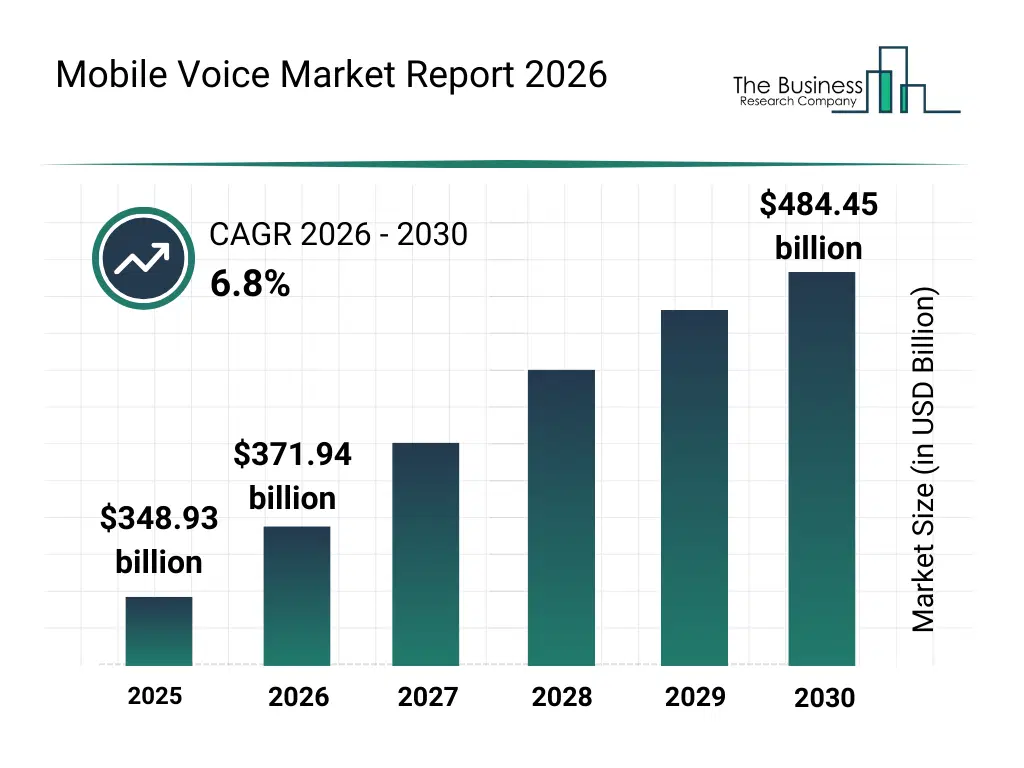
What Is The Mobile Voice Market Size and Share 2026?
The mobile voice market size has grown strongly in recent years. It will grow from $348.93 billion in 2025 to $371.94 billion in 2026 at a compound annual growth rate (CAGR) of 6.6%. The growth in the historic period can be attributed to rapid expansion of cellular network infrastructure, declining voice call tariffs, increasing mobile subscriber penetration, growth in prepaid subscription models, expansion of international roaming agreements.What Is The Mobile Voice Market Growth Forecast?
The mobile voice market size is expected to see strong growth in the next few years. It will grow to $484.45 billion in 2030 at a compound annual growth rate (CAGR) of 6.8%. The growth in the forecast period can be attributed to growing deployment of 5G networks, rising enterprise mobility solutions, increasing integration of cloud-based voice platforms, expansion of OTT voice services, rising demand for seamless global connectivity. Major trends in the forecast period include increasing adoption of volte and vo5g services, rising demand for international roaming plans, growing preference for prepaid and flexible subscription models, expansion of enterprise mobile voice solutions, increasing bundling of voice services with data packages.
Global Mobile Voice Market Segmentation
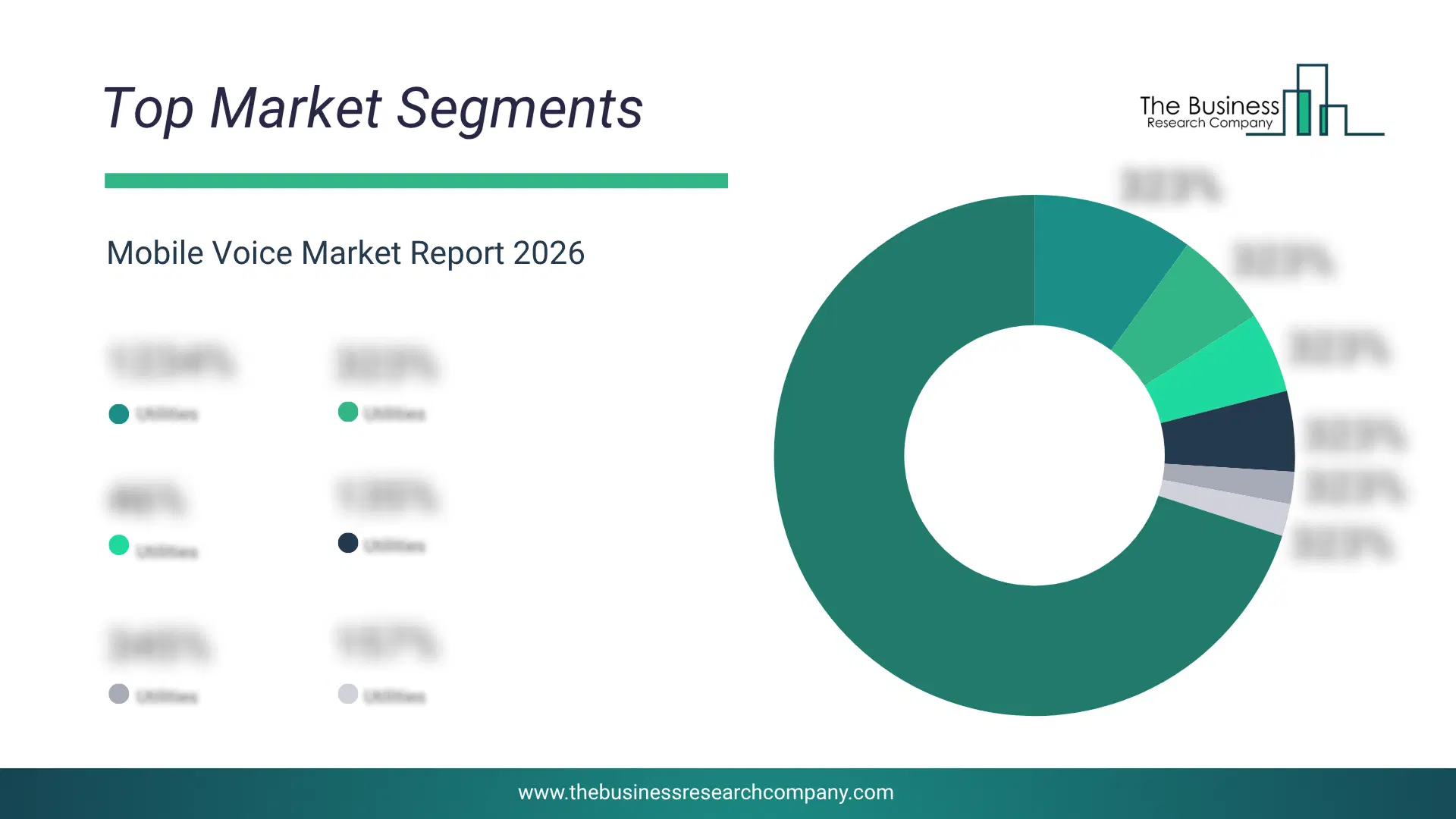
1) By Component: Hardware, Software, Services 2) By Type: VoLTE Services, Vo5G Services, VoIP Applications, Traditional Mobile Voice, International Calling, Domestic Calling 3) By Subscription: Prepaid, Postpaid, Roaming Services 4) By Application: Consumer Calling, Enterprise Communication, Over-The-Top (OTT) Voice Services, Emergency Services 5) By End-User: Information Technology (IT) And Telecommunications, Banking, Financial Services, And Insurance (BFSI), Healthcare, Retail And eCommerce, Education, Hospitality And Travel, Government And Public Sector, Automotive Subsegments: 1) By Hardware: Mechanical Switches, Electromechanical Switches, Digital Switches, Programmable Timers, Astronomical Timers 2) By Software: Configuration Software, Monitoring Software, Scheduling Software, Cloud Management Software, Automation Software 3) By Services: Installation Services, Maintenance Services, Repair Services, Consultation Services, Calibration ServicesWhat Is The Driver Of The Mobile Voice Market?
The increasing smartphone penetration is expected to propel the growth of the mobile voice market going forward. Smartphone penetration refers to the percentage of the population that owns and actively uses smartphones capable of accessing mobile networks and voice services. Smartphone penetration is rising primarily due to the growing affordability of smartphones, which enables wider adoption across various income segments. Mobile voice services support smartphone penetration by providing essential communication functionality that encourages users to acquire and regularly use smartphones. For instance, in October 2023, according to the Global System for Mobile Communications Association (GSMA), a UK-based non-profit industry trade body and global organization, over 54% of the global population, about 4.3 billion people, now own a smartphone, marking a majority share compared with the prior period. Therefore, increasing smartphone penetration is driving the growth of the mobile voice industry.Key Players In The Global Mobile Voice Market
Major companies operating in the mobile voice market are China Mobile Communications Corporation, Verizon Communications Incorporated, AT and T Incorporated, T-Mobile United States Incorporated, China Telecom Corporation Limited, China United Network Communications Group Company Limited, Vodafone Group Public Limited Company, Telefónica Sociedad Anónima, Bharat Sanchar Nigam Limited, Bharti Airtel Limited, Mobile TeleSystems Public Joint Stock Company, Telekomunikasi Selular, Radiomóvil Dipsa, VEON Limited, Ethiopian Telecommunication Corporation, MTN Nigeria Communications Limited, Reliance Jio Infocomm Limited, Indosat Ooredoo Hutchison, Mobile Communications Company of Iran, and GrameenPhone Limited.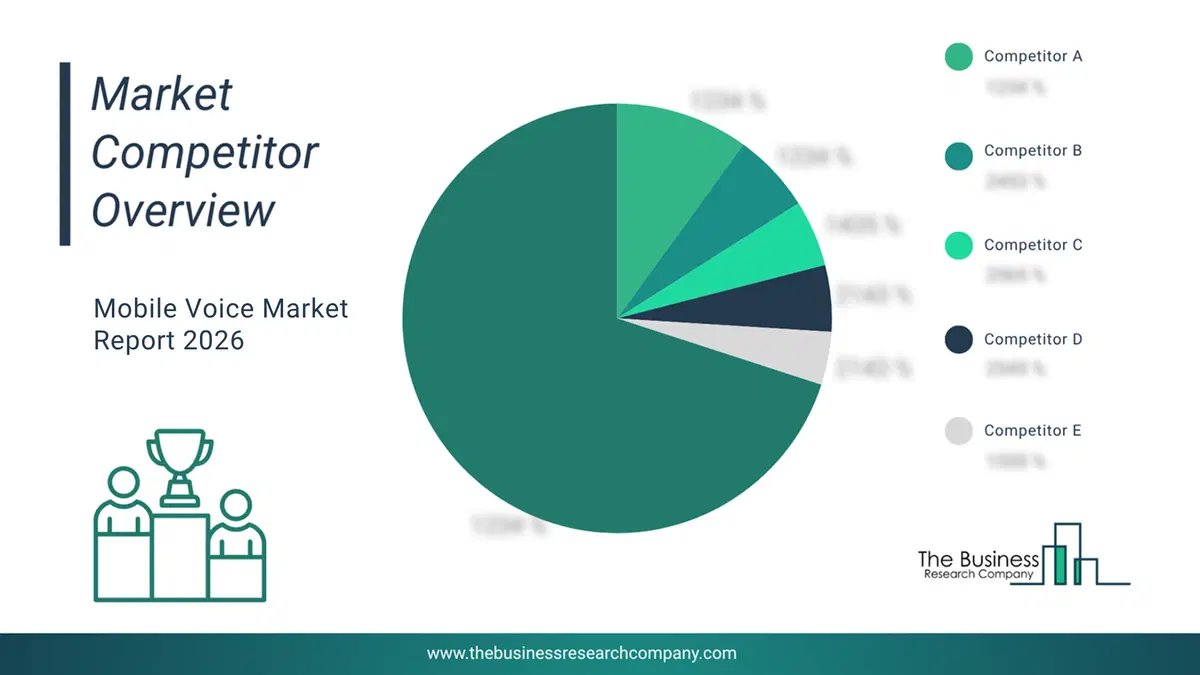
This chart is for illustrative purposes; the full report includes a detailed competitor analysis and comprehensive overview of the top 10 companies in the market.
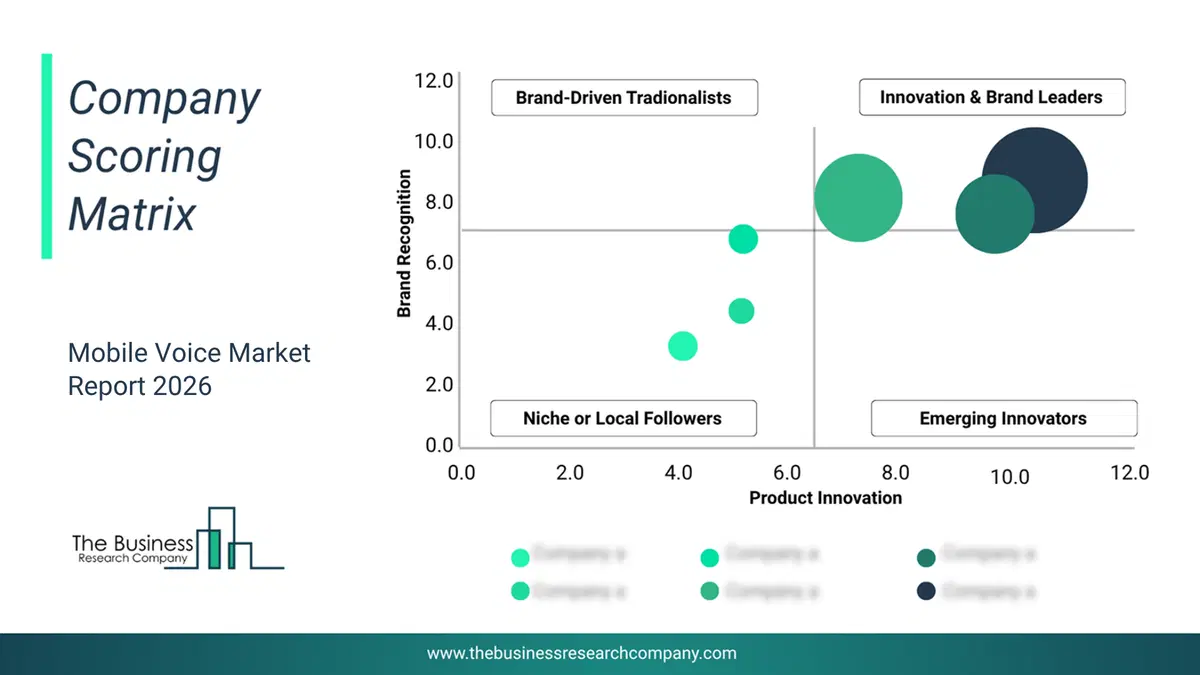
This chart maps companies by product innovation and brand strength, with bubble size indicating relative revenue, helping identify market leaders, challengers, and niche players. This is an illustrative chart; the full report provides a complete and accurate competitive analysis.
Global Mobile Voice Market Trends and Insights
Major companies operating in the mobile voice market are focusing on developing advanced solutions such as real-time spatial audio features to enable more immersive and realistic voice communication across devices and platforms. Real-time spatial audio features use advanced sound processing to place voices dynamically within a three-dimensional audio space during live conversations, delivering a natural sense of direction and depth and making it easier to distinguish speakers and perceive sound as coming from realistic, lifelike positions. For instance, in June 2024, Nokia, a Finland-based telecommunications infrastructure company, introduced the Immersive Voice and Audio Services codec (IVAS), which enables real-time three-dimensional spatial audio for voice calls and enhances listening depth and clarity beyond traditional monophonic voice communication. The technology supports richer sound reproduction, spatial separation of participants, and improved engagement for conferencing scenarios. Immersive codecs can substantially elevate user experience and unlock new interactive applications, but widespread operator and device support is still evolving, requiring ecosystem adoption of the next-generation network standards.What Are Latest Mergers And Acquisitions In The Mobile Voice Market?
In November 2025, Zadarma, a Bulgaria-based provider of cloud communication and voice over internet protocol services, acquired MegaCall for an undisclosed amount. With this acquisition, Zadarma expanded its European voice and cloud telephony footprint by integrating MegaCall’s established VoIP customer base and enhancing its suite of voice, virtual number, and business communication tools. Megacall is a Spain-based provider of VoIP voice communication services, cloud PBX platforms, and virtual phone number solutions for small, medium, and enterprise customers.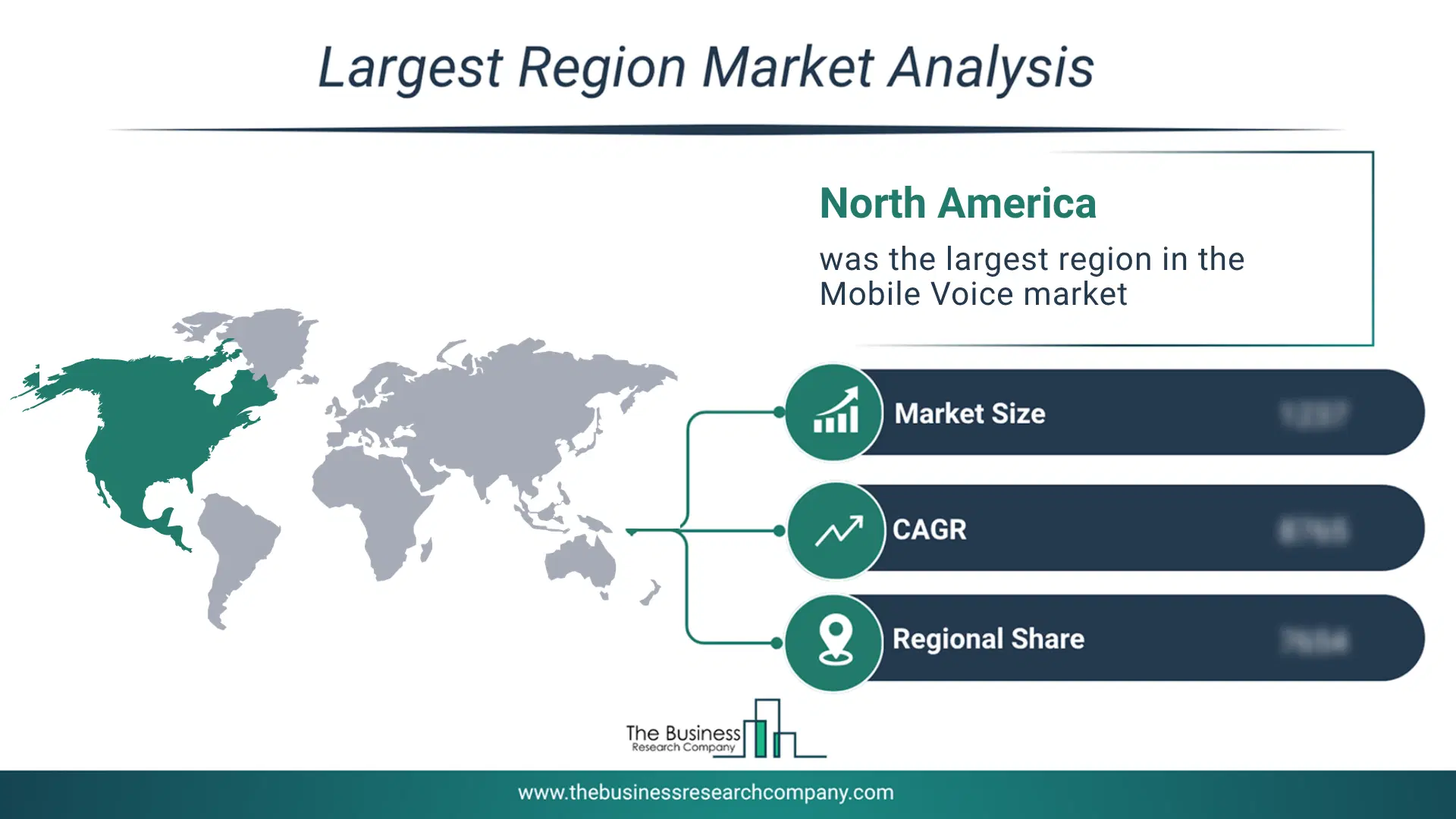
Regional Insights
North America was the largest region in the mobile voice market in 2025. Asia-Pacific is expected to be the fastest-growing region in the forecast period. The regions covered in this market report are Asia-Pacific, South East Asia, Western Europe, Eastern Europe, North America, South America, Middle East, Africa. The countries covered in this market report are Australia, Brazil, China, France, Germany, India, Indonesia, Japan, Taiwan, Russia, South Korea, UK, USA, Canada, Italy, Spain.What Defines the Mobile Voice Market?
The mobile voice market consists of revenues earned by entities by providing services such as voice calling plans, prepaid and postpaid subscriptions, international roaming services, voice over long-term evolution calling, and value-added voice services. The market value includes the value of related goods sold by the service provider or included within the service offering. The mobile voice market also includes sales of microphones, speakers, baseband processors, and audio codecs. Values in this market are ‘factory gate’ values, that is, the value of goods sold by the manufacturers or creators of the goods, whether to other entities (including downstream manufacturers, wholesalers, distributors, and retailers) or directly to end customers. The value of goods in this market includes related services sold by the creators of the goods.How is Market Value Defined and Measured?
The market value is defined as the revenues that enterprises gain from the sale of goods and/or services within the specified market and geography through sales, grants, or donations in terms of the currency (in USD unless otherwise specified). The revenues for a specified geography are consumption values that are revenues generated by organizations in the specified geography within the market, irrespective of where they are produced. It does not include revenues from resales along the supply chain, either further along the supply chain or as part of other products.
This chart presents market attractiveness based on a quantitative evaluation of growth, competition, strategic alignment, and risk, offering a clear view of opportunity areas for decision-making. This chart is for illustrative purposes; the full report contains the complete analysis.

This chart highlights the Total Addressable Market (TAM) by estimating the maximum revenue opportunity using an assumption-driven approach, supporting strategic planning and opportunity sizing across markets. The chart is illustrative; the full report provides a more comprehensive analysis.
What Key Data and Analysis Are Included in the Mobile Voice Market Report 2026?
The mobile voice market research report is one of a series of new reports from The Business Research Company that provides mobile voice market statistics, including mobile voice industry global market size, regional shares, competitors with a mobile voice market share, detailed mobile voice market segments, market trends and opportunities, and any further data you may need to thrive in the mobile voice industry. This mobile voice market research report delivers a complete perspective of everything you need, with an in-depth analysis of the current and future scenario of the industry.Mobile Voice Market Report Forecast Analysis
| Report Attribute | Details |
|---|---|
| Market Size Value In 2026 | $371.94 billion |
| Revenue Forecast In 2030 | $484.45 billion |
| Growth Rate | CAGR of 6.8% from 2026 to 2030 |
| Base Year For Estimation | 2025 |
| Actual Estimates/Historical Data | 2020-2025 |
| Forecast Period | 2026 - 2030 |
| Market Representation | Revenue in USD Billion and CAGR from 2026 to 2030 |
| Segments Covered | Component, Type, Subscription, Application, End-User |
| Regional Scope | Asia-Pacific, Western Europe, Eastern Europe, North America, South America, Middle East, Africa |
| Country Scope | The Countries Covered In This Market Report Are Australia, Brazil, China, France, Germany, India, Indonesia, Japan, Taiwan, Russia, South Korea, Uk, Usa, Canada, Italy, Spain. |
| Key Companies Profiled | China Mobile Communications Corporation, Verizon Communications Incorporated, AT and T Incorporated, T-Mobile United States Incorporated, China Telecom Corporation Limited, China United Network Communications Group Company Limited, Vodafone Group Public Limited Company, Telefónica Sociedad Anónima, Bharat Sanchar Nigam Limited, Bharti Airtel Limited, Mobile TeleSystems Public Joint Stock Company, Telekomunikasi Selular, Radiomóvil Dipsa, VEON Limited, Ethiopian Telecommunication Corporation, MTN Nigeria Communications Limited, Reliance Jio Infocomm Limited, Indosat Ooredoo Hutchison, Mobile Communications Company of Iran, and GrameenPhone Limited. |
| Customization Scope | Request for Customization |
| Pricing And Purchase Options | Explore Purchase Options |