

Modern Manufacturing Execution System Market Report 2026
Global Outlook – By Component (Software, Service), By Deployment (On-Premise, Cloud, Hybrid), By Application (Fast Moving Consumer Goods (FMCG), Medical, Automotive, Electronics, Aerospace And Defense, Other Applications) – Market Size, Trends, Strategies, and Forecast to 2030
Modern Manufacturing Execution System Market Overview
• Modern Manufacturing Execution System market size has reached to $22.79 billion in 2025 • Expected to grow to $47.82 billion in 2030 at a compound annual growth rate (CAGR) of 15.9% • Growth Driver: The Rising Adoption Of Cloud-Based Solutions Fueling The Growth Of The Market Due To Increasing Demand For Scalable And Cost-Efficient IT Infrastructure • Market Trend: Advancements In Manufacturing Execution Systems Transforming The Modern Manufacturing Execution System Market • North America was the largest region in 2025 and Asia-Pacific is the fastest growing region.Market Gains By 2030 – Top Opportunities By Segment
Market Gain identifies the most promising market opportunities by highlighting the segments or products expected to generate the highest incremental revenue growth over the next five years.
What Is Covered Under Modern Manufacturing Execution System Market?
A modern manufacturing execution system is a software-based solution that manages, monitors, and controls manufacturing operations in real time. This system plays a crucial role in the Industry 4.0 environment by enabling data-driven decision-making, boosting productivity, cutting costs, and aiding in the digital transformation of manufacturing processes. The modern manufacturing execution system is indispensable for enterprises seeking to enhance operational transparency, streamline production operations, and adjust to the evolving requirements of the industrial landscape. The main components of the modern manufacturing execution system are software and services. Software refers to the programs and applications that control and utilize the hardware, enabling various computing functions and tasks. These can be deployed in various modes, including on-premise, cloud, and hybrid, and used in a variety of applications such as fast-moving consumer goods (FMCG), medical, automotive, electronics, aerospace and defense, and others.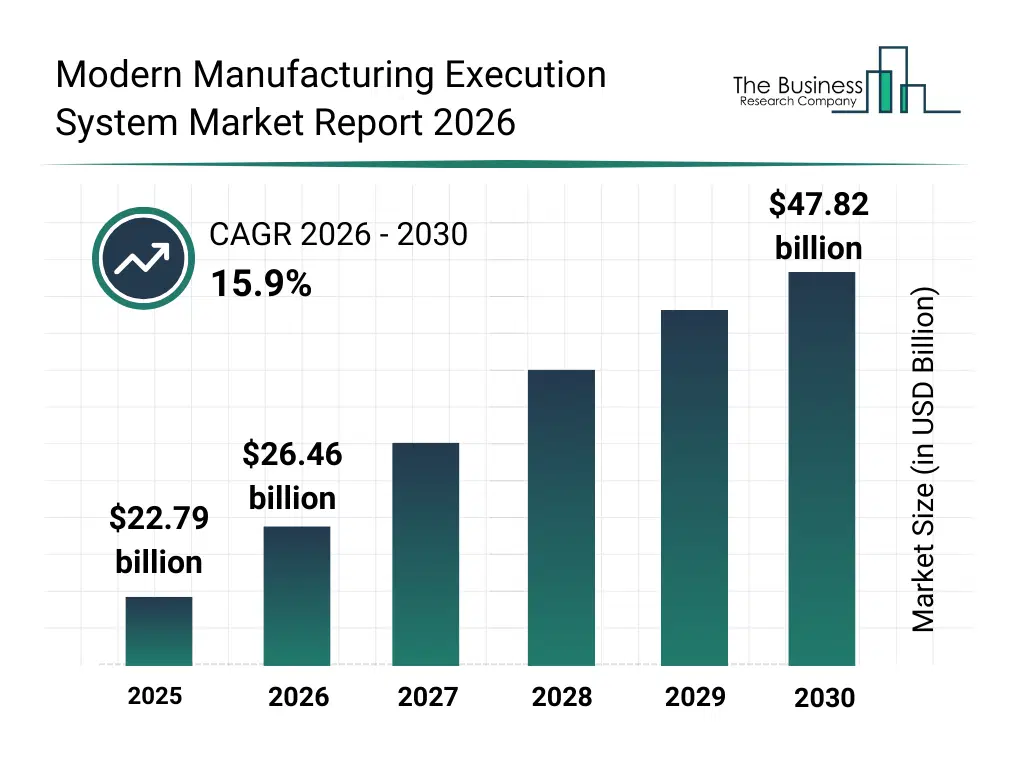
What Is The Modern Manufacturing Execution System Market Size and Share 2026?
The modern manufacturing execution system market size has grown rapidly in recent years. It will grow from $22.79 billion in 2025 to $26.46 billion in 2026 at a compound annual growth rate (CAGR) of 16.1%. The growth in the historic period can be attributed to automation adoption in manufacturing, need for production visibility, quality control requirements, lean manufacturing initiatives, regulatory compliance needs.What Is The Modern Manufacturing Execution System Market Growth Forecast?
The modern manufacturing execution system market size is expected to see rapid growth in the next few years. It will grow to $47.82 billion in 2030 at a compound annual growth rate (CAGR) of 15.9%. The growth in the forecast period can be attributed to smart factory expansion, ai-enabled manufacturing analytics, cloud mes adoption, demand for operational transparency, sustainable manufacturing practices. Major trends in the forecast period include real-time production monitoring, cloud-based mes deployment, data-driven manufacturing operations, integrated shop floor visibility, modular and scalable mes platforms.
Global Modern Manufacturing Execution System Market Segmentation
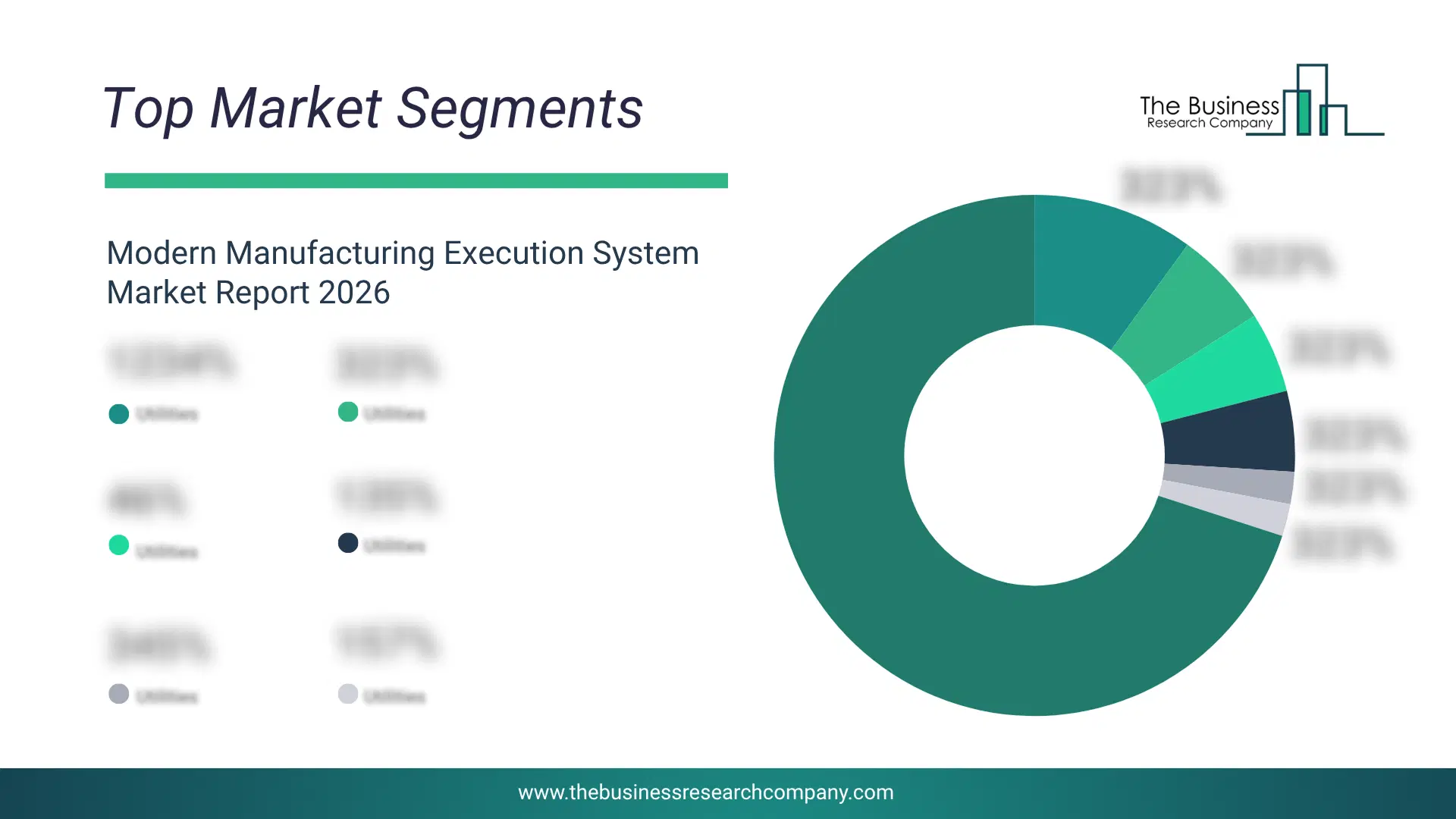
1) By Component: Software, Service 2) By Deployment: On-Premise, Cloud, Hybrid 3) By Application: Fast Moving Consumer Goods (FMCG), Medical, Automotive, Electronics, Aerospace And Defense, Other Applications Subsegments: 1) By Software: MES Software (On-Premise), MES Software (Cloud-Based) 2) By Service: Consulting Services, Integration Services, Support And Maintenance Services The top segments in the modern manufacturing execution system market will be: • Software will reach $31.16 Billion by 2030. • Service will reach $16.51 Billion by 2030.What Is The Driver Of The Modern Manufacturing Execution System Market?
The rising adoption of cloud-based solutions is expected to propel the growth of the modern manufacturing execution system market going forward. Cloud-based solutions refer to software, platforms, or infrastructure services hosted and accessed over the internet rather than installed on local computers or servers. The adoption of cloud-based solutions is rising due to their scalability, flexibility, accessibility, and cost-effectiveness for businesses across various industries. Cloud-based solutions in modern manufacturing execution systems (MES) enable manufacturers to access real-time production data, collaborate across multiple locations, and scale their operations efficiently using remote servers and services accessed via the internet. For instance, in December 2023, according to according to The European Commission, a Belgium-based government agency, node deployment, a type of cloud service increased from 498 in 2022 to nearly 1,836 in 2024. Therefore, the rising adoption of cloud-based solutions is driving the growth of the modern manufacturing execution system industry.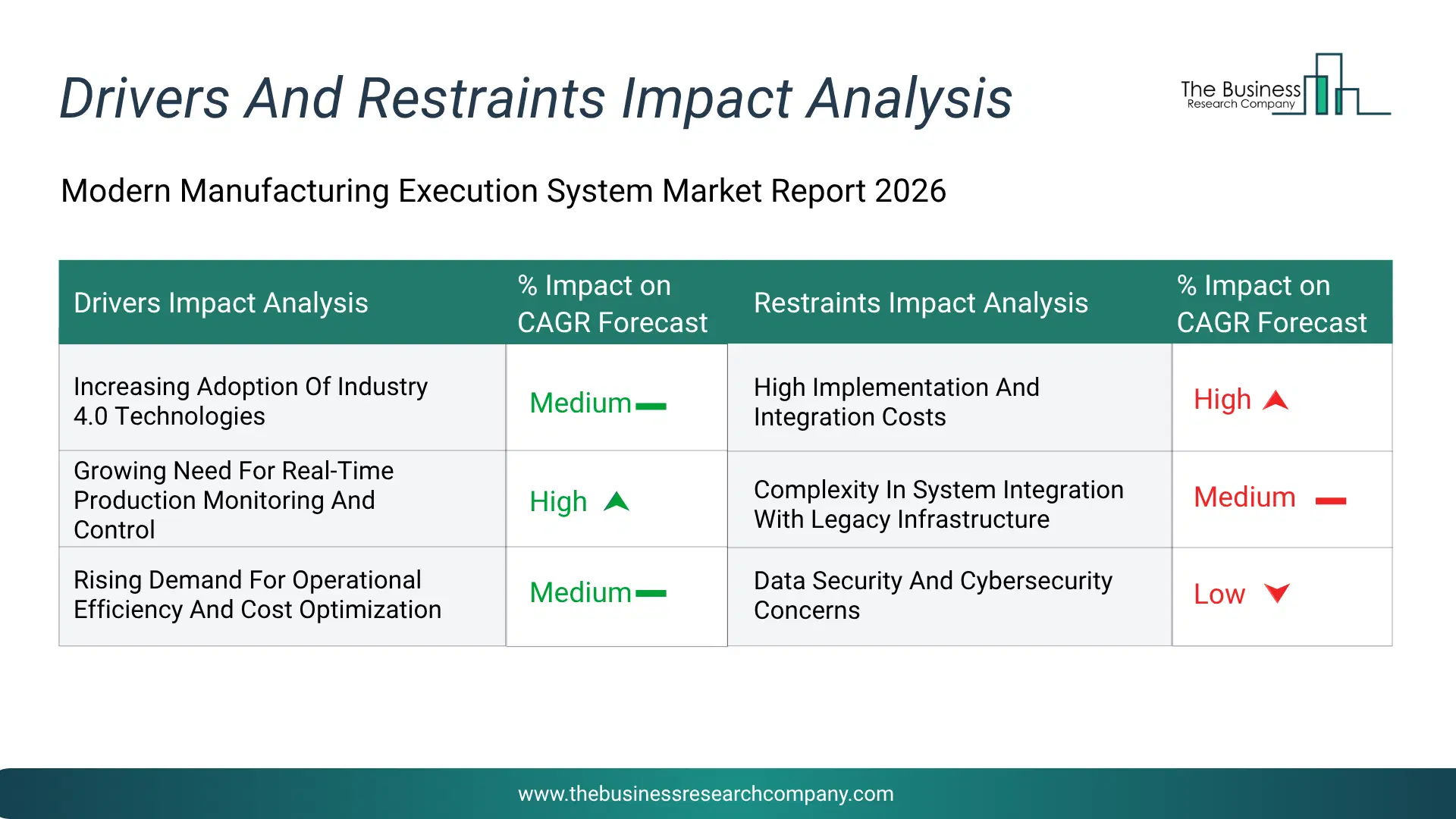
Infographic Chart Showing Key Market Drivers Analysis And Restraints For Modern Manufacturing Execution System Market
The chart presents an impact analysis of key drivers and restraints, quantifying their relative influence on the market's growth rate and helping assess the balance between growth enablers and limiting factors. This chart offers a high-level perspective; the full report contains more detailed insights.
How Will The Drivers Impact Growth In The Global Modern Manufacturing Execution System Market?
• Increasing Adoption Of Industry 4.0 Technologies (Medium) – During the forecast period, the increasing adoption of industry 4.0 technologies is expected to become a key growth driver for the modern manufacturing execution system market by 2030. The rapid adoption of Industry 4.0 technologies such as IoT, AI, and advanced analytics is a major driver for the modern MES market. MES platforms act as a central system that integrates these technologies into manufacturing operations, enabling real-time monitoring and data-driven decision-making. As manufacturers shift toward smart factories, MES becomes essential for connecting machines, systems, and processes. This integration improves efficiency, reduces downtime, and enhances overall productivity. Consequently, rising Industry 4.0 investments directly accelerate the demand for modern MES solutions. • Growing Need For Real-Time Production Monitoring And Control (High) – During the forecast period, the growing need for real-time production monitoring and control is expected to emerge as a major factor driving the expansion of the modern manufacturing execution system market by 2030. The increasing need for real-time visibility across production processes is significantly driving MES adoption. Modern MES systems provide instant insights into machine performance, production status, and quality metrics, allowing manufacturers to respond quickly to issues. This real-time control minimizes production delays, reduces waste, and improves product consistency. As manufacturing environments become more complex and globalized, the ability to monitor operations continuously becomes critical. Hence, MES solutions are increasingly deployed to ensure operational transparency and efficient workflow management. • Rising Demand For Operational Efficiency And Cost Optimization (Medium) – During the forecast period, the rising demand for operational efficiency and cost optimization is expected to act as a key growth catalyst for the modern manufacturing execution system market by 2030. Manufacturers are under constant pressure to reduce operational costs while maximizing output, which drives the adoption of MES solutions. MES systems streamline production processes by optimizing resource utilization, minimizing downtime, and reducing errors. By automating workflows and improving coordination across departments, MES helps eliminate inefficiencies in the production cycle. This leads to lower operational expenses and improved profit margins. As competition intensifies across industries, companies increasingly rely on MES to achieve cost efficiency and sustain long-term growth.How Will The Restraints Impact Growth In The Global Modern Manufacturing Execution System Market?
• High Implementation And Integration Costs (Medium) – During the forecast period, the high cost associated with implementing and integrating modern MES solutions acts as a major restraint for the market. Deploying MES requires significant investment in software, hardware upgrades, system customization, and skilled personnel. Additionally, integrating MES with legacy systems such as ERP and shop-floor equipment can be complex and time-consuming. Small and medium-sized manufacturers often find these costs prohibitive, limiting adoption. As a result, despite long-term benefits, high upfront expenditure slows down market growth. • Complexity In System Integration With Legacy Infrastructure (High) – During the forecast period, the integrating MES with existing legacy manufacturing systems remains a significant challenge for many organizations. Older systems may lack compatibility with modern MES platforms, requiring extensive modifications or complete replacement. This complexity increases project timelines, operational disruptions, and technical risks during deployment. Manufacturers may hesitate to adopt MES due to concerns over production downtime and integration failures. Therefore, integration challenges act as a barrier to widespread MES adoption. • Data Security And Cybersecurity Concerns (Medium) – During the forecast period, the growing connectivity of MES systems with IoT devices and cloud platforms raises concerns regarding data security and cyber threats. Sensitive production data, intellectual property, and operational information are at risk of breaches if adequate security measures are not in place. Cyberattacks on manufacturing systems can disrupt operations and lead to financial losses. This risk makes organizations cautious about adopting fully connected MES solutions. Hence, security concerns can slow down the adoption rate of MES in critical industries.Key Players In The Global Modern Manufacturing Execution System Market
Major companies operating in the modern manufacturing execution system market are Siemens AG; Accenture Plc; General Electric Company; Schneider Electric SE; Honeywell International Inc.; SAP SE; ABB Ltd; Emerson Electric Co.; Rockwell Automation Inc.; Dassault Systèmes; Krones AG; Epicor Software Corporation; Aptean Inc.; MPDV Mikrolab GmbH; Plex Systems; Yokogawa Electric Corporation; Werum IT Solutions GmbH; Aegis Software; InfinityQS International; Critical Manufacturing; FORCAM GmbH; ATS Global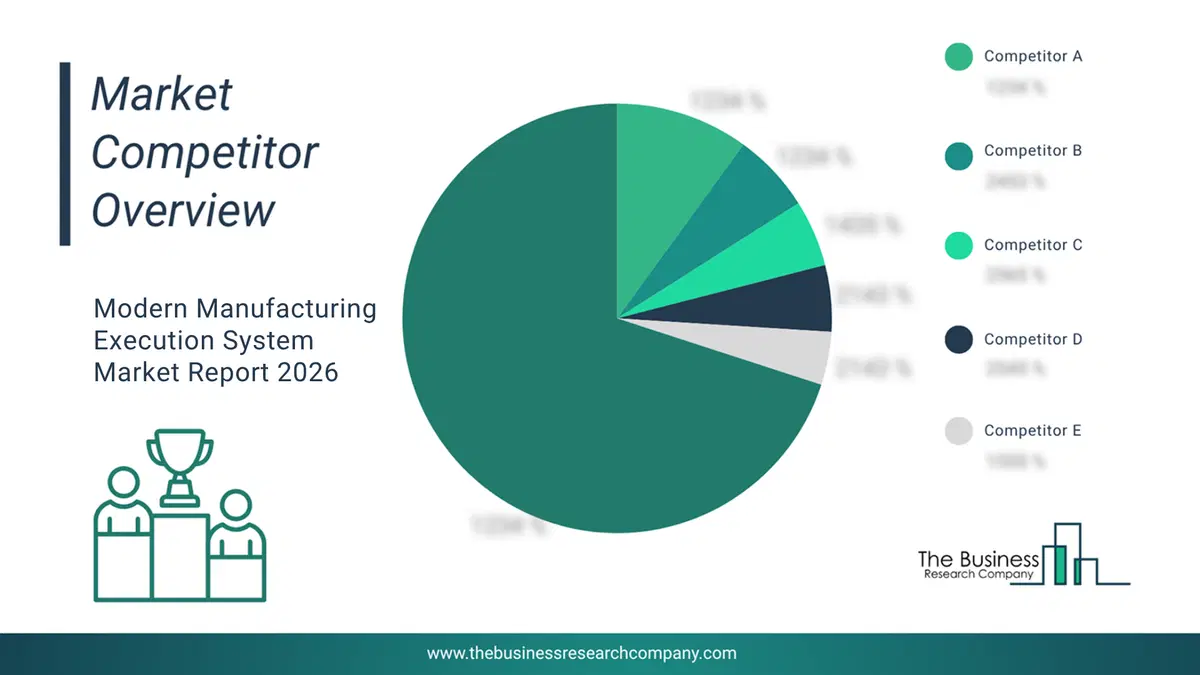
This chart is for illustrative purposes; the full report includes a detailed competitor analysis and comprehensive overview of the top 10 companies in the market.
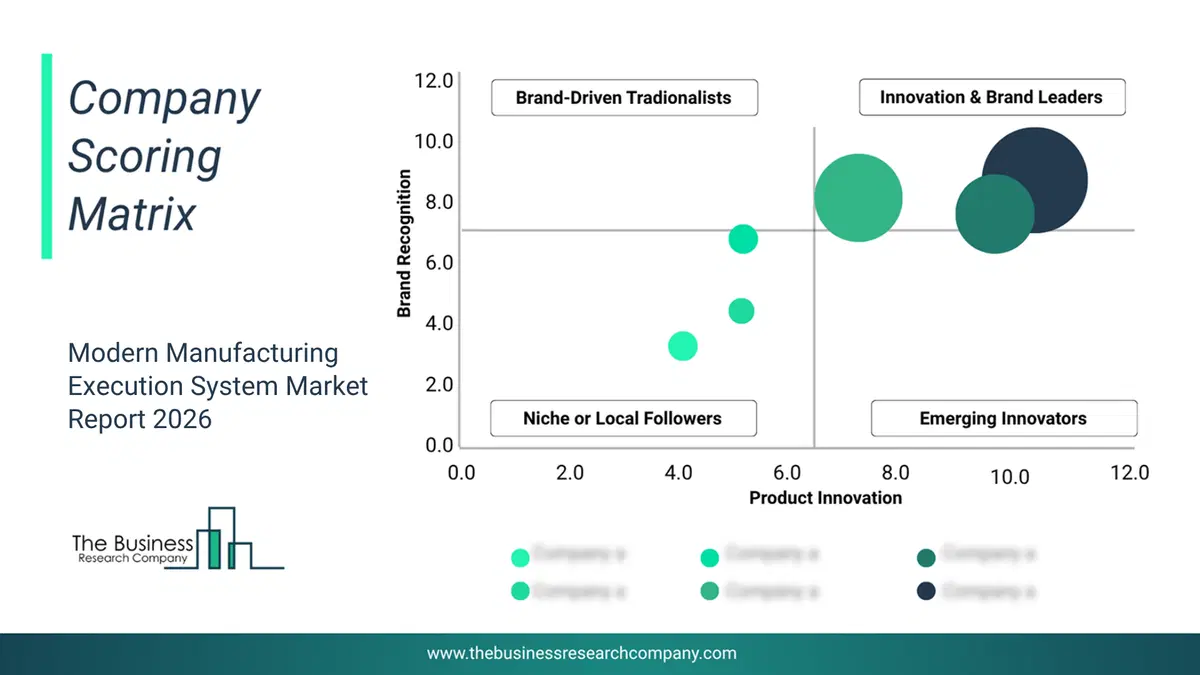
This chart maps companies by product innovation and brand strength, with bubble size indicating relative revenue, helping identify market leaders, challengers, and niche players. This is an illustrative chart; the full report provides a complete and accurate competitive analysis.
Global Modern Manufacturing Execution System Market Trends and Insights
Major companies operating in the modern manufacturing execution system market are developing innovative products, such as Manufacturing Execution System (MES) software, to gain a competitive edge in the market. Manufacturing execution system (MES) software is a computerized system used in manufacturing industries to track and manage production processes and data in real time. For instance, in February 2023, AVEVA, a UK-based information technology consulting company, launched a new version of its Manufacturing Execution System (MES) software to support data centre deployments. This updated version offers multi-site support, catering to the needs of data centre operators by enhancing MES with capabilities in monitoring and control, asset performance, and operations optimization. The MES software digitises, standardizes, and optimises operational processes and work activities across industrial manufacturing plants. It manages inventory, production, and quality-related plant activities to ensure the production of high-quality products at the lowest cost.What Are Latest Mergers And Acquisitions In The Modern Manufacturing Execution System Market?
In January 2023, Schneider Electric SE, a France-based provider of energy management, industrial automation solutions, and related digital software, acquired AVEVA Group plc for an undisclosed amount. With this acquisition, Schneider Electric aims to strengthen its end-to-end industrial software portfolio by fully integrating AVEVA’s industrial applications, including its modern manufacturing execution system (MES) solutions, to support data-driven, real-time control and digital transformation across manufacturing operations. AVEVA Group plc is a UK-based industrial software provider specialising in modern manufacturing execution systems that enhance real-time production visibility and operational efficiency.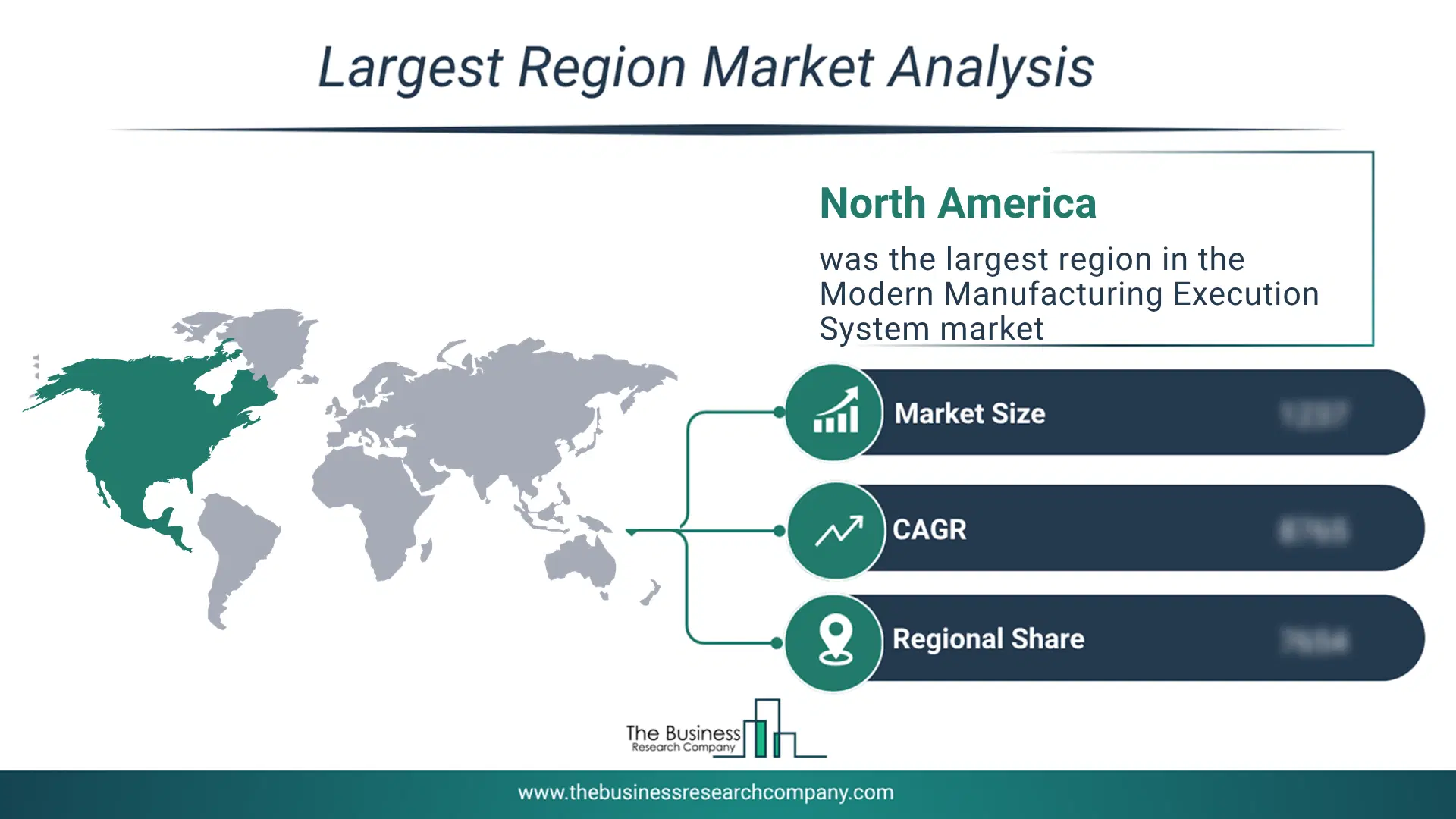
Regional Insights
North America was the largest region in the modern manufacturing execution system market in 2025. Asia-Pacific is expected to be the fastest-growing region in the forecast period. The regions covered in this market report are Asia-Pacific, South East Asia, Western Europe, Eastern Europe, North America, South America, Middle East, Africa. The countries covered in this market report are Australia, Brazil, China, France, Germany, India, Indonesia, Japan, Taiwan, Russia, South Korea, UK, USA, Canada, Italy, SpainWhat Defines the Modern Manufacturing Execution System Market?
The modern manufacturing execution system market includes revenues earned by entities by providing services such as implementation services, integration services, and support and maintenance services. The market value includes the value of related goods sold by the service provider or included within the service offering. Only goods and services traded between entities or sold to end consumers are included.How is Market Value Defined and Measured?
The market value is defined as the revenues that enterprises gain from the sale of goods and/or services within the specified market and geography through sales, grants, or donations in terms of the currency (in USD unless otherwise specified). The revenues for a specified geography are consumption values that are revenues generated by organizations in the specified geography within the market, irrespective of where they are produced. It does not include revenues from resales along the supply chain, either further along the supply chain or as part of other products.
This chart presents market attractiveness based on a quantitative evaluation of growth, competition, strategic alignment, and risk, offering a clear view of opportunity areas for decision-making. This chart is for illustrative purposes; the full report contains the complete analysis.

This chart highlights the Total Addressable Market (TAM) by estimating the maximum revenue opportunity using an assumption-driven approach, supporting strategic planning and opportunity sizing across markets. The chart is illustrative; the full report provides a more comprehensive analysis.
What Key Data and Analysis Are Included in the Modern Manufacturing Execution System Market Report 2026?
The modern manufacturing execution system market research report is one of a series of new reports from The Business Research Company that provides market statistics, including industry global market size, regional shares, competitors with the market share, detailed market segments, market trends and opportunities, and any further data you may need to thrive in the modern manufacturing execution system industry. The market research report delivers a complete perspective of everything you need, with an in-depth analysis of the current and future state of the industry.Modern Manufacturing Execution System Market Report Forecast Analysis
| Report Attribute | Details |
|---|---|
| Market Size Value In 2026 | $26.46 billion |
| Revenue Forecast In 2030 | $47.82 billion |
| Growth Rate | CAGR of 16.1% from 2026 to 2030 |
| Base Year For Estimation | 2025 |
| Actual Estimates/Historical Data | 2020-2025 |
| Forecast Period | 2026 - 2030 |
| Market Representation | Revenue in USD Billion and CAGR from 2026 to 2030 |
| Segments Covered | Component, Deployment, Application |
| Regional Scope | Asia-Pacific, Western Europe, Eastern Europe, North America, South America, Middle East, Africa |
| Country Scope | The countries covered in the report are Australia, Brazil, China, France, Germany, India, Indonesia, Japan, Taiwan, Russia, South Korea, UK, USA, Canada, Italy, Spain. |
| Key Companies Profiled | Siemens AG; Accenture Plc; General Electric Company; Schneider Electric SE; Honeywell International Inc.; SAP SE; ABB Ltd; Emerson Electric Co.; Rockwell Automation Inc.; Dassault Systèmes; Krones AG; Epicor Software Corporation; Aptean Inc.; MPDV Mikrolab GmbH; Plex Systems; Yokogawa Electric Corporation; Werum IT Solutions GmbH; Aegis Software; InfinityQS International; Critical Manufacturing; FORCAM GmbH; ATS Global |
| Customization Scope | Request for Customization |
| Pricing And Purchase Options | Explore Purchase Options |