
Modified Starch Market Report 2026
Global Outlook – By Type (Cationic Starch, Etherified Starch, Resistant Starch, Pre-Gelatinized), By Raw Material (Potato, Corn, Cassava, Wheat, Other Raw Materials), By Application (Food & Beverage Processing, Paper & Packaging, Textile & Weaving, Pharmaceutical & Healthcare, Animal Feed & Pet Food, Industrial & Chemical Applications) – Market Size, Trends, Strategies, and Forecast to 2030
Modified Starch Market Overview
• Modified Starch market size has reached to $13.6 billion in 2025 • Expected to grow to $18.38 billion in 2030 at a compound annual growth rate (CAGR) of 6.2% • Growth Driver: Rising Investments Fuels Growth In The Modified Starch Market • Market Trend: Advancing Natural Ingredient Technologies For Processed And Plant-Based Foods • Asia-Pacific was the largest region and fastest growing region.What Is Covered Under Modified Starch Market?
Modified starch refers to the starch extracted from grains and vegetables such as corn, waxy maize, tapioca, potato, or wheat that has been treated to improve its ability to maintain the texture and structure of the food. Modified starch is used in food products that need to be cooked at high temperatures, microwaved, freeze-dried, or baked and fried so that the real texture of the food does not change during the cooking process. The main types of modified starch include cationic starch, etherified starch, resistant starch, and pre-gelatinized starch. Cationic starch is produced by treating a slurry of partially swollen granules of starch with a reactive compound. Cationic starches are generally used as wet-end additives when making paper. The different modified starch raw materials include potato, corn, cassava, wheat, and other raw materials for applications in food and beverages, animal feed, papermaking, weaving and textiles, pharmaceuticals, and other applications.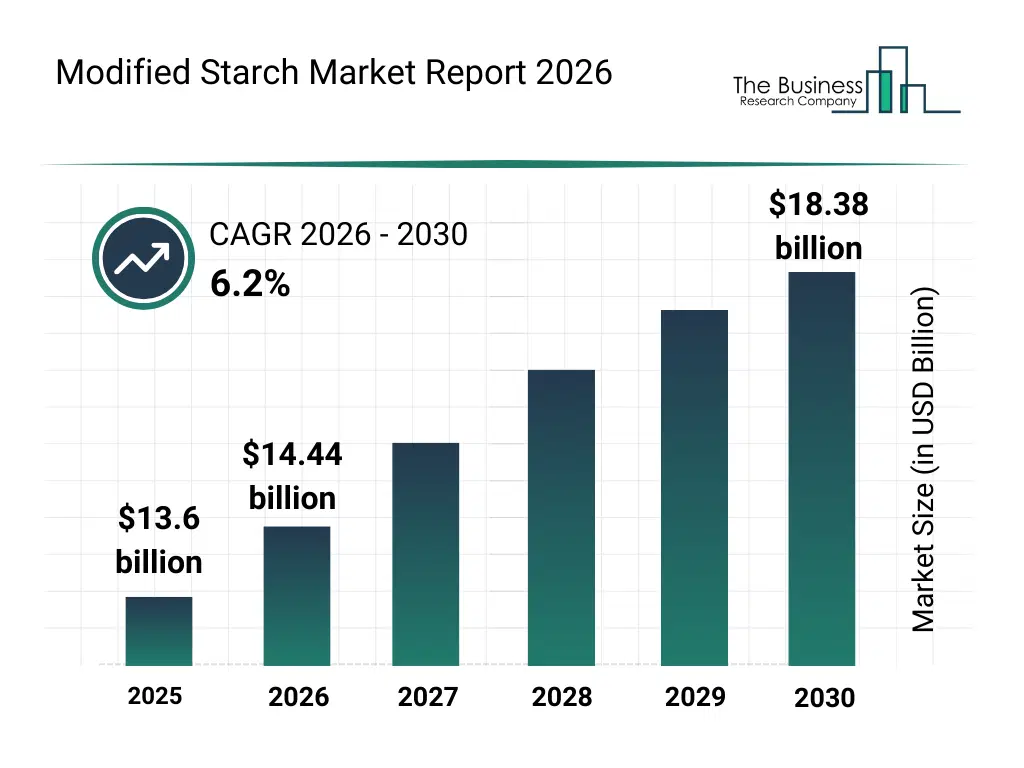
What Is The Modified Starch Market Size and Share 2026?
The modified starch market size has grown strongly in recent years. It will grow from $13.6 billion in 2025 to $14.44 billion in 2026 at a compound annual growth rate (CAGR) of 6.1%. The growth in the historic period can be attributed to growth in processed food consumption, increasing use of starch-based thickeners, expansion of food manufacturing capacities, rising demand for shelf-stable products, availability of diverse starch raw materials.What Is The Modified Starch Market Growth Forecast?
The modified starch market size is expected to see strong growth in the next few years. It will grow to $18.38 billion in 2030 at a compound annual growth rate (CAGR) of 6.2%. The growth in the forecast period can be attributed to rising focus on functional and dietary fiber ingredients, increasing demand for clean-label formulations, expansion of convenience food consumption, growing innovation in starch modification techniques, increasing adoption in pharmaceutical formulations. Major trends in the forecast period include increasing demand for clean-label food ingredients, rising adoption of resistant starch in functional foods, growing use of modified starch in processed foods, expansion of heat-stable and freeze-thaw stable starches, enhanced focus on texture and shelf-life optimization.
Global Modified Starch Market Segmentation
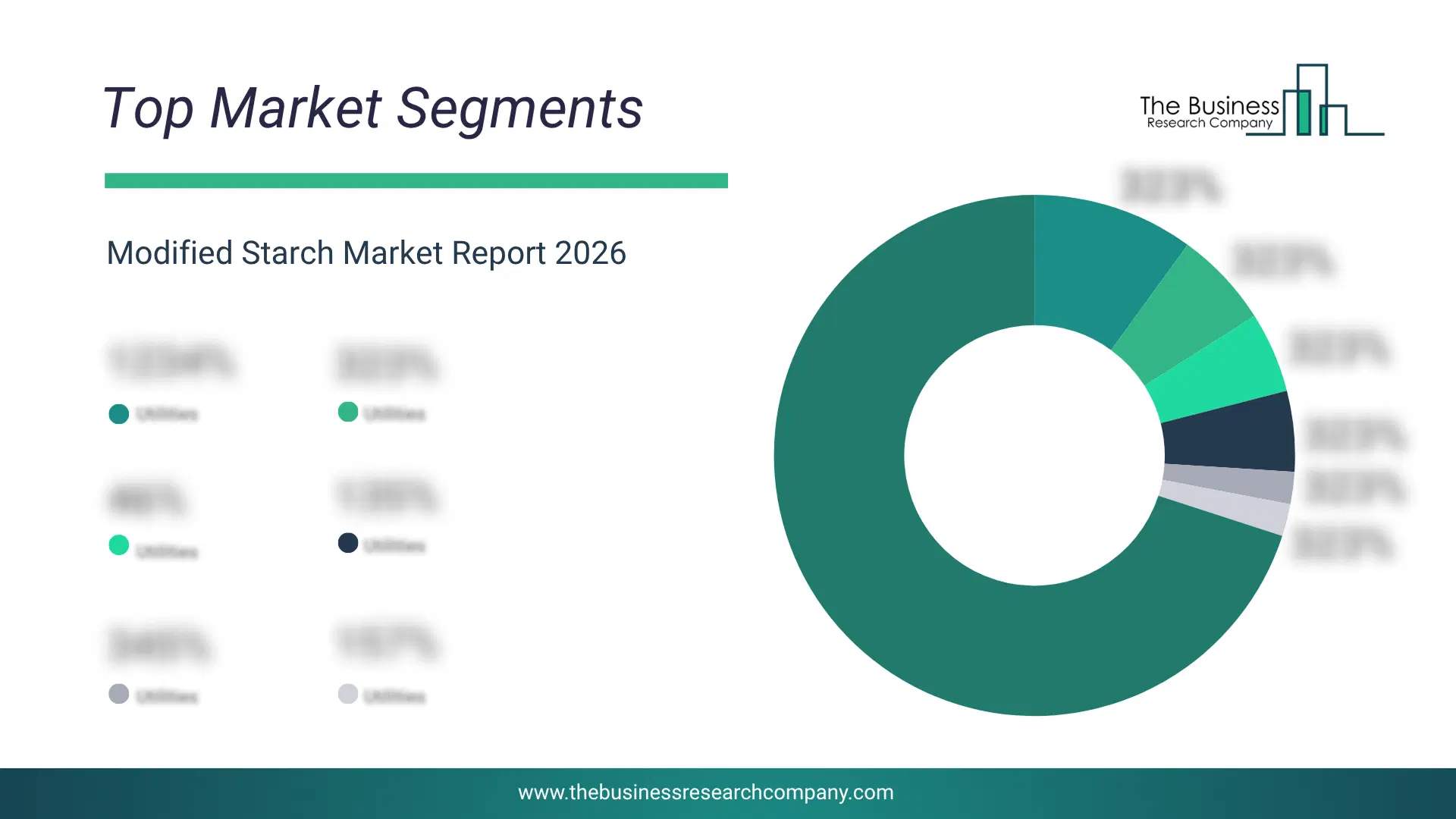
1) By Type: Cationic Starch, Etherified Starch, Resistant Starch, Pre-Gelatinized 2) By Raw Material: Potato, Corn, Cassava, Wheat, Other Raw Materials 3) By Application: Food & Beverage Processing, Paper & Packaging, Textile & Weaving, Pharmaceutical & Healthcare, Animal Feed & Pet Food, Industrial & Chemical Applications Subsegments: 1) By Cationic Starch: Quaternary Ammonium Starch, Starch Ether 2) By Etherified Starch: Hydroxypropyl Starch, Hydroxyethyl Starch, Carboxymethyl Starch 3) By Resistant Starch: Type II – Granular Resistant Starch (Physically Modified), Type III – Retrograded Resistant Starch (Thermally Processed), Type IV – Chemically Modified Resistant Starch 4) By Pre-Gelatinized Starch: Instant Starch, Cold-Water Soluble StarchWhat Is The Driver Of The Modified Starch Market?
The increasing investment in the modified starch industry is expected to propel the growth of the modified starch market. Large players are investing in the modified starch industry to meet the demand, due to the increasing consumption of modified starch in various applications including food and beverage, paper, pharmaceuticals, textile, and other applications. For instance, in June 2023, BENEO GmbH, a Germany-based functional ingredients company, invested $6.4 million (€6 million) in expanding drying capacity at its Wijgmaal factory, featuring a new drum dryer within a 1,000m2 facility. The expansion aimed to meet the growing demand for its specialty rice starch ingredients and secure the future growth of its pre-cooked rice starch portfolio. Therefore, the increasing investment in the modified starch industry is expected to propel the growth of the modified starch industry.Key Players In The Global Modified Starch Market
Major companies operating in the modified starch market are Cargill Inc., Archer Daniels Midland Company, Ingredion Incorporated, AGRANA Beteiligungs-AG, Tate & Lyle PLC, Roquette Frères, Avebe U.A., Manildra Group, Grain Processing Corporation, MGP Ingredients Inc., PT Budi Starch & Sweetener Tbk, Global Bio-Chem Technology Group Company Limited, Advanced Biochemical (Thailand) Co Ltd., Everest Starch (India) Pvt Ltd., Emsland Group, SPAC Starch Products (India) Ltd., Shandong Fuyang Biotechnology Co Ltd., Shree Ambika Agro Processing Industries Pvt Ltd., Starch Asia Co Ltd., Shanghai Riken Technology Co Ltd., Penford Corporation, Beneo GmbH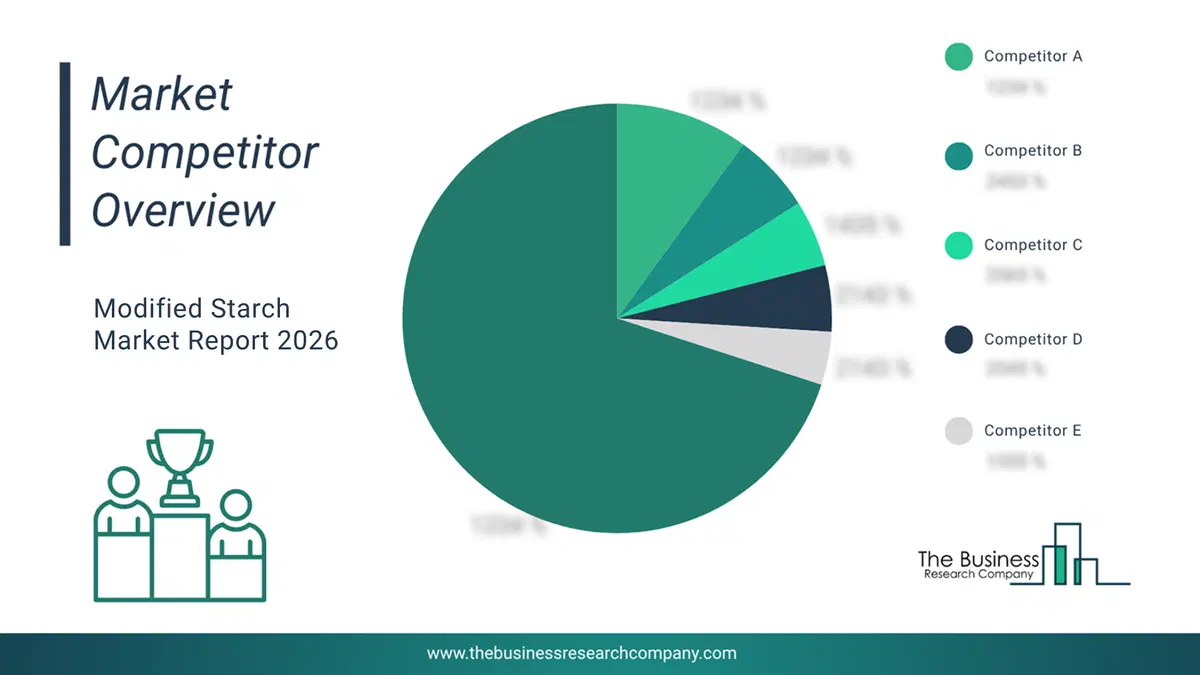
This chart is for illustrative purposes; the full report includes a detailed competitor analysis and comprehensive overview of the top 10 companies in the market.
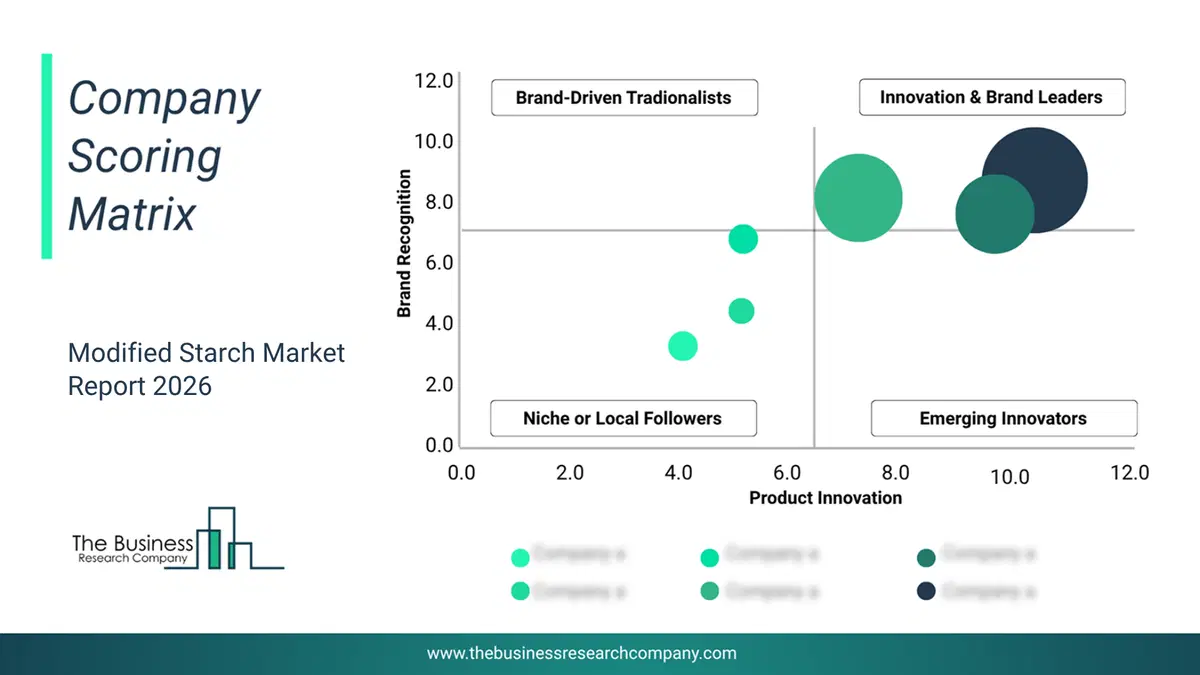
This chart maps companies by product innovation and brand strength, with bubble size indicating relative revenue, helping identify market leaders, challengers, and niche players. This is an illustrative chart; the full report provides a complete and accurate competitive analysis.
Global Modified Starch Market Trends and Insights
Major companies operating in the modified starch market are focusing on developing innovative products such as minimally processed starches to meet growing demand for clean-label, natural, and functional ingredients. Minimally processed starches are native starches derived from traditional crops that undergo limited physical processing without chemical modification, helping manufacturers achieve clean-label formulations while still providing essential functions like thickening, gelling, stabilizing, and improving texture in foods. For instance, in February 2024, Ingredion Incorporated, a U.S.-based food ingredient company, launched NOVATION Indulge 2940, a non-GMO native corn starch for dairy, alternative-dairy, and dessert applications. The starch provides unique gelling, thickening, and co-texturizing properties, delivering smooth, indulgent texture in finished products. It enables manufacturers to maintain a clean-label formulation without relying on chemically modified starches. Additional features include stability under heat and freeze-thaw cycles, versatility across processed foods and desserts, and improved cost-in-use and supply reliability compared with conventional starches. This makes it an effective, natural alternative for modern food formulations.What Are Latest Mergers And Acquisitions In The Modified Starch Market?
In November 2023, Sajo Industries Company Limited, a South Korea–based food and ingredients group, acquired Ingredion Korea for US $290 million. With this acquisition, Sajo aims to strengthen its materials and ingredients business by taking over Ingredion Korea’s starch and starch syrup operations. Ingredion Korea Ltd. is a South Korea–based manufacturing company that specializes in producing starches, starch syrups, and other value-added ingredients for food, beverage, and industrial applications.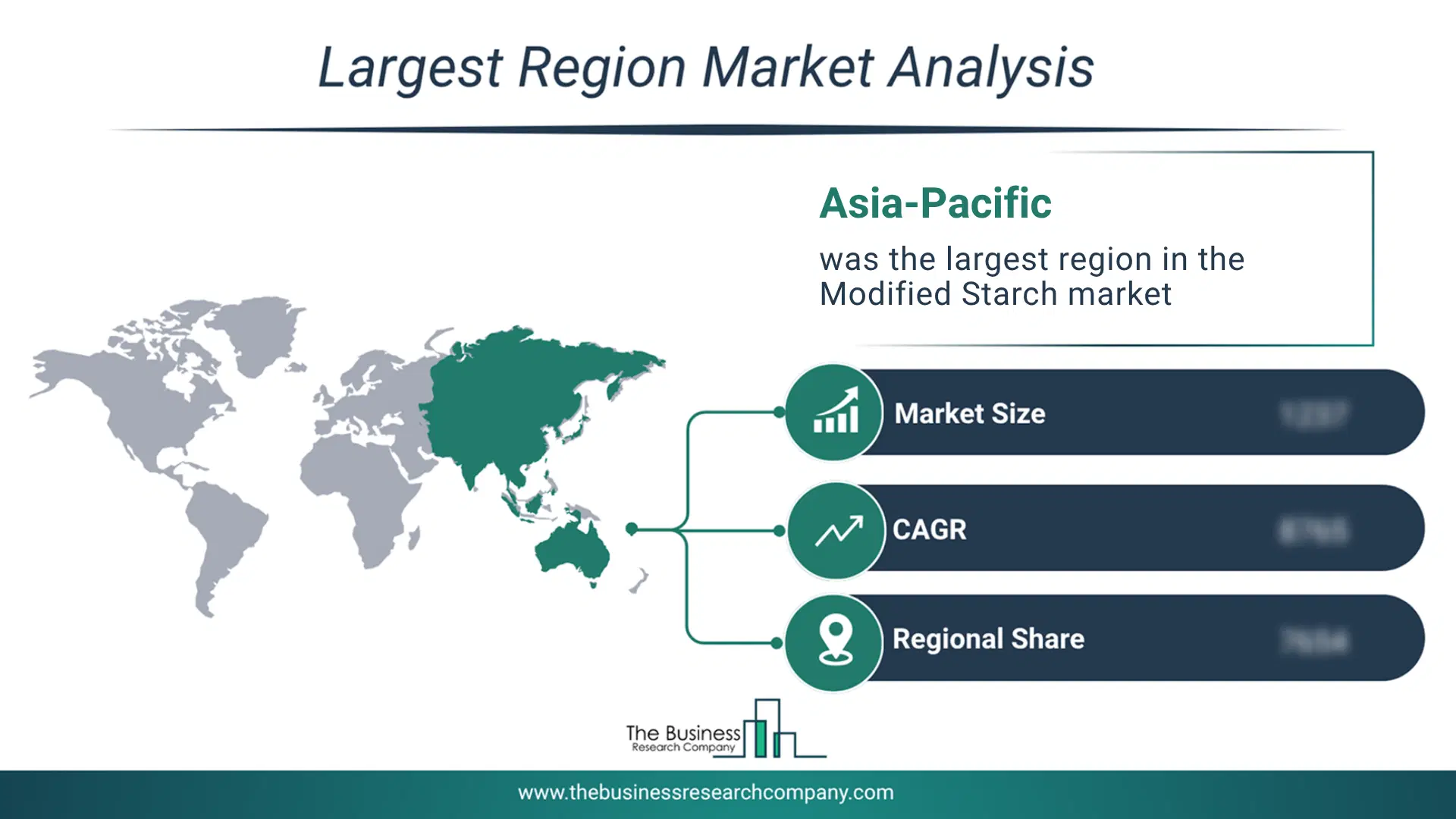
Regional Outlook
Asia-Pacific was the largest region in the modified starch market in 2025. Asia-Pacific is expected to be the fastest-growing region in the forecast period. The regions covered in this market report are Asia-Pacific, South East Asia, Western Europe, Eastern Europe, North America, South America, Middle East and Africa. The countries covered in this market report are Australia, Brazil, China, France, Germany, India, Indonesia, Japan, Taiwan, Russia, South Korea, UK, USA, Italy, Spain, CanadaWhat Defines the Modified Starch Market?
The modified starch market consists of sales of distarch phosphate, phosphated distarch phosphate, acetylated distarch phosphate, acetylated starch, acetylated distarch adipate. Values in this market are ‘factory gate’ values, that is the value of goods sold by the manufacturers or creators of the goods, whether to other entities (including downstream manufacturers, wholesalers, distributors and retailers) or directly to end customers. The value of goods in this market includes related services sold by the creators of the goods.How is Market Value Defined and Measured?
The market value is defined as the revenues that enterprises gain from the sale of goods and/or services within the specified market and geography through sales, grants, or donations in terms of the currency (in USD unless otherwise specified). The revenues for a specified geography are consumption values that are revenues generated by organizations in the specified geography within the market, irrespective of where they are produced. It does not include revenues from resales along the supply chain, either further along the supply chain or as part of other products.
This chart presents market attractiveness based on a quantitative evaluation of growth, competition, strategic alignment, and risk, offering a clear view of opportunity areas for decision-making. This chart is for illustrative purposes; the full report contains the complete analysis.

This chart highlights the Total Addressable Market (TAM) by estimating the maximum revenue opportunity using an assumption-driven approach, supporting strategic planning and opportunity sizing across markets. The chart is illustrative; the full report provides a more comprehensive analysis.
What Key Data and Analysis Are Included in the Modified Starch Market Report 2026?
The modified starch market research report is one of a series of new reports from The Business Research Company that provides market statistics, including industry global market size, regional shares, competitors with the market share, detailed market segments, market trends and opportunities, and any further data you may need to thrive in the modified starch industry. The market research report delivers a complete perspective of everything you need, with an in-depth analysis of the current and future state of the industry.Modified Starch Market Report Forecast Analysis
| Report Attribute | Details |
|---|---|
| Market Size Value In 2026 | $14.44 billion |
| Revenue Forecast In 2030 | $18.38 billion |
| Growth Rate | CAGR of 6.1% from 2026 to 2030 |
| Base Year For Estimation | 2025 |
| Actual Estimates/Historical Data | 2020-2025 |
| Forecast Period | 2026 - 2030 |
| Market Representation | Revenue in USD Billion and CAGR from 2026 to 2030 |
| Segments Covered | Type, Raw Material, Application |
| Regional Scope | Asia-Pacific, Western Europe, Eastern Europe, North America, South America, Middle East, Africa |
| Country Scope | The countries covered in the report are Australia, Brazil, China, France, Germany, India, Indonesia, Japan, Taiwan, Russia, South Korea, UK, USA, Canada, Italy, Spain. |
| Key Companies Profiled | Cargill Inc., Archer Daniels Midland Company, Ingredion Incorporated, AGRANA Beteiligungs-AG, Tate & Lyle PLC, Roquette Frères, Avebe U.A., Manildra Group, Grain Processing Corporation, MGP Ingredients Inc., PT Budi Starch & Sweetener Tbk, Global Bio-Chem Technology Group Company Limited, Advanced Biochemical (Thailand) Co Ltd., Everest Starch (India) Pvt Ltd., Emsland Group, SPAC Starch Products (India) Ltd., Shandong Fuyang Biotechnology Co Ltd., Shree Ambika Agro Processing Industries Pvt Ltd., Starch Asia Co Ltd., Shanghai Riken Technology Co Ltd., Penford Corporation, Beneo GmbH |
| Customization Scope | Request for Customization |
| Pricing And Purchase Options | Explore Purchase Options |