
Modular Automation Market Report 2026
Global Outlook – By Type (Modular Control Systems, Modular Production & Assembly Systems, Modular Process Automation Systems, Modular Material Handling Systems, Modular Robotics & Automation Cells), By Technology (Industrial Internet Of Things (IIoT), Robotics), By Enterprise Size (Small And Medium Enterprises, Large Enterprises), By Application (Assembly, Inspection, Testing, Material Handling, Packaging), By End-User Industry (Manufacturing, Healthcare, Aerospace And Defense, Energy And Utilities) – Market Size, Trends, Strategies, and Forecast to 2030
Modular Automation Market Overview
• Modular Automation market size has reached to $14.27 billion in 2025 • Expected to grow to $24.57 billion in 2030 at a compound annual growth rate (CAGR) of 11.4% • Growth Driver: Rising Demand For Automation Solutions Fueling The Growth Of The Market Due To Need For Operational Efficiency And Flexibility • Market Trend: Advancing Automation Through Modular Remote Innovations • North America was the largest region in 2025 and Asia-Pacific is the fastest growing region.What Is Covered Under Modular Automation Market?
Modular automation is a system design approach that utilizes standardized, interchangeable modules to construct flexible and scalable automation solutions. Its purpose is to simplify customization, facilitate quick adaptation to changing production needs, and minimize setup time and costs. The main types of modular automation are distributed control systems (DCS) and module type packages. A distributed control system (DCS) is an automated control system where control elements are distributed throughout a plant or process, enabling centralized monitoring and decentralized control for improved reliability, scalability, and efficiency. These systems use various technologies such as the industrial internet of things (IIoT), robotics, artificial intelligence (AI), and cloud computing. They are used by different enterprise sizes, including small and medium enterprises (SMEs) and large enterprises. Key applications include assembly, inspection, testing, material handling, and packaging, and are utilized by end-user industries such as manufacturing, healthcare, aerospace and defense, and energy and utilities.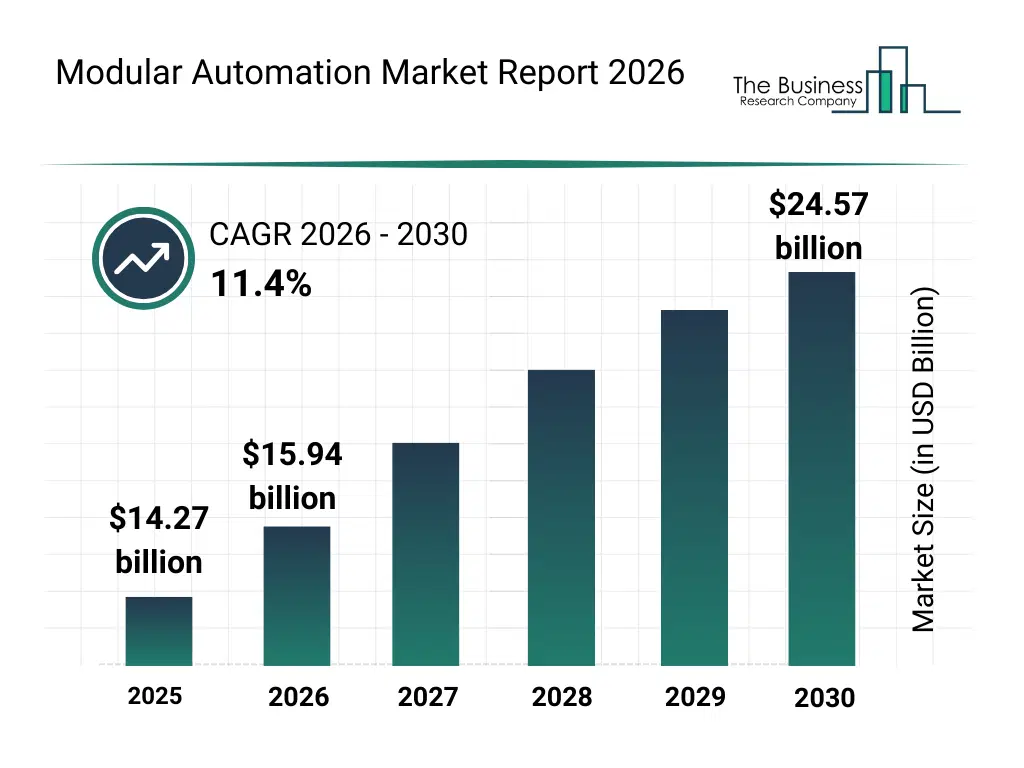
What Is The Modular Automation Market Size and Share 2026?
The modular automation market size has grown rapidly in recent years. It will grow from $14.27 billion in 2025 to $15.94 billion in 2026 at a compound annual growth rate (CAGR) of 11.7%. The growth in the historic period can be attributed to industrial automation adoption, demand for manufacturing efficiency, growth of mass customization, need for faster production changeovers, reduction of labor dependency.What Is The Modular Automation Market Growth Forecast?
The modular automation market size is expected to see rapid growth in the next few years. It will grow to $24.57 billion in 2030 at a compound annual growth rate (CAGR) of 11.4%. The growth in the forecast period can be attributed to integration of AI driven automation, growth of smart manufacturing, demand for modular production expansion, rising investment in digital factories, adoption by small and medium enterprises. Major trends in the forecast period include growing adoption of flexible manufacturing systems, increasing demand for plug and play automation, rising focus on scalable production lines, expansion of smart factory implementations, preference for reduced installation and downtime.Tariff Impact On Modular Automation Market
Tariffs have increased costs of automation hardware, control systems, and industrial electronics used in modular automation solutions. Manufacturing sectors in europe and asia pacific are most impacted. Complex automation modules face higher pricing pressure. However, tariffs are driving local system integration and regional solution development.
Global Modular Automation Market Segmentation
1) By Type: Modular Control Systems, Modular Production & Assembly Systems, Modular Process Automation Systems, Modular Material Handling Systems, Modular Robotics & Automation Cells 2) By Technology: Industrial Internet Of Things (IIoT), Robotics 3) By Enterprise Size: Small And Medium Enterprises, Large Enterprises 4) By Application: Assembly, Inspection, Testing, Material Handling, Packaging 5) By End-User Industry: Manufacturing, Healthcare, Aerospace And Defense, Energy And Utilities Subsegments: 1) By Modular Control Systems: Modular PLC & PAC Systems, Distributed I/O & Remote Terminal Modules, Modular Safety Control Systems, Scalable Motion Control Modules, Software-Configurable Control Platforms 2) By Modular Production & Assembly Systems: Modular Assembly Stations, Reconfigurable Production Lines, Standardized Workcell Modules, Plug-and-Play Assembly Units, Flexible Transfer & Indexing Modules 3) By Modular Process Automation Systems: Process Skid-Mounted Automation Units, Standardized Process Equipment Modules, Modular Batch Processing Units, Pre-Engineered Process Automation Skids, Distributed Process Control Modules 4) By Modular Material Handling Systems: Modular Conveyor Systems, Automated Guided Vehicle (AGV) Modules, Autonomous Mobile Robot (AMR) Modules, Modular Palletizing & Depalletizing Units, Reconfigurable Sorting & Routing Modules 5) By Modular Robotics & Automation Cells: Robot Workcell Modules, Collaborative Robot (Cobot) Cells, Vision-Integrated Robotics Modules, Pick-and-Place Automation Cells, End-of-Line Robotic Packaging CellsWhat Is The Driver Of The Modular Automation Market?
The increasing demand for automation solutions is expected to propel the growth of the modular automation market going forward. Automation solutions refer to technologies, systems, or services designed to perform tasks with minimal human intervention, enhancing efficiency, accuracy, and productivity across various industries. Automation solutions are rising primarily due to the growing demand for operational efficiency, as businesses seek to reduce costs, minimize errors, and improve productivity through intelligent and streamlined processes. Modular automation enhances automation solutions by enabling flexible, scalable, and easily reconfigurable systems that adapt quickly to changing production needs and technological advancements. For instance, in September 2025, according to the International Federation of Robotics, a Germany-based non-profit research and industry association, the total number of industrial robots in operational use worldwide reached 4,664,000 units in 2024, reflecting a 9 percent increase compared with the previous year. Therefore, increasing demand for automation solutions is driving the growth of the modular automation industry.Key Players In The Global Modular Automation Market
Major companies operating in the modular automation market are Siemens AG, General Electric Company (GE), Mitsubishi Electric Corporation, Schneider Electric SE, Honeywell International Inc., ABB Ltd, Toshiba Corporation, Emerson Electric Co., Bosch Rexroth AG, Rockwell Automation Inc., Keyence Corporation, FANUC Corporation, Phoenix Contact GmbH & Co. KG, Festo Inc., Yokogawa Electric Corporation, Beckhoff Automation GmbH & Co. KG, Ascential Technologies Inc., Pilz GmbH & Co. KG, HIMA Paul Hildebrandt GmbH, Modular Automation Ltd.
This chart is for illustrative purposes; the full report includes a detailed competitor analysis and comprehensive overview of the top 10 companies in the market.
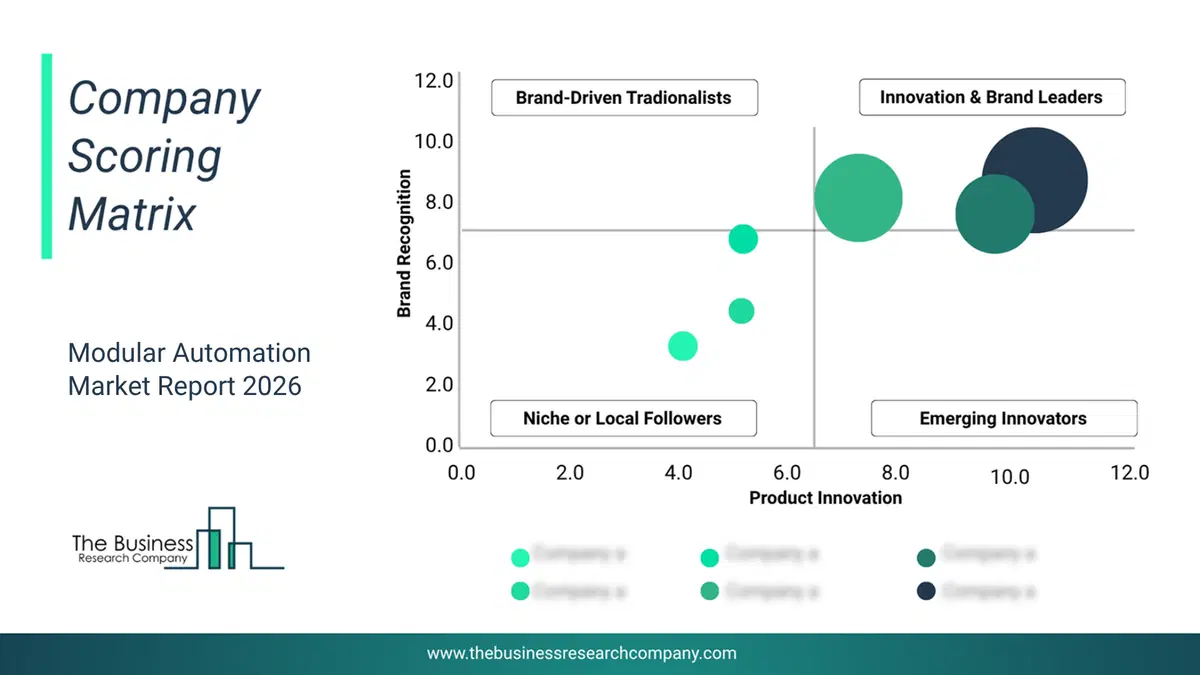
This chart maps companies by product innovation and brand strength, with bubble size indicating relative revenue, helping identify market leaders, challengers, and niche players. This is an illustrative chart; the full report provides a complete and accurate competitive analysis.
Global Modular Automation Market Trends and Insights
Major companies operating in the modular automation market are focusing on developing technological innovations such as modular remote units to enhance system flexibility, enable faster deployment, and improve operational efficiency across diverse industrial applications. A modular remote unit is a configurable, self-contained device used in automation systems to perform control, monitoring, or data acquisition tasks remotely, allowing for flexible system expansion and decentralized operation. For instance, in May 2025, WEG S.A., a Brazil-based motors and generators company, introduced the RUW200, a next-generation modular remote unit designed to optimize device integration and operational performance in industrial automation environments. Engineered as a compact and scalable solution, the RUW200 offers advanced connectivity through dual Ethernet ports and supports key industrial communication protocols, including EtherNet or IP, Modbus-TCP, and MQTT, positioning it as fully IoT-ready. The unit supports expansion with up to eight I/O modules, offering adaptability to diverse automation requirements, and is fully interoperable with WEG’s existing PLC platforms, including the PLC200, PLC410, and PLC500.What Are Latest Mergers And Acquisitions In The Modular Automation Market?
In March 2024, Bruker Corporation, a US-based provider of advanced scientific instruments and analytical solutions for molecular and materials research, acquired Chemspeed Technologies AG for US$ 180 million. With this acquisition, Bruker gains access to Chemspeed’s modular automation platforms and laboratory robotics expertise, thereby enhancing its integrated automation and digital workflow capabilities while expanding its customer reach across R&D and quality control environments. Chemspeed Technologies AG is a Switzerland-based provider of modular and scalable automated laboratory solutions, known for its vendor-agnostic robotics platforms used in chemical research, pharmaceuticals, and materials science.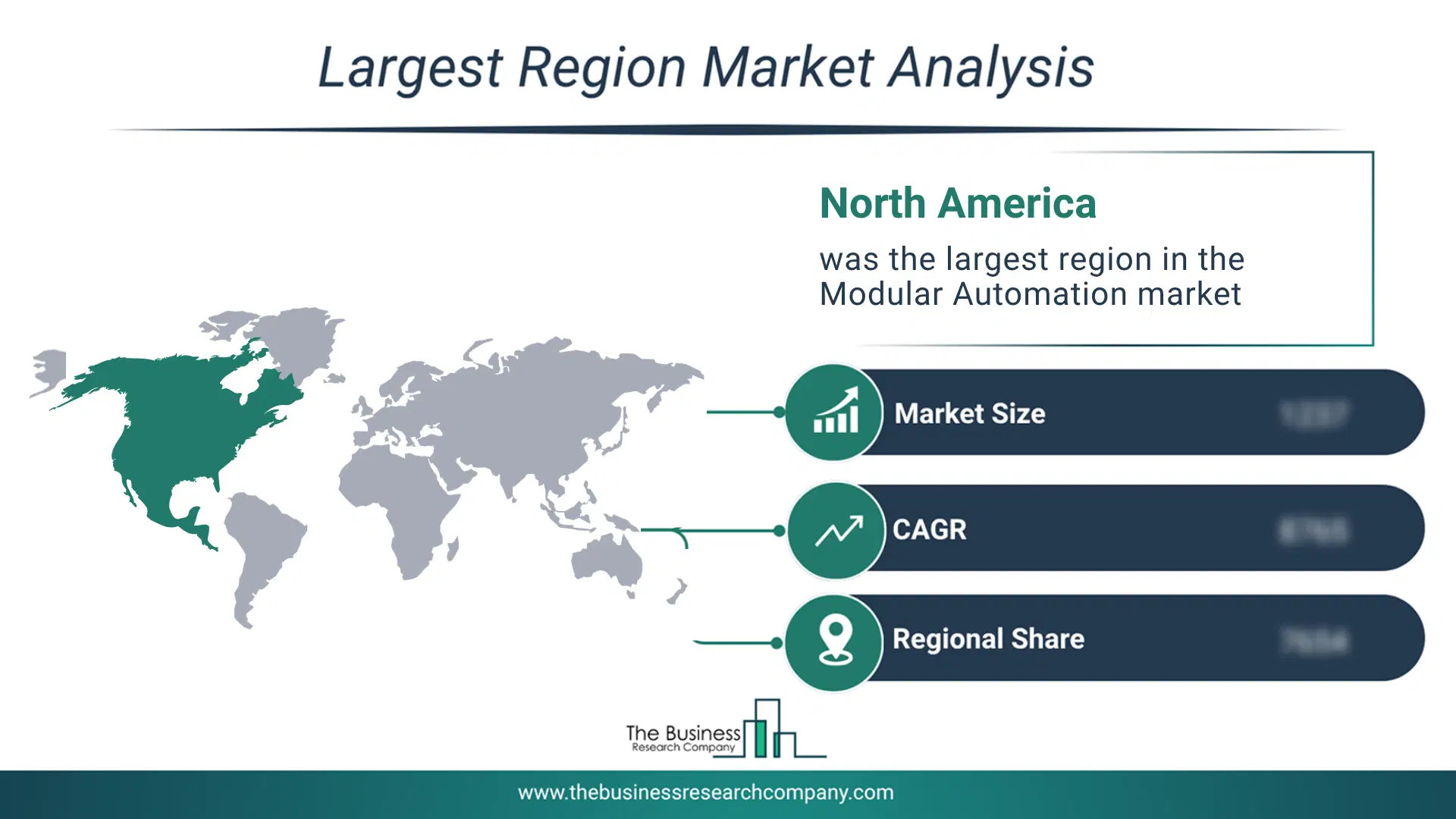
Regional Outlook
North America was the largest region in the modular automation market in 2025. Asia-Pacific is expected to be the fastest-growing region in the forecast period. The regions covered in this market report are Asia-Pacific, South East Asia, Western Europe, Eastern Europe, North America, South America, Middle East, Africa The countries covered in this market report are Australia, Brazil, China, France, Germany, India, Indonesia, Japan, Taiwan, Russia, South Korea, UK, USA, Canada, Italy, Spain.What Defines the Modular Automation Market?
The modular automation market includes revenues earned by entities from system integration services, installation and commissioning services, maintenance and repair services, training and education services, and upgrade and retrofitting services. The market value includes the value of related goods sold by the service provider or included within the service offering. The modular automation market also includes sales of programmable logic controllers (PLCs), human-machine interfaces (HMIs), industrial robots, modular conveyor systems, and automated guided vehicles (AGVs). Values in this market are ‘factory gate’ values; that is, the value of goods sold by the manufacturers or creators of the goods, whether to other entities (including downstream manufacturers, wholesalers, distributors, and retailers) or directly to end customers. The value of goods in this market includes related services sold by the creators of the goods.How is Market Value Defined and Measured?
The market value is defined as the revenues that enterprises gain from the sale of goods and/or services within the specified market and geography through sales, grants, or donations in terms of the currency (in USD unless otherwise specified). The revenues for a specified geography are consumption values that are revenues generated by organizations in the specified geography within the market, irrespective of where they are produced. It does not include revenues from resales along the supply chain, either further along the supply chain or as part of other products.
This chart presents market attractiveness based on a quantitative evaluation of growth, competition, strategic alignment, and risk, offering a clear view of opportunity areas for decision-making. This chart is for illustrative purposes; the full report contains the complete analysis.

This chart highlights the Total Addressable Market (TAM) by estimating the maximum revenue opportunity using an assumption-driven approach, supporting strategic planning and opportunity sizing across markets. The chart is illustrative; the full report provides a more comprehensive analysis.
What Key Data and Analysis Are Included in the Modular Automation Market Report 2026?
The modular automation market research report is one of a series of new reports from The Business Research Company that provides market statistics, including industry global market size, regional shares, competitors with the market share, detailed market segments, market trends and opportunities, and any further data you may need to thrive in the modular automation industry. The market research report delivers a complete perspective of everything you need, with an in-depth analysis of the current and future state of the industry.Modular Automation Market Report Forecast Analysis
| Report Attribute | Details |
|---|---|
| Market Size Value In 2026 | $15.94 billion |
| Revenue Forecast In 2030 | $24.57 billion |
| Growth Rate | CAGR of 11.4% from 2026 to 2030 |
| Base Year For Estimation | 2025 |
| Actual Estimates/Historical Data | 2020-2025 |
| Forecast Period | 2026 - 2030 |
| Market Representation | Revenue in USD Billion and CAGR from 2026 to 2030 |
| Segments Covered | Type, Technology, Enterprise Size, Application, End-User Industry |
| Regional Scope | Asia-Pacific, Western Europe, Eastern Europe, North America, South America, Middle East, Africa |
| Key Companies Profiled | Siemens AG, General Electric Company (GE), Mitsubishi Electric Corporation, Schneider Electric SE, Honeywell International Inc., ABB Ltd, Toshiba Corporation, Emerson Electric Co., Bosch Rexroth AG, Rockwell Automation Inc., Keyence Corporation, FANUC Corporation, Phoenix Contact GmbH & Co. KG, Festo Inc., Yokogawa Electric Corporation, Beckhoff Automation GmbH & Co. KG, Ascential Technologies Inc., Pilz GmbH & Co. KG, HIMA Paul Hildebrandt GmbH, Modular Automation Ltd. |
| Customization Scope | Request for Customization |
| Pricing And Purchase Options | Explore Purchase Options |