
Modular Construction Market Report 2026
Global Outlook – By Type (Permanent, Relocatable ), By Material (Steel, Wood, Concrete ), By Module (Four-sided, Open-Sided, Partially Open-Sided, Mixed modules And Floor Cassettes, Modules supported By A primary structure, Other Modules), By End-Use Sector (Residential, Office, Education, Retail And Commercial, Hospitality, Healthcare, Other End Users) – Market Size, Trends, Strategies, and Forecast to 2030
Modular Construction Market Overview
• Modular Construction market size has reached to $107.83 billion in 2025 • Expected to grow to $161.02 billion in 2030 at a compound annual growth rate (CAGR) of 8.4% • Growth Driver: Rapid Urbanization Driving The Expansion Of The Thermal System Market • Market Trend: Advancing Efficiency Through Standardized Modular Design Innovations • Asia-Pacific was the largest region and fastest growing region.Market Gains By 2030 – Top Opportunities By Segment
Market Gain identifies the most promising market opportunities by highlighting the segments or products expected to generate the highest incremental revenue growth over the next five years.
What Is Covered Under Modular Construction Market?
Modular construction is a process in which buildings are manufactured off-site while adhering to the same building norms and requirements as traditional construction methods. It is utilized in the construction of various buildings since it has numerous advantages such as saving time, lowering labor costs, reducing volume of waste, and boosting productivity by delivering standardized components. The main types of modular construction are permanent and relocatable. Permanent refers to parts of a construction project which are used and remain in position for a long time either retrofitted to existing buildings or designed around modular building techniques. The various materials include steel, wood, and concrete, which are used in module form as four-sided, open-sided, partially open-sided, mixed modules and floor cassettes, modules supported by a primary structure and others. These are used by residential, office, education, retail and commercial, hospitality, healthcare and others.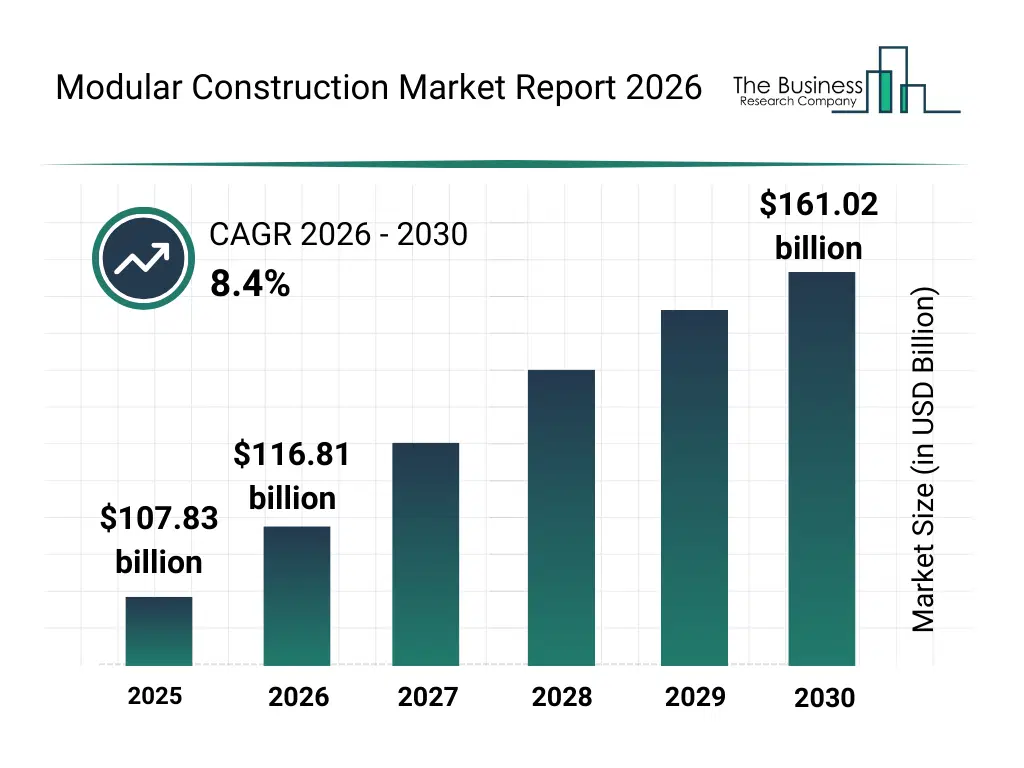
What Is The Modular Construction Market Size and Share 2026?
The modular construction market size has grown strongly in recent years. It will grow from $107.83 billion in 2025 to $116.81 billion in 2026 at a compound annual growth rate (CAGR) of 8.3%. The growth in the historic period can be attributed to early adoption of prefabricated building techniques, rising need for faster construction timelines, growth in cost-saving construction methods, expansion of standardized module production, increasing demand for relocatable temporary structures.What Is The Modular Construction Market Growth Forecast?
The modular construction market size is expected to see strong growth in the next few years. It will grow to $161.02 billion in 2030 at a compound annual growth rate (CAGR) of 8.4%. The growth in the forecast period can be attributed to growing adoption of automated modular manufacturing, rising focus on sustainable building materials, increasing demand for modular healthcare and education facilities, expansion of permanent modular housing projects, greater integration of IoT-enabled building systems. Major trends in the forecast period include rising adoption of off-site construction methods, expansion of standardized prefabricated components, growing demand for cost-efficient modular housing, increased utilization of mixed-module structural designs, higher market focus on temporary and mobile modular units.
Global Modular Construction Market Segmentation
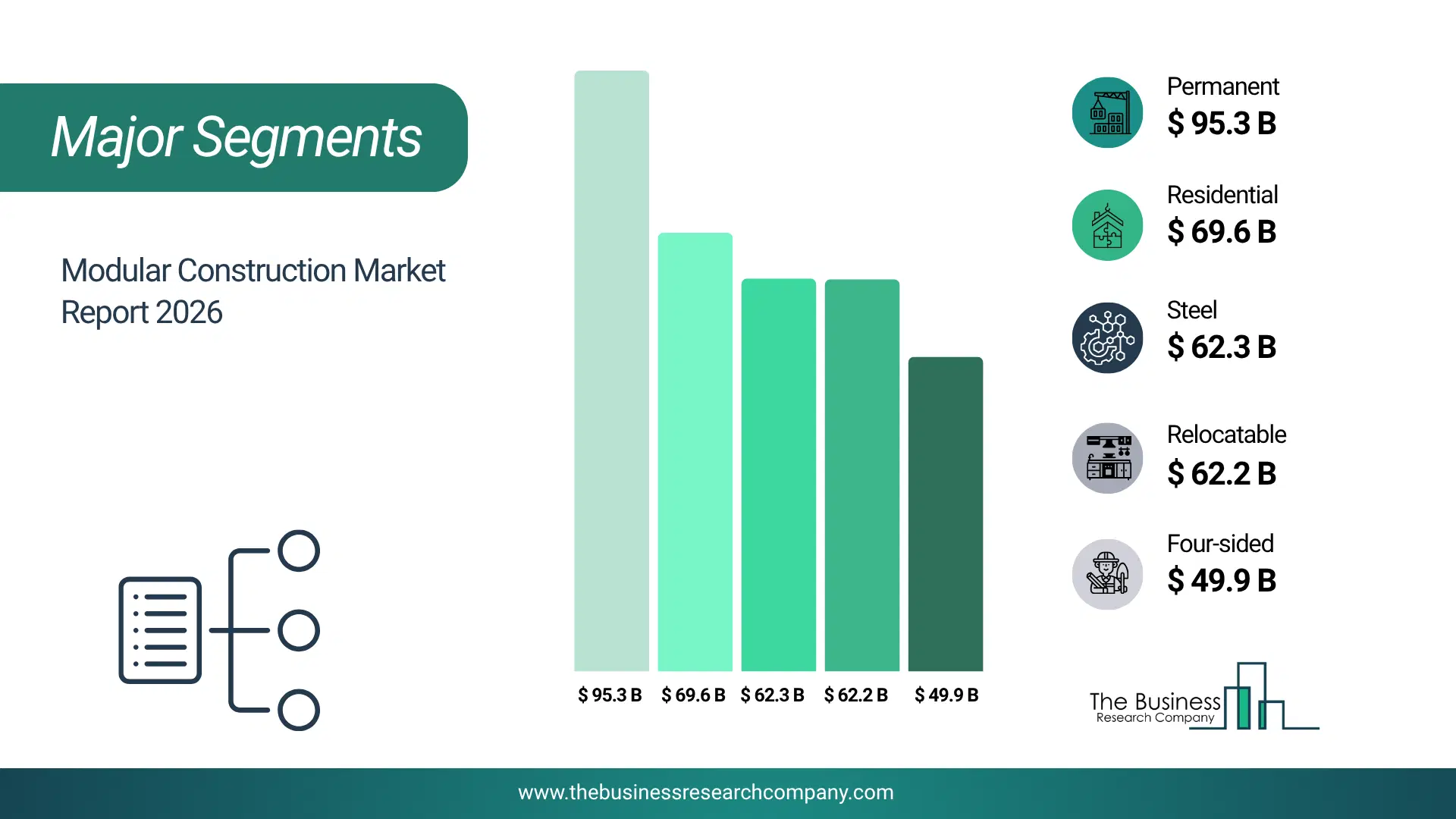
1) By Type: Permanent, Relocatable 2) By Material: Steel, Wood, Concrete 3) By Module: Four-sided, Open-Sided, Partially Open-Sided, Mixed modules And Floor Cassettes, Modules supported By A primary structure, Other Modules 4) By End-Use Sector: Residential, Office, Education, Retail And Commercial, Hospitality, Healthcare, Other End Users Subsegments: 1) By Permanent: Modular Buildings, Permanent Structures 2) By Relocatable: Temporary Facilities, Mobile Units The top segments in the modular construction market will be: • Permanent will reach $95367.91 Million by 2030. • Residential will reach $69666.4 Million by 2030. • Steel will reach $62356.42 Million by 2030. • Relocatable will reach $62266.55 Million by 2030. • Four-sided will reach $49904.31 Million by 2030.What Is The Driver Of The Modular Construction Market?
Growing urbanization is expected to boost the growth of the modular construction market going forward. Urbanization refers to the gathering of people into certain geographic locations. The rising urbanization trend creates a conducive environment for the growth of the modular construction market, as its characteristics align with the challenges and requirements of building in densely populated urban areas. For instance, according to a report published by the World Bank, a US-based international organization, in 2022, more than 50% of the world's population reside in urban regions. The number of people living in urban areas is projected to rise to 6 billion by 2045, a 1.5-fold increase. By 2030, the world is predicted to have 1.2 million km2 more of urban built-up area as urban land consumption is expected to continue to expand at a rate that is up to 50% faster than population growth. Therefore, growing urbanization is driving the growth of the modular construction industry.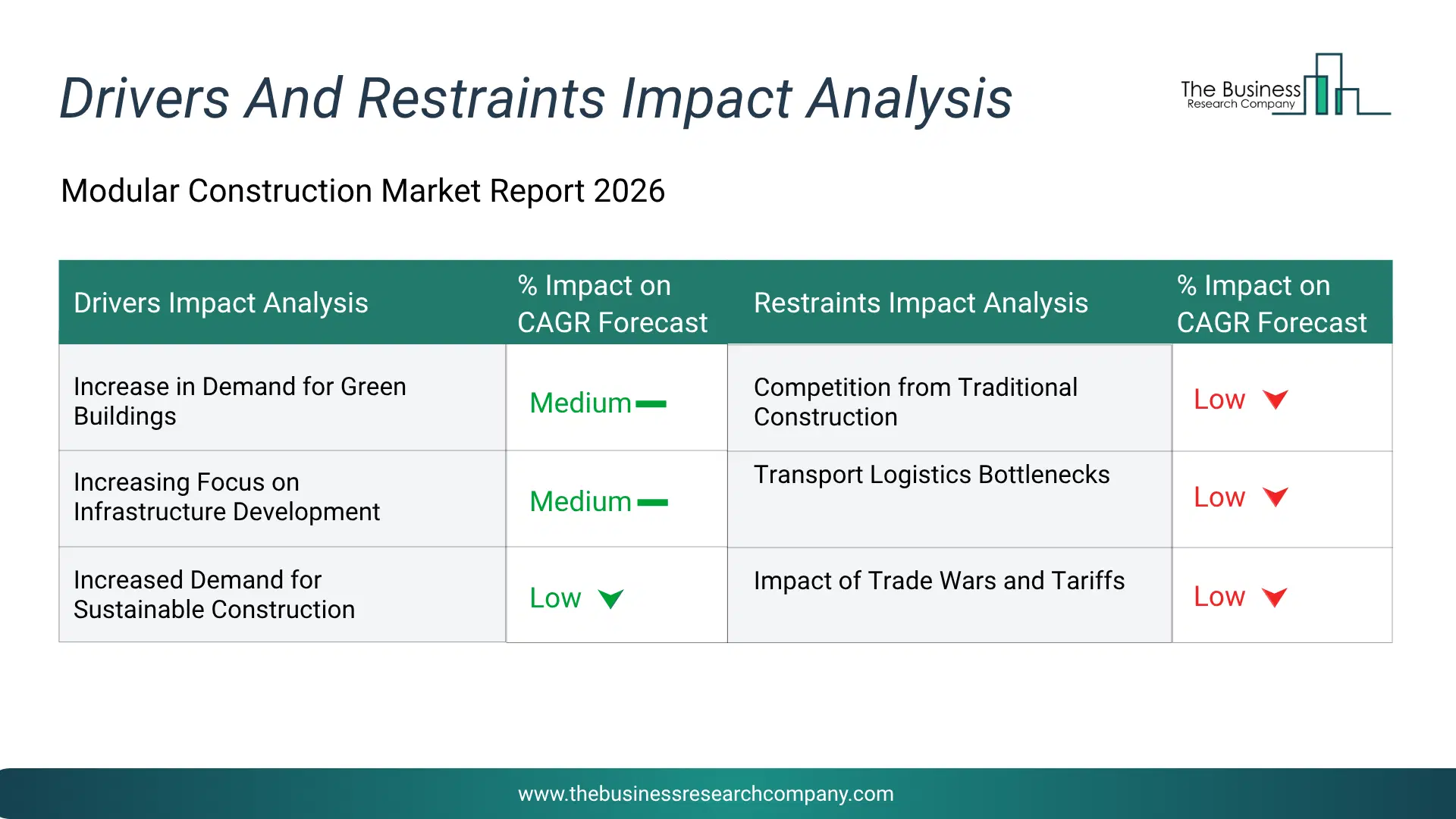
Infographic Chart Showing Key Market Drivers Analysis And Restraints For Modular Construction Market
The chart presents an impact analysis of key drivers and restraints, quantifying their relative influence on the market's growth rate and helping assess the balance between growth enablers and limiting factors. This chart offers a high-level perspective; the full report contains more detailed insights.
How Will The Drivers Impact Growth In The Global Modular Construction Market?
• Increase in Demand for Green Buildings (Medium) – During the forecast period, the increase in demand for green buildings will become a key driver of growth in the modular construction market by 2030. as sustainability and eco‑friendly practices gain importance among developers, policymakers and end users, there is a rising focus on reducing waste, conserving energy and minimizing environmental impact in construction projects. modular construction supports these sustainability goals by enabling controlled off‑site manufacturing, reducing material waste and optimizing energy use in buildings. developers are increasingly seeking solutions that comply with green building standards and certifications, making modular construction a preferred approach. the adoption of energy-efficient and eco-friendly designs is expected to continue driving the expansion of modular construction globally. as a result, the increase in demand for green buildings is anticipated to contributing to a 1.6% annual growth in the market. • Increasing Focus on Infrastructure Development (Medium) – During the forecast period, the increasing focus on infrastructure development will emerge as a major factor driving the expansion of the modular construction market by 2030. governments and private sector planners are accelerating investments in infrastructure such as hospitals, schools, transportation facilities and commercial space. modular construction enables faster delivery, streamlined assembly and reduced site disruption compared to traditional methods. modular construction allows for simultaneous off-site fabrication and on-site preparation, shortening project schedules significantly. as public and private sector investments in infrastructure continue to rise, modular construction is expected to play a pivotal role in meeting growing infrastructure demands efficiently. consequently, the increasing focus on infrastructure development is projected to contributing to a 1.3% annual growth in the market. • Increased Demand for Sustainable Construction (Low) – During the forecast period, the increased demand for sustainable construction will serve as a key growth catalyst for the modular construction market by 2030, construction industry stakeholders including builders, developers and regulators are placing greater emphasis on environmentally sound building practices that reduce waste and lower a structure’s lifetime carbon footprint. modular building techniques contribute to sustainability by minimizing on-site resource waste, enabling precise material usage and incorporating recyclable and low-impact materials. modular construction also reduces construction time and disruption, which lowers energy consumption and emissions during the building process. as governments and organizations prioritize eco-friendly development, modular construction is emerging as a key strategy for achieving sustainable construction objectives. therefore, this increased demand for sustainable construction is projected to supporting to a 0.9% annual growth in the market. • Growing Need for Relocatable and Temporary Buildings (Low) – During the forecast period, the modular construction market is also being driven by the growing need for relocatable and temporary buildings. Many sectors such as education, healthcare, events, disaster response and construction site operations require flexible, fast-to-deploy structures that can be relocated or repurposed as needs evolve. Relocatable modular buildings offer the ability to provide quick, functional space without the time and cost constraints of traditional construction, making them ideal for temporary or mobile applications. These buildings can be easily expanded, reconfigured, or disassembled, providing adaptability for changing operational requirements. As organizations increasingly seek agile and cost-efficient building solutions, the demand for relocatable and temporary modular buildings is expected to grow steadily. The growing need for relocatable and temporary buildings during the forecast period in 2025 is 0.6%.How Will The Restraints Impact Growth In The Global Modular Construction Market?
• Competition from Traditional Construction (Medium) – During the forecast period, competition from traditional construction is restricting the growth of the modular construction market during the forecast period. traditional construction methods continue to retain strong market share due to established supply chains, widespread contractor expertise and familiarity among developers and regulators. many stakeholders still view traditional on-site building methods as the default approach, with proven flexibility for bespoke architectural designs, easier customization during construction and lower perceived risk, particularly for complex or one-off projects. this preference for conventional construction slows adoption of modular techniques, even though modular offers advantages like faster schedules and reduced waste. in many regions, traditional builders maintain deeper relationships with suppliers and labor forces, making it harder for modular firms to compete for new contracts and financing. as a result, the persistent presence and perception advantages of traditional construction methods may delay client transitions to modular alternatives and restrict the modular construction market’s growth during the forecast period. growth affected by competition from traditional construction during the forecast period in 2025 is -0.5%. • Transport Logistics Bottlenecks (Medium) – During the forecast period, transport logistics bottlenecks are restricting the growth of the modular construction market during the forecast period. modular construction relies heavily on the transportation of large volumetric units from factories to construction sites, which creates unique logistical challenges that traditional methods do not face. transporting large modules requires specialized equipment and careful coordination due to their size and handling requirements and current global shipping conditions such as port congestion and high freight costs exacerbate delivery delays and increase project complexity. these logistical hurdles often result in unpredictable delivery schedules, stretching project timelines, increasing costs and forcing developers to reallocate resources to manage transportation risk rather than on-site construction activities. as a result, modular construction projects may face delayed installations, crane scheduling conflicts, or idle labor crews while waiting for module deliveries, thereby restricting the growth of the modular construction market during the forecast period. growth affected by transport logistics bottlenecks during the forecast period in 2025 is -0.8%. • Impact of Trade Wars and Tariffs (Low) – During the forecast period, impact of trade wars and tariffs constraints are restricting the growth of the modular construction market during the forecast period. tariffs on essential construction materials such as steel, lumber and aluminum increase the cost of procurement for modular builders by raising material prices and disrupting established global supply channels. modular construction’s dependence on global sourcing for components means that tariff-induced cost increases and supply delays directly translate into higher project expenses and longer lead times. these trade barriers often force manufacturers and developers to seek new suppliers, renegotiate contracts, or absorb added import duties, adding operational complexity and financial strain to projects. from a business perspective, tariff and trade-war related cost pressures may slow procurement decisions and delay project starts, as firms struggle to lock in stable pricing and reliable delivery schedules. as a result, higher material costs and disrupted supply chains may discourage investment in modular construction and restrict market growth during the forecast period. growth affected by impact of trade wars and tariffs during the forecast period in 2025 is -0.2%.Key Players In The Global Modular Construction Market
Major companies operating in the modular construction market are Bouygues Construction SA, Laing O'Rourke, Skanska AB, ATCO Ltd., Balfour Beatty Plc., Taisei Corporation, Supertech Industries LLC, Anderco Pte. Ltd., Giant Containers Inc., Honomobo Corporation, Lendlease Corporation, SG Blocks Inc., Guerdon L.L.C, Modulex PLC, Bechtel Corporation, ACS Group, Fluor Corporation, JL Construction, Julius Berger Nigeria PLC, Kiewit Corporation, Larsen & Toubro Limited, McGRATH RENTCORP, Palomar Modular Buildings, Red Sea Housing Services, SEKISUI CHEMICAL CO. LTD, System House R & C Co. Ltd, WillScot Mobile Mini Holdings Corp, Westchester Modular Homes, Koma Modular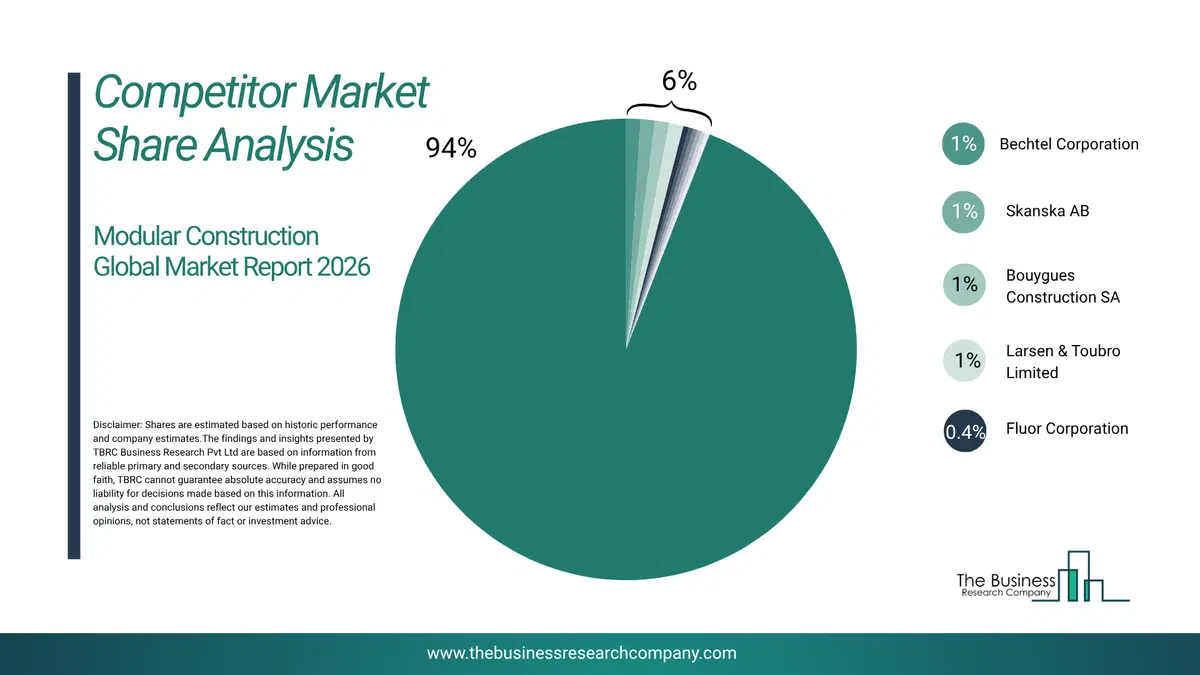
This chart is for illustrative purposes; the full report includes a detailed competitor analysis and comprehensive overview of the top 10 companies in the market.
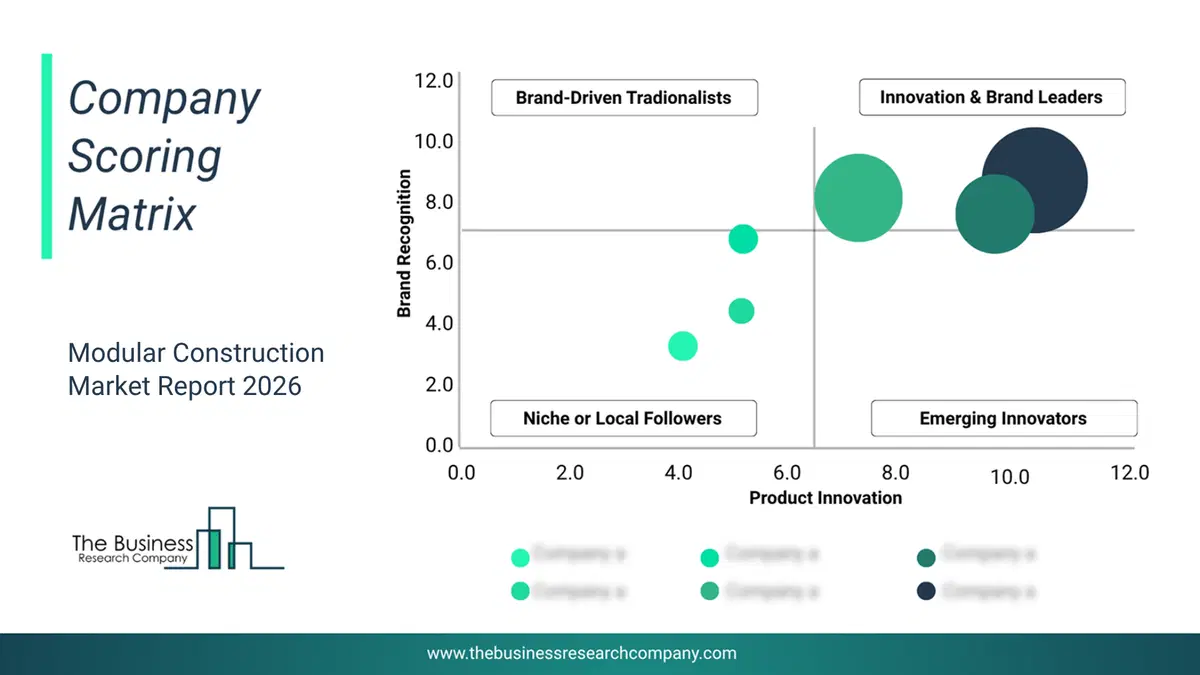
This chart maps companies by product innovation and brand strength, with bubble size indicating relative revenue, helping identify market leaders, challengers, and niche players. This is an illustrative chart; the full report provides a complete and accurate competitive analysis.
Global Modular Construction Market Trends and Insights
Major companies operating in the modular construction market are focusing on developing technological advancements such as standardized design modules to accelerate project timelines, enhance scalability, reduce construction costs, and ensure consistent quality across diverse projects. Standardized design modules refer to pre-engineered and prefabricated building components designed with uniform dimensions and specifications, allowing for easy assembly, scalability, and replication across multiple construction projects. For instance, in November 2023, TenneT, a Netherlands-based energy company, launched a modular construction for the Large Projects program to accelerate the expansion of the electricity grid. This initiative focuses on the construction of 380 kV substations and high-voltage pylons using standard designs and fixed modules. The modular approach streamlines and standardizes the design, planning, and implementation phases, making procurement, plot acquisition, and environmental discussions more efficient. It also reduces repetitive tasks, allowing engineers and workers to focus on more challenging and complex aspects of grid expansion projects. This program is a significant step in enabling faster and more efficient grid expansion, crucial for supporting the energy transition and meeting growing electricity demands.What Are Latest Mergers And Acquisitions In The Modular Construction Market?
In April 2024, LaPhair Capital Partners, a US-based venture capital company, acquired Kinexx Modular Construction for an undisclosed amount. to enhance homeownership opportunities in urban areas and tackle the housing crisis by acquiring Kinexx Modular Construction, focusing on sustainable building solutions and fostering economic development in underserved communities. Kinexx Modular Construction is a US-based company that specializes in the quick design, manufacturing, and installation of sustainable modular homes, particularly for urban infill projects.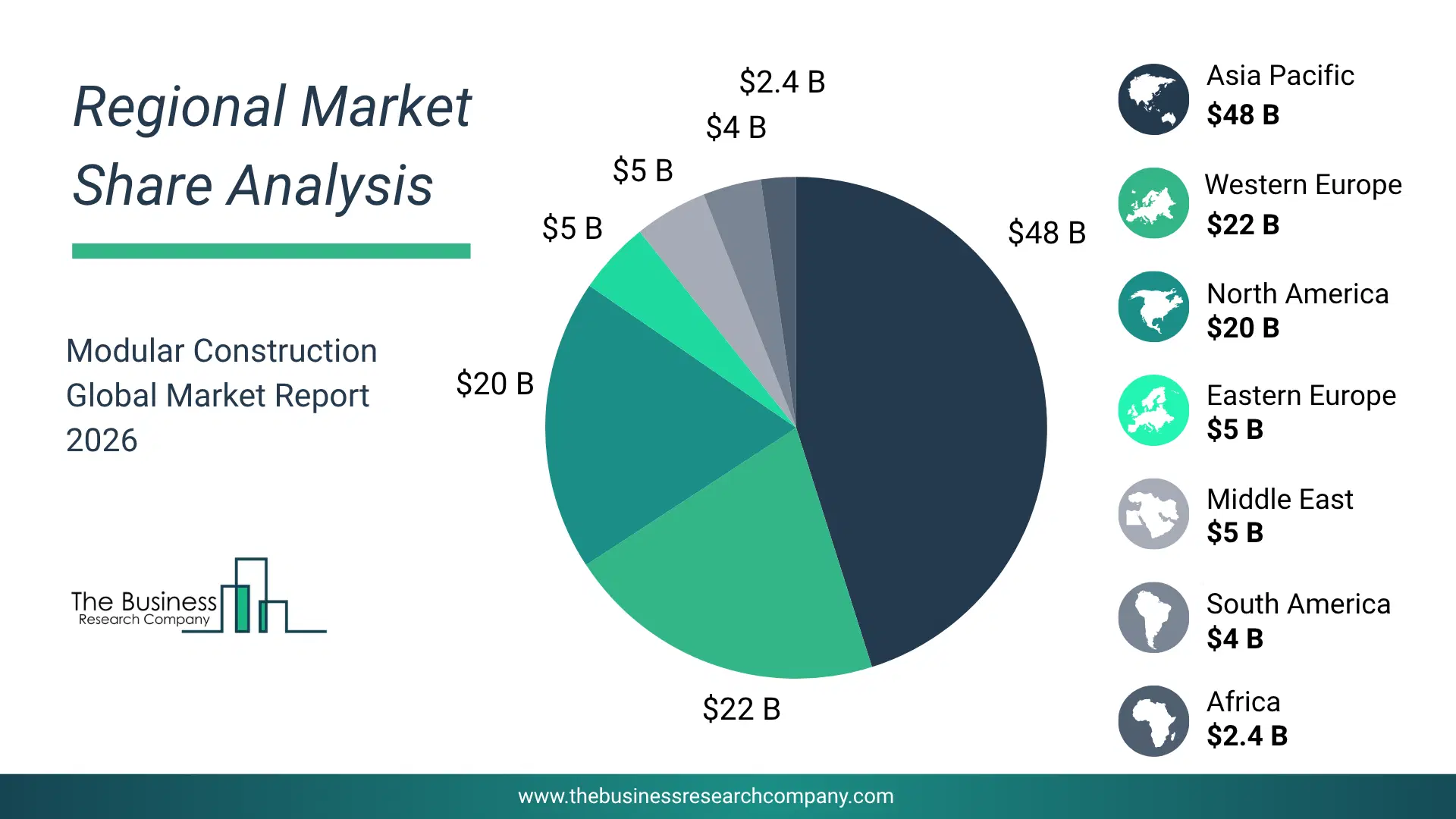
Regional Insights
Asia-Pacific was the largest region in the modular construction market share in 2025. The regions covered in this market report are Asia-Pacific, South East Asia, Western Europe, Eastern Europe, North America, South America, Middle East, Africa. The countries covered in this market report are Australia, Brazil, China, France, Germany, India, Indonesia, Japan, Taiwan, Russia, South Korea, UK, USA, Canada, Italy, Spain.What Defines the Modular Construction Market?
The modular construction market includes revenues earned by entities by constructing or engineering prefabricated constructions. The market value includes the value of related goods sold by the service provider or included within the service offering. Only goods and services traded between entities or sold to end consumers are included.How is Market Value Defined and Measured?
The market value is defined as the revenues that enterprises gain from the sale of goods and/or services within the specified market and geography through sales, grants, or donations in terms of the currency (in USD unless otherwise specified). The revenues for a specified geography are consumption values that are revenues generated by organizations in the specified geography within the market, irrespective of where they are produced. It does not include revenues from resales along the supply chain, either further along the supply chain or as part of other products.
This chart presents market attractiveness based on a quantitative evaluation of growth, competition, strategic alignment, and risk, offering a clear view of opportunity areas for decision-making. This chart is for illustrative purposes; the full report contains the complete analysis.

This chart highlights the Total Addressable Market (TAM) by estimating the maximum revenue opportunity using an assumption-driven approach, supporting strategic planning and opportunity sizing across markets. The chart is illustrative; the full report provides a more comprehensive analysis.
What Key Data and Analysis Are Included in theModular Construction Market Report 2026?
The modular construction market research report is one of a series of new reports from The Business Research Company that provides market statistics, including industry global market size, regional shares, competitors with the market share, detailed market segments, market trends and opportunities, and any further data you may need to thrive in the modular construction industry. The market research report delivers a complete perspective of everything you need, with an in-depth analysis of the current and future state of the industry.Modular Construction Market Report Forecast Analysis
| Report Attribute | Details |
|---|---|
| Market Size Value In 2026 | $116.81 billion |
| Revenue Forecast In 2030 | $161.02 billion |
| Growth Rate | CAGR of 8.3% from 2026 to 2030 |
| Base Year For Estimation | 2025 |
| Actual Estimates/Historical Data | 2020-2025 |
| Forecast Period | 2026 - 2030 - 2035 |
| Market Representation | Revenue in USD Billion and CAGR from 2026 to 2030 |
| Segments Covered | Type, Material, Module, End-Use Sector |
| Regional Scope | Asia-Pacific, Western Europe, Eastern Europe, North America, South America, Middle East, Africa |
| Country Scope | The countries covered in the report are Australia, Brazil, China, France, Germany, India, Indonesia, Japan, Taiwan, Russia, South Korea, UK, USA, Canada, Italy, Spain. |
| Key Companies Profiled | Bouygues Construction SA, Laing O'Rourke, Skanska AB, ATCO Ltd., Balfour Beatty Plc., Taisei Corporation, Supertech Industries LLC, Anderco Pte. Ltd., Giant Containers Inc., Honomobo Corporation, Lendlease Corporation, SG Blocks Inc., Guerdon L.L.C, Modulex PLC, Bechtel Corporation, ACS Group, Fluor Corporation, JL Construction, Julius Berger Nigeria PLC, Kiewit Corporation, Larsen & Toubro Limited, McGRATH RENTCORP, Palomar Modular Buildings, Red Sea Housing Services, SEKISUI CHEMICAL CO. LTD, System House R & C Co. Ltd, WillScot Mobile Mini Holdings Corp, Westchester Modular Homes, Koma Modular |
| Customization Scope | Request for Customization |
| Pricing And Purchase Options | Explore Purchase Options |