
Molecular Breeding Global Market Opportunities And Strategies To 2035
By Process (QTL Mapping, Marker-Assisted Selection, Marker-Assisted Backcrossing, Genomic Selection, Other Processes), By Marker Type (Single Sequence Repeats (SSR), Single Nucleotide Polymorphism (SNP), Other Marker Type), By Application (Crop Breeding, Livestock Breeding), And By Region, Opportunities And Strategies – Global Forecast To 2035
Molecular Breeding Market Definition
Molecular breeding refers to the application of molecular biology tools, particularly DNA markers, to enhance the precision, speed, and efficiency of breeding programs in agriculture. It is a modern approach that integrates genetic information into traditional breeding processes to select desirable traits such as yield, disease resistance, drought tolerance, and nutritional quality. The molecular breeding market consists of sales by entities (organizations, sole traders, or partnerships) of reagents, instruments, services, and software for DNA marker-based selection in plant and animal breeding programs. Molecular breeding leverages tools such as QTL mapping, marker-assisted selection (MAS), and genomic selection to pinpoint and enhance desirable traits such as disease resistance or yield more rapidly than conventional methods.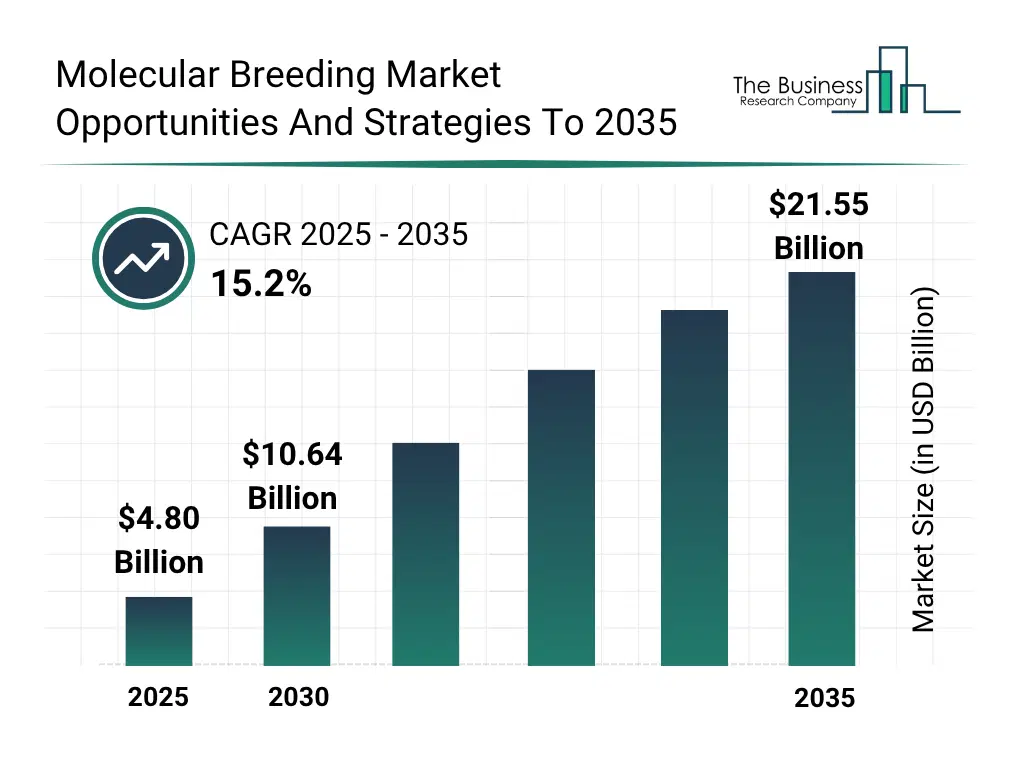
Molecular Breeding Market Size
The global molecular breeding market reached a value of nearly $4,798.9 million in 2025, having grown at a compound annual growth rate (CAGR) of 18.4% since 2020. The market is expected to grow from $4,798.9 million in 2025 to $10,641.2 million in 2030 at a rate of 17.3%. The market is then expected to grow at a CAGR of 15.2% from 2030 and reach $21,554.3 million in 2035. Growth in the historic period resulted from increasing food security concerns, increased incidence of pest and disease outbreaks, growing focus on food safety and regulatory compliance and growing need for climate-resilient crop varieties. Factors that negatively affected high technology and R&D costs and lack of skilled professionals. Going forward, increased investment in livestock farming and meat production, rising awareness of sustainable farming practices, rising food demand and increasing demand for high-yield crops. Factors that could hinder the strict regulatory frameworks, limited infrastructure availability and impact of trade war and tariffs.
Molecular Breeding Market Segmentation
The molecular breeding market is segmented by process, by marker type and by application.By Process –
The molecular breeding market is segmented by process into:
- a) QTL Mapping
- b) Marker-Assisted Selection
- c) Marker-Assisted Backcrossing
- d) Genomic Selection
- e) Other Processes
By Marker Type –
The molecular breeding market is segmented by marker type into:
- a) Single Sequence Repeats (SSR)
- b) Single Nucleotide Polymorphism (SNP)
- c) Other Marker Type
By Application –
The molecular breeding market is segmented by application into:
- a) Crop Breeding
- b) Livestock Breeding
By Geography - The molecular breeding market is segmented by geography into:
- China
- India
- Japan
- Australia
- Indonesia
- South Korea
- USA
- Canada
- Brazil
- France
- Germany
- UK
- Italy
- Spain
- Russia
-
o Asia Pacific
o Africa