
Molecular Spectroscopy Market Report 2026
Global Outlook – By Product Type (Consumables, Instruments), By Technology (Nuclear Magnetic Resonance Spectroscopy, UV-Visible Spectroscopy, Infrared Spectroscopy, Near-Infrared Spectroscopy, Color Measurement Spectroscopy, Raman Spectroscopy, Other Technologies), By Application (Pharmaceutical Applications, Food And Beverage Testing, Biotechnology And Biopharmaceutical Applications, Environmental Testing, Academic Research, Other Applications) – Market Size, Trends, Strategies, and Forecast to 2030
Molecular Spectroscopy Market Overview
• Molecular Spectroscopy market size has reached to $7.03 billion in 2025 • Expected to grow to $10.46 billion in 2030 at a compound annual growth rate (CAGR) of 8.1% • Growth Driver: Pharmaceutical Industry Boom to Drive Molecular Spectroscopy Market Growth • Market Trend: Revolutionizing Diagnostics Through The Impact Of MALDI Technology In Molecular Spectroscopy • North America was the largest region in 2025 and Asia-Pacific is the fastest growing region.What Is Covered Under Molecular Spectroscopy Market?
Molecular spectroscopy is a scientific technique used to analyze and measure the interactions between molecules and electromagnetic radiation. It involves studying the absorption, emission, or scattering of electromagnetic radiation by molecules to gain insights into their structure, composition, dynamics, and interactions. This technique is fundamental in various fields such as chemistry, physics, biology, and materials science for understanding molecular properties and behaviors. The main product types of molecular spectroscopy include consumables and instruments. Consumables in molecular spectroscopy refer to the disposable items or materials used in spectroscopic analysis, such as cuvettes, sample holders, calibration standards, and reagents. The technologies are categorized into nuclear magnetic resonance spectroscopy, UV-visible spectroscopy, infrared spectroscopy, near-infrared spectroscopy, color measurement spectroscopy, raman spectroscopy, and others used in applications such as pharmaceutical applications, food and beverage testing, biotechnology and biopharmaceutical applications, environmental testing, academic research, and others.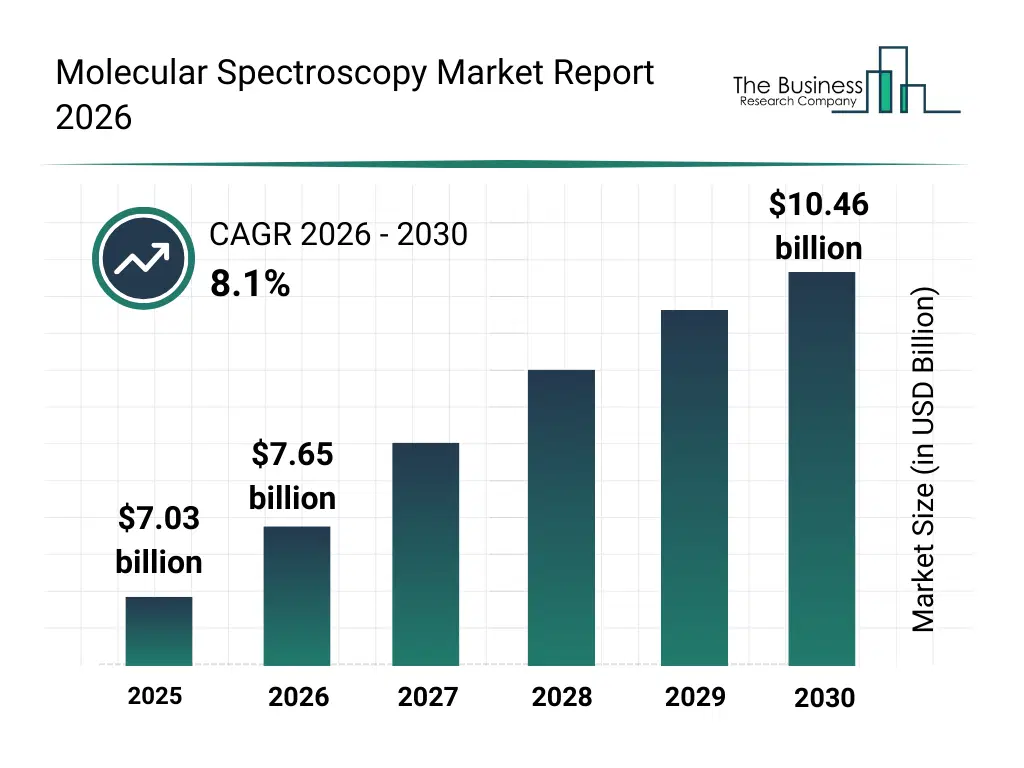
What Is The Molecular Spectroscopy Market Size and Share 2026?
The molecular spectroscopy market size has grown strongly in recent years. It will grow from $7.03 billion in 2025 to $7.65 billion in 2026 at a compound annual growth rate (CAGR) of 8.8%. The growth in the historic period can be attributed to increasing scientific research activities, rising pharmaceutical development programs, growing need for accurate material analysis, expansion of biotechnology research, rising demand for laboratory instrumentation.What Is The Molecular Spectroscopy Market Growth Forecast?
The molecular spectroscopy market size is expected to see strong growth in the next few years. It will grow to $10.46 billion in 2030 at a compound annual growth rate (CAGR) of 8.1%. The growth in the forecast period can be attributed to growing precision medicine advancements, rising investment in research institutions, increasing demand for advanced analytical equipment, expanding pharmaceutical innovation, growing environmental testing needs. Major trends in the forecast period include rising use in pharmaceutical and biotechnology research, increasing application in chemical and material analysis, growing adoption in environmental testing, expansion of advanced analytical laboratory solutions, strengthening demand for high precision molecular testing.
Global Molecular Spectroscopy Market Segmentation
1) By Product Type: Consumables, Instruments 2) By Technology: Nuclear Magnetic Resonance Spectroscopy, UV-Visible Spectroscopy, Infrared Spectroscopy, Near-Infrared Spectroscopy, Color Measurement Spectroscopy, Raman Spectroscopy, Other Technologies 3) By Application: Pharmaceutical Applications, Food And Beverage Testing, Biotechnology And Biopharmaceutical Applications, Environmental Testing, Academic Research, Other Applications Subsegments: 1) By Consumables: Reagents, Calibration Standards, Sample Vials, Light Sources 2) By Instruments: UV-Visible Spectrometers, Infrared (IR) Spectrometers, Raman Spectrometers, Near-Infrared (NIR) Spectrometers, Mass Spectrometers, Fluorescence SpectrometersWhat Is The Driver Of The Molecular Spectroscopy Market?
The rapid growth of the pharmaceutical industry is expected to propel the growth of the molecular spectroscopy market going forward. The pharmaceutical sector involves discovering, developing, producing, and marketing medications. The pharmaceutical industry has seen rapid growth due to technological advances, increased R&D investment, rising global healthcare demands, and the prevalence of chronic illnesses requiring innovative treatments. Molecular spectroscopy enables precise analysis of drug compounds, accelerates development, and ensures quality control. For instance, in January 2023, according to the IQVIA Institute for Human Data Science, a US-based data group, global medicine spending is projected to reach about USD 1.9 trillion by 2027, reflecting a sustained growth trajectory since 2022. Therefore, the rapid growth of the pharmaceutical industry will drive the development of the molecular spectroscopy industry.Key Players In The Global Molecular Spectroscopy Market
Major companies operating in the molecular spectroscopy market report are Thermo Fisher Scientific Inc., Danaher Corporation, ABB Ltd., Merck KGaA, Agilent Technologies Inc., Olympus Corporation, Keyence Corporation, Teledyne Technologies Incorporated, PerkinElmer Inc., Shimadzu Corporation, Coherent Inc., Endress+Hauser Group Services AG, Bio-Rad Laboratories Inc., Bruker Corporation, Horiba Ltd, Hamamatsu Photonics K.K., VIAVI Solutions Inc., Jeol Ltd, Renishaw plc., Metrohm India Limited, Thorlabs Inc., B&W Tek., JASCO International Co. Ltd., Digilab Inc., Keit Ltd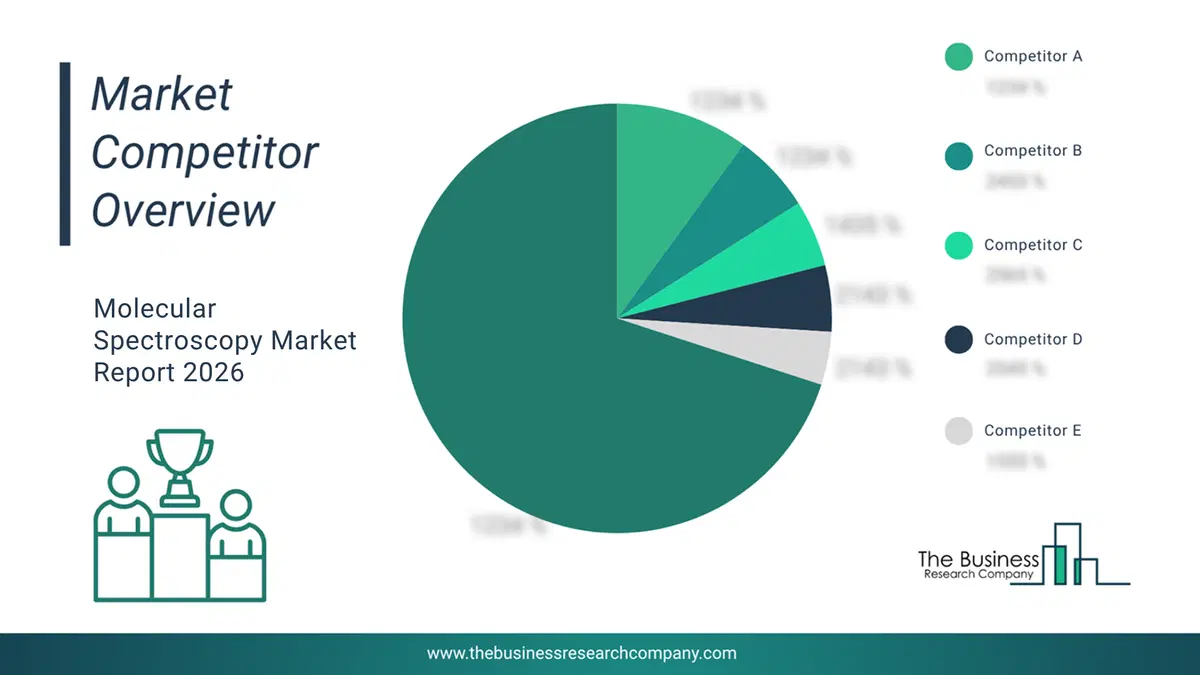
This chart is for illustrative purposes; the full report includes a detailed competitor analysis and comprehensive overview of the top 10 companies in the market.
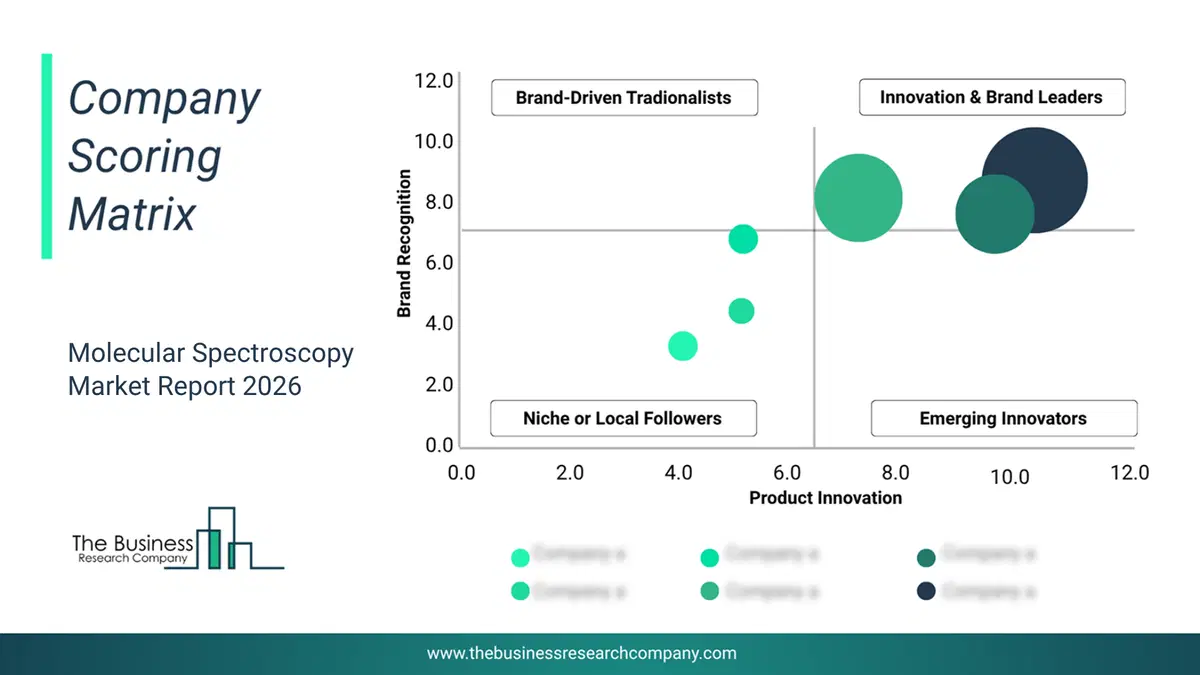
This chart maps companies by product innovation and brand strength, with bubble size indicating relative revenue, helping identify market leaders, challengers, and niche players. This is an illustrative chart; the full report provides a complete and accurate competitive analysis.
Global Molecular Spectroscopy Market Trends and Insights
Major companies operating in the molecular spectroscopy market are focusing on advancements such as developing Matrix Assisted Laser Desorption Ionization, to use its high sensitivity and specificity in detecting and quantifying M-proteins in serum samples. Matrix-Assisted Laser Desorption/Ionization (MALDI) is a mass spectrometry technique that ionizes large biomolecules, such as proteins and peptides, by mixing them with a matrix that absorbs laser energy. For instance, in August 2023, ThermoFisher Scientific's, a US-based scientific instrumentation company, launched EXENT solution. The EXENT Solution is designed to provide enhanced diagnostic accuracy and efficiency, supporting healthcare providers with more reliable tools for patient testing and diagnostics. With IVDR compliance, ThermoFisher aims to address the increasing demand for precision diagnostics while meeting rigorous regulatory standards, which is crucial for adoption in EU markets. This launch reinforces ThermoFisher's commitment to advancing diagnostic technologies and improving patient care globally.What Are Latest Mergers And Acquisitions In The Molecular Spectroscopy Market?
In April 2024, Specac Ltd., a UK-based manufacturer of spectroscopic accessories, acquired Harrick Scientific Inc. for an undisclosed amount. This acquisition will enable Specac to broaden its offerings, enhance customer service, and strengthen global distribution networks, accelerating growth and improving operational efficiency. Harrick Scientific Inc. is a US-based company that designs and manufactures molecular spectroscopy instruments.
Regional Outlook
North America was the largest region in the molecular spectroscopy market in 2025. Asia-Pacific is expected to be the fastest-growing region in the forecast period. The regions covered in this market report are Asia-Pacific, South East Asia, Western Europe, Eastern Europe, North America, South America, Middle East, Africa. The countries covered in this market report are Australia, Brazil, China, France, Germany, India, Indonesia, Japan, Taiwan, Russia, South Korea, UK, USA, Canada, Italy, SpainWhat Defines the Molecular Spectroscopy Market?
The molecular spectroscopy market consists of revenues earned by entities by providing services such as installation, calibration, and maintenance services, analytical services, and software as a service (SaaS). The market value includes the value of related goods sold by the service provider or included within the service offering. The molecular spectroscopy market also includes sales instruments such as X-ray diffraction (XRD) and X-ray fluorescence, conventional CD spectrometers, and hyperspectral imaging. Values in this market are ‘factory gate’ values, that is, the value of goods sold by the manufacturers or creators of the goods, whether to other entities (including downstream manufacturers, wholesalers, distributors, and retailers) or directly to end customers. The value of goods in this market includes related services sold by the creators of the goods.How is Market Value Defined and Measured?
The market value is defined as the revenues that enterprises gain from the sale of goods and/or services within the specified market and geography through sales, grants, or donations in terms of the currency (in USD unless otherwise specified). The revenues for a specified geography are consumption values that are revenues generated by organizations in the specified geography within the market, irrespective of where they are produced. It does not include revenues from resales along the supply chain, either further along the supply chain or as part of other products.
This chart presents market attractiveness based on a quantitative evaluation of growth, competition, strategic alignment, and risk, offering a clear view of opportunity areas for decision-making. This chart is for illustrative purposes; the full report contains the complete analysis.

This chart highlights the Total Addressable Market (TAM) by estimating the maximum revenue opportunity using an assumption-driven approach, supporting strategic planning and opportunity sizing across markets. The chart is illustrative; the full report provides a more comprehensive analysis.
What Key Data and Analysis Are Included in the Molecular Spectroscopy Market Report 2026?
The molecular spectroscopy market research report is one of a series of new reports from The Business Research Company that provides market statistics, including industry global market size, regional shares, competitors with the market share, detailed market segments, market trends and opportunities, and any further data you may need to thrive in the molecular spectroscopy industry. The market research report delivers a complete perspective of everything you need, with an in-depth analysis of the current and future state of the industry.Molecular Spectroscopy Market Report Forecast Analysis
| Report Attribute | Details |
|---|---|
| Market Size Value In 2026 | $7.65 billion |
| Revenue Forecast In 2030 | $10.46 billion |
| Growth Rate | CAGR of 8.8% from 2026 to 2030 |
| Base Year For Estimation | 2025 |
| Actual Estimates/Historical Data | 2020-2025 |
| Forecast Period | 2026 - 2030 - 2030 |
| Market Representation | Revenue in USD Billion and CAGR from 2026 to 2030 |
| Segments Covered | Product Type, Technology, Application |
| Regional Scope | Asia-Pacific, Western Europe, Eastern Europe, North America, South America, Middle East, Africa |
| Country Scope | The countries covered in the report are Australia, Brazil, China, France, Germany, India, Indonesia, Japan, Taiwan, Russia, South Korea, UK, USA, Canada, Italy, Spain. |
| Key Companies Profiled | Thermo Fisher Scientific Inc., Danaher Corporation, ABB Ltd., Merck KGaA, Agilent Technologies Inc., Olympus Corporation, Keyence Corporation, Teledyne Technologies Incorporated, PerkinElmer Inc., Shimadzu Corporation, Coherent Inc., Endress+Hauser Group Services AG, Bio-Rad Laboratories Inc., Bruker Corporation, Horiba Ltd, Hamamatsu Photonics K.K., VIAVI Solutions Inc., Jeol Ltd, Renishaw plc., Metrohm India Limited, Thorlabs Inc., B&W Tek., JASCO International Co. Ltd., Digilab Inc., Keit Ltd |
| Customization Scope | Request for Customization |
| Pricing And Purchase Options | Explore Purchase Options |