
Monolithic Refractories Market Report 2026
Global Outlook – By Product Type (Castables, Plastic Refractories, Ramming Mixes, Gunning Mixes, Coating Refractories, Other Product Types), By Material (Alumina, Magnesite, Silica, Chromite, Zirconia, Other Materials), By Form (Dry, Wet), By Application (Iron And Steel, Cement, Glass, Power Generation, Non-Ferrous Metals, Petrochemicals, Other Applications), By End-User Industry (Metallurgy, Energy, Chemical, Other End-User Industries) – Market Size, Trends, Strategies, and Forecast to 2035
Monolithic Refractories Market Overview
• Monolithic Refractories market size has reached to $5.65 billion in 2025 • Expected to grow to $7.5 billion in 2030 at a compound annual growth rate (CAGR) of 5.9% • Growth Driver: Surge In Steel Production Fueling The Market Growth Due To Rising Infrastructure Development And Construction Demand • Market Trend: Advancements In High-Performance Heat-Resistant Materials For Industrial Efficiency • Asia-Pacific was the largest region in 2025 and Asia Pacific is the fastest growing region.What Is Covered Under Monolithic Refractories Market?
Monolithic refractories are unshaped refractory materials that are supplied in a dry or wet form and installed as a continuous, jointless lining. They typically consist of refractory aggregates, binders, and additives that harden after placement through drying, chemical bonding, or heat. These materials are valued for their ease of installation, reduced joints, and ability to form seamless linings in high-temperature environments. The main product types of monolithic refractories include castables, plastic refractories, ramming mixes, gunning mixes, coating refractories, and other product types. Castables refer to unshaped refractory materials that are poured or cast into place and hardened to form heat-resistant linings in high-temperature industrial environments. These materials are based on types such as alumina, magnesite, silica, chromite, zirconia, and other materials and are available in dry and wet forms. They are used in applications such as iron and steel, cement, glass, power generation, non-ferrous metals, petrochemicals, and others, serving end users including metallurgy, energy, chemical, and others.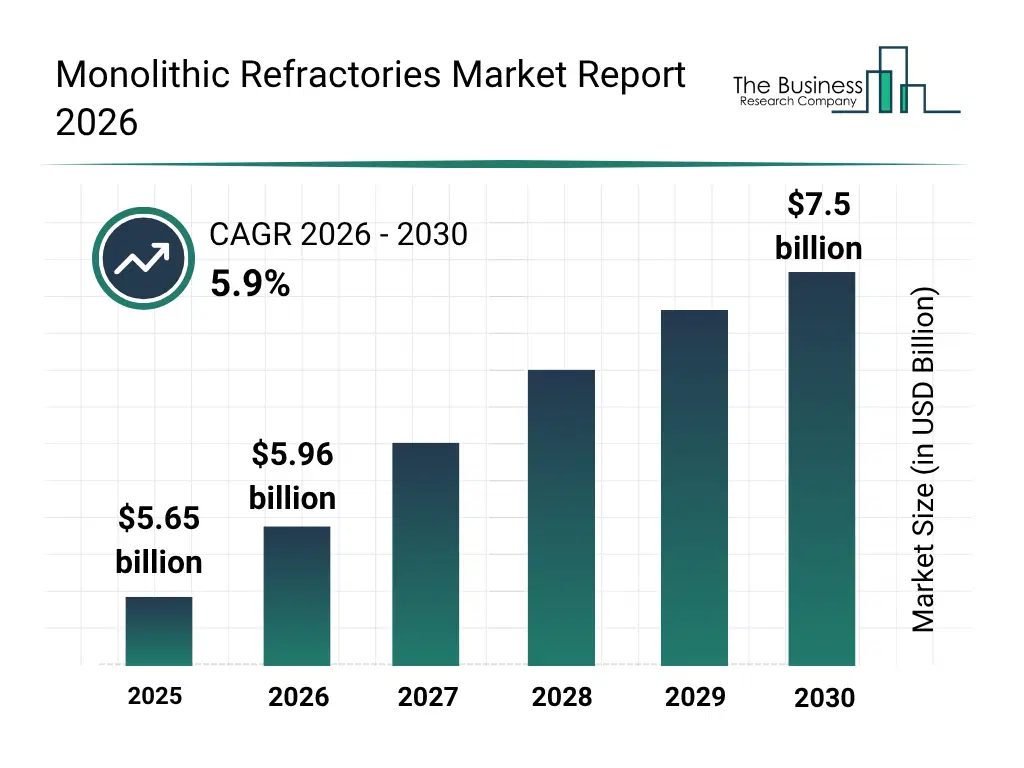
What Is The Monolithic Refractories Market Size and Share 2026?
The monolithic refractories market size has grown strongly in recent years.It will grow from $5.65 billion in 2025 to $5.96 billion in 2026 at a compound annual growth rate (CAGR) of 5.6%. The growth in the historic period can be attributed to expansion of steel and cement manufacturing capacity, increasing demand for high temperature industrial furnaces, rising adoption of basic refractory materials in metallurgy, growth in petrochemical processing infrastructure, early modernization of industrial kiln lining systems.What Is The Monolithic Refractories Market Growth Forecast?
The monolithic refractories market size is expected to see strong growth in the next few years.It will grow to $7.5 billion by 2030 at a compound annual growth rate (CAGR) of 5.9%. The growth in the forecast period can be attributed to increasing demand for energy efficient industrial heating systems, rising adoption of sustainable and longer lifecycle refractory solutions, growth in automated industrial maintenance and repair systems, expansion of non-ferrous metal processing industries, stricter environmental regulations driving advanced refractory usage.Major trends in the forecast period include advanced monolithic refractory formulations with enhanced thermal shock resistance, increasing adoption of low cement and ultra low cement castables for high efficiency furnace linings, rising use of gunning and shotcrete application techniques for rapid industrial maintenance, development of corrosion resistant refractory materials for extreme metallurgical environments, integration of automated refractory installation and monitoring systems in high temperature industries.
Global Monolithic Refractories Market Segmentation
1) By Product Type: Castables, Plastic Refractories, Ramming Mixes, Gunning Mixes, Coating Refractories, Other Product Types 2) By Material: Alumina, Magnesite, Silica, Chromite, Zirconia, Other Materials 3) By Form: Dry, Wet 4) By Application: Iron And Steel, Cement, Glass, Power Generation, Non-Ferrous Metals, Petrochemicals, Other Applications 5) By End-User Industry: Metallurgy, Energy, Chemical, Other End-User Industries Subsegments: 1) By Castables: Low Cement Castables (LCC), Ultra-Low Cement Castables (ULCC), No Cement Castables (NCC), Conventional Castables, Insulating Castables, Self-Flowing Castables, Shotcrete Castables 2) By Plastic Refractories: Phosphate-Bonded Plastics, Clay-Bonded Plastics, High Alumina Plastic Refractories, Insulating Plastic Refractories 3) By Ramming Mixes: Acidic Ramming Mixes, Basic Ramming Mixes, Neutral Ramming Mixes, Silica Ramming Mixes, Magnesite Ramming Mixes 4) By Gunning Mixes: Dry Gunning Mixes, Wet Gunning Mixes, Shotcrete Gunning Materials, High Alumina Gunning Mixes, Insulating Gunning Mixes 5) By Coating Refractories: Protective Coatings, Anti-Corrosion Coatings, Wear-Resistant Coatings, Insulating Coatings, Slag-Resistant Coatings 6) By Other Product Types: Mortars, Refractory Cements, Tundish Sprays, Tap Hole Clays, Refractory Patching CompoundsWhat Is The Driver Of The Monolithic Refractories Market?
The growing steel production is expected to propel the growth of the monolithic refractories industry going forward.Steel production refers to the industrial process of manufacturing steel from raw materials such as iron ore, scrap metal, and alloying elements through methods.Steel production is increasing due to rising demand driven by rapid infrastructure development and large-scale construction projects, as expanding urbanization and industrialization require significant quantities of steel for building structures, transportation networks, and energy infrastructure.Monolithic refractories support steel production by providing excellent high-temperature resistance, thermal stability, and durability in critical equipment such as furnaces and ladles, enabling efficient heat containment, reduced downtime, and continuous, cost-effective steel manufacturing operations.For instance, in April 2026, according to the American Iron and Steel Institute (AISI), a US-based organization, raw steel production for the week ending April 4, 2026, increased by 1.6% compared to the previous week ending March 28, 2026, when output stood at 1,803,000 net tons with a capability utilization rate of 77.9%.Therefore, the growing steel production is driving the growth of the monolithic refractories industry.Key Players In The Global Monolithic Refractories Market
Major companies operating in the monolithic refractories market are Compagnie de Saint-Gobain S. A., Imerys S. A., RHI Magnesita N. V., Vesuvius plc, Shinagawa Refractories Co. Ltd., Puyang Refractories Group Co. Ltd., Carborundum Universal Ltd., Refratechnik Holding GmbH, Henan Refractory Group, Höganäs Borgestad Group, Alsey Refractories Co., Mahakoshal Refractories Pvt. Ltd., Zhengzhou Rongsheng Refractory Co. Ltd., Zhengzhou Huaxu Refractory Co. Ltd., Gita Refractories Pvt. Ltd., Satabdi Monolithics Industries Pvt. Ltd., Shri Balaji Refractories, Qingdao Laurent New Materials Co. Ltd., Magnezit Group, Yingkou Jinlong Refractories Group Co. Ltd., Shandong Minye Refractory Fibre Co. Ltd.Global Monolithic Refractories Market Trends and Insights
Major companies operating in the monolithic refractories market are focusing on developing innovative products such as, high-alumina castable refractories to enhance thermal efficiency and extend equipment lifespan in high-temperature industrial applications. High-alumina castable refractories are unshaped refractory materials composed primarily of high-purity alumina and bonding agents that can be cast into place, helping improve thermal resistance, mechanical strength, and durability while reducing maintenance and downtime in high-temperature industrial operations. For instance, in November 2024, Vesuvius plc, a UK-based refractory solutions provider, launched new alumina-silica and monolithic manufacturing plants in Visakhapatnam, India, strengthening its production capabilities in advanced refractory materials. The newly introduced monolithic solutions are composed of high-purity alumina and silica blends designed to withstand extreme temperatures and harsh chemical environments, ensuring longer service life and reduced downtime. These materials offer enhanced flow characteristics for easier installation, improved thermal shock resistance, and optimized performance in continuous casting and furnace linings. Additionally, the solutions support sustainability by reducing energy consumption during application and operation, while catering to the growing infrastructure and steel production demands in the region.What Are Latest Mergers And Acquisitions In The Monolithic Refractories Market?
In April 2023, RHI Magnesita N. V., an Austria-based manufacturing company, acquired Dalmia Bharat Refractories Limited for an undisclosed amount. With this acquisition, RHI Magnesita N. V. aims to strengthen its presence in the Indian market and expand its local production capabilities while enhancing its customer base in the region, improving supply chain efficiency, and leveraging synergies to deliver a broader portfolio of refractory solutions tailored to the growing demands of core industries such as steel and cement. Dalmia Bharat Refractories Limited is an India-based manufacturing company that specializes in providing high-quality refractory products and solutions.Regional Insights
Asia-Pacific was the largest region in the monolithic refractories market in 2025. Asia Pacific is expected to be the fastest-growing region in the forecast period. The regions covered in this market report are Asia-Pacific, South East Asia, Western Europe, Eastern Europe, North America, South America, Middle East and Africa. The countries covered in this market report are Australia, Brazil, China, France, Germany, India, Indonesia, Japan, Taiwan, Russia, South Korea, UK, USA, Canada, Italy, Spain.What Defines the Monolithic Refractories Market?
The monolithic refractories market consists of sales of vibratables, flowables, unshaped refractories, precast shapes, and insulating refractories. Values in this market are ‘factory gate’ values, that is the value of goods sold by the manufacturers or creators of the goods, whether to other entities (including downstream manufacturers, wholesalers, distributors and retailers) or directly to end customers. The value of goods in this market includes related services sold by the creators of the goods.What is the Market Assessment and Strategic Outlook for the Monolithic Refractories Industry?
The monolithic refractories market research report is one of a series of new reports from The Business Research Company that provides market statistics, including industry global market size, regional shares, competitors with the market share, detailed market segments, market trends and opportunities, and any further data you may need to thrive in the monolithic refractories industry. The market research report delivers a complete perspective of everything you need, with an in-depth analysis of the current and future state of the industry.What is the Market Assessment and Strategic Outlook for the Monolithic Refractories Market Report 2026?
The monolithic refractories market research report is one of a series of new reports from The Business Research Company that provides monolithic refractories market statistics, including monolithic refractories industry global market size, regional shares, competitors with a monolithic refractories market share, detailed monolithic refractories market segments, market trends and opportunities, and any further data you may need to thrive in the monolithic refractories industry. This monolithic refractories market research report delivers a complete perspective of everything you need, with an in-depth analysis of the current and future scenario of the industry.Monolithic Refractories Market Report Forecast Analysis
| Report Attribute | Details |
|---|---|
| Market Size Value In 2026 | $5.96 billion |
| Revenue Forecast In 2035 | $7.5 billion |
| Growth Rate | CAGR of 5.9% from 2026 to 2035 |
| Base Year For Estimation | 2025 |
| Actual Estimates/Historical Data | 2020-2025 |
| Forecast Period | 2026 - 2030 - 2035 |
| Market Representation | Revenue in USD Billion and CAGR from 2026 to 2035 |
| Segments Covered | Product Type, Material, Form, Application, End-User Industry |
| Regional Scope | Asia-Pacific, Western Europe, Eastern Europe, North America, South America, Middle East, Africa |
| Country Scope | The countries covered in the report are Australia, Brazil, China, France, Germany, India, Indonesia, Japan, Taiwan, Russia, South Korea, UK, USA, Canada, Italy, Spain. |
| Key Companies Profiled | Compagnie de Saint-Gobain S. A., Imerys S. A., RHI Magnesita N. V., Vesuvius plc, Shinagawa Refractories Co. Ltd., Puyang Refractories Group Co. Ltd., Carborundum Universal Ltd., Refratechnik Holding GmbH, Henan Refractory Group, Höganäs Borgestad Group, Alsey Refractories Co., Mahakoshal Refractories Pvt. Ltd., Zhengzhou Rongsheng Refractory Co. Ltd., Zhengzhou Huaxu Refractory Co. Ltd., Gita Refractories Pvt. Ltd., Satabdi Monolithics Industries Pvt. Ltd., Shri Balaji Refractories, Qingdao Laurent New Materials Co. Ltd., Magnezit Group, Yingkou Jinlong Refractories Group Co. Ltd., Shandong Minye Refractory Fibre Co. Ltd. |
| Customization Scope | Request for Customization |
| Pricing And Purchase Options | Explore Purchase Options |