
Contact Us
  Search
The Business Research Company Logo
Monosodium Glutamate Market 2025
Published :May 2025
Pages :344
Format :PDF
Delivery Time :2-3 Business Days
Why 2-3 days? We update the report with the latest data and news before delivery. Let us know if you need us to expedite.
Report Price :$4,490.00

Monosodium Glutamate Market 2025

By Type (Monosodium Glutamate (Regular), Salted Monosodium Glutamate, Special Monosodium Glutamate), By Form (Powder, Granules), By Distribution Channel (Business-To-Business (B2B), Business-To-Consumer (B2C)), By Application (Preservatives, Additives, Acidity Regulators, Flavor Enhancers, Other Applications), By End-User Industry (Pharmaceutical Industry, Food Processing Industry, Cosmetics Industry, Livestock Industry, Other End-User Industries), And By Region, Opportunities And Strategies – Global Forecast To 2035
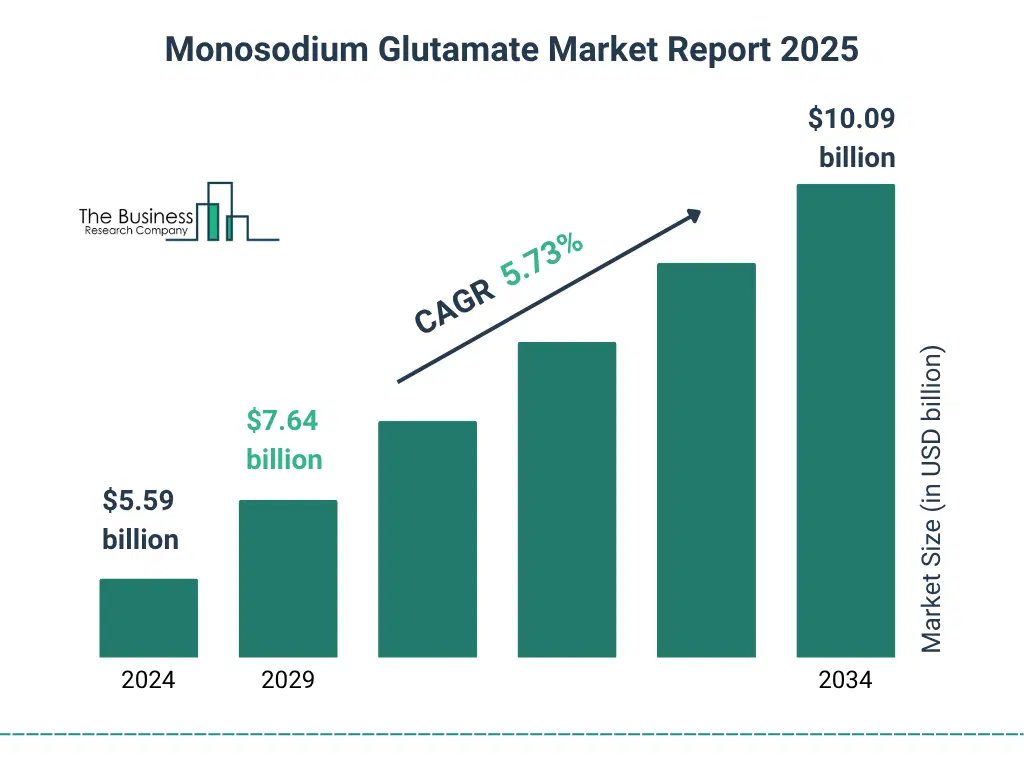
Monosodium Glutamate Market Size and growth rate 2025 to 2029: Graph

Monosodium Glutamate Market Definition

Monosodium Glutamate (MSG) is a food additive used to enhance the umami flavor in various dishes. It is the sodium salt of glutamic acid, an amino acid naturally present in many protein-rich foods. The primary purpose of MSG is to intensify taste without adding extra salt, making them more flavorful and appealing. It is widely used in soups, canned foods, instant noodles, snacks, processed meats, and fast food. The monosodium glutamate market consists of sales of monosodium glutamate and related services by entities (organizations, sole traders and partnerships) that are utilized during the manufacturing process of processed foods and is also employed in household cooking to elevate flavor profiles. Consumers who enjoy savory foods, particularly in Asian cuisines, frequently consume products containing MSG.
Research Expert

Book your 30 minutes free consultation with our research experts

Monosodium Glutamate Market Size

The global monosodium glutamate market reached a value of nearly $5,588.76 million in 2024, having grown at a compound annual growth rate (CAGR) of 3.91% since 2019. The market is expected to grow from $5,588.76 million in 2024 to $7,638.05 million in 2029 at a rate of 6.45%. The market is then expected to grow at a CAGR of 5.73% from 2029 and reach $10,093.37 million in 2034. Growth in the historic period resulted from the rising changes in lifestyle and food habits, increasing demand for plant-based proteins, expanding food service industry and increasing demand for processed foods. Factors that negatively affected growth in the historic period was sustainability issues. Going forward, the rising meat consumption, rising fast-food consumption, rising popularity of umami flavors and favorable government initiatives will drive the growth. Factor that could hinder the growth of the monosodium glutamate market in the future include stricter food labeling regulations and import tariffs and antidumping duties.

Monosodium Glutamate Market Drivers

The key drivers of the monosodium glutamate market include: Rising Meat Consumption During the forecast period, the rising meat consumption is expected to propel the growth of the monosodium glutamate market. MSG (monosodium glutamate) is widely utilized in processed and packaged meat products to enhance their umami flavor, making them more appealing to consumers. With the rising demand for processed meats, including sausages, canned meats and frozen ready-to-eat products, the market for MSG is expected to expand. This growth is largely fueled by the fast food and restaurant industry, which relies on monosodium glutamate to elevate the taste of meat-based offerings. For instance, in November 2021, according to Chilecarne, a Chile-based association that represents meat exporting companies, by 2030, the world's meat supply would increase to 374 million tons. Therefore, the rising meat consumption will drive the growth of the monosodium glutamate market.

Monosodium Glutamate Market Restraints

The key restraints on the monosodium glutamate market include: Stricter Food Labeling Regulations During the forecasted period, the stricter food labeling regulations is expected to restrict the growth of the monosodium glutamate market. Stricter food labeling regulations increase transparency and consumer scrutiny. Mandatory disclosure has led to a rise in "MSG-free" products, forcing manufacturers to adopt natural alternatives. Mandatory disclosure has made it harder for manufacturers to use monosodium glutamate (MSG) discreetly, leading to a rise in "MSG-free" product trends. This has pressured companies to reformulate with natural alternatives, reducing MSG’s demand. For example, in April 2023, the United States Congress introduced the Food Labeling Modernization Act (FLMA). This proposed legislation aims to update and strengthen food labeling requirements, including provisions that could impact the disclosure of additives such as monosodium glutamate (MSG). Specifically, the FLMA seeks to amend standards of identity to allow for salt substitution across all packaged foods, which may influence the use and labeling of flavor enhancers like MSG. Therefore, the stricter food labeling regulations will restarin the growth of the monosodium glutamate market.

Need data on a specific region in this market?

Opportunities And Recommendations In The Monosodium Glutamate Market

Opportunities – The top opportunities in the monosodium glutamate market segmented by type will arise in the monosodium glutamate (regular) segment, which will gain $3,889.23 million of global annual sales by 2029. The top opportunities in the monosodium glutamate market segmented by form will arise in the powder segment, which will gain $5,136.63 million of global annual sales by 2029. The top opportunities in the monosodium glutamate market segmented by distribution channel will arise in the business-to-business (B2B) segment, which will gain $5,282.40 million of global annual sales by 2029. The top opportunities in the monosodium glutamate market segmented by application will arise in the flavor enhancers segment, which will gain $1,557.28 million of global annual sales by 2029. The top opportunities in the monosodium glutamate market segmented by end-user industry will arise in the food processing industry segment, which will gain $4,122.64 million of global annual sales by 2029. The monosodium glutamate market size will gain the most in the USA at $575.00 million. Recommendations- To take advantage of the opportunities, The Business Research Company recommends the focus on repositioning msg through consumer-facing seasoning innovations, focus on scaling production through vertically integrated facilities, focus on expanding industrial applications through safe and efficient innovation, focus on expanding in the salted monosodium glutamate segment, expand in emerging markets, continue to focus on developed markets, focus on expanding regional partnerships and direct-to-retail channels, focus on dynamic pricing strategies to address regional cost sensitivities, focus on leveraging health-based communication and targeted regional campaigns, focus on expanding digital presence and industry collaboration, focus on targeting pharmaceutical industry stakeholders for application expansion.
Chat with us