
Moon-Based Solar Power Array Market Report 2026
Global Outlook – By Component (Solar Panels, Power Transmission Systems, Energy Storage, Control Systems), By Technology (Photovoltaic, Concentrated Solar Power, Hybrid Systems), By Deployment Type (Permanent, Temporary), By Application (Energy Generation, Space Missions, Lunar Habitats, Satellite Power, Other Applications), By End-User (Government And Space Agencies, Commercial Enterprises, Research Institutes, Other End-Users) – Market Size, Trends, Strategies, and Forecast to 2030
Moon-Based Solar Power Array Market Overview
• Moon-Based Solar Power Array market size has reached to $1.27 billion in 2025 • Expected to grow to $3.3 billion in 2030 at a compound annual growth rate (CAGR) of 21% • Growth Driver: Increasing Investments In Space Technology Drive The Moon-Based Solar Power Array Market Through Innovation And Infrastructure • Market Trend: Technological Advancements In Vertical Solar Array Systems Drive Lunar Energy Innovation • North America was the largest region in 2025 and Asia-Pacific is the fastest growing region.What Is Covered Under Moon-Based Solar Power Array Market?
A moon-based solar power array is a large-scale space infrastructure system constructed on the lunar surface that employs expansive networks of photovoltaic panels or other advanced solar energy collection technologies to capture and convert continuous sunlight into electrical power, which is then transmitted to Earth or space-based facilities through high-efficiency wireless energy transfer methods. Such arrays are envisioned as strategic solutions for providing uninterrupted, sustainable, and large-capacity energy to support terrestrial or extraterrestrial operations, reduce dependence on finite resources, and enhance global energy security. The main components of the moon-based solar power array include solar panels, power transmission systems, energy storage, and control systems. Solar panels refer to the photovoltaic modules installed on lunar surfaces to capture solar energy efficiently and convert it into usable electrical power for various applications, including energy generation and support for lunar missions. There are technologies such as photovoltaic, concentrated solar power, and hybrid systems. The deployment types include permanent and temporary installations. The applications cover energy generation, space missions, lunar habitats, satellite power, and other specialized uses, and they are used by several end-users such as government and space agencies, commercial enterprises, research institutes, and others.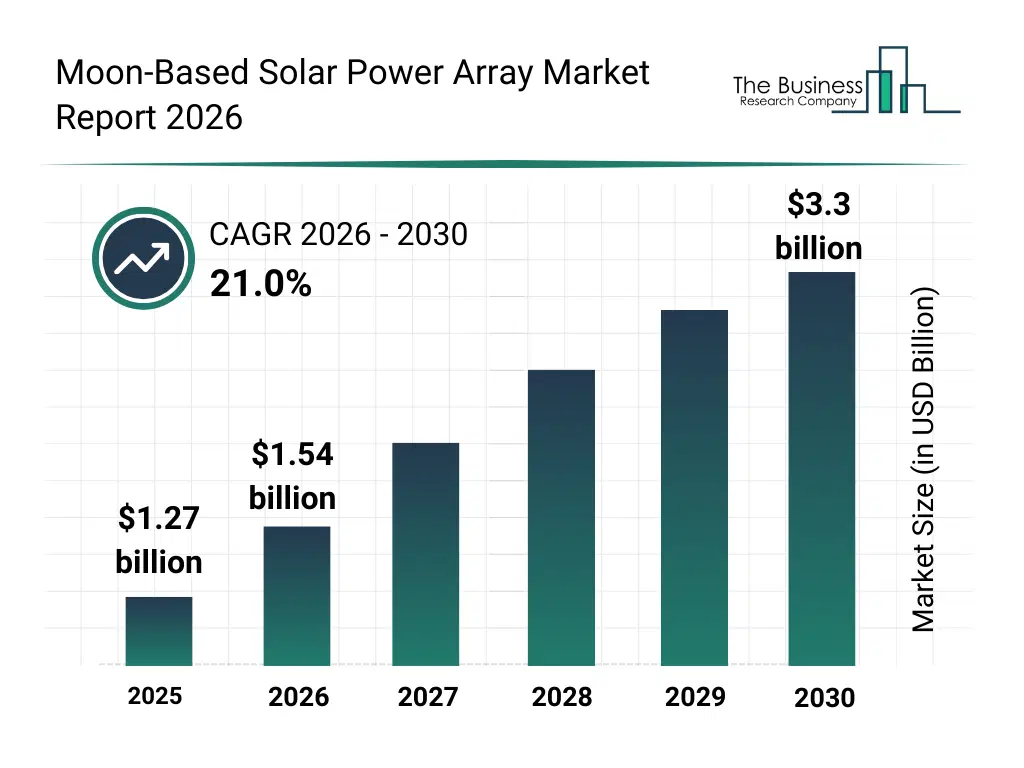
What Is The Moon-Based Solar Power Array Market Size and Share 2026?
The moon-based solar power array market size has grown exponentially in recent years. It will grow from $1.27 billion in 2025 to $1.54 billion in 2026 at a compound annual growth rate (CAGR) of 21.3%. The growth in the historic period can be attributed to initial conceptual studies and feasibility research for lunar energy systems, advancements in photovoltaic panel efficiency, growth in space infrastructure investment, increasing interest in renewable energy alternatives, demonstration of long-duration solar exposure experiments in lunar analog environments.What Is The Moon-Based Solar Power Array Market Growth Forecast?
The moon-based solar power array market size is expected to see exponential growth in the next few years. It will grow to $3.3 billion in 2030 at a compound annual growth rate (CAGR) of 21.0%. The growth in the forecast period can be attributed to development of high-efficiency wireless energy transfer technologies, expansion in modular and scalable lunar solar array designs, integration with orbital energy storage and transmission systems, international collaborations for lunar infrastructure projects, adoption of autonomous construction and maintenance robotics for lunar deployment. Major trends in the forecast period include advanced wireless power transmission technologies, lunar surface infrastructure development, integration of energy storage systems in space applications, autonomous monitoring and fault detection in space-based arrays, modular and scalable solar panel architectures for extraterrestrial use,.
Global Moon-Based Solar Power Array Market Segmentation
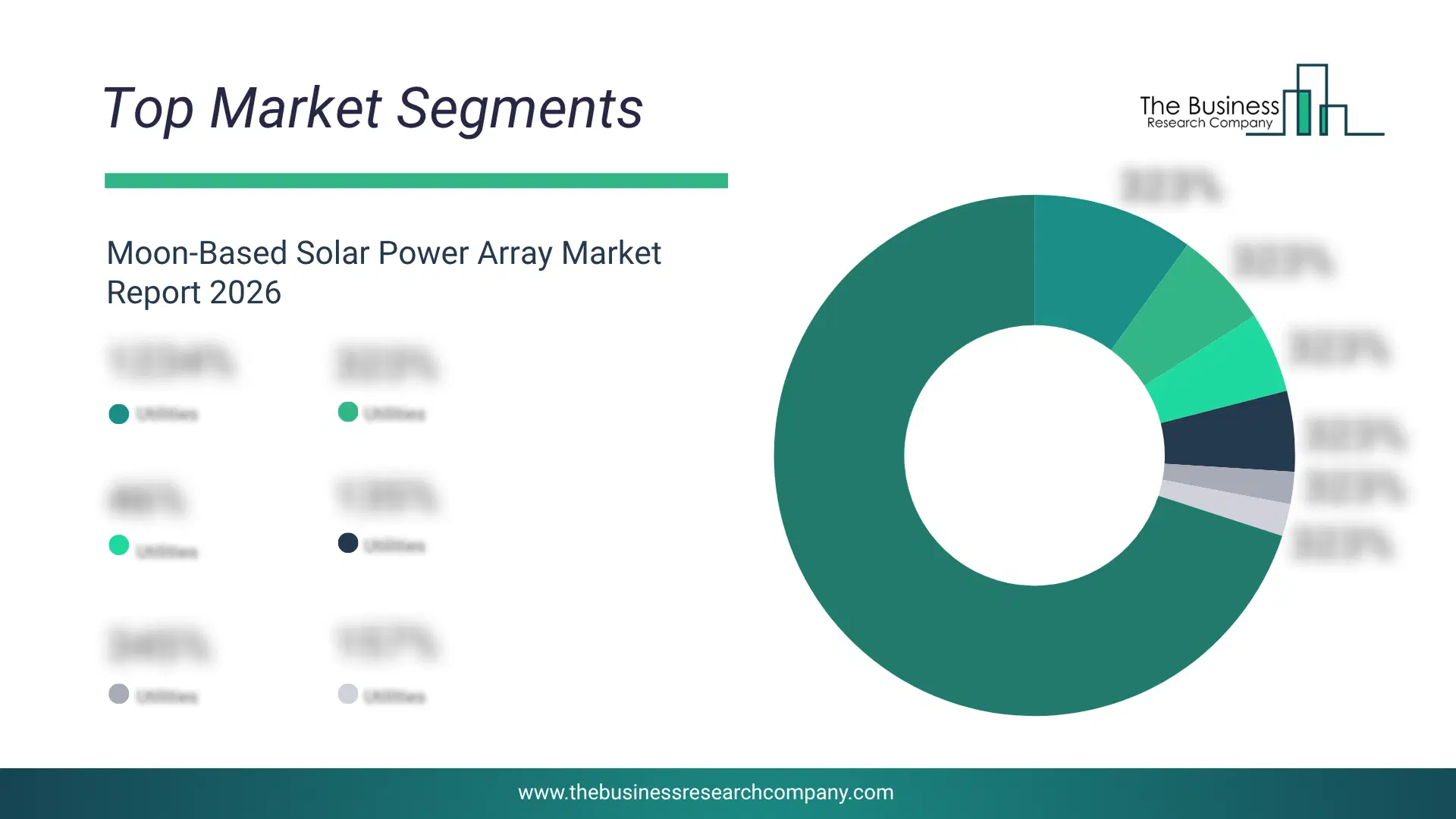
1) By Component: Solar Panels, Power Transmission Systems, Energy Storage, Control Systems 2) By Technology: Photovoltaic, Concentrated Solar Power, Hybrid Systems 3) By Deployment Type: Permanent, Temporary 4) By Application: Energy Generation, Space Missions, Lunar Habitats, Satellite Power, Other Applications 5) By End-User: Government And Space Agencies, Commercial Enterprises, Research Institutes, Other End-Users Subsegments: 1) By Solar Panels: Monocrystalline Solar Panels, Polycrystalline Solar Panels, Thin Film Solar Panels 2) By Power Transmission Systems: Wireless Power Transmission, Laser Power Transmission, Microwave Power Transmission 3) By Energy Storage: Thermal Energy Storage, Chemical Energy Storage, Mechanical Energy Storage 4) By Control Systems: Autonomous Control Systems, Remote Monitoring Systems, Fault Detection SystemsWhat Is Driver Of The Moon-Based Solar Power Array Market?
The increasing investments in space technology are expected to propel the growth of the moon-based solar power array market going forward. Investments in space technology refer to the allocation of financial resources by governments, agencies, or private entities to develop, enhance, and deploy innovations that support space exploration, infrastructure, and commercialization. Investments in space technology are rising due to the growing demand for satellite-based services. These services provide critical benefits in communication, navigation, and Earth observation, driving consistent funding and innovation. Investments in space technology accelerate the adoption of moon-based solar power arrays by advancing infrastructure, materials, and energy systems essential for scalable and sustainable extraterrestrial applications. For instance, in August 2025, according to the UK Space Agency, a UK-based government department, UK space organizations recorded approximately £1 billion (about US$1.25 billion) in research and development spending in 2022/23 and secured £481 million (about US$601 million) through 92 investment deals, with grants and prizes contributing 44% of total funding and 55% of all transactions, while venture capital accounted for 43% of investment value and 16% of deal volume in 2024. Therefore, the increasing investments in space technology are driving the moon-based solar power array industry.Key Players In The Global Moon-Based Solar Power Array Market
Major companies operating in the moon-based solar power array market are The Boeing Company, Airbus SE, Lockheed Martin Corporation, Northrop Grumman, Mitsubishi Electric, National Aeronautics and Space Administration (NASA), Thales Group, L3Harris Technologies, Shimizu Corporation, Blue Origin, Sierra Space, Rocket Lab, Redwire, Azur Space Solar Power GmbH, Astrobotic Technology, Solestial, Outward Technologies (Blueshift LLC), Solar Group Holdings Ltd., Solaren Corporation, Solar Moon Analytics.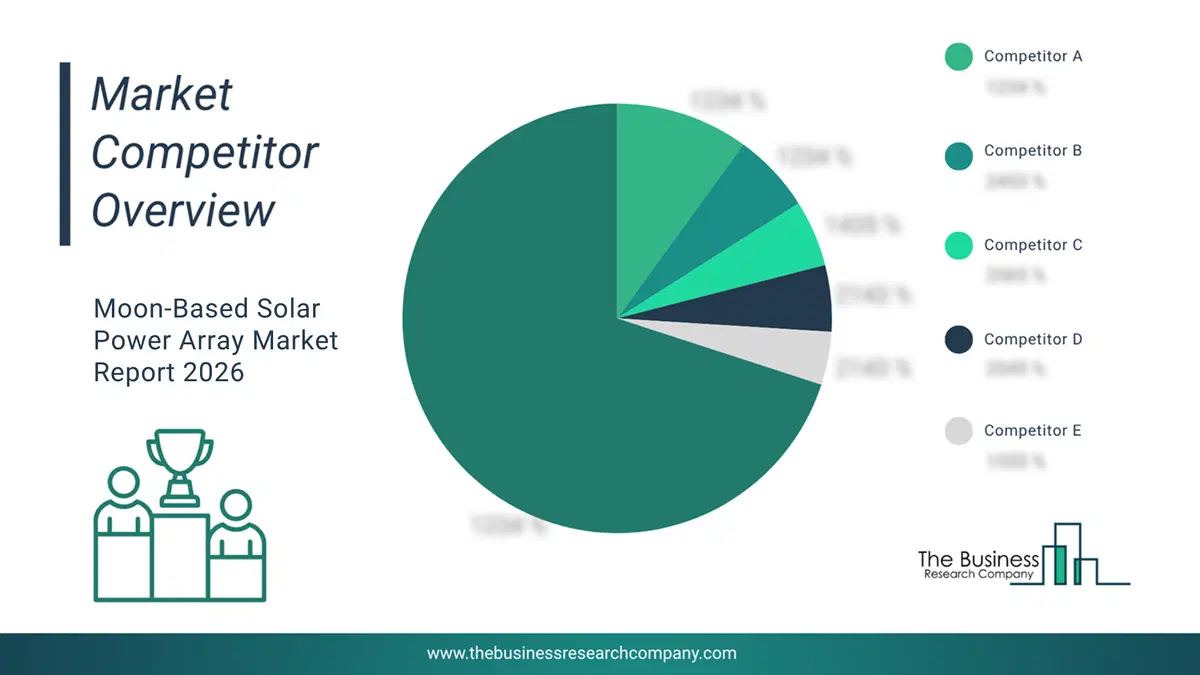
This chart is for illustrative purposes; the full report includes a detailed competitor analysis and comprehensive overview of the top 10 companies in the market.
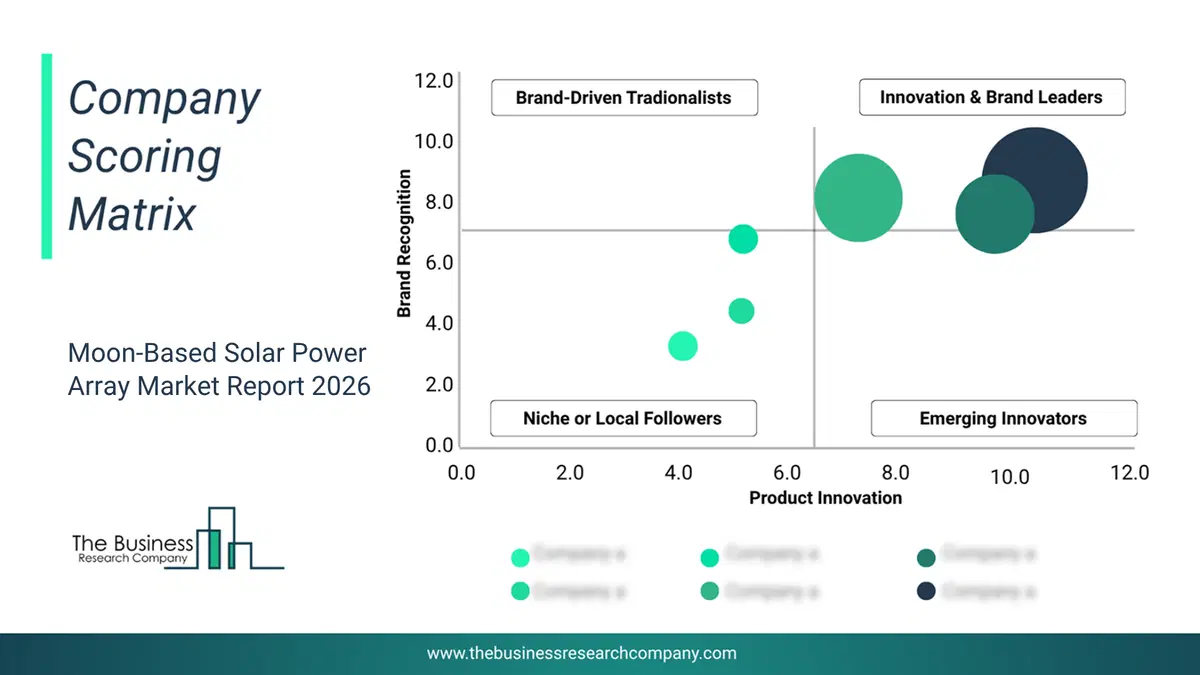
This chart maps companies by product innovation and brand strength, with bubble size indicating relative revenue, helping identify market leaders, challengers, and niche players. This is an illustrative chart; the full report provides a complete and accurate competitive analysis.
Global Moon-Based Solar Power Array Market Trends and Insights
Major companies operating in the moon-based solar power array market are focusing on developing innovative advancements such as lunar vertical solar arrays to support continuous power generation in shadowed and extreme lunar environments. A lunar vertical solar array is a deployable photovoltaic system engineered to collect sunlight above obstructive lunar terrain and maintain operational performance under severe temperature variations. For instance, in November 2024, Lockheed Martin, a US-based aerospace and defense technology company, announced its Lunar Vertical Solar Array Technology (LVSAT) prototype. The prototype completed key deployment, regolith interaction, and extreme cold-soak tests, demonstrating its suitability for operating near the lunar south pole. It represents a critical step toward establishing durable lunar energy infrastructure that will underpin long-duration habitation, mobility, communications, and scientific activities.What Are Latest Mergers And Acquisitions In The Moon-Based Solar Power Array Market? Joint Study Advances Integrated Solar And Fuel-Cell Power For Sustained Lunar Operations
In September 2025, Astrobotic Technology, a US-based lunar infrastructure and power systems company, entered a strategic partnership with American Honda Motor Co., the United States subsidiary of Japan-based Honda, to integrate Astrobotic’s Vertical Solar Array Technology (VSAT) with Honda’s regenerative fuel cell system as part of a feasibility study to develop continuous, long-duration lunar power solutions. With this collaboration, both companies aim to advance scalable lunar energy infrastructure by combining solar generation with closed-loop energy storage to support sustained astronaut missions on the Moon. American Honda Motor Co. is a US-based provider of mobility, energy, and advanced technology solutions across automotive, robotics, and power systems.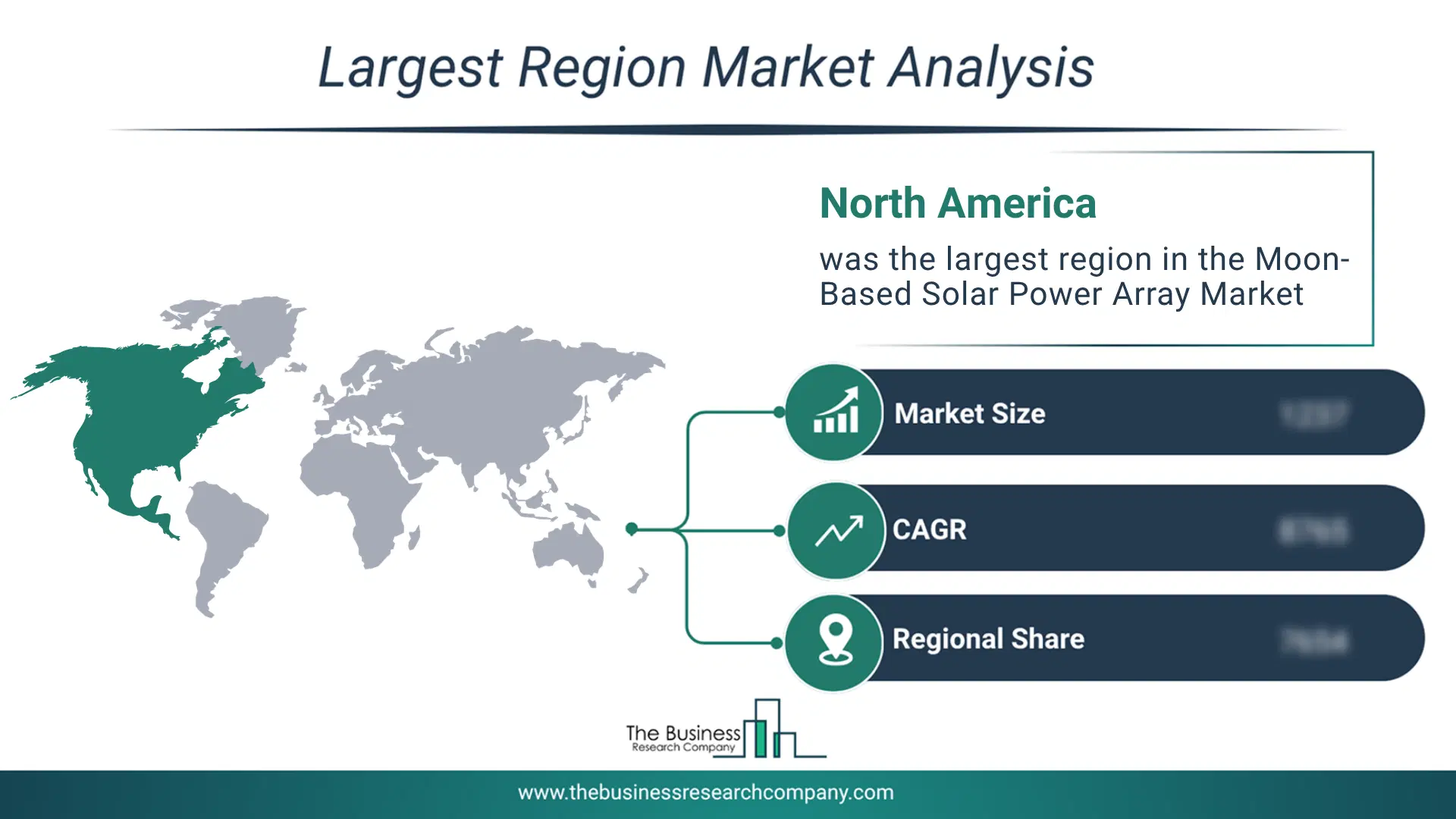
Regional Insights
North America was the largest region in the moon-based solar power array market in 2025. Asia-Pacific is expected to be the fastest-growing region in the forecast period. The regions covered in this market report are Asia-Pacific, South East Asia, Western Europe, Eastern Europe, North America, South America, Middle East, Africa. The countries covered in this market report are Australia, Brazil, China, France, Germany, India, Indonesia, Japan, Taiwan, Russia, South Korea, UK, USA, Canada, Italy, SpainWhat Defines the Moon-Based Solar Power Array Market?
The moon-based solar power array market consists of sales of structural support frameworks, solar tracking mechanisms, and advanced monitoring and diagnostic systems. Values in this market are ‘factory gate’ values, that is the value of goods sold by the manufacturers or creators of the goods, whether to other entities (including downstream manufacturers, wholesalers, distributors and retailers) or directly to end customers. The value of goods in this market includes related services sold by the creators of the goods.How is Market Value Defined and Measured?
The market value is defined as the revenues that enterprises gain from the sale of goods and/or services within the specified market and geography through sales, grants, or donations in terms of the currency (in USD unless otherwise specified). The revenues for a specified geography are consumption values that are revenues generated by organizations in the specified geography within the market, irrespective of where they are produced. It does not include revenues from resales along the supply chain, either further along the supply chain or as part of other products.
This chart presents market attractiveness based on a quantitative evaluation of growth, competition, strategic alignment, and risk, offering a clear view of opportunity areas for decision-making. This chart is for illustrative purposes; the full report contains the complete analysis.

This chart highlights the Total Addressable Market (TAM) by estimating the maximum revenue opportunity using an assumption-driven approach, supporting strategic planning and opportunity sizing across markets. The chart is illustrative; the full report provides a more comprehensive analysis.
What Key Data and Analysis Are Included in the Moon-Based Solar Power Array Market Report 2026?
The moon-based solar power array market research report is one of a series of new reports from The Business Research Company that provides market statistics, including industry global market size, regional shares, competitors with the market share, detailed market segments, market trends and opportunities, and any further data you may need to thrive in the moon-based solar power array industry. The market research report delivers a complete perspective of everything you need, with an in-depth analysis of the current and future state of the industry.Moon-Based Solar Power Array Market Report Forecast Analysis
| Report Attribute | Details |
|---|---|
| Market Size Value In 2026 | $1.54 billion |
| Revenue Forecast In 2030 | $3.3 billion |
| Growth Rate | CAGR of 21% from 2026 to 2030 |
| Base Year For Estimation | 2025 |
| Actual Estimates/Historical Data | 2020-2025 |
| Forecast Period | 2026 - 2030 |
| Market Representation | Revenue in USD Billion and CAGR from 2026 to 2030 |
| Segments Covered | Component, Technology, Deployment Type, Application, End-User |
| Regional Scope | Asia-Pacific, Western Europe, Eastern Europe, North America, South America, Middle East, Africa |
| Country Scope | The countries covered in the moon-based solar power array market report are Australia, Brazil, China, France, Germany, India, Indonesia, Japan, Taiwan, Russia, South Korea, UK, USA, Canada, Italy, Spain |
| Key Companies Profiled | The Boeing Company, Airbus SE, Lockheed Martin Corporation, Northrop Grumman, Mitsubishi Electric, National Aeronautics and Space Administration (NASA), Thales Group, L3Harris Technologies, Shimizu Corporation, Blue Origin, Sierra Space, Rocket Lab, Redwire, Azur Space Solar Power GmbH, Astrobotic Technology, Solestial, Outward Technologies (Blueshift LLC), Solar Group Holdings Ltd., Solaren Corporation, Solar Moon Analytics. |
| Customization Scope | Request for Customization |
| Pricing And Purchase Options | Explore Purchase Options |