
Motor Vehicle Body Market Report 2026
Global Outlook – By Type Of Vehicle (Passenger Vehicle, Light Commercial Vehicle, Heavy Trucks, Buses And Coaches), By End Use (OEM, Aftermarket), By Application (Personal Use, Commercial Use, Industrial Use) – Market Size, Trends, Strategies, and Forecast to 2030
Motor Vehicle Body Market Overview
• Motor Vehicle Body market size has reached to $231.25 billion in 2025 • Expected to grow to $365.02 billion in 2030 at a compound annual growth rate (CAGR) of 9.7% • Growth Driver: Rising Motor Vehicle Production Boosts Demand For Motor Vehicle Body Market • Market Trend: Advancing Lightweight Composite Innovations for Enhanced Vehicle Efficiency • Asia-Pacific was the largest region in 2025 and Western Europe is the fastest growing region.What Is Covered Under Motor Vehicle Body Market?
A motor vehicle body refers to the outer shell of a vehicle that houses passengers and goods while offering protection. It shapes the vehicle's appearance and includes elements such as the roof, doors, and windows. Typically made from materials such as steel or aluminum, it is designed to be both strong and lightweight. The main types of vehicles in the motor vehicle body are passenger vehicles, light commercial vehicles, heavy trucks, buses, and coaches. Passenger vehicles are designed and constructed for the carriage of people and their luggage. These are used in the OEM and aftermarket.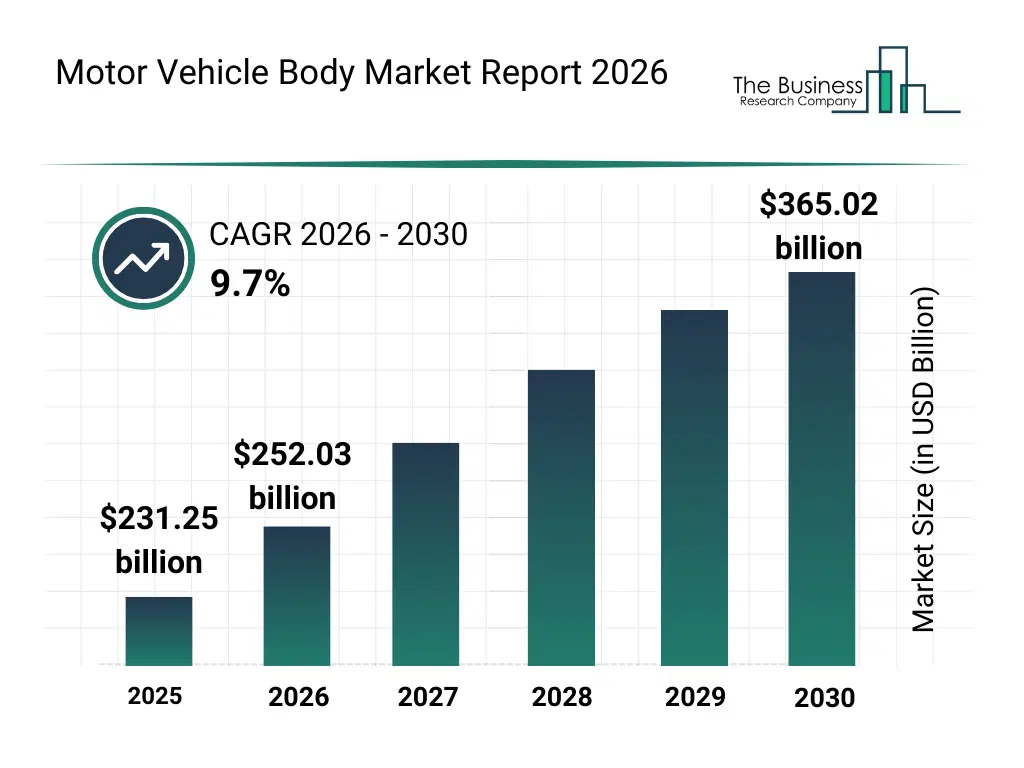
What Is The Motor Vehicle Body Market Size and Share 2026?
The motor vehicle body market size has grown strongly in recent years. It will grow from $231.25 billion in 2025 to $252.03 billion in 2026 at a compound annual growth rate (CAGR) of 9.0%. The growth in the historic period can be attributed to growth of automotive production, demand for fuel efficiency, safety regulation enforcement, steel and aluminum adoption, vehicle design evolution.What Is The Motor Vehicle Body Market Growth Forecast?
The motor vehicle body market size is expected to see strong growth in the next few years. It will grow to $365.02 billion in 2030 at a compound annual growth rate (CAGR) of 9.7%. The growth in the forecast period can be attributed to electric vehicle platform expansion, lightweighting regulations, use of advanced composites, automated body manufacturing, design customization demand. Major trends in the forecast period include increasing use of lightweight body materials, rising adoption of modular body designs, growing focus on aerodynamic efficiency, expansion of ev specific vehicle bodies, improvement in crash safety structures.
Global Motor Vehicle Body Market Segmentation
1) By Type Of Vehicle: Passenger Vehicle, Light Commercial Vehicle, Heavy Trucks, Buses And Coaches 2) By End Use: OEM, Aftermarket 3) By Application: Personal Use, Commercial Use, Industrial Use Subsegments: 1) By Passenger Vehicle: Sedan Bodies, Hatchback Bodies, SUV And Crossover Bodies, Coupe And Convertible Bodies 2) By Light Commercial Vehicle: Van Bodies, Pickup Truck Bodies, Small Delivery Vehicle Bodies 3) By Heavy Trucks: Truck Cab Bodies, Chassis And Frame Bodies, Freight And Cargo Bodies 4) By Buses And Coaches: City Bus Bodies, Intercity Coach Bodies, School Bus Bodies, Double-Decker Bus BodiesWhat Is The Driver Of The Motor Vehicle Body Market?
Increasing production of passenger cars, light commercial vehicles, buses, and heavy trucks is expected to propel the growth of the motor vehicle body market going forward. Passenger cars, light commercial vehicles, buses, and heavy trucks refer to the full range of motor vehicles designed for personal transport (passenger cars), light goods transport (light commercial vehicles), mass transit or group transport (buses), and heavy-duty transport of goods or passengers (heavy trucks). This vehicle production is rising due to increasing global demand for mobility and freight transport as economies expand and consumer vehicle uptake grows. The motor vehicle body industry is witnessing increased demand as the rapid expansion of this full-range vehicle output pushes manufacturers to adopt enhanced body-construction, customization, and safety-compliance solutions. For instance, in April 2024, according to the Serbian Association of Vehicle and Parts Importers, a Serbia-based professional automotive organization, 93,546,599 vehicles (including 67,133,570 passenger vehicles) were produced worldwide in 2023, up from 84,830,376 vehicles in 2022, highlighting a significant increase in global automotive output. Therefore, increasing production of passenger cars, light commercial vehicles, buses, and heavy trucks is driving the demand for the motor vehicle body industry.Key Players In The Global Motor Vehicle Body Market
Major companies operating in the motor vehicle body market report include Magna International Inc., Lear Corporation, General Motors Co., Aisin Seiki Co. Ltd, Faurecia SA, Plastic Omnium SA, Grupo Antolín Irausa SA., Mitsubishi Motors Corporation, Autoliv Inc, Paccar Inc, Tata Motors Passenger Vehicles Limited, Ashok Leyland Limited, Eicher Motors Limited, Jbm Auto Limited, Volvo Group India Private Limited, Amw Motors Limited, Chongqing Zhidao Machinery Co, Ltd, Shandong Taixing Casting Co., Ltd, Suizhou Fuhua Automobile Trailer Co., Ltd, Potou Jiaohe Hongxing Machinery Factory, Aptiv Plc, Sensata Technologies Holding Plc, Tesla Motors Limited, Alliance Automotive Procurement Limited, Marelli Automotive Systems UK, Ibc Vehicles Limited, Avtotor, Moskvich, Benteler Automotive Poland Sp. O, Umicore Autocat Poland Sp. z o.o, Ford, Chrysler, Toyota, Nissan, Mazda, Honda, Linamar Corporation, Flex-N-Gate Corporation, Martinrea International Inc, Key Safety Systems (KSS), BMW Brazil, DHB Sistemas, Chevrolet, Volkswagen, Iveco, Arabian Automobiles Co. LLC, Geely, Manufacturing Commercial Vehicles Co. S.A. E, Cania AB, Mercedes-Benz (Egypt), Innoson Vehicle Manufacturing (IVM)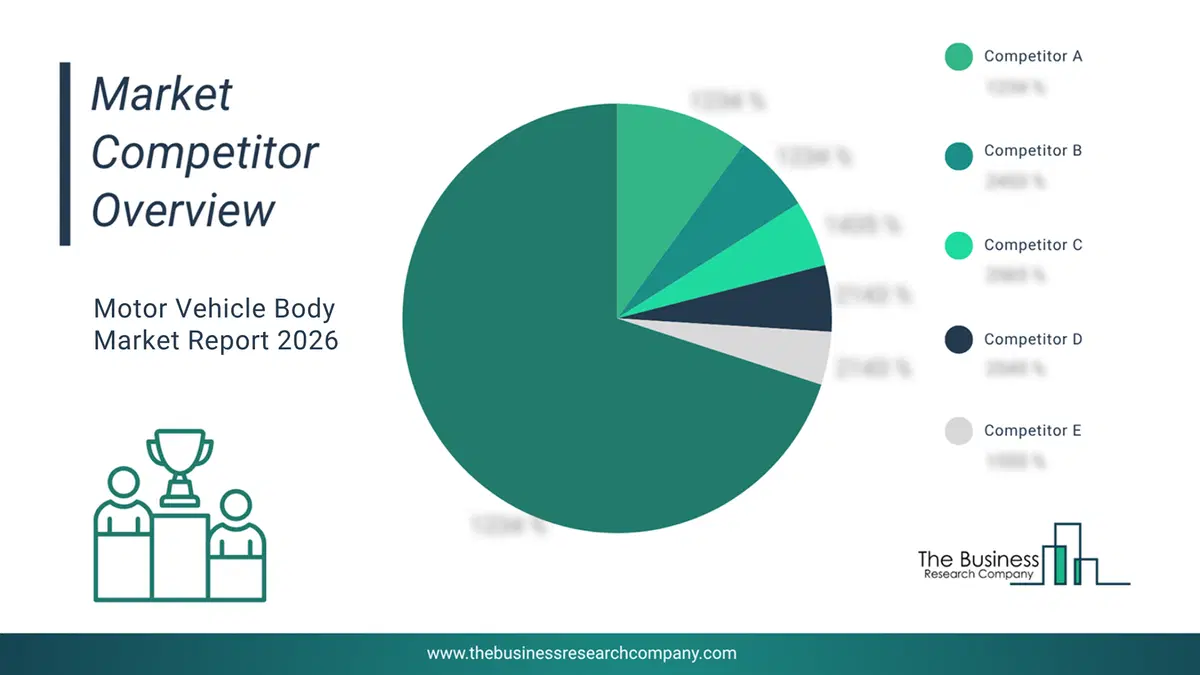
This chart is for illustrative purposes; the full report includes a detailed competitor analysis and comprehensive overview of the top 10 companies in the market.
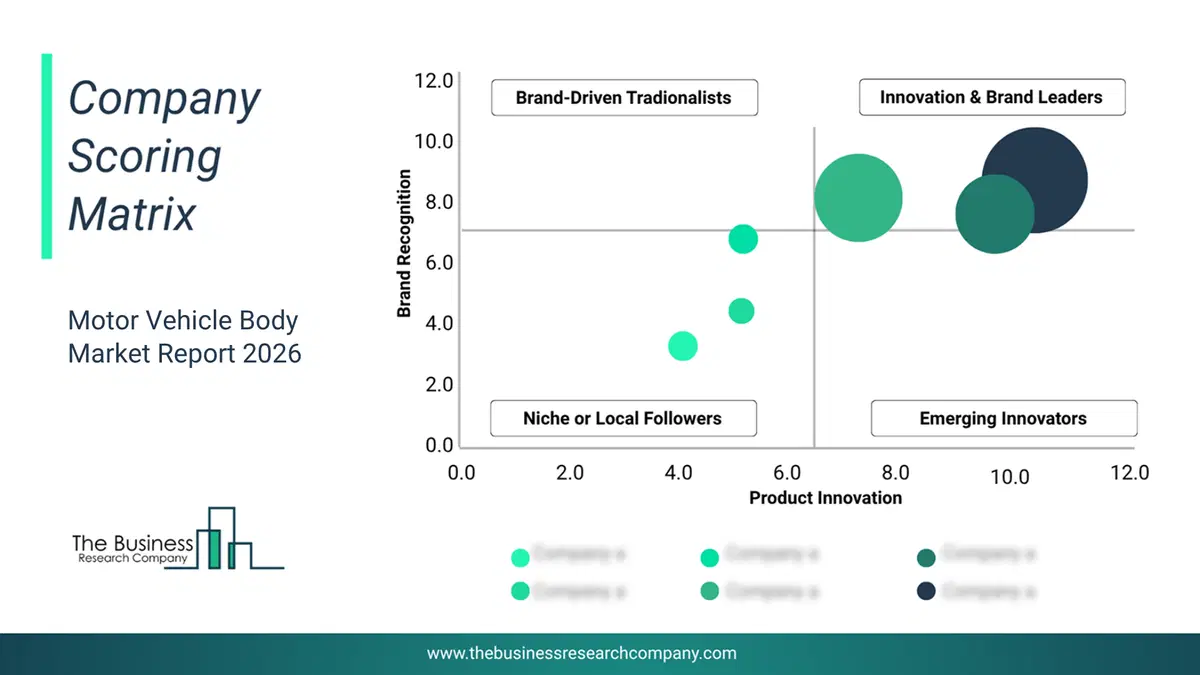
This chart maps companies by product innovation and brand strength, with bubble size indicating relative revenue, helping identify market leaders, challengers, and niche players. This is an illustrative chart; the full report provides a complete and accurate competitive analysis.
Global Motor Vehicle Body Market Trends and Insights
Major companies operating in the motor vehicle body market are focusing on developing innovative lightweight solutions, such as ultra-low density sheet molding compound materials, to enhance fuel efficiency and reduce emissions. Ultra low density sheet molding compounds are composite materials made by embedding reinforcing fibers in a polymer matrix, which significantly reduce vehicle weight while maintaining durability and high-quality surface characteristics, enabling capabilities such as improved vehicle range and Class A exterior finishing. For instance, in November 2025, Continental Structural Plastics Inc. (CSP), a US-based manufacturing company, launched TCA Float, an ultra-low density sheet molding compound designed for automotive exterior body panels, featuring up to 25 percent weight reduction and a paint ready Class A surface finish. TCA Float improves overall vehicle mass reduction and supports better performance and energy efficiency.What Are Latest Mergers And Acquisitions In The Motor Vehicle Body Market?
In March 2024, Morgan Truck Body, a US-based manufacturing company, acquired Transit Truck Bodies Inc. for an undisclosed amount. With this acquisition, Morgan sought to expand its North American manufacturing footprint and strengthen its presence in the light- and medium-duty truck-body market. Transit Truck Bodies Inc. is a Canada-based manufacturing company that specializes in producing dry-freight, refrigerated, cutaway, and custom truck bodies.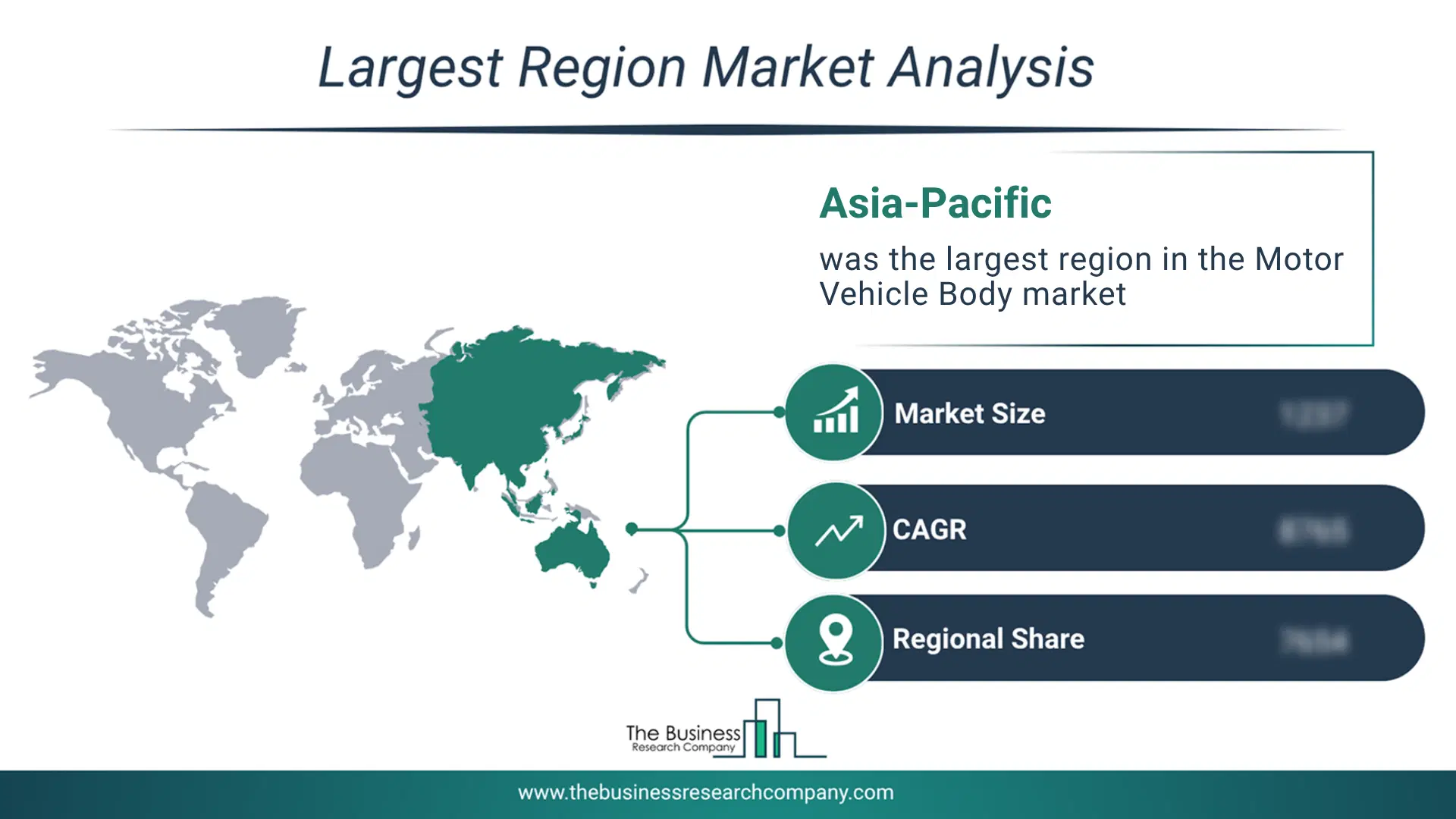
Regional Outlook
Asia-Pacific was the largest region in the motor vehicle body market in 2025. Western Europe was the second largest region in the global motor vehicle body market share. The regions covered in this market report include Asia-Pacific, South East Asia, Western Europe, Eastern Europe, North America, South America, Middle East, Africa. The countries covered in this market report include Australia, Brazil, China, France, Germany, India, Indonesia, Japan, Taiwan, Russia, South Korea, UK, USA, Canada, Italy, SpainWhat Defines the Motor Vehicle Body Market?
The motor vehicle body market consists of sales of fenders, bumpers, windshields, glass, seats, motors, transmissions, air conditioning condensers, and radiators. Values in this market are factory gate values, that is the value of goods sold by the manufacturers or creators of the goods, whether to other entities (including downstream manufacturers, wholesalers, distributors, and retailers) or directly to end customers. The value of goods in this market includes related services sold by the creators of the goods.How is Market Value Defined and Measured?
The market value is defined as the revenues that enterprises gain from the sale of goods and/or services within the specified market and geography through sales, grants, or donations in terms of the currency (in USD unless otherwise specified). The revenues for a specified geography are consumption values that are revenues generated by organizations in the specified geography within the market, irrespective of where they are produced. It does not include revenues from resales along the supply chain, either further along the supply chain or as part of other products.
This chart presents market attractiveness based on a quantitative evaluation of growth, competition, strategic alignment, and risk, offering a clear view of opportunity areas for decision-making. This chart is for illustrative purposes; the full report contains the complete analysis.

This chart highlights the Total Addressable Market (TAM) by estimating the maximum revenue opportunity using an assumption-driven approach, supporting strategic planning and opportunity sizing across markets. The chart is illustrative; the full report provides a more comprehensive analysis.
What Key Data and Analysis Are Included in the Motor Vehicle Body Market Report 2026?
The motor vehicle body market research report is one of a series of new reports from The Business Research Company that provides market statistics, including industry global market size, regional shares, competitors with the market share, detailed market segments, market trends and opportunities, and any further data you may need to thrive in the motor vehicle body industry. The market research report delivers a complete perspective of everything you need, with an in-depth analysis of the current and future state of the industry.Motor Vehicle Body Market Report Forecast Analysis
| Report Attribute | Details |
|---|---|
| Market Size Value In 2026 | $252.03 billion |
| Revenue Forecast In 2030 | $365.02 billion |
| Growth Rate | CAGR of 9.0% from 2026 to 2030 |
| Base Year For Estimation | 2025 |
| Actual Estimates/Historical Data | 2020-2025 |
| Forecast Period | 2026 - 2030 - 2030 |
| Market Representation | Revenue in USD Billion and CAGR from 2026 to 2030 |
| Segments Covered | Type Of Vehicle, End Use, Application |
| Regional Scope | Asia-Pacific, Western Europe, Eastern Europe, North America, South America, Middle East, Africa |
| Country Scope | The countries covered in the report are Australia, Brazil, China, France, Germany, India, Indonesia, Japan, Taiwan, Russia, South Korea, UK, USA, Canada, Italy, Spain. |
| Key Companies Profiled | Magna International Inc., Lear Corporation, General Motors Co., Aisin Seiki Co. Ltd, Faurecia SA, Plastic Omnium SA, Grupo Antolín Irausa SA., Mitsubishi Motors Corporation, Autoliv Inc, Paccar Inc, Tata Motors Passenger Vehicles Limited, Ashok Leyland Limited, Eicher Motors Limited, Jbm Auto Limited, Volvo Group India Private Limited, Amw Motors Limited, Chongqing Zhidao Machinery Co, Ltd, Shandong Taixing Casting Co., Ltd, Suizhou Fuhua Automobile Trailer Co., Ltd, Potou Jiaohe Hongxing Machinery Factory, Aptiv Plc, Sensata Technologies Holding Plc, Tesla Motors Limited, Alliance Automotive Procurement Limited, Marelli Automotive Systems UK, Ibc Vehicles Limited, Avtotor, Moskvich, Benteler Automotive Poland Sp. O, Umicore Autocat Poland Sp. z o.o, Ford, Chrysler, Toyota, Nissan, Mazda, Honda, Linamar Corporation, Flex-N-Gate Corporation, Martinrea International Inc, Key Safety Systems (KSS), BMW Brazil, DHB Sistemas, Chevrolet, Volkswagen, Iveco, Arabian Automobiles Co. LLC, Geely, Manufacturing Commercial Vehicles Co. S.A. E, Cania AB, Mercedes-Benz (Egypt), Innoson Vehicle Manufacturing (IVM) |
| Customization Scope | Request for Customization |
| Pricing And Purchase Options | Explore Purchase Options |