
Motor Vehicle Engine, Power Train & Parts Market Report 2026
Global Outlook – By Type (Vehicle Engine And Engine Parts, Power Train And Power Train Parts ), By Application (Passenger Vehicle, Commercial Vehicle ), By End Use (OEM, Aftermarket) – Market Size, Trends, Strategies, and Forecast to 2030
Motor Vehicle Engine, Power Train & Parts Market Overview
• Motor Vehicle Engine, Power Train & Parts market size has reached to $877.47 billion in 2025 • Expected to grow to $1218.19 billion in 2030 at a compound annual growth rate (CAGR) of 6.9% • Growth Driver: Rising Electric Vehicles Fuels Growth In The Motor Vehicle Engine, Power Train, And Parts Market • Market Trend: Next-Generation Modular Powertrains Driving Efficiency And Emissions Compliance • Asia-Pacific was the largest region in 2025.What Is Covered Under Motor Vehicle Engine, Power Train & Parts Market?
The motor vehicle engine, powertrain, and parts sector encompass the critical components and systems that drive the operation and performance of vehicles. The engine serves as the primary power source, converting fuel or electric energy into mechanical energy to propel the vehicle. The powertrain works together to transfer power from the engine to the wheels, ensuring efficient movement and handling. The parts are essential for optimizing performance, fuel efficiency, and emissions control of vehicles. The main types of motor vehicle engines, power trains, and parts are Vehicle engine and engine parts, power train, and power train parts. The vehicle engine and engine parts refer to the vehicle engine parts that are used in motor vehicles. The various applications include passenger vehicles and commercial vehicles. These are used in the OEM and aftermarket.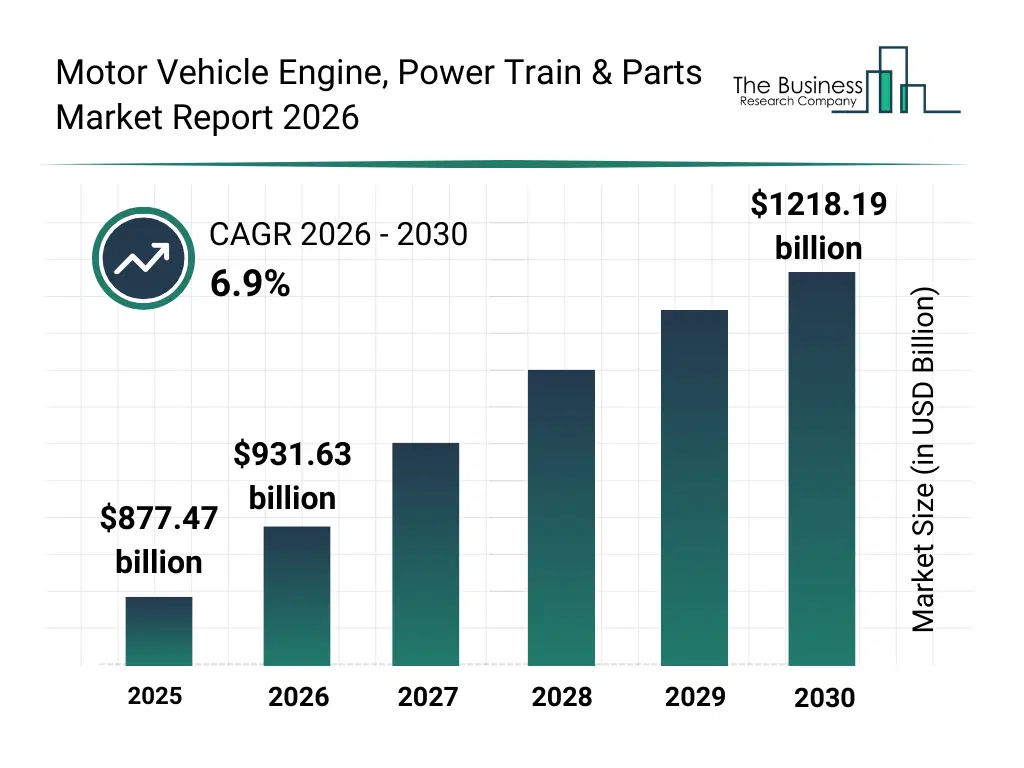
What Is The Motor Vehicle Engine, Power Train & Parts Market Size and Share 2026?
The motor vehicle engine, power train & parts market size has grown strongly in recent years. It will grow from $877.47 billion in 2025 to $931.63 billion in 2026 at a compound annual growth rate (CAGR) of 6.2%. The growth in the historic period can be attributed to growth of internal combustion engine vehicles, expansion of global vehicle production, demand for performance optimization, evolution of drivetrain technologies, aftermarket parts replacement demand.What Is The Motor Vehicle Engine, Power Train & Parts Market Growth Forecast?
The motor vehicle engine, power train & parts market size is expected to see strong growth in the next few years. It will grow to $1218.19 billion in 2030 at a compound annual growth rate (CAGR) of 6.9%. The growth in the forecast period can be attributed to electrification of vehicle fleets, hybrid powertrain adoption, emission compliance requirements, demand for efficient drivetrains, growth of ev powertrain components. Major trends in the forecast period include growing shift toward electrified powertrains, increasing integration of advanced transmission systems, rising demand for lightweight engine components, expansion of modular powertrain architectures, higher focus on fuel efficiency optimization.
Global Motor Vehicle Engine, Power Train & Parts Market Segmentation
1) By Type: Vehicle Engine And Engine Parts, Power Train And Power Train Parts 2) By Application: Passenger Vehicle, Commercial Vehicle 3) By End Use: OEM, Aftermarket Subsegments: 1) By Vehicle Engine And Engine Parts: Internal Combustion Engines (ICE), Electric Vehicle Engines, Hybrid Vehicle Engines, Engine Parts (Pistons, Crankshafts, Cylinder Heads, Timing Belts) 2) By Power Train And Power Train Parts: Transmission Systems, Drivetrain Components (Axles, Differential, Drive Shafts), Clutch Systems, Gearboxes, Propeller Shafts, CouplingsWhat Are The Drivers Of The Motor Vehicle Engine, Power Train & Parts Market?
The increasing demand for electric vehicles (EVs) is expected to propel the growth of the motor vehicle engines, power trains, and parts market going forward. An electric vehicle (EV) is a type of vehicle that is powered by one or more electric motors, using electricity stored in batteries or other energy storage devices as its primary source of energy. Electric vehicles (EVs) are using advanced motor vehicle engines, electric powertrains, and specialized components to enhance performance, efficiency, and sustainability, marking a significant shift in the automotive industry. For instance, in July 2023, according to the International Energy Agency, a France-based intergovernmental organization, sales of electric vehicles were 10 million in 2022, and there will be an increase to 14 million sales of electric vehicles in 2023. Therefore, the increasing demand for electric vehicles (EVs) is driving the growth of motor vehicle engines, power trains, and parts market. The growing demand for aftermarket parts is expected to propel the growth of the motor vehicle engine, power train, and parts market in the coming years. Aftermarket automotive parts are parts that are not manufactured by the original equipment manufacturer (OEM). These are used as replacements or to upgrade the original components of a vehicle. Aftermarket components in the motor vehicle engine, power train, and parts industry are utilized for replacement, performance enhancements, economical options, modification, and maintenance. Aftermarket components are frequently less expensive than OEM parts while providing comparable or superior performance. For instance, in June 2024, according to Auto Care Association, a US-based trade association, total United States light duty aftermarket sales grew by 8.6% in 2023 to $392 billion, surpassing the previous year’s projections of 8.1%. Light-vehicle growth in 2024 is expected to be 5.9%, with the total light-, medium- and heavy-duty automotive aftermarket projected to reach $617.3 billion in 2027. Therefore, the growing demand for aftermarket parts is driving the motor vehicle engine, power train, and parts market.Key Players In The Global Motor Vehicle Engine, Power Train & Parts Market
Major companies operating in the motor vehicle engine, power train & parts market report include Robert Bosch GmbH, Aisin Seiki Co Ltd, Toyota Motor Corp, Denso Corp., Schaeffler Technologies AG & Co. KG, Continental AG, Tata Motor Group, Dana Incorporated, Magna International Inc., ZF Friedrichshafen AG, Hyundai Motor Company, GKN Ltd., BorgWarner Inc., Mahle GmbH, Hitachi Automotive Systems Ltd., American Axle & Manufacturing Holdings Inc., Linamar Corporation, Rheinmetall Automotive AG, Allison Transmission Holdings Inc., Cummins Inc.
This chart is for illustrative purposes; the full report includes a detailed competitor analysis and comprehensive overview of the top 10 companies in the market.
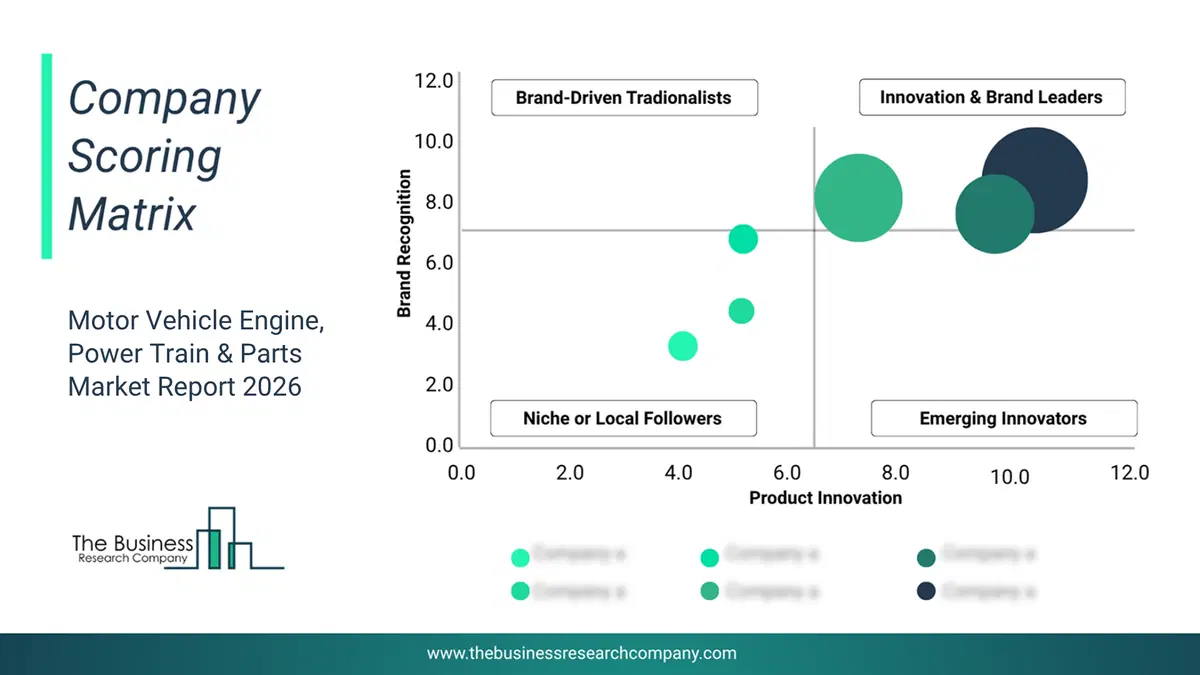
This chart maps companies by product innovation and brand strength, with bubble size indicating relative revenue, helping identify market leaders, challengers, and niche players. This is an illustrative chart; the full report provides a complete and accurate competitive analysis.
Global Motor Vehicle Engine, Power Train & Parts Market Trends and Insights
Major companies operating in the motor vehicle engine, powertrain and parts market are developing innovative solutions such as integrated hybrid and range-extender powertrain systems to enhance fuel efficiency, flexible powertrain deployment, and low-emission performance. Integrated hybrid and range-extender powertrain systems combine an internal-combustion engine, electric motor, transmission, and power electronics into a single compact module that simplifies packaging and enables multiple propulsion configurations. For instance, in April 2025, Horse Powertrain, a China-based powertrain technology company, launched the “Future Hybrid Concept”, a next-generation integrated hybrid and range-extended electric vehicle (REEV) powertrain system designed to support flexible electrified mobility, featuring a compact unified layout, modular compatibility with existing battery electric vehicle (BEV) platforms, and fuel-agnostic capability for gasoline and alternative fuels. The Future Hybrid Concept improves vehicle packaging efficiency, reduces integration complexity, and enables OEMs to electrify or hybridize vehicles without needing entirely new powertrain architectures.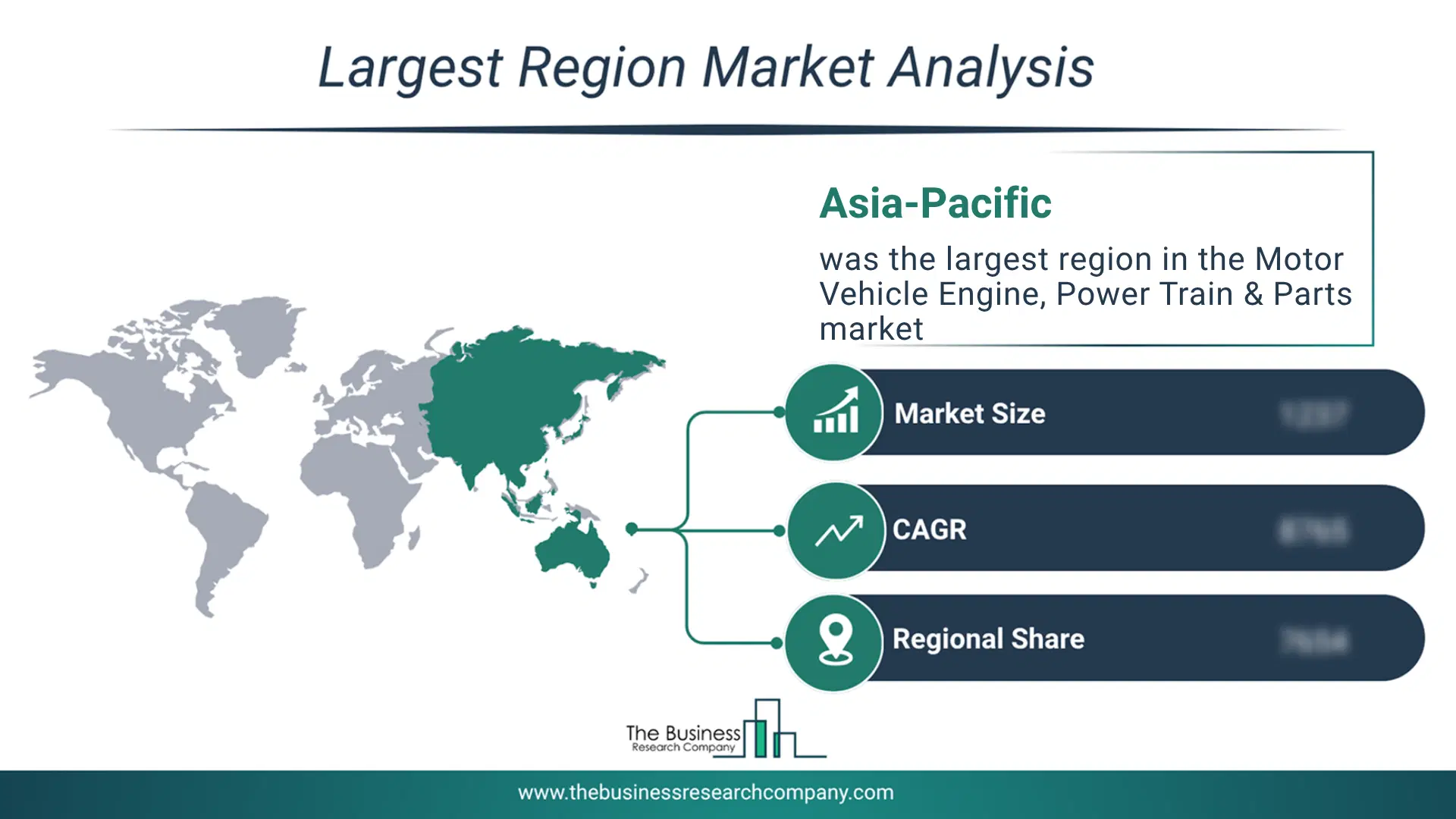
Regional Outlook
Asia-Pacific was the largest region in the motor vehicle engines, power trains, & parts market in 2025. Western Europe was the second largest market in motor vehicle engines, power trains, & parts market. The regions covered in this market report include Asia-Pacific, South East Asia, Western Europe, Eastern Europe, North America, South America, Middle East, Africa. The countries covered in this market report include China, India, Japan, Australia, Indonesia, South Korea, Bangladesh, Thailand, Vietnam, Malaysia, Singapore, Philippines, Hong Kong, Taiwan, New Zealand, UK, Germany, France, Italy, Spain, Austria, Belgium, Denmark, Finland, Ireland, Netherlands, Norway, Portugal, Sweden, Switzerland, Russia, Czech Republic, Poland, Romania, Ukraine, USA, Canada, Mexico, Brazil, Chile, Argentina, Colombia, Peru, Saudi Arabia, Israel, Iran, Turkey, UAE, Egypt, Nigeria, South Africa.What Defines the Motor Vehicle Engine, Power Train & Parts Market?
The motor vehicle engine, power train, and parts market consist of sales of engine, transmission, driveshaft, axles, and differential. Values in this market are ‘factory gate’ values, that is the value of goods sold by the manufacturers or creators of the goods, whether to other entities (including downstream manufacturers, wholesalers, distributors and retailers) or directly to end customers. The value of goods in this market includes related services sold by the creators of the goods.How is Market Value Defined and Measured?
The market value is defined as the revenues that enterprises gain from the sale of goods and/or services within the specified market and geography through sales, grants, or donations in terms of the currency (in USD unless otherwise specified). The revenues for a specified geography are consumption values that are revenues generated by organizations in the specified geography within the market, irrespective of where they are produced. It does not include revenues from resales along the supply chain, either further along the supply chain or as part of other products.
This chart presents market attractiveness based on a quantitative evaluation of growth, competition, strategic alignment, and risk, offering a clear view of opportunity areas for decision-making. This chart is for illustrative purposes; the full report contains the complete analysis.

This chart highlights the Total Addressable Market (TAM) by estimating the maximum revenue opportunity using an assumption-driven approach, supporting strategic planning and opportunity sizing across markets. The chart is illustrative; the full report provides a more comprehensive analysis.
What Key Data and Analysis Are Included in the Motor Vehicle Engine, Power Train & Parts Market Report 2026?
The motor vehicle engine, power train & parts market research report is one of a series of new reports from The Business Research Company that provides market statistics, including industry global market size, regional shares, competitors with the market share, detailed market segments, market trends and opportunities, and any further data you may need to thrive in the motor vehicle engine, power train & parts industry. The market research report delivers a complete perspective of everything you need, with an in-depth analysis of the current and future state of the industry.Motor Vehicle Engine, Power Train & Parts Market Report Forecast Analysis
| Report Attribute | Details |
|---|---|
| Market Size Value In 2026 | $931.63 billion |
| Revenue Forecast In 2030 | $1218.19 billion |
| Growth Rate | CAGR of 6.2% from 2026 to 2030 |
| Base Year For Estimation | 2025 |
| Actual Estimates/Historical Data | 2020-2025 |
| Forecast Period | 2026 - 2030 - 2030 |
| Market Representation | Revenue in USD Billion and CAGR from 2026 to 2030 |
| Segments Covered | Type, Application, End Use |
| Regional Scope | Asia-Pacific, Western Europe, Eastern Europe, North America, South America, Middle East, Africa |
| Country Scope | The countries covered in the report are Australia, Brazil, China, France, Germany, India, Indonesia, Japan, Taiwan, Russia, South Korea, UK, USA, Canada, Italy, Spain. |
| Key Companies Profiled | Robert Bosch GmbH, Aisin Seiki Co Ltd, Toyota Motor Corp, Denso Corp., Schaeffler Technologies AG & Co. KG, Continental AG, Tata Motor Group, Dana Incorporated, Magna International Inc., ZF Friedrichshafen AG, Hyundai Motor Company, GKN Ltd., BorgWarner Inc., Mahle GmbH, Hitachi Automotive Systems Ltd., American Axle & Manufacturing Holdings Inc., Linamar Corporation, Rheinmetall Automotive AG, Allison Transmission Holdings Inc., Cummins Inc. |
| Customization Scope | Request for Customization |
| Pricing And Purchase Options | Explore Purchase Options |