

Multi-Agent System Market Report 2026
Global Outlook – By Agent System Type (Single Agent Systems, Multi Agent Systems), By Deployment Mode (Cloud, On Premises), By Application (Customer Service And Virtual Assistants, Robotics And Automation, Healthcare, Financial Services, Security And Surveillance, Gaming And Entertainment, Marketing And Sales, Human Resources, Other Applications), By End Use Industry (Manufacturing, Supply Chain And Logistics, Healthcare And Life Sciences, Banking Financial Services And Insurance, Other End Use Industries) – Market Size, Trends, Strategies, and Forecast to 2030
Multi-Agent System Market Overview
• Multi-Agent System market size has reached to $5.97 billion in 2025 • Expected to grow to $25.47 billion in 2030 at a compound annual growth rate (CAGR) of 33.6% • Growth Driver: Surge in Increasing Adoption of Autonomous Systems Across Industries Fueling the Growth of the Multi-Agent System Market Due to Rising Demand for Efficiency and Productivity • Market Trend: Interoperable AI Agents Enhance Client Solutions • North America was the largest region in 2025 and Asia-Pacific is the fastest growing region.What Is Covered Under Multi-Agent System Market?
Multi-agent system refers to distributed computational systems in which multiple autonomous agents interact, cooperate, or compete to solve complex tasks more efficiently than a single centralized system. Its primary purpose is to enable intelligent decision-making, adaptive problem-solving, and coordinated behavior across dynamic and decentralized environments. It also supports enhanced system scalability, improved real-time responsiveness, and greater operational resilience through collaborative agent interactions. The main agent system types of multi-agent system include single agent systems and multi agent systems. Single agent systems are architectures where a single autonomous entity operates independently to perceive its environment, make decisions, and perform tasks without coordination with other agents. Different deployment modes include cloud and on premises. Various applications involved are customer service and virtual assistants, robotics and automation, healthcare, financial services, security and surveillance, gaming and entertainment, marketing and sales, human resources, and others, and these systems are adopted across end use industries such as manufacturing, supply chain and logistics, healthcare and life sciences, banking financial services and insurance, and others.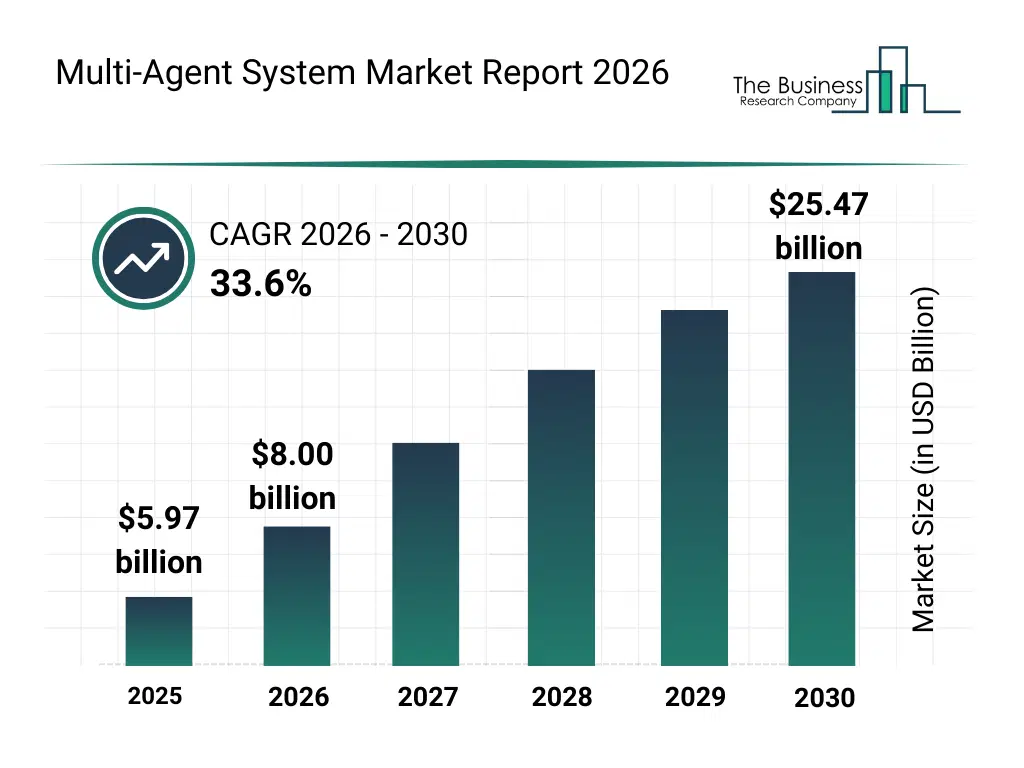
What Is The Multi-Agent System Market Size and Share 2026?
The multi-agent system market size has grown exponentially in recent years. It will grow from $5.97 billion in 2025 to $8.00 billion in 2026 at a compound annual growth rate (CAGR) of 33.9%. The growth in the historic period can be attributed to growing adoption of distributed computing solutions, increasing need for collaborative decision-making systems, rising use of autonomous software agents, expansion of complex industrial automation environments, growing focus on real-time system coordination.What Is The Multi-Agent System Market Growth Forecast?
The multi-agent system market size is expected to see exponential growth in the next few years. It will grow to $25.47 billion in 2030 at a compound annual growth rate (CAGR) of 33.6%. The growth in the forecast period can be attributed to increasing integration of artificial intelligence (AI) in autonomous agents, rising demand for decentralized problem-solving frameworks, growing adoption of intelligent automation across industries, expansion of smart infrastructure and internet of things (IOT) ecosystems, rise in use of multi-agent coordination for large-scale simulations. Major trends in the forecast period include technology driven innovations in autonomous agent architectures, advancements in artificial intelligence (AI) based communication protocols, developments in agent-based simulation and modeling tools, rising research and development in cooperative and swarm intelligence systems, and innovation in scalable and adaptive multi-agent platforms.
Global Multi-Agent System Market Segmentation
1) By Agent System Type: Single Agent Systems, Multi Agent Systems 2) By Deployment Mode: Cloud, On Premises 3) By Application: Customer Service And Virtual Assistants, Robotics And Automation, Healthcare, Financial Services, Security And Surveillance, Gaming And Entertainment, Marketing And Sales, Human Resources, Other Applications 4) By End Use Industry: Manufacturing, Supply Chain And Logistics, Healthcare And Life Sciences, Banking Financial Services And Insurance, Other End Use Industries Subsegments: 1) By Single Agent Systems: Reactive Agent Systems, Deliberative Agent Systems, Hybrid Agent Systems 2) By Multi Agent Systems: Cooperative Agent Systems, Competitive Agent Systems, Hybrid Multi Agent SystemsWhat Is The Driver Of The Multi-Agent System Market?
The increasing adoption of autonomous systems across industries is expected to propel the growth of the Multi Agent System (MAS) market going forward. Autonomous systems refer to self-operating machines or robots that can perform tasks with minimal human intervention. The rise in adoption of autonomous systems is due to mounting demand for efficiency, precision, and productivity gains across manufacturing, logistics, and other sectors. The multi-agent system market supports adoption of autonomous systems across industries by providing the agent-based architectures and coordination frameworks that allow autonomous systems to work collaboratively or competitively at scale. For instance, in September 2025, according to the International Federation of Robotics (IFR), a Germany-based professional industry association, the global operational stock of industrial robots reached 4,664,000 units in 2024, representing a 9% increase compared with 2023. Therefore, the increasing adoption of autonomous systems across industries is driving the growth of the Multi Agent System market.Key Players In The Global Multi-Agent System Market
Major companies operating in the multi-agent system market are Amazon Web Services Inc., Google LLC, Microsoft Corporation, OpenAI L.L.C., Netcracker Technology Corp., Automation Anywhere Inc., Anthropic PBC, GreyOrange Pte. Ltd., Kore.ai Inc., Moveworks Inc., UnifyApps Inc., Aisera Inc., LangChain Inc., LlamaIndex Inc., Scensei, Beam AI Inc., Relevance AI Pty Ltd., CrewAI Inc., AnyLogic Company, Swarms AI, SmythOS Inc., Eigent AI, Akira AI, AgentX (AgentX.so)
This chart is for illustrative purposes; the full report includes a detailed competitor analysis and comprehensive overview of the top 10 companies in the market.
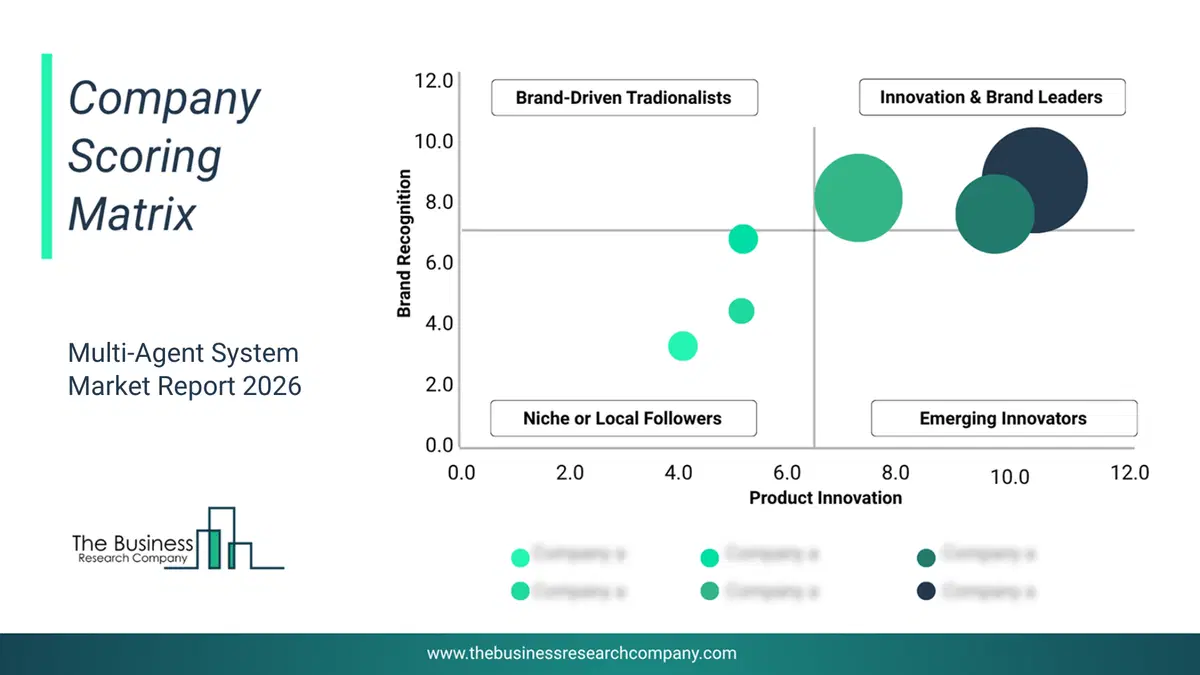
This chart maps companies by product innovation and brand strength, with bubble size indicating relative revenue, helping identify market leaders, challengers, and niche players. This is an illustrative chart; the full report provides a complete and accurate competitive analysis.
Global Multi-Agent System Market Trends and Insights
Major companies operating in the multi-agent system market are focusing on technological innovation, such as multi-agent AI platforms, to enhance client delivery, accelerate innovation, and complement human expertise across global teams. Multi-agent AI platforms integrate numerous intelligent AI agents that can interact with each other and with human professionals, leveraging large language models (LLMs) to provide trusted, context-aware solutions while maintaining interoperability across diverse enterprise systems. For instance, in June 2025, Klynveld Peat Marwick Goerdeler, a Netherlands-based professional services company, launched KPMG Workbench, an AI platform built on Microsoft Azure AI Foundry Services, featuring a network of 50 AI assistants with nearly a thousand more in development. It supports scalable, secure, and efficient AI adoption, empowering professionals to deliver faster, high-quality solutions for clients worldwide.What Are Latest Mergers And Acquisitions In The Multi-Agent System Market?
In July 2025, NICE Ltd., a US-based provider of AI-driven customer experience and enterprise communication solutions, acquired Cognigy GmbH for $955 million. With this acquisition, NiCE enhanced its AI-powered customer experience platform by integrating Cognigy’s conversational and agentic AI capabilities, creating an end-to-end AI-native CX stack for orchestrating workflows and automating enterprise customer interactions. Cognigy GmbH is a Germany-based company specializing in AI-driven conversational platforms that enable multi-agent systems for enterprise automation.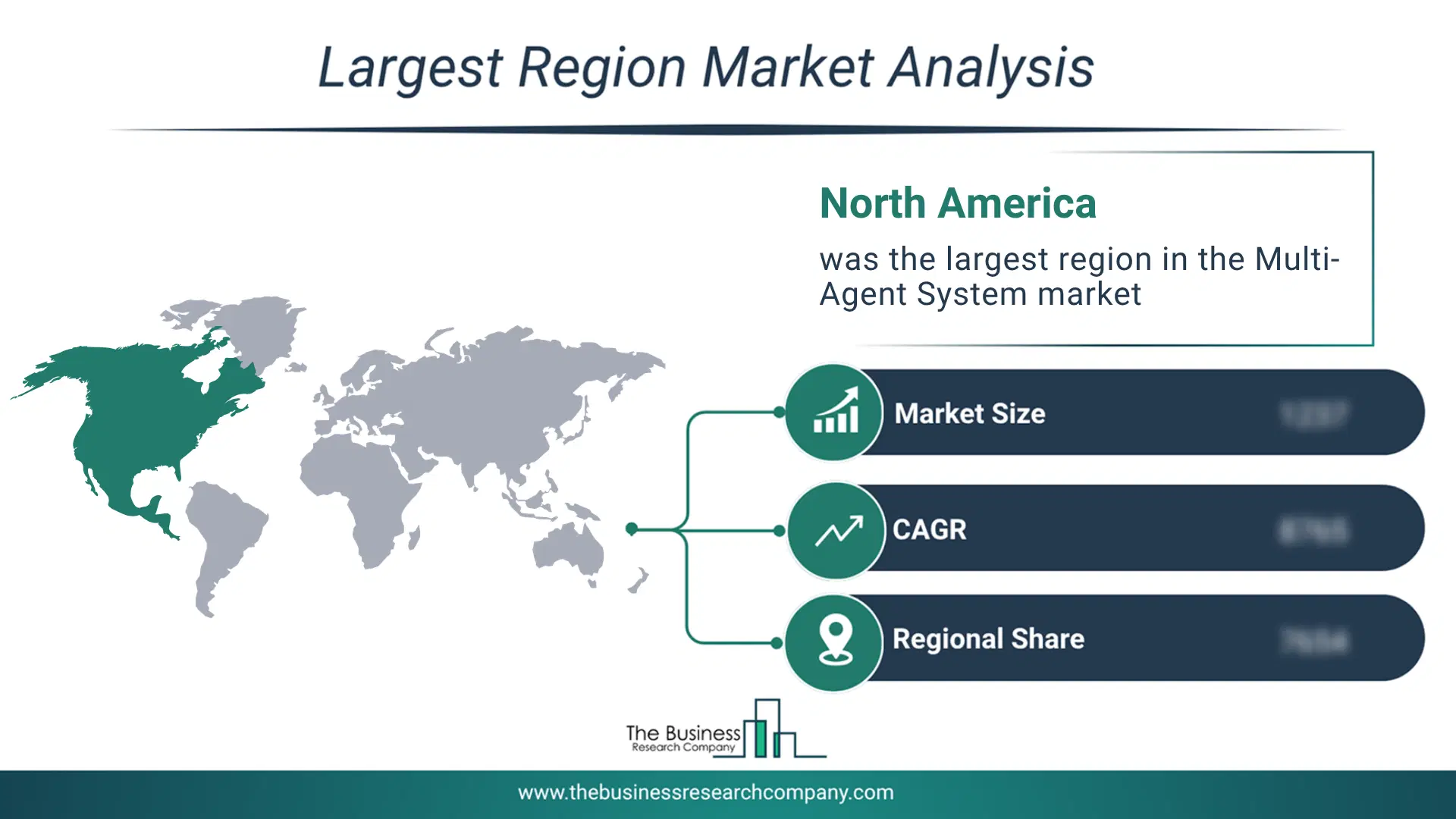
Regional Insights
North America was the largest region in the multi-agent system market in 2025. Asia-Pacific is expected to be the fastest-growing region in the forecast period. The regions covered in this market report are Asia-Pacific, South East Asia, Western Europe, Eastern Europe, North America, South America, Middle East, Africa. The countries covered in this market report are Australia, Brazil, China, France, Germany, India, Indonesia, Japan, Taiwan, Russia, South Korea, UK, USA, Canada, Italy, Spain.What Defines the Multi-Agent System Market?
The multi-agent system consists of revenues earned by entities by providing technologies such as autonomous agent frameworks, distributed decision-making engines, collaborative robotic agents, multi-agent simulation platforms, and intelligent coordination algorithms. The market value includes the value of related goods sold by the service provider or included within the service offering. The multi-agent system includes sales of agent communication protocols, cooperative control software, decentralized computing modules, and multi-agent development toolkits. Values in this market are ‘factory gate’ values, that is, the value of goods sold by the manufacturers or creators of the goods, whether to other entities (including downstream manufacturers, wholesalers, distributors, and retailers) or directly to end customers. The value of goods in this market includes related services sold by the creators of the goods.How is Market Value Defined and Measured?
The market value is defined as the revenues that enterprises gain from the sale of goods and/or services within the specified market and geography through sales, grants, or donations in terms of the currency (in USD unless otherwise specified). The revenues for a specified geography are consumption values that are revenues generated by organizations in the specified geography within the market, irrespective of where they are produced. It does not include revenues from resales along the supply chain, either further along the supply chain or as part of other products.
This chart presents market attractiveness based on a quantitative evaluation of growth, competition, strategic alignment, and risk, offering a clear view of opportunity areas for decision-making. This chart is for illustrative purposes; the full report contains the complete analysis.

This chart highlights the Total Addressable Market (TAM) by estimating the maximum revenue opportunity using an assumption-driven approach, supporting strategic planning and opportunity sizing across markets. The chart is illustrative; the full report provides a more comprehensive analysis.
What Key Data and Analysis Are Included in the Multi-Agent System Market Report 2026?
The multi-agent system market research report is one of a series of new reports from The Business Research Company that provides market statistics, including industry global market size, regional shares, competitors with the market share, detailed market segments, market trends and opportunities, and any further data you may need to thrive in the multi-agent system industry. The market research report delivers a complete perspective of everything you need, with an in-depth analysis of the current and future state of the industry.Multi-Agent System Market Report Forecast Analysis
| Report Attribute | Details |
|---|---|
| Market Size Value In 2026 | $8.00 billion |
| Revenue Forecast In 2030 | $25.47 billion |
| Growth Rate | CAGR of 33.6% from 2026 to 2030 |
| Base Year For Estimation | 2025 |
| Actual Estimates/Historical Data | 2020-2025 |
| Forecast Period | 2026 - 2030 |
| Market Representation | Revenue in USD Billion and CAGR from 2026 to 2030 |
| Segments Covered | Agent System Type, Deployment Mode, Application, End Use Industry |
| Regional Scope | Asia-Pacific, Western Europe, Eastern Europe, North America, South America, Middle East, Africa |
| Country Scope | The Countries Covered In This Market Report Are Australia, Brazil, China, France, Germany, India, Indonesia, Japan, Taiwan, Russia, South Korea, Uk, Usa, Canada, Italy, Spain. |
| Key Companies Profiled | Amazon Web Services Inc., Google LLC, Microsoft Corporation, OpenAI L.L.C., Netcracker Technology Corp., Automation Anywhere Inc., Anthropic PBC, GreyOrange Pte. Ltd., Kore.ai Inc., Moveworks Inc., UnifyApps Inc., Aisera Inc., LangChain Inc., LlamaIndex Inc., Scensei, Beam AI Inc., Relevance AI Pty Ltd., CrewAI Inc., AnyLogic Company, Swarms AI, SmythOS Inc., Eigent AI, Akira AI, AgentX (AgentX.so) |
| Customization Scope | Request for Customization |
| Pricing And Purchase Options | Explore Purchase Options |