
Multifamily Housing Green Buildings Market Report 2026
Global Outlook – By Project Type (New Construction, Remodeling), By Product (Interior Products, Exterior Products), By Construction Type (Full Green, Semi Green) – Market Size, Trends, Strategies, and Forecast to 2030
Multifamily Housing Green Buildings Market Overview
• Multifamily Housing Green Buildings market size has reached to $196.04 billion in 2025 • Expected to grow to $488.16 billion in 2030 at a compound annual growth rate (CAGR) of 19.9% • Growth Driver: Increasing Investment In Energy Efficiency Is Anticipated To Fuel Multi-Family Residential Green Building Market • Market Trend: Innovations In Green Transformation For Multifamily Housing Through Builmirai Internet Of Things (IoT) Solution • Asia-Pacific was the largest region and fastest growing region.What Is Covered Under Multifamily Housing Green Buildings Market?
Multi-family residential green building is the process of building, altering, repairing, improving, or demolishing any multi-family housing structure that is built to be environmentally sustainable using a detailed design and plan. The main types of multifamily housing green buildings are new construction and remodeling. Remodeling is the process of changing or modifying something's structure, style, or shape. The different types of products include interior and exterior products. Various types of construction include full-green and semi-green construction.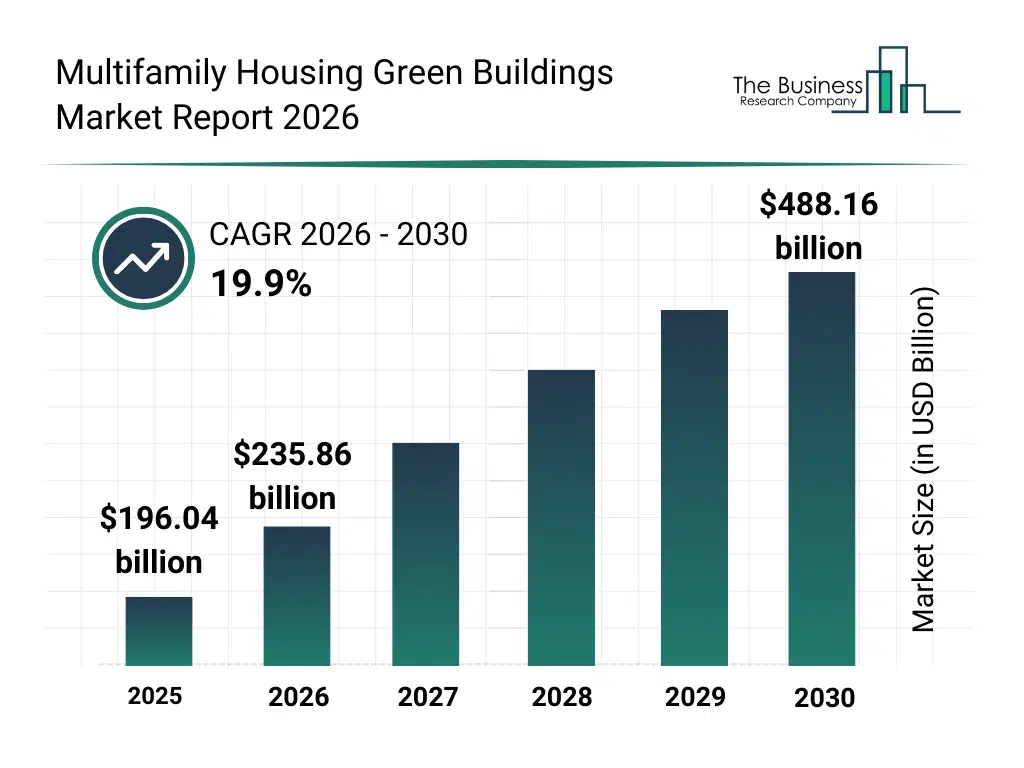
What Is The Multifamily Housing Green Buildings Market Size and Share 2026?
The multifamily housing green buildings market size has grown exponentially in recent years. It will grow from $196.04 billion in 2025 to $235.86 billion in 2026 at a compound annual growth rate (CAGR) of 20.3%. The growth in the historic period can be attributed to rising adoption of sustainability standards, increasing green material availability, growth in residential retrofits, rising investment in multi-unit housing, expansion of eco-friendly construction practices.What Is The Multifamily Housing Green Buildings Market Growth Forecast?
The multifamily housing green buildings market size is expected to see rapid growth in the next few years. It will grow to $488.16 billion in 2030 at a compound annual growth rate (CAGR) of 19.9%. The growth in the forecast period can be attributed to increasing demand for net-zero housing, rising use of smart home energy systems, growing preference for low-carbon materials, expansion of green-certified residential projects, higher integration of renewable energy technologies. Major trends in the forecast period include increasing construction of eco-friendly residential units, growth in green retrofitting projects, rising adoption of high-performance building materials, expansion of energy-efficient residential clusters, increasing focus on low-carbon building certification.
Global Multifamily Housing Green Buildings Market Segmentation
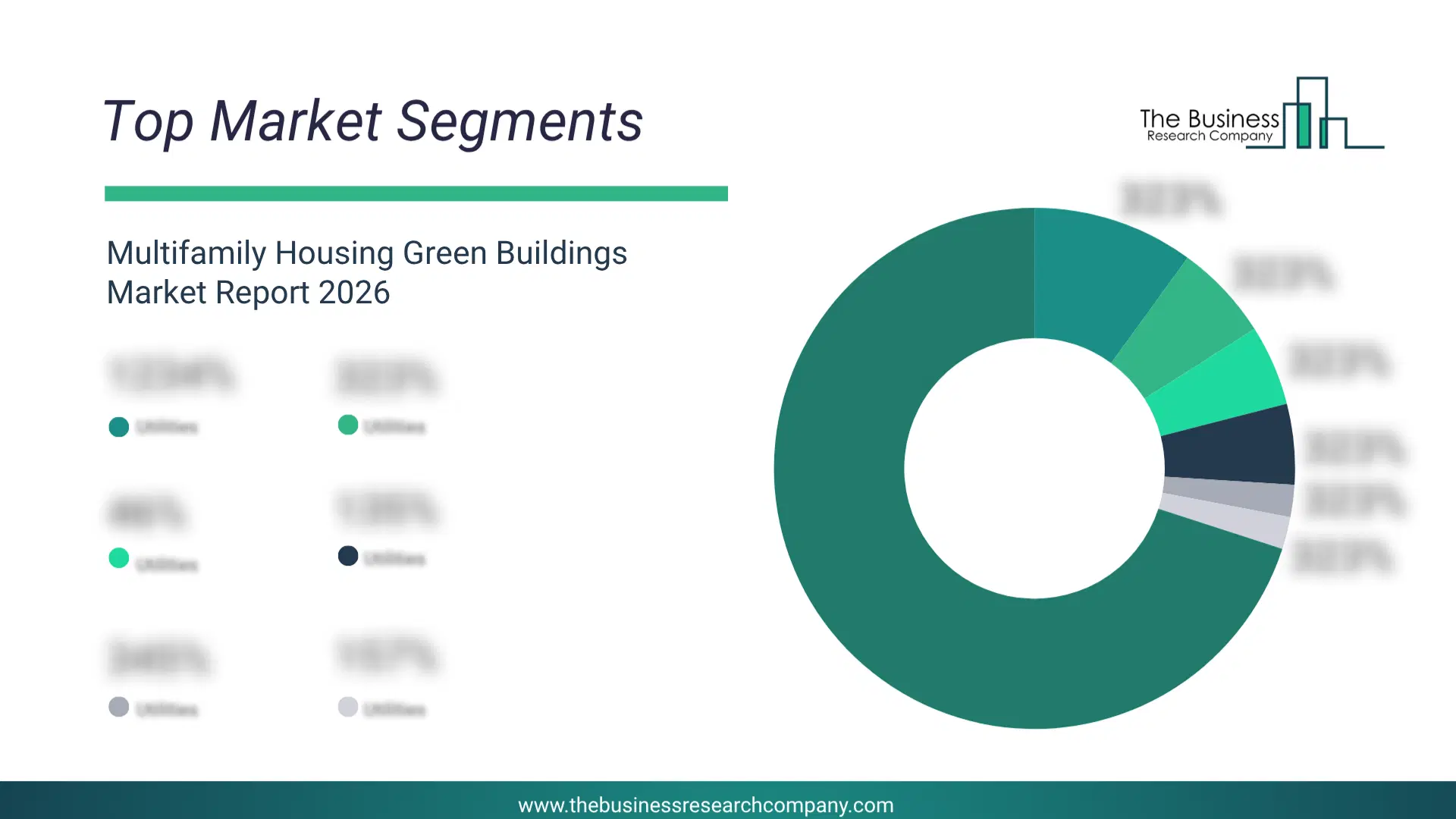
1) By Project Type: New Construction, Remodeling 2) By Product: Interior Products, Exterior Products 3) By Construction Type: Full Green, Semi Green Subsegments: 1) By New Construction: Residential Buildings, Commercial Buildings 2) By Remodelling: Retrofit Projects, Renovation ProjectsWhat Is The Driver Of The Multifamily Housing Green Buildings Market?
Increasing investment in energy efficiency is expected to propel the multi-family residential green building market going forward. Energy efficiency refers to the method of using less energy to perform the same task or provide the same service, thereby reducing energy waste. Multi-family residential green building promotes energy efficiency by integrating sustainable construction practices and materials to reduce energy consumption in communal living spaces. For instance, in November 2024, according to a report by the International Energy Agency, a France-based autonomous intergovernmental organization, the investments in more efficient buildings, transportation, and industry would need to triple from USD 660 billion in 2024 to about USD 1.9 trillion in 2030 to be in line with the NZE Scenario. Therefore, the increased investment in energy efficiency is driving the multi-family residential green building market.Key Players In The Global Multifamily Housing Green Buildings Market
Major companies operating in the multifamily housing green buildings market are Turner Construction Co, Clark Group, AECOM, Swinerton, Hensel Phelps, Skanska, Lendlease, Holder Construction, Webcor, Walsh Group, Gilbane Building Co, Structure Tone, Whiting-Turner Contracting Co., Clayco, DPR Construction, PCL Construction Enterprises, Suffolk, Austin Industries, McCarthy Holdings, BL Harbert International, James G. Davis Construction, Hoffman Construction, Brasfield & Gorrie, David E. Harvey Builders, The Balfour Beatty US, Hathaway Dinwiddie Construction, Mortenson Construction, Sundt Construction, HITT Contracting, Power Construction, Gensler, Stantec, HOK, JE Dunn Construction, Suffolk Construction, The Whiting-Turner Contracting Co., McCarthy Building Companies Inc., Ryan Companies US Inc., The Beck Group, The Weitz Company, The Boldt Company, The Opus Group, The Korte Company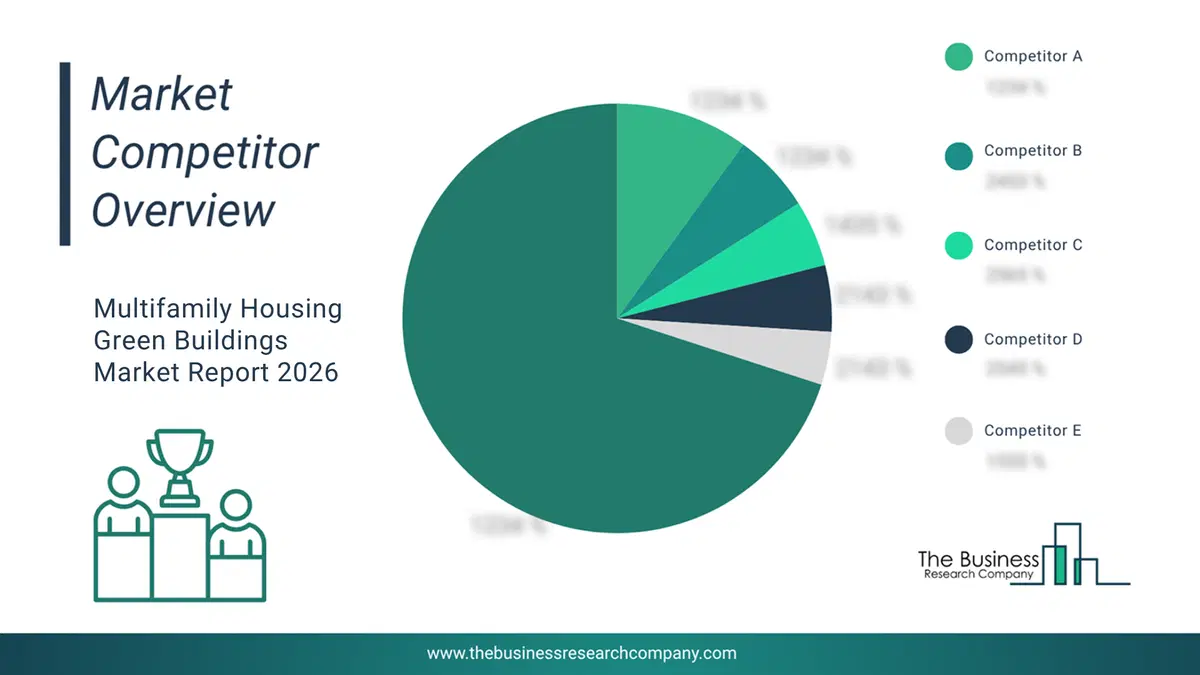
This chart is for illustrative purposes; the full report includes a detailed competitor analysis and comprehensive overview of the top 10 companies in the market.
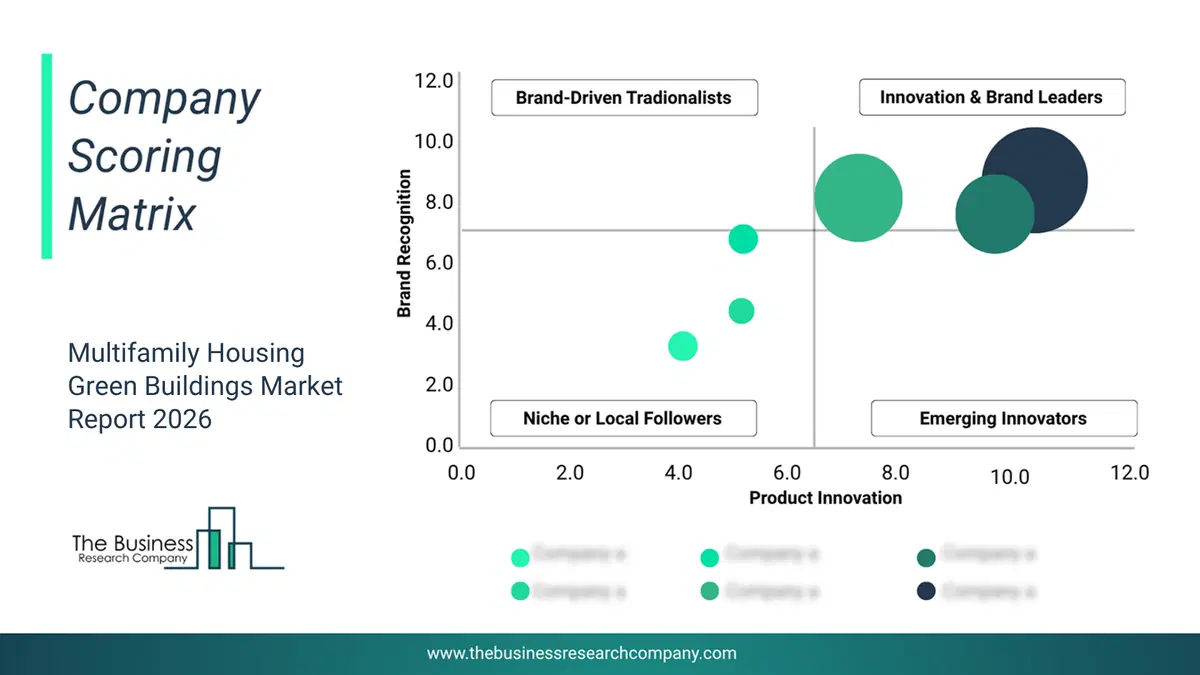
This chart maps companies by product innovation and brand strength, with bubble size indicating relative revenue, helping identify market leaders, challengers, and niche players. This is an illustrative chart; the full report provides a complete and accurate competitive analysis.
Global Multifamily Housing Green Buildings Market Trends and Insights
Major companies operating in the multifamily housing green buildings sector are innovating advanced technologies, such as green transformation (GX), to enhance sustainability, energy efficiency, and environmental performance in residential developments. Green transformation (GX) refers to the process of adopting sustainable practices, technologies, and innovations to minimize environmental impact and promote energy efficiency. For instance, in September 2024, Hitachi Ltd., a Japan-based conglomerate company, launched a new model of the BuilMirai Building IoT solution. The BuilMirai Building IoT solution is a comprehensive platform aimed at enhancing the management and operational efficiency of small and medium-sized buildings. The solution emphasizes green building practices, aligning with global trends toward sustainability in construction and management. The company will provide these solutions through monthly subscription plans, allowing customers to choose services as needed, which lowers their investment costs and promotes green transformation (GX) and digital transformation (DX) for small and medium-sized buildings. BuilMirai connects various building facilities and systems, facilitating improved management and operational efficiency.What Are Latest Mergers And Acquisitions In The Multifamily Housing Green Buildings Market?
In October 2025, Measurabl, a US‑based real‑estate sustainability software company, partnered with the Green Building Council of Australia to integrate the Green Star certification data into Measurabl’s global real‑estate sustainability platform. The partnership between Measurabl and the Green Building Council of Australia aims to streamline sustainability reporting, enhance ESG data management, and support green‑building performance across commercial and multifamily real‑estate assets. The Green Building Council of Australia is an Australia‑based organization that develops and administers the Green Star rating system for environmentally sustainable buildings.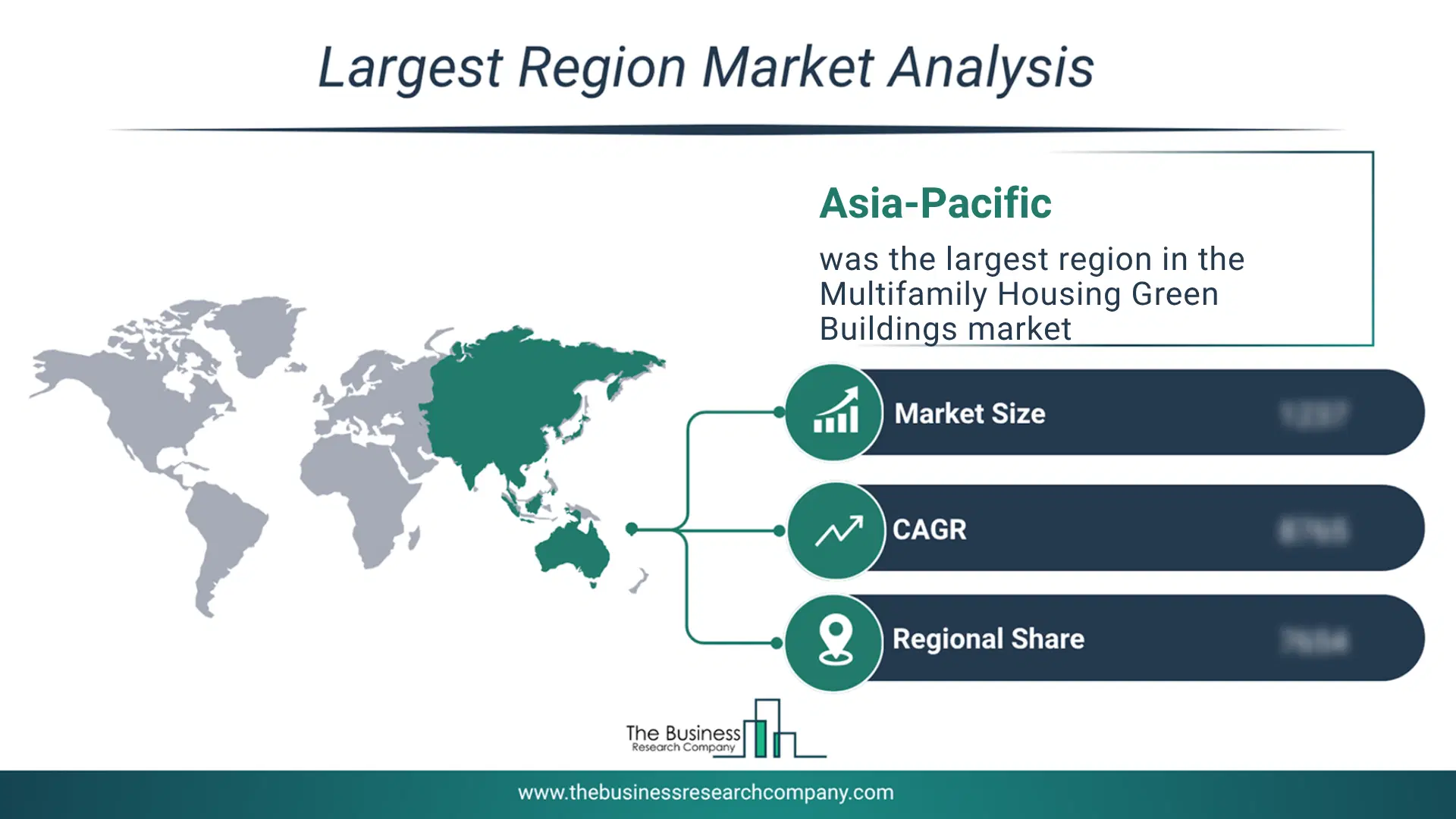
Regional Insights
Asia-Pacific was the largest region in the multifamily housing green buildings market in 2025. Eastern Europe is expected to be the fastest-growing region in the multifamily housing green buildings market during the forecast period. The regions covered in this market report are Asia-Pacific, South East Asia, Western Europe, Eastern Europe, North America, South America, Middle East, Africa. The countries covered in this market report are Australia, Brazil, China, France, Germany, India, Indonesia, Japan, Taiwan, Russia, South Korea, UK, USA, Canada, Italy, Spain.What Defines the Multifamily Housing Green Buildings Market?
The multifamily housing green buildings market includes revenues earned by entities by constructing or remodeling and renovating multifamily green buildings. This market includes the sales of residential housing general contractors (that is new construction, remodeling, or renovating existing residential structures), for-sale builders and remodelers of residential structures, residential project construction management firms, and residential design-build firms. The multifamily housing green building construction work performed includes new work, additions, alterations, maintenance, and repairs. A green building is an environment-sustainable building that is designed, constructed, and operated to minimize environmental impacts. The market value includes the value of related goods sold by the service provider or included within the service offering. Only goods and services traded between entities or sold to end consumers are included.How is Market Value Defined and Measured?
The market value is defined as the revenues that enterprises gain from the sale of goods and/or services within the specified market and geography through sales, grants, or donations in terms of the currency (in USD unless otherwise specified). The revenues for a specified geography are consumption values that are revenues generated by organizations in the specified geography within the market, irrespective of where they are produced. It does not include revenues from resales along the supply chain, either further along the supply chain or as part of other products.
This chart presents market attractiveness based on a quantitative evaluation of growth, competition, strategic alignment, and risk, offering a clear view of opportunity areas for decision-making. This chart is for illustrative purposes; the full report contains the complete analysis.

This chart highlights the Total Addressable Market (TAM) by estimating the maximum revenue opportunity using an assumption-driven approach, supporting strategic planning and opportunity sizing across markets. The chart is illustrative; the full report provides a more comprehensive analysis.
What Key Data and Analysis Are Included in theMultifamily Housing Green Buildings Market Report 2026?
The multifamily housing green buildings market research report is one of a series of new reports from The Business Research Company that provides market statistics, including industry global market size, regional shares, competitors with the market share, detailed market segments, market trends and opportunities, and any further data you may need to thrive in the multifamily housing green buildings industry. The market research report delivers a complete perspective of everything you need, with an in-depth analysis of the current and future state of the industry.Multifamily Housing Green Buildings Market Report Forecast Analysis
| Report Attribute | Details |
|---|---|
| Market Size Value In 2026 | $235.86 billion |
| Revenue Forecast In 2030 | $488.16 billion |
| Growth Rate | CAGR of 20.3% from 2026 to 2030 |
| Base Year For Estimation | 2025 |
| Actual Estimates/Historical Data | 2020-2025 |
| Forecast Period | 2026 - 2030 |
| Market Representation | Revenue in USD Billion and CAGR from 2026 to 2030 |
| Segments Covered | Project Type, Product, Construction Type |
| Regional Scope | Asia-Pacific, Western Europe, Eastern Europe, North America, South America, Middle East, Africa |
| Country Scope | The countries covered in this market report are Australia, Brazil, China, France, Germany, India, Indonesia, Japan, Taiwan, Russia, South Korea, UK, USA, Canada, Italy, Spain |
| Key Companies Profiled | Turner Construction Co, Clark Group, AECOM, Swinerton, Hensel Phelps, Skanska, Lendlease, Holder Construction, Webcor, Walsh Group, Gilbane Building Co, Structure Tone, Whiting-Turner Contracting Co., Clayco, DPR Construction, PCL Construction Enterprises, Suffolk, Austin Industries, McCarthy Holdings, BL Harbert International, James G. Davis Construction, Hoffman Construction, Brasfield & Gorrie, David E. Harvey Builders, The Balfour Beatty US, Hathaway Dinwiddie Construction, Mortenson Construction, Sundt Construction, HITT Contracting, Power Construction, Gensler, Stantec, HOK, JE Dunn Construction, Suffolk Construction, The Whiting-Turner Contracting Co., McCarthy Building Companies Inc., Ryan Companies US Inc., The Beck Group, The Weitz Company, The Boldt Company, The Opus Group, The Korte Company |
| Customization Scope | Request for Customization |
| Pricing And Purchase Options | Explore Purchase Options |