
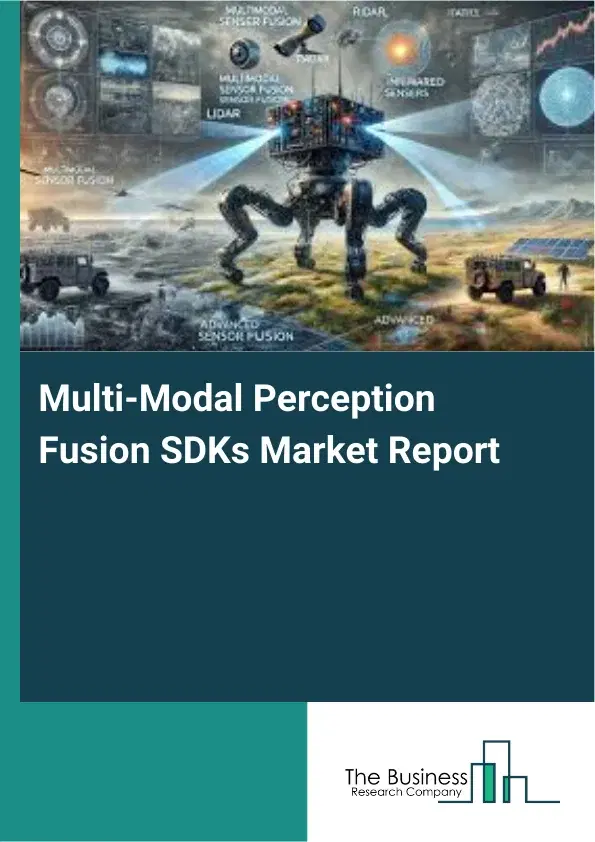
Multi-Modal Perception Fusion SDKs Market Report 2026
Global Outlook – By Component (Software, Services), By Modality (Vision, Audio, Text, Sensor Data, Other Modalities), By Deployment Mode (On Premises, Cloud), By End User (Automotive, Healthcare, Consumer Electronics, Industrial, Security, Other End Users) – Market Size, Trends, Strategies, and Forecast to 2030
Multi-Modal Perception Fusion SDKs Market Overview
• Multi-Modal Perception Fusion SDKs market size has reached to $2.14 billion in 2025 • Expected to grow to $6.21 billion in 2030 at a compound annual growth rate (CAGR) of 23.8% • Growth Driver: Surge In Rising Deployment Of Autonomous Vehicles Fueling The Growth Of The Market Due To Increasing Commercial Usage Of Avs • Market Trend: TIER IV Introduced A Renewed Sensor Fusion Development Kit To Enhance Advanced Object Recognition And Real-Time Autonomous Perception • North America was the largest region in 2025 and Asia-Pacific is the fastest growing region.What Is Covered Under Multi-Modal Perception Fusion SDKs Market?
Multi-modal perception fusion software development kits (SDKs) are software development kits designed to combine and interpret data from multiple sensing modalities such as vision, audio, radar, and other contextual inputs to create a unified understanding of an environment. These software development kits (SDKs) enable advanced perception by synchronizing, aligning, and fusing heterogeneous data streams to improve accuracy, robustness, and situational awareness. They support the development of intelligent systems by providing tools, algorithms, and frameworks that enhance real-time decision making and adaptive responses. The main types of multi-modal perception fusion software development kits include software and services. Software refers to development kits that enable the integration and fusion of multiple data modalities to create unified perception systems for intelligent applications. The kits support modalities such as vision, audio, text, sensor data, and other modalities and are deployed through on-premises and cloud models. The systems are used by end users such as automotive, healthcare, consumer electronics, industrial, security, and other end users.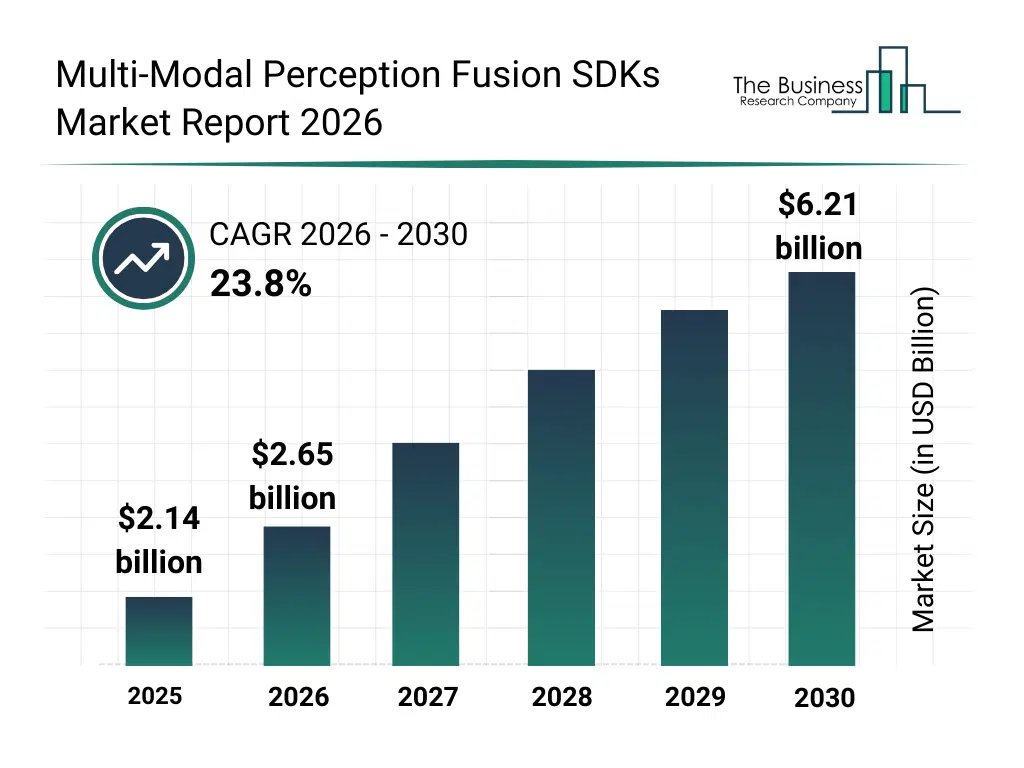
What Is The Multi-Modal Perception Fusion SDKs Market Size and Share 2026?
The multi-modal perception fusion sdks market size has grown exponentially in recent years. It will grow from $2.14 billion in 2025 to $2.65 billion in 2026 at a compound annual growth rate (CAGR) of 23.5%. The growth in the historic period can be attributed to growth of autonomous vehicle perception, expansion of robotics sensing stacks, rise of Computer Vision platforms, increase in multi sensor devices, early sensor fusion middleware.What Is The Multi-Modal Perception Fusion SDKs Market Growth Forecast?
The multi-modal perception fusion sdks market size is expected to see exponential growth in the next few years. It will grow to $6.21 billion in 2030 at a compound annual growth rate (CAGR) of 23.8%. The growth in the forecast period can be attributed to demand for robust autonomous perception, growth of industrial robotics, expansion of smart surveillance systems, rise of edge AI perception, need for real time situational awareness. Major trends in the forecast period include sensor fusion sdk toolchains, real time multisensor alignment, perception model integration kits, simulation driven fusion testing, edge deployed fusion frameworks.
Global Multi-Modal Perception Fusion SDKs Market Segmentation
1) By Component: Software; Services 2) By Modality: Vision; Audio; Text; Sensor Data; Other Modalities 3) By Deployment Mode: On Premises; Cloud 4) By End User: Automotive; Healthcare; Consumer Electronics; Industrial; Security; Other End Users Subsegments: 1) By Software: Vision Processing Modules; Audio Processing Modules; Text Processing Modules; Sensor Fusion Engines 2) By Services: System Integration Services; Custom Development Services; Maintenance And Support Services; Consulting ServicesWhat Is The Driver Of The Multi-Modal Perception Fusion SDKs Market?
The rising deployment of autonomous vehicles is expected to propel the growth of the multi-modal perception fusion SDKs market going forward. Autonomous vehicles refers to the commercial operation of vehicles capable of automated driving functions without direct human control on public roads. Autonomous vehicles are increasing due to rapid advancements in artificial intelligence and sensor technologies that enable safer and more reliable self-driving capabilities. Multi-modal perception fusion SDKs support autonomous vehicles by combining data from cameras, LiDAR, radar, and other sensors to create accurate, real-time environmental understanding for safer navigation and decision-making. For instance, in December 2023, according to the Insurance Institute for Highway Safety (IIHS), a US-based non-profit organization, it is projected that there are approximately 3.5 billion autonomous vehicle connections globally by 2025, increasing to 4.5 billion by 2030. Therefore, a rising deployment of autonomous vehicles is expected to drive the growth of the multi-modal perception fusion SDKs industry.Key Players In The Global Multi-Modal Perception Fusion SDKs Market
Major companies operating in the multi-modal perception fusion sdks market are Meta Platforms Inc., SoundHound AI Inc., Continental AG, NVIDIA Corporation, Valeo SE, Texas Instruments Incorporated, TDK Corporation, Hangzhou Hikvision Digital Technology Co. Ltd., SLAMTEC Co. Ltd., Horizon Robotics Inc., SenseTime Group Limited, Robotonomous Inc., Ambarella Inc., AImotive Kft., Applied Intuition Inc., Innoviz Technologies Ltd., StradVision Co. Ltd., ClarifAI Inc., Suteng Innovation Technology Co. Ltd., Eyeris Technologies Inc., Cognata Ltd., Aeva Inc.
This chart is for illustrative purposes; the full report includes a detailed competitor analysis and comprehensive overview of the top 10 companies in the market.
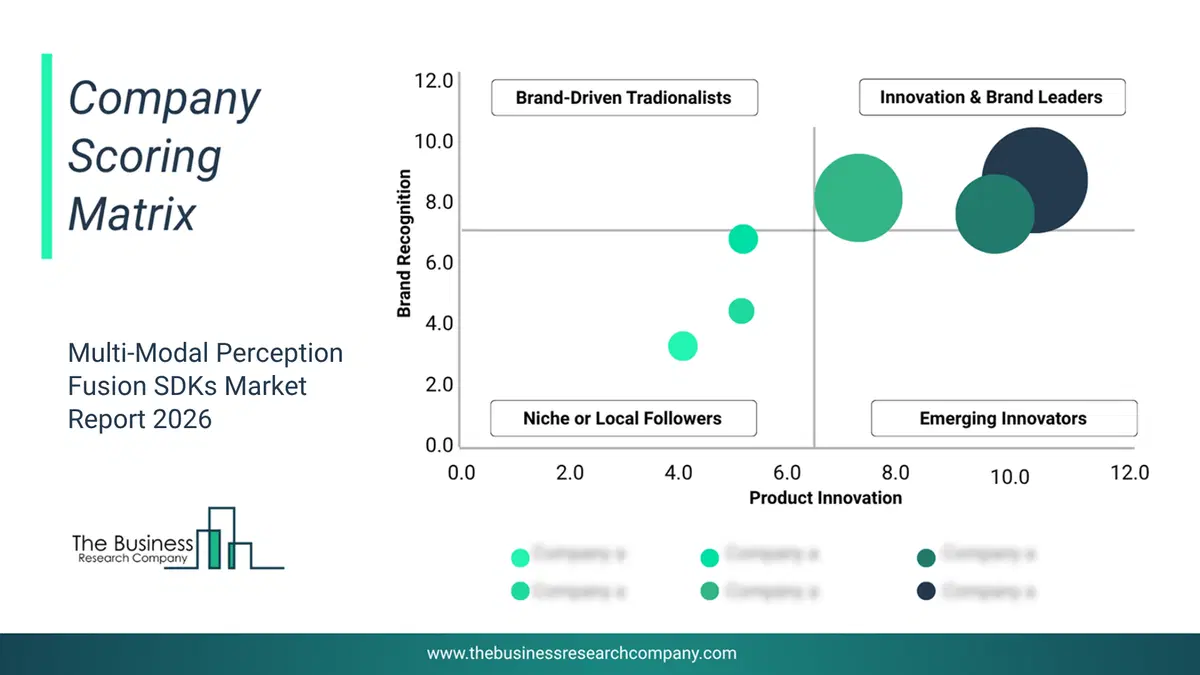
This chart maps companies by product innovation and brand strength, with bubble size indicating relative revenue, helping identify market leaders, challengers, and niche players. This is an illustrative chart; the full report provides a complete and accurate competitive analysis.
Global Multi-Modal Perception Fusion SDKs Market Trends and Insights
Major companies operating in the multi-modal perception fusion SDKs market are focusing on technological innovation, such as advanced object recognition technologies, to improve perception accuracy, enable real-time understanding of complex driving environments, and support safer and more reliable autonomous vehicle operations at scale. Advanced object recognition technologies refer to AI-based algorithms and models that analyze and fuse data from multiple sensors to accurately identify, classify, and track vehicles, pedestrians, and obstacles in real time under diverse driving conditions. For instance, in June 2023, Tier IV Inc., a Japan-based provider of autonomous driving software solutions, launched the Sensor Fusion Development Kit to enable seamless integration and fusion of camera, LiDAR, and radar data for advanced autonomous vehicle perception. It provides a ready-to-use package that combines advanced automotive sensors such as HDR cameras and 3D LiDARs with industrial-grade computing hardware to support high-performance perception development. It helps users build and test sensor fusion pipelines faster by reducing complexity around sensor/computer setup, ROS2 environment configuration, system synchronization, calibration, and perception model tuning. The kit includes proven hardware and software already used in TIER IV’s autonomous driving systems, along with detailed documentation for smooth integration and operation.What Are Latest Mergers And Acquisitions In The Multi-Modal Perception Fusion SDKs Market?
In February 2023, Torc Robotics Inc., a US-based provider of autonomous vehicle systems and self-driving technology, acquired Algolux Inc. for an undisclosed amount. With this acquisition, Torc Robotics aimed to strengthen its perception software stack by integrating Algolux’s advanced multi-modal perception fusion SDKs that deliver improved computer vision, sensor fusion, and machine learning-based environment understanding for autonomous driving platforms. Algolux Inc. is a Canada-based provider of perception software and AI-powered multi-sensor fusion SDKs designed to enhance object detection, depth estimation, and scene interpretation.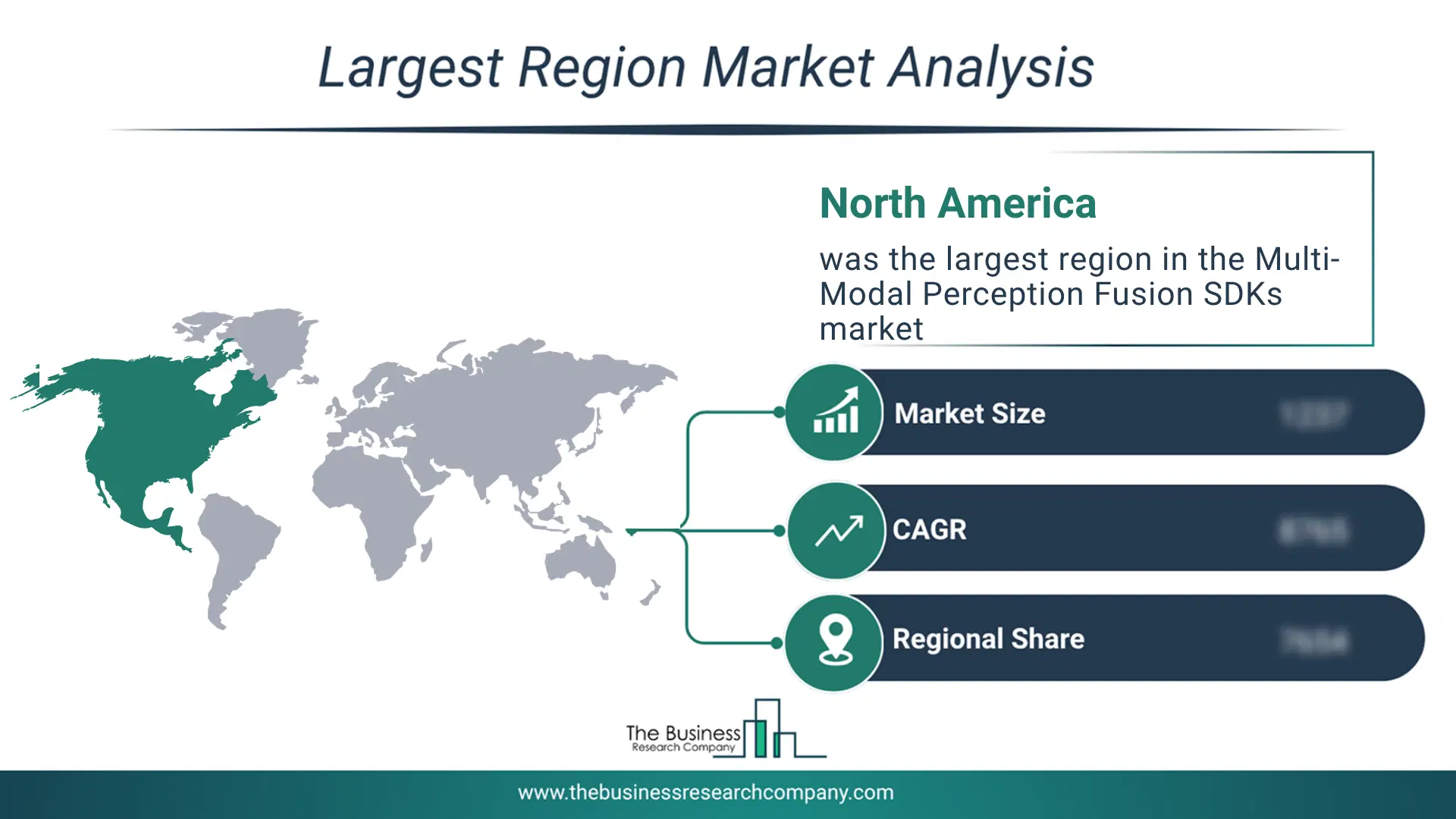
Regional Insights
North America was the largest region in the multi-modal perception fusion SDKs market in 2025. Asia-Pacific is expected to be the fastest-growing region in the forecast period. The regions covered in this market report are Asia-Pacific, South East Asia, Western Europe, Eastern Europe, North America, South America, Middle East, Africa. The countries covered in this market report are Australia, Brazil, China, France, Germany, India, Indonesia, Japan, Taiwan, Russia, South Korea, UK, USA, Canada, Italy, Spain.What Defines the Multi-Modal Perception Fusion SDKs Market?
The multi-modal perception fusion software development kits (SDKs) market consists of revenues earned by entities by providing services such as real-time perception processing, SDK licensing and deployment support, system testing and validation, performance optimization, and ongoing technical support and maintenance. The market value includes the value of related goods sold by the service provider or included within the service offering. The multi-modal perception fusion software development kits (SDKs) market also includes sales of pre-trained perception models, sensor fusion middleware, application programming interfaces (APIs), simulation and testing tools, and development toolchains. Values in this market are ‘factory gate’ values, that is the value of goods sold by the manufacturers or creators of the goods, whether to other entities (including downstream manufacturers, wholesalers, distributors and retailers) or directly to end customers. The value of goods in this market includes related services sold by the creators of the goods.How is Market Value Defined and Measured?
The market value is defined as the revenues that enterprises gain from the sale of goods and/or services within the specified market and geography through sales, grants, or donations in terms of the currency (in USD unless otherwise specified). The revenues for a specified geography are consumption values that are revenues generated by organizations in the specified geography within the market, irrespective of where they are produced. It does not include revenues from resales along the supply chain, either further along the supply chain or as part of other products.
This chart presents market attractiveness based on a quantitative evaluation of growth, competition, strategic alignment, and risk, offering a clear view of opportunity areas for decision-making. This chart is for illustrative purposes; the full report contains the complete analysis.

This chart highlights the Total Addressable Market (TAM) by estimating the maximum revenue opportunity using an assumption-driven approach, supporting strategic planning and opportunity sizing across markets. The chart is illustrative; the full report provides a more comprehensive analysis.
What Key Data and Analysis Are Included in the Multi-Modal Perception Fusion SDKs Market Report 2026?
The multi-modal perception fusion sdks market research report is one of a series of new reports from The Business Research Company that provides market statistics, including industry global market size, regional shares, competitors with the market share, detailed market segments, market trends and opportunities, and any further data you may need to thrive in the multi-modal perception fusion sdks industry. The market research report delivers a complete perspective of everything you need, with an in-depth analysis of the current and future state of the industry.Multi-Modal Perception Fusion SDKs Market Report Forecast Analysis
| Report Attribute | Details |
|---|---|
| Market Size Value In 2026 | $2.65 billion |
| Revenue Forecast In 2030 | $6.21 billion |
| Growth Rate | CAGR of 23.8% from 2026 to 2030 |
| Base Year For Estimation | 2025 |
| Actual Estimates/Historical Data | 2020-2025 |
| Forecast Period | 2026 - 2030 |
| Market Representation | Revenue in USD Billion and CAGR from 2026 to 2030 |
| Segments Covered | Component, Modality, Deployment Mode, End User |
| Regional Scope | Asia-Pacific, Western Europe, Eastern Europe, North America, South America, Middle East, Africa |
| Country Scope | The Countries Covered In This Market Report Are Australia, Brazil, China, France, Germany, India, Indonesia, Japan, Taiwan, Russia, South Korea, Uk, Usa, Canada, Italy, Spain. |
| Key Companies Profiled | Meta Platforms Inc., SoundHound AI Inc., Continental AG, NVIDIA Corporation, Valeo SE, Texas Instruments Incorporated, TDK Corporation, Hangzhou Hikvision Digital Technology Co. Ltd., SLAMTEC Co. Ltd., Horizon Robotics Inc., SenseTime Group Limited, Robotonomous Inc., Ambarella Inc., AImotive Kft., Applied Intuition Inc., Innoviz Technologies Ltd., StradVision Co. Ltd., ClarifAI Inc., Suteng Innovation Technology Co. Ltd., Eyeris Technologies Inc., Cognata Ltd., Aeva Inc. |
| Customization Scope | Request for Customization |
| Pricing And Purchase Options | Explore Purchase Options |