

Multi‑NIC CNI Bonding Market Report 2026
Global Outlook – By Component (Software, Hardware, Services), By Network Type (Ethernet, InfiniBand, Other Network Types), By Deployment Mode (On-Premises, Cloud-Based, Hybrid), By Application (Network Load Balancing, High Availability And Failover, Traffic Management, Data Center Networking), By Industry Vertical (Telecommunications, Information Technology, Banking, Financial Services And Insurance (BFSI), Healthcare) – Market Size, Trends, Strategies, and Forecast to 2030
Multi-NIC CNI Bonding Market Overview
• Multi-NIC CNI Bonding market size has reached to $1.63 billion in 2025 • Expected to grow to $3.44 billion in 2030 at a compound annual growth rate (CAGR) of 16% • Growth Driver: Rising Demand For Network Redundancy Driving The Growth Of The Market Due To Increasing Need For Continuous Connectivity And Network Resilience • Market Trend: Expansion Of Multi-NIC CNI Networking Enhances Bandwidth And Network Performance For AI And HPC Workloads • North America was the largest region in 2025 and Asia-Pacific is the fastest growing region.What Is Covered Under Multi‑NIC CNI Bonding Market?
Multi-NIC CNI bonding is a networking architecture that combines multiple physical or virtual network interface cards within a containerized environment through the Container Network Interface framework to create a unified logical connection, enhancing bandwidth utilization, network resilience, fault tolerance, traffic distribution, and overall communication reliability across orchestrated workloads. It is widely applied in cloud-native and distributed computing environments to improve network availability, optimize data transfer efficiency, support high-performance workloads, strengthen infrastructure redundancy, and enable consistent connectivity for applications requiring dependable and scalable network communication. The main components of multi-NIC CNI bonding include software, hardware, and services. Software refers to programs and tools used to configure, manage, and optimize network interface bonding within containerized network environments. The network types include Ethernet, InfiniBand, and other network types, while deployment modes include on-premises, cloud-based, and hybrid models. The applications include network load balancing, high availability and failover, traffic management, and data center networking, while industry verticals include telecommunications, information technology, banking, financial services and insurance, and healthcare.
What Is The Multi‑NIC CNI Bonding Market Size and Share 2026?
The multi‑nic cni bonding market size has grown rapidly in recent years. It will grow from $1.63 billion in 2025 to $1.9 billion in 2026 at a compound annual growth rate (CAGR) of 16.7%. The growth in the historic period can be attributed to growth of containerized application deployments, expansion of cloud computing infrastructure, increasing adoption of Kubernetes platforms, rising demand for network redundancy, growth in data center networking requirements.What Is The Multi‑NIC CNI Bonding Market Growth Forecast?
The multi‑nic cni bonding market size is expected to see rapid growth in the next few years. It will grow to $3.44 billion in 2030 at a compound annual growth rate (CAGR) of 16.0%. The growth in the forecast period can be attributed to increasing adoption of cloud-native architectures, rising demand for high-performance container networking, growing deployment of distributed computing workloads, increasing need for network resilience in data centers, expansion of hybrid cloud infrastructure. Major trends in the forecast period include increasing adoption of multi-NIC bonding in Kubernetes environments, growing use of high-performance network interfaces for containerized workloads, rising deployment of redundant network paths for containerized applications, increasing integration of Ethernet and InfiniBand connectivity in cloud-native infrastructure, growing demand for fault-tolerant network configurations in data centers.Tariff Impact On Multi‑NIC CNI Bonding Market
Tariffs are impacting the multi-NIC CNI bonding market by increasing the cost of imported network interface cards, network switches, servers, high-performance networking appliances, and semiconductor-based components required for containerized networking environments. This is slowing the deployment of containerized networking infrastructure, particularly in regions dependent on imports such as Asia-Pacific and Latin America. Hardware-intensive segments like network interface cards, high-performance networking appliances, and data center networking are most affected due to global supply chain dependencies. However, tariffs are also encouraging local manufacturing, regional supplier diversification, and increased investment in domestic networking infrastructure ecosystems, creating long-term resilience in the market.
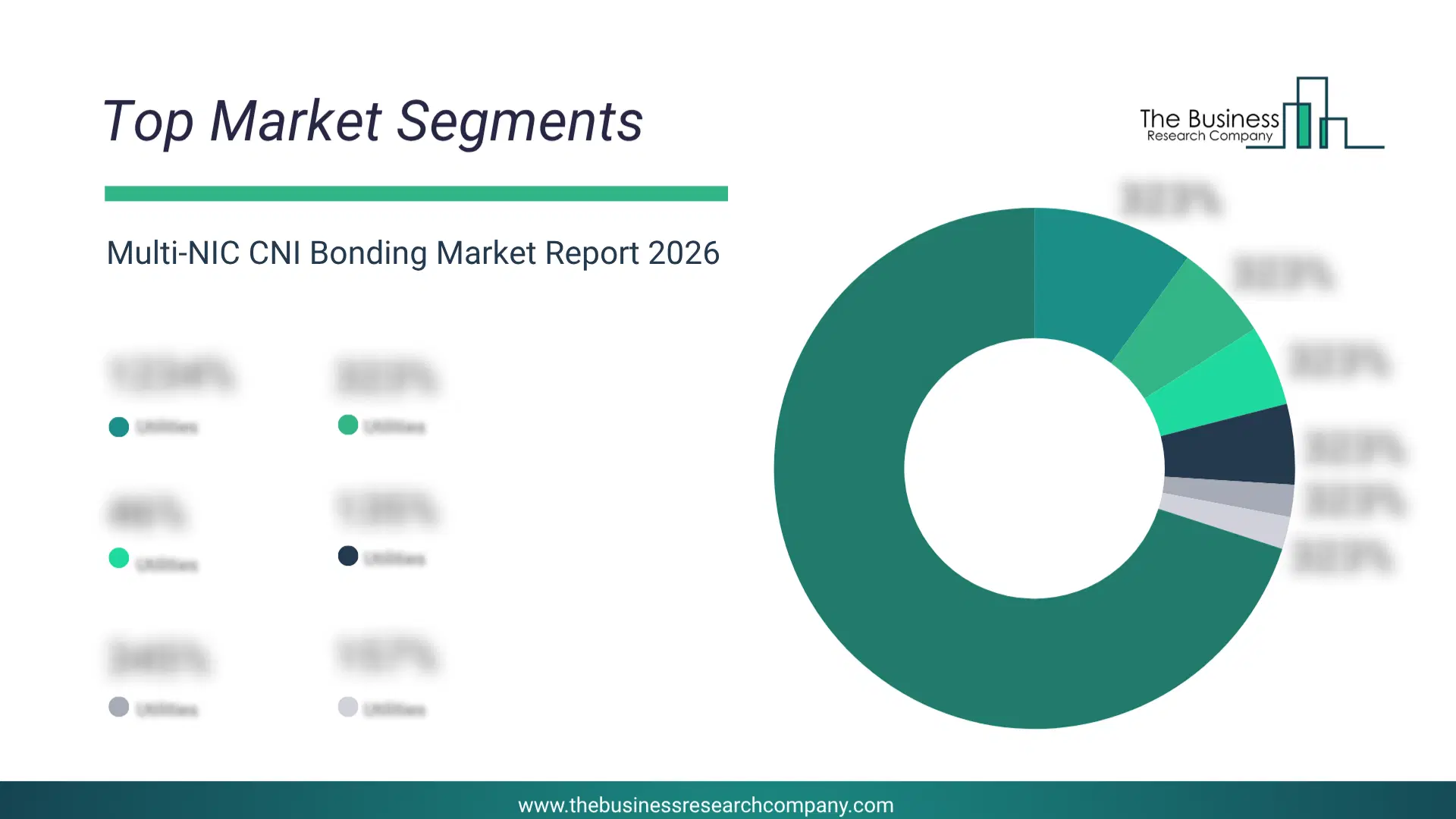
Global Multi‑NIC CNI Bonding Market Segmentation
1) By Component: Software, Hardware, Services 2) By Network Type: Ethernet, InfiniBand, Other Network Types 3) By Deployment Mode: On-Premises, Cloud-Based, Hybrid 4) By Application: Network Load Balancing, High Availability And Failover, Traffic Management, Data Center Networking 5) By Industry Vertical: Telecommunications, Information Technology, Banking, Financial Services And Insurance (BFSI), Healthcare Subsegments: 1) By Software: Container Networking Software, Network Bonding Management Software, Kubernetes Networking Platforms, Network Monitoring And Analytics Software 2) By Hardware: Network Interface Cards, Network Switches, Servers And Edge Devices, High Performance Networking Appliances 3) By Services: Consulting Services, Deployment And Integration Services, Managed Networking Services, Maintenance And Technical Support ServicesWhat Are The Drivers Of The Multi‑NIC CNI Bonding Market?
The rising demand for network redundancy is expected to propel the growth of the multi-NIC CNI bonding market going forward. Network redundancy refers to the practice of using backup network devices, systems, or communication paths to ensure continuous network operation in case of failures, outages, or disruptions. The rising demand for network redundancy is driven by the need for uninterrupted connectivity, as businesses rely on continuous network availability to prevent downtime, maintain operational efficiency, and ensure reliable digital communication. Multi-NIC CNI bonding helps meet the growing demand for network redundancy by combining multiple network interfaces into a single resilient connection, ensuring continuous connectivity and minimizing downtime during network failures or traffic disruptions. For instance, in September 2025, according to Opengear, a US-based provider of network resilience solutions, 84% of businesses reported an increase in network outages over the preceding two years. The increasing frequency of network outages is driving demand for network redundancy solutions, including backup network paths, redundant infrastructure, and automated failover mechanisms, to maintain connectivity and minimize service disruptions. Therefore, the rising demand for network redundancy is driving the growth of the multi‑NIC CNI bonding industry. The increasing cloud adoption is expected to propel the growth of the multi-NIC CNI bonding market going forward. Cloud is a computing model that delivers on-demand access to shared computing resources, including servers, storage, networking, databases, software, and analytics, over the internet, enabling organizations to scale resources efficiently while minimizing the need for on-premises infrastructure. Increasing cloud adoption is primarily driven by the growing need for operational agility, as cloud platforms allow organizations to rapidly deploy applications, scale computing resources based on changing workloads, accelerate innovation, and reduce infrastructure management complexity, enabling businesses to respond more effectively to evolving market demands and digital transformation initiatives. Multi-network interface card container network interface bonding supports increasing cloud adoption by enhancing network resilience, optimizing bandwidth utilization, and ensuring high availability for cloud-native applications, thereby improving the reliability and performance of modern cloud environments. For instance, in June 2026, according to Eurostat, the Luxembourg-based official statistical office of the European Union, 52.74% of enterprises in the European Union (EU) used paid cloud computing services in 2025. Therefore, the increasing cloud adoption is driving the growth of the multi‑NIC CNI bonding industry.Key Players In The Global Multi‑NIC CNI Bonding Market
Major companies operating in the multi‑nic cni bonding market are Amazon Web Services Inc., Google LLC, Microsoft Corporation, NVIDIA Corporation, International Business Machines Corporation, Broadcom Inc., Cisco Systems Inc., Oracle Corporation, Intel Corporation, Nokia Corporation, SUSE LLC, Arista Networks Inc., Fortinet Inc., Canonical Ltd., Mirantis Inc., Tigera Inc., DaoCloud Inc., Spectro Cloud Inc.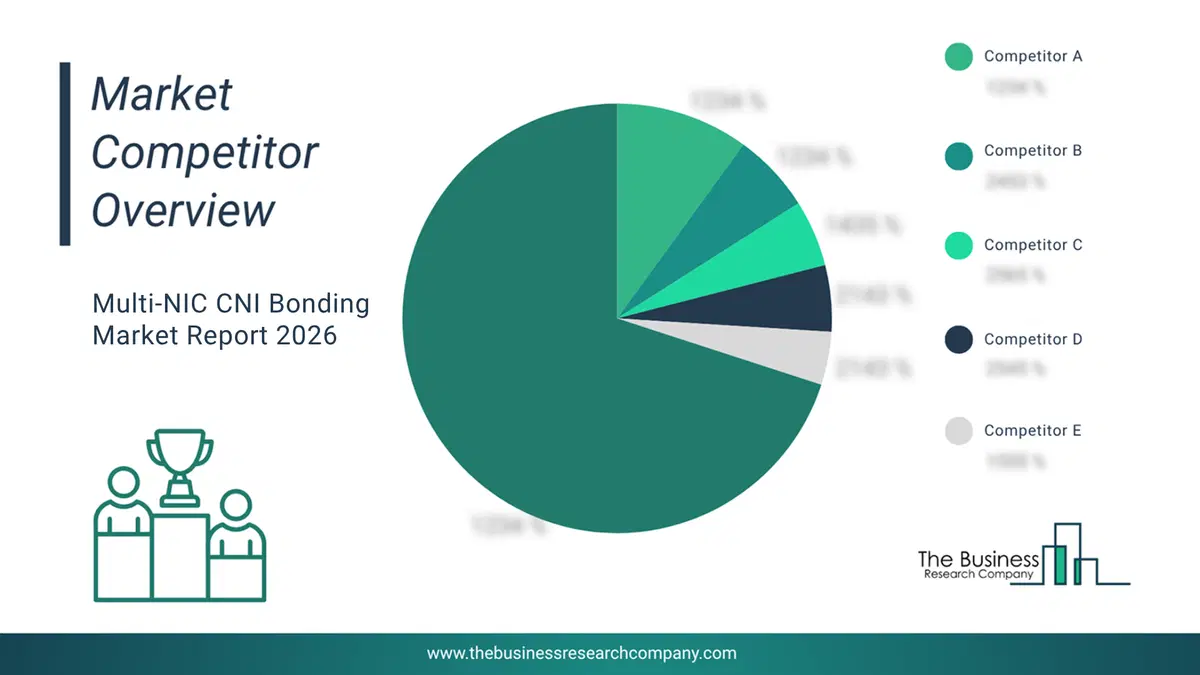
This chart is for illustrative purposes; the full report includes a detailed competitor analysis and comprehensive overview of the top 10 companies in the market.
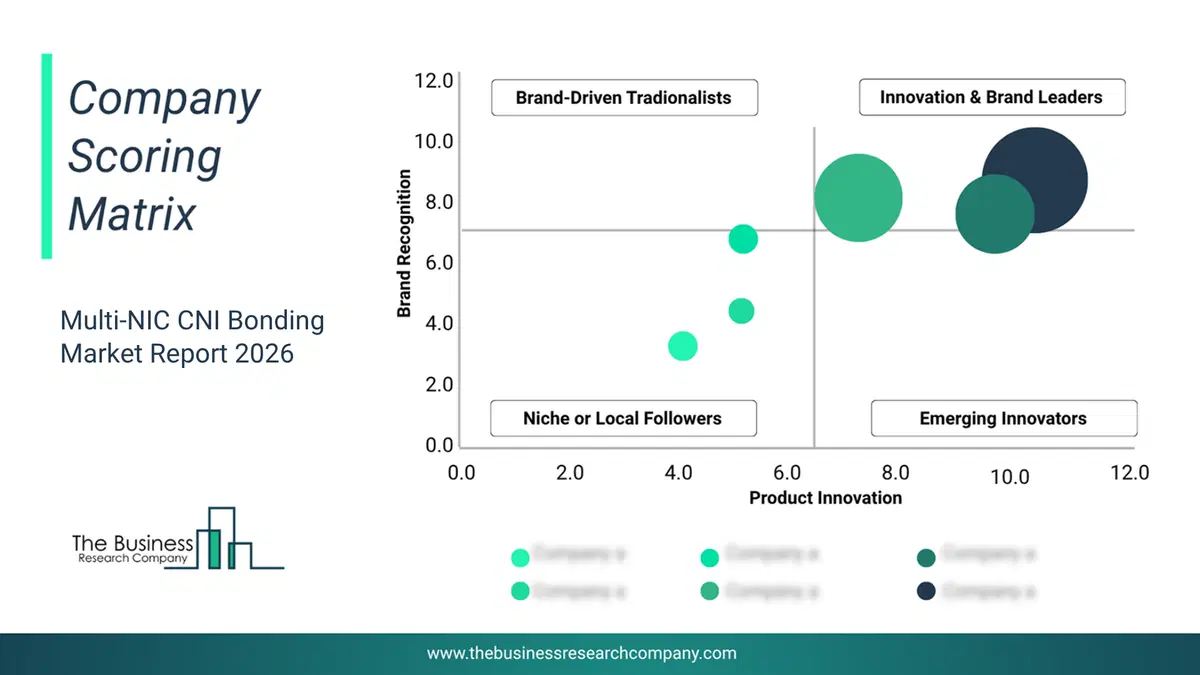
This chart maps companies by product innovation and brand strength, with bubble size indicating relative revenue, helping identify market leaders, challengers, and niche players. This is an illustrative chart; the full report provides a complete and accurate competitive analysis.
Global Multi‑NIC CNI Bonding Market Trends and Insights
Major companies operating in the Multi-NIC CNI bonding market are focusing on expanding multi-NIC container networking capabilities, such as attaching multiple network interfaces to Kubernetes pods, to increase network bandwidth, improve packet-rate performance, and support high-performance workloads. Multi-NIC CNI networking enables a single Kubernetes pod to use multiple network interfaces associated with different network cards on the underlying compute instance, allowing application traffic to utilize concurrent network connections and the available capacity of multiple NICs. For instance, in July 2025, Amazon Web Services Inc., a US-based cloud computing company, enhanced its Amazon VPC Container Network Interface (CNI) Plugin to support multiple network interfaces per pod. The enhancement enables multi-homed pods to distribute application traffic across multiple concurrent Elastic Network Interface (ENI) connections, increasing bandwidth and packet-rate performance for Kubernetes workloads, particularly for artificial intelligence, machine learning, and high-performance computing applications.
Regional Outlook
North America was the largest region in the multi‑nic cni bonding market in 2025. Asia-Pacific is expected to be the fastest-growing region in the forecast period. The regions covered in the multi‑nic cni bonding market report are Asia-Pacific, South East Asia, Western Europe, Eastern Europe, North America, South America, Middle East, Africa. The countries covered in the multi‑nic cni bonding market report are Australia, Brazil, China, France, Germany, India, Indonesia, Japan, Taiwan, Russia, South Korea, UK, USA, Canada, Italy, Spain.What Defines the Multi‑NIC CNI Bonding Market?
The multi-NIC CNI bonding market includes revenues earned by entities by providing services such as network integration services, cloud networking services, container networking services, network orchestration services, managed Kubernetes services, virtual network configuration services, edge connectivity services, cybersecurity services, performance management services, and network consulting services. The market value includes the value of related goods sold by the service provider or included within the service offering. The multi-NIC CNI bonding market also consists of sales of products such as network interface cards, Ethernet adapters, smart network switches, network processors, data center gateways, edge routers, hardware load balancers, server appliances, Kubernetes networking platforms, container networking appliances, optical transceivers, and network acceleration devices. Values in this market are ‘factory gate’ values, that is, the value of goods sold by the manufacturers or creators of the goods, whether to other entities (including downstream manufacturers, wholesalers, distributors, and retailers) or directly to end customers. The value of goods in this market includes related services sold by the creators of the goods.How is Market Value Defined and Measured?
The market value is defined as the revenues that enterprises gain from the sale of goods and/or services within the specified market and geography through sales, grants, or donations in terms of the currency (in USD unless otherwise specified). The revenues for a specified geography are consumption values that are revenues generated by organizations in the specified geography within the market, irrespective of where they are produced. It does not include revenues from resales along the supply chain, either further along the supply chain or as part of other products.
This chart presents market attractiveness based on a quantitative evaluation of growth, competition, strategic alignment, and risk, offering a clear view of opportunity areas for decision-making. This chart is for illustrative purposes; the full report contains the complete analysis.

This chart highlights the Total Addressable Market (TAM) by estimating the maximum revenue opportunity using an assumption-driven approach, supporting strategic planning and opportunity sizing across markets. The chart is illustrative; the full report provides a more comprehensive analysis.
What Key Data and Analysis Are Included in the Multi‑NIC CNI Bonding Market Report 2026?
The multi‑nic cni bonding market research report is one of a series of new reports from The Business Research Company that provides market statistics, including industry global market size, regional shares, competitors with the market share, detailed market segments, market trends and opportunities, and any further data you may need to thrive in the multi‑nic cni bonding industry. The market research report delivers a complete perspective of everything you need, with an in-depth analysis of the current and future state of the industry.Multi‑NIC CNI Bonding Market Report Forecast Analysis
| Report Attribute | Details |
|---|---|
| Market Size Value In 2026 | $1.9 billion |
| Revenue Forecast In 2030 | $3.44 billion |
| Growth Rate | CAGR of 16.0% from 2026 to 2030 |
| Base Year For Estimation | 2025 |
| Actual Estimates/Historical Data | 2020-2025 |
| Forecast Period | 2026 - 2030 |
| Market Representation | Revenue in USD Billion and CAGR from 2026 to 2030 |
| Segments Covered | Component, Network Type, Deployment Mode, Application, Industry Vertical |
| Regional Scope | Asia-Pacific, Western Europe, Eastern Europe, North America, South America, Middle East, Africa |
| Country Scope | The countries covered in the report are Australia, Brazil, China, France, Germany, India, Indonesia, Japan, Taiwan, Russia, South Korea, UK, USA, Canada, Italy, Spain. |
| Key Companies Profiled | Amazon Web Services Inc., Google LLC, Microsoft Corporation, NVIDIA Corporation, International Business Machines Corporation, Broadcom Inc., Cisco Systems Inc., Oracle Corporation, Intel Corporation, Nokia Corporation, SUSE LLC, Arista Networks Inc., Fortinet Inc., Canonical Ltd., Mirantis Inc., Tigera Inc., DaoCloud Inc., Spectro Cloud Inc. |
| Customization Scope | Request for Customization |
| Pricing And Purchase Options | Explore Purchase Options |