
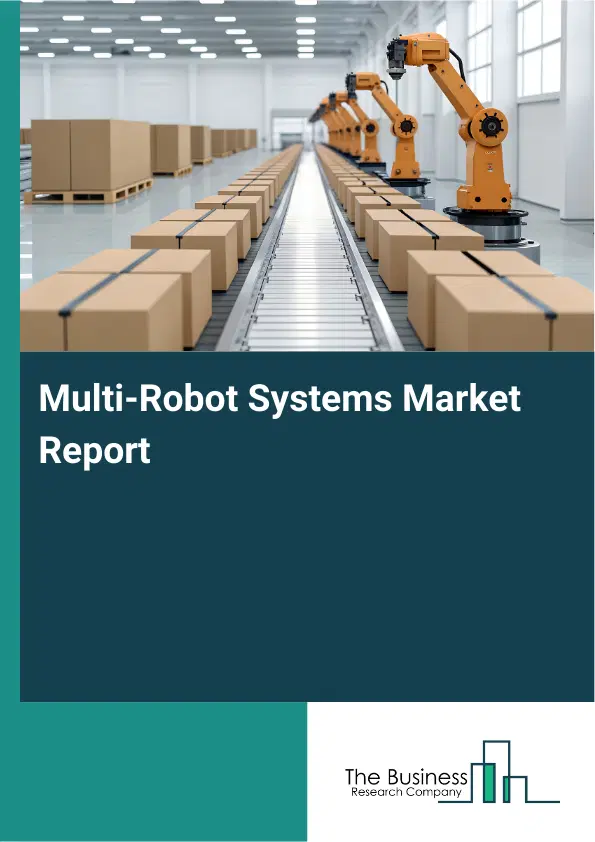
Multi-Robot Systems Market Report 2026
Global Outlook – By Component (Hardware, Software, Services), By Deployment Type (On-Premise Deployment, Cloud-Based Deployment, Hybrid Deployment), By Technology (Swarm Robotics, Collaborative Robotics (Cobots), Autonomous Mobile Robots (AMRs), Teleoperated Robots, Humanoid Robots), By Application (Industrial Automation, Healthcare And Medical Robotics, Agricultural Robotics, Defense And Security, Logistics And Warehousing, Construction And Infrastructure), By End-User (Automotive, Electronics, Food And Beverage, Pharmaceuticals, Other End-Users) – Market Size, Trends, Strategies, and Forecast to 2030
Multi-Robot Systems Market Overview
• Multi-Robot Systems market size has reached to $5.1 billion in 2025 • Expected to grow to $6.15 billion in 2030 at a compound annual growth rate (CAGR) of 3.7% • Growth Driver: Increasing Adoption Of Industrial Automation Fueling The Growth Of The Market Due To Demand For Enhancing Efficiency And Cost Reduction • Market Trend: Technologically Advanced Solutions Enable Seamless Robot Coordination • North America was the largest region in 2025.What Is Covered Under Multi-Robot Systems Market?
Multi-robot systems are coordinated groups of autonomous or semi-autonomous robots that collaborate to perform tasks in a shared environment. Their primary purpose is to enhance efficiency, scalability, and robustness in complex operations by distributing workloads, enabling parallel task execution, and providing redundancy in case of individual robot failures. The main types of components in multi-robot systems are hardware, software, and services. Hardware encompasses the physical components such as robots, sensors, actuators, and communication devices, that enable robots to perform tasks autonomously or collaboratively. These systems can be deployed through on-premise deployment, cloud-based deployment, and hybrid deployment, and utilize technologies such as swarm robotics, collaborative robotics (cobots), autonomous mobile robots (AMRs), teleoperated robots, and humanoid robots. Multi-robot systems find applications in industrial automation, healthcare and medical robotics, agricultural robotics, defense and security, logistics and warehousing, serving end users such as automotive, electronics, food and beverage, pharmaceuticals, and others.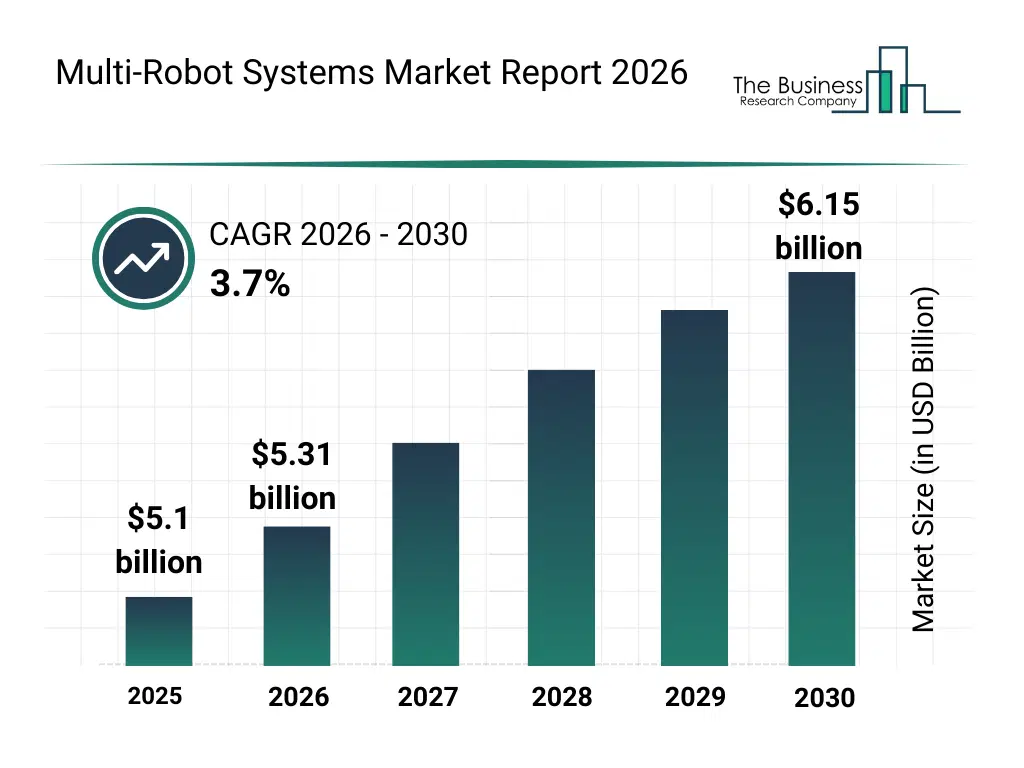
What Is The Multi-Robot Systems Market Size and Share 2026?
The multi-robot systems market size has grown steadily in recent years. It will grow from $5.1 billion in 2025 to $5.31 billion in 2026 at a compound annual growth rate (CAGR) of 4.1%. The growth in the historic period can be attributed to automation in manufacturing, labor shortage issues, advancement in robotics hardware, demand for operational efficiency, growth in industrial automation.What Is The Multi-Robot Systems Market Growth Forecast?
The multi-robot systems market size is expected to see steady growth in the next few years. It will grow to $6.15 billion in 2030 at a compound annual growth rate (CAGR) of 3.7%. The growth in the forecast period can be attributed to warehouse automation expansion, AI driven robotics coordination, growth in logistics robotics, demand for scalable automation, adoption of cloud based robot management. Major trends in the forecast period include growing deployment of swarm robotics, rising adoption of autonomous mobile robots, integration of ai based robot coordination, expansion of robots in warehouse automation, increased focus on collaborative robot fleets.Tariff Impact On Multi-Robot Systems Market
Tariffs have impacted the multi-robot systems market by raising costs of robotic hardware, sensors, and control systems. Industrial automation and logistics deployments are most affected, especially in Asia Pacific regions. Increased prices have slowed some large-scale deployments. However, tariffs have supported local robot assembly and system integration.
Global Multi-Robot Systems Market Segmentation
1) By Component: Hardware, Software, Services 2) By Deployment Type: On-Premise Deployment, Cloud-Based Deployment, Hybrid Deployment 3) By Technology: Swarm Robotics, Collaborative Robotics (Cobots), Autonomous Mobile Robots (AMRs), Teleoperated Robots, Humanoid Robots 4) By Application: Industrial Automation, Healthcare And Medical Robotics, Agricultural Robotics, Defense And Security, Logistics And Warehousing, Construction And Infrastructure 5) By End-User: Automotive, Electronics, Food And Beverage, Pharmaceuticals, Other End-Users Subsegments: 1) By Hardware: Sensors, Controllers, Communication Systems, Power Supply Units, End Effectors 2) By Software: Robot Operating Systems, Data Analytics Platforms, Simulation And Testing Tools, Fleet Management Software, Artificial Intelligence And Machine Learning Algorithms 3) By Services: Integration And Deployment, Training And Education, Maintenance And Support, Consulting Services, Managed ServicesWhat Is The Driver Of The Multi-Robot Systems Market?
The increasing adoption of industrial automation is expected to propel the growth of the multi-robot systems market going forward. Industrial automation refers to the use of technology, such as robotics and control systems, to perform industrial processes with minimal human intervention, improving efficiency, accuracy, and productivity. The adoption of industrial automation is increasing due to the need for increased operational efficiency as businesses aim to reduce costs, minimize errors, and boost productivity. Multi-robot systems enhance industrial automation by enabling coordinated operations among multiple robots, increasing efficiency and reducing human intervention. They support complex tasks through real-time collaboration and data sharing, improving productivity, precision, and operational flexibility across manufacturing, logistics, and service environments. For instance, in September 2024, according to the International Federation of Robotics, a Germany-based non-profit organization, there were 4,281,585 robotic units operating in factories globally in 2023, marking a 10% increase from 3,904,000 units in 2022. Therefore, the increasing adoption of industrial automation is driving the growth of the multi-robot systems industry.Key Players In The Global Multi-Robot Systems Market
Major companies operating in the multi-robot systems market are Mitsubishi Electric Corporation, ABB Ltd, Kawasaki Heavy Industries Ltd., FANUC Corporation, Omron Adept Technologies Inc., Yaskawa Electric Corporation, KUKA Aktiengesellschaft, Stäubli International AG, Nachi-Fujikoshi Corporation, Comau S.p.A., Schunk GmbH & Co. KG, Siasun Robot & Automation Co. Ltd., Universal Robots A/S, System Logistics S.p.A., Locus Robotics Corporation, Vecna Robotics Inc., Abco Automation Inc., Agility Robotics Inc., Robotnik Automation S.L.L., Elettric 80 S.p.A., SwarmFarm Robotics Pty Ltd., Festo AG & Co. KG
This chart is for illustrative purposes; the full report includes a detailed competitor analysis and comprehensive overview of the top 10 companies in the market.
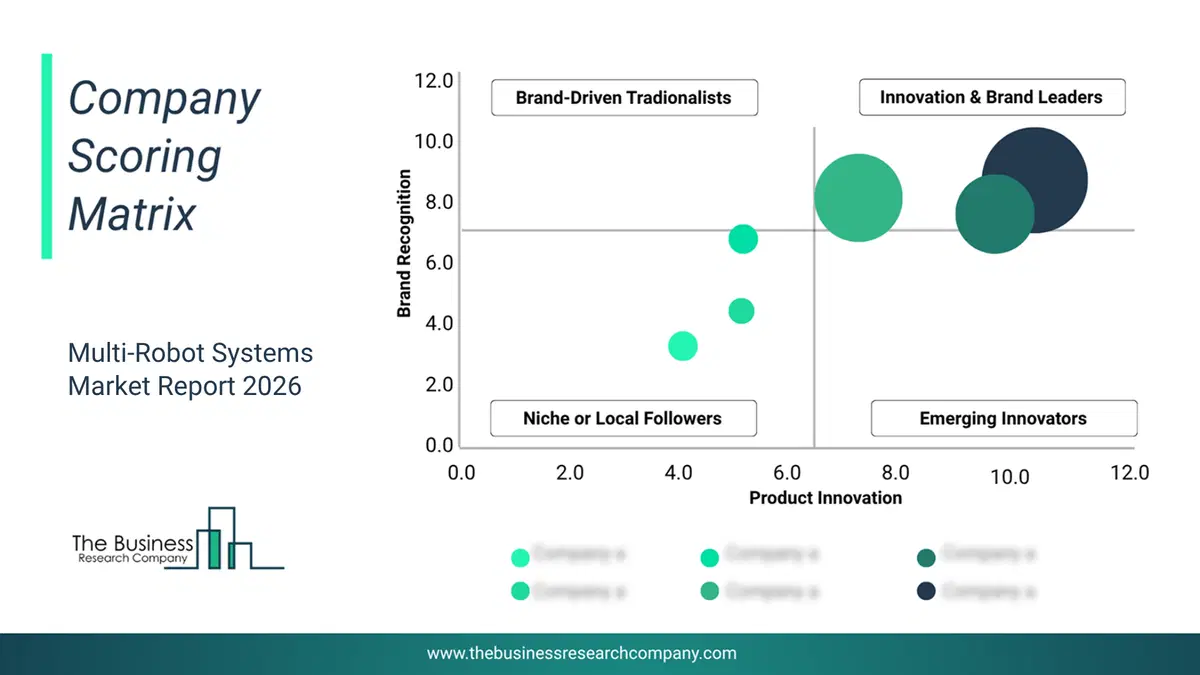
This chart maps companies by product innovation and brand strength, with bubble size indicating relative revenue, helping identify market leaders, challengers, and niche players. This is an illustrative chart; the full report provides a complete and accurate competitive analysis.
Global Multi-Robot Systems Market Trends and Insights
Major companies operating in the multi-robot systems market are focusing on developing technologically advanced solutions, such as multi-robot collaborative operating systems, to enable seamless coordination among heterogeneous robots and reduce human intervention across industrial, service, and logistics applications. A multi-robot collaborative operating system is a software platform that enables multiple robots to coordinate tasks, share real-time data, and work together efficiently across diverse environments. For instance, in April 2025, Chinasoft International Ltd., a China-based IT service management company, partnered with Shenzhen Kaihong Digital Industry Development Co. Ltd. and launched M-Robots OS, a heterogeneous multi-robot collaborative operating system. It enables real-time cooperation among diverse robots, including industrial arms, assistive robots, and mobile service robots. The platform also offers ultra-low latency communication, wide hardware compatibility, an AI-native architecture for autonomous task optimization, and comprehensive development tools to accelerate sector-specific applications. It addresses fragmented standards and redundant investments in China’s robotics industry by promoting multi-robot collaboration and swarm intelligence, aiming to advance applications across manufacturing, healthcare, logistics, and education.What Are Latest Mergers And Acquisitions In The Multi-Robot Systems Market?
In October 2023, Rockwell Automation Inc., a US-based industrial automation company, acquired Clearpath Robotics Inc. for an undisclosed amount. With this acquisition, Rockwell Automation aims to strengthen its portfolio in autonomous production logistics by integrating autonomous mobile robots and fleet management software with its existing industrial automation and control systems. Clearpath Robotics Inc. is a Canada-based autonomous robotics company specializing in multi-robot systems.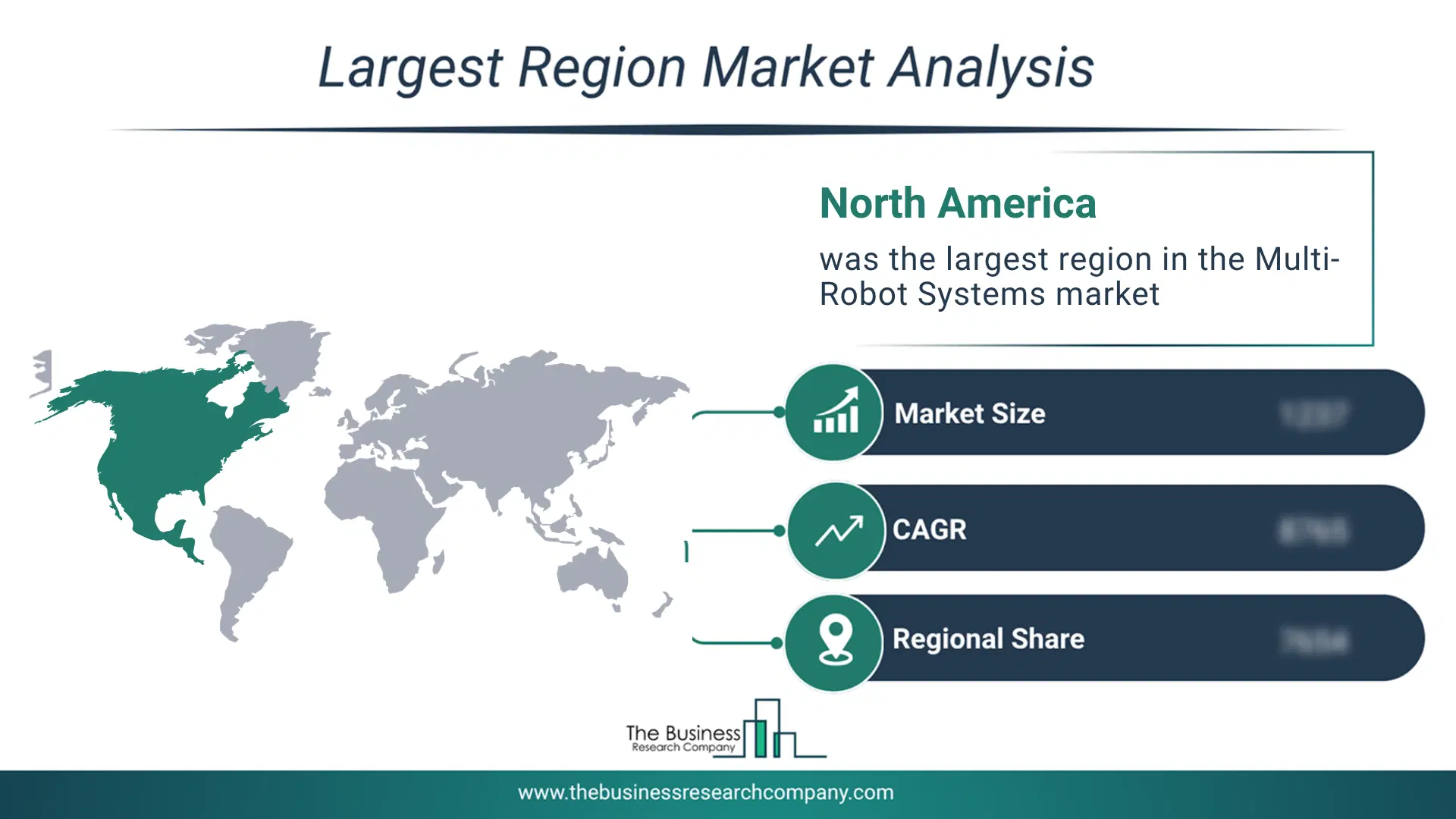
Regional Outlook
North America was the largest region in the multi-robot systems market in 2025. The regions covered in this market report are Asia-Pacific, South East Asia, Western Europe, Eastern Europe, North America, South America, Middle East, Africa The countries covered in this market report are Australia, Brazil, China, France, Germany, India, Indonesia, Japan, Taiwan, Russia, South Korea, UK, USA, Canada, Italy, Spain.What Defines the Multi-Robot Systems Market?
The multi-robot systems market includes revenues earned by entities by providing services, such as task allocation, path planning, fleet management, swarm coordination, and environment mapping. The market value includes the value of related goods sold by the service provider or included within the service offering. The multi-robot systems market also includes sales of autonomous mobile robots, unmanned aerial vehicles, robotic arms, ground delivery robots, and underwater drones. Values in this market are ‘factory gate’ values, that is, the value of goods sold by the manufacturers or creators of the goods, whether to other entities (including downstream manufacturers, wholesalers, distributors, and retailers) or directly to end customers. The value of goods in this market includes related services sold by the creators of the goods.How is Market Value Defined and Measured?
The market value is defined as the revenues that enterprises gain from the sale of goods and/or services within the specified market and geography through sales, grants, or donations in terms of the currency (in USD unless otherwise specified). The revenues for a specified geography are consumption values that are revenues generated by organizations in the specified geography within the market, irrespective of where they are produced. It does not include revenues from resales along the supply chain, either further along the supply chain or as part of other products.
This chart presents market attractiveness based on a quantitative evaluation of growth, competition, strategic alignment, and risk, offering a clear view of opportunity areas for decision-making. This chart is for illustrative purposes; the full report contains the complete analysis.

This chart highlights the Total Addressable Market (TAM) by estimating the maximum revenue opportunity using an assumption-driven approach, supporting strategic planning and opportunity sizing across markets. The chart is illustrative; the full report provides a more comprehensive analysis.
What Key Data and Analysis Are Included in the Multi-Robot Systems Market Report 2026?
The multi-robot systems market research report is one of a series of new reports from The Business Research Company that provides market statistics, including industry global market size, regional shares, competitors with the market share, detailed market segments, market trends and opportunities, and any further data you may need to thrive in the multi-robot systems industry. The market research report delivers a complete perspective of everything you need, with an in-depth analysis of the current and future state of the industry.Multi Robot Systems Market Report Forecast Analysis
| Report Attribute | Details |
|---|---|
| Market Size Value In 2026 | $5.31 billion |
| Revenue Forecast In 2030 | $6.15 billion |
| Base Year For Estimation | 2025 |
| Actual Estimates/Historical Data | 2020-2025 |
| Forecast Period | 2026 - 2030 |
| Market Representation | Revenue in USD Billion and CAGR from 2026 to 2030 |
| Segments Covered | Component, Deployment Type, Technology, Application, End-User |
| Regional Scope | Asia-Pacific, Western Europe, Eastern Europe, North America, South America, Middle East, Africa |
| Key Companies Profiled | Mitsubishi Electric Corporation, ABB Ltd, Kawasaki Heavy Industries Ltd., FANUC Corporation, Omron Adept Technologies Inc., Yaskawa Electric Corporation, KUKA Aktiengesellschaft, Stäubli International AG, Nachi-Fujikoshi Corporation, Comau S.p.A., Schunk GmbH & Co. KG, Siasun Robot & Automation Co. Ltd., Universal Robots A/S, System Logistics S.p.A., Locus Robotics Corporation, Vecna Robotics Inc., Abco Automation Inc., Agility Robotics Inc., Robotnik Automation S.L.L., Elettric 80 S.p.A., SwarmFarm Robotics Pty Ltd., Festo AG & Co. KG |
| Customization Scope | Request for Customization |
| Pricing And Purchase Options | Explore Purchase Options |