
Multi-Spectral And Hyperspectral Imaging Market Report 2026
Global Outlook – By Type (Multispectral Cameras, Hyperspectral Scanners, Integrated Spectral Platforms), By Platform Type (Ground Based, Aerial, Airborne, Space Based), By Technology Type (Push Broom Imaging, Snapshot Imaging, Scanning Imaging), By Application (Environmental Monitoring, Precision Agriculture, Mining And Mineral Exploration, Defense And Surveillance, Healthcare And Medical Diagnostics, Food And Beverage Inspection, Industrial Quality Control, Remote Sensing), By End User (Government And Defense Organizations, Agriculture Sector, Healthcare Providers, Food And Beverage Industry, Industrial And Manufacturing Companies, Research And Academic Institutions) – Market Size, Trends, Strategies, and Forecast to 2030
Multi-Spectral And Hyperspectral Imaging Market Overview
• Multi-Spectral And Hyperspectral Imaging market size has reached to $4.07 billion in 2025 • Expected to grow to $4.49 billion in 2030 at a compound annual growth rate (CAGR) of 10.6% • Growth Driver: The Rising Adoption Of Precision Agriculture Is Fueling The Growth Of The Market Due To Increasing Use Of Advanced Digital Technologies And GPS-Enabled Systems • Market Trend: AI-Driven Advances In Multi-Spectral And Hyperspectral Imaging For Enhanced Detection And Analysis • North America was the largest region in 2025 and Asia-Pacific is the fastest growing region.What Is Covered Under Multi-Spectral And Hyperspectral Imaging Market?
Multi-spectral and hyperspectral imaging refers to advanced sensing technologies that capture and process image data across multiple and continuous spectral bands beyond the visible light spectrum. These systems enable precise material identification, chemical composition analysis, and environmental characterization by detecting subtle spectral signatures across different wavelengths, supporting highly detailed imaging and analytical applications. The main types of the multi-spectral and hyperspectral imaging are multispectral cameras, hyperspectral scanners, and integrated spectral platforms. Multispectral cameras refer to imaging devices that capture data across a limited number of spectral bands to analyze and interpret surface characteristics of objects. These solutions are deployed across various platform types, including ground based, aerial, airborne, and space based systems. They utilize different technology types, such as push broom imaging, snapshot imaging, and scanning imaging. These solutions are applied across a wide range of applications or end uses, including environmental monitoring, precision agriculture, mining and mineral exploration, defense and surveillance, healthcare and medical diagnostics, food and beverage inspection, industrial quality control, and remote sensing, and are used by multiple end users, such as government and defense organizations, agriculture sector, healthcare providers, food and beverage industry, industrial and manufacturing companies, and research and academic institutions.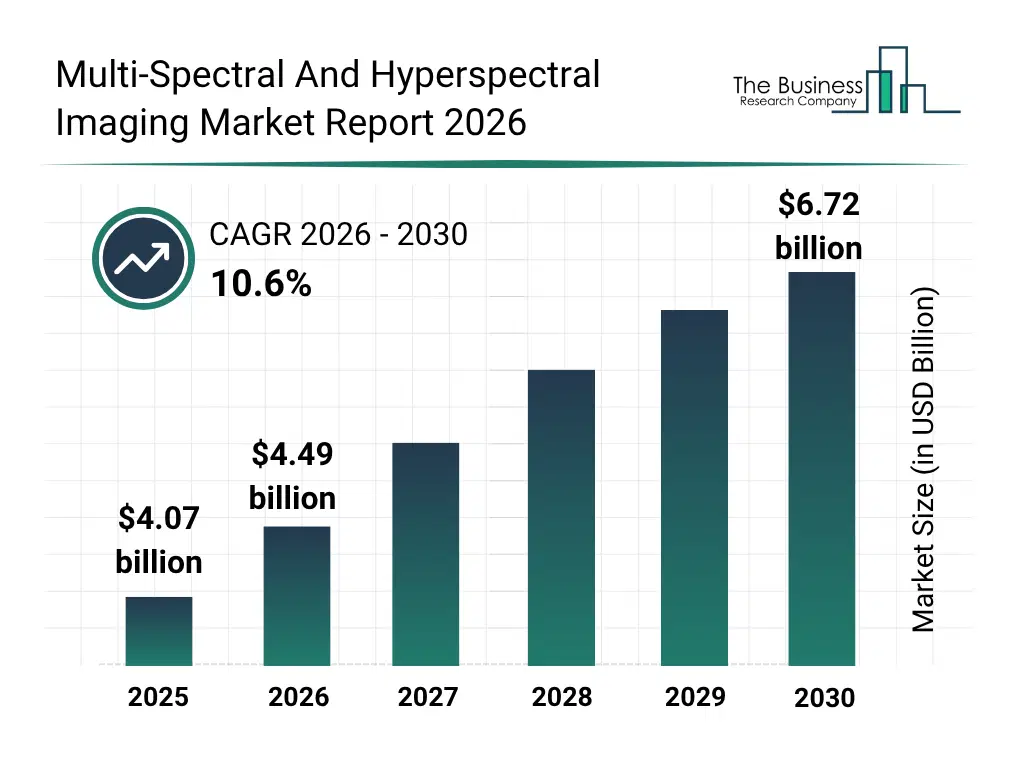
What Is The Multi-Spectral And Hyperspectral Imaging Market Size and Share 2026?
The multi-spectral and hyperspectral imaging market size has grown rapidly in recent years. It will grow from $4.07 billion in 2025 to $4.49 billion in 2026 at a compound annual growth rate (CAGR) of 10.4%. The growth in the historic period can be attributed to rise in remote sensing applications, increasing demand for agricultural monitoring, expansion of defense surveillance systems, growth in geological exploration activities, early adoption in medical imaging research.What Is The Multi-Spectral And Hyperspectral Imaging Market Growth Forecast?
The multi-spectral and hyperspectral imaging market size is expected to see rapid growth in the next few years. It will grow to $6.72 billion by 2030 at a compound annual growth rate (CAGR) of 10.6%. The growth in the forecast period can be attributed to integration of ai in spectral analysis, rising demand for precision agriculture solutions, expansion of earth observation satellite programs, increasing use in autonomous systems navigation, growing need for real-time environmental monitoring. Major trends in the forecast period include AI-enhanced spectral data processing and classification, drone and satellite-based hyperspectral imaging expansion, real-time edge-based spectral analytics integration, advanced material identification and chemical mapping systems, miniaturization of hyperspectral sensors and payloads.
Global Multi-Spectral And Hyperspectral Imaging Market Segmentation
1) By Type: Multispectral Cameras, Hyperspectral Scanners, Integrated Spectral Platforms 2) By Platform Type: Ground Based, Aerial, Airborne, Space Based 3) By Technology Type: Push Broom Imaging, Snapshot Imaging, Scanning Imaging 4) By Application: Environmental Monitoring, Precision Agriculture, Mining And Mineral Exploration, Defense And Surveillance, Healthcare And Medical Diagnostics, Food And Beverage Inspection, Industrial Quality Control, Remote Sensing 5) By End User: Government And Defense Organizations, Agriculture Sector, Healthcare Providers, Food And Beverage Industry, Industrial And Manufacturing Companies, Research And Academic Institutions Subsegments: 1) By Multispectral Cameras: Push Broom Cameras, Snapshot Cameras, Filter Wheel Cameras, Tunable Filter Cameras, Line Scan Cameras 2) By Hyperspectral Scanners: Push Broom Scanners, Whisk Broom Scanners, Snapshot Scanners, Coded Aperture Scanners, Fourier Transform Scanners 3) By Integrated Spectral Platforms: Drone Based Platforms, Airborne Platforms, Satellite Based Platforms, Ground Based Platforms, Vehicle Mounted PlatformsWhat Is The Driver Of The Multi-Spectral And Hyperspectral Imaging Market?
The rising adoption of precision agriculture is expected to propel the growth of the multispectral and hyperspectral imaging market. Precision agriculture is a modern farming approach that uses technology and data to manage crops and soil more accurately and efficiently. The increasing global adoption of precision agriculture is driven by the widespread use of GPS-enabled guidance systems, which allow farmers to optimize field operations with greater accuracy and efficiency. Multispectral and hyperspectral imaging technologies support precision agriculture by enabling farmers to monitor crop health using light beyond human vision. Multispectral imaging provides rapid insights into crop stress and growth patterns, while hyperspectral imaging offers detailed analysis of plant diseases and nutrient conditions, enabling more precise and efficient farming practices. For instance, according to PubMed Central (PMC), a US-based free digital, the adoption of digital technologies in agriculture in China is projected to increase significantly, with open-field and enclosed crop cultivation reaching 25% and 45% by 2025, and 50% and 70% by 2035, respectively. Therefore, rising adoption of precision agriculture is driving the growth of the multi-spectral and hyperspectral imaging industry.Key Players In The Global Multi-Spectral And Hyperspectral Imaging Market
Major companies operating in the multi-spectral and hyperspectral imaging market are Teledyne Technologies Incorporated, Bruker Corporation, ZEISS Group, Hamamatsu Photonics K.K., Interuniversity Microelectronics Centre, Thorlabs Inc., Pixxel Inc, Brimrose Corporation, Surface Optics Corporation, XIMEA GmbH, BaySpec Inc., Resonon Inc., Norsk Elektro Optikk AS, ITRES Research Ltd., SpecTIR LLC, HyperSpectral Corp, Hyperspectral Intelligence Inc., Living Optics Ltd, HAIP Solutions GmbH, HyVista Corp Pty Ltd., CytoViva Inc
This chart is for illustrative purposes; the full report includes a detailed competitor analysis and comprehensive overview of the top 10 companies in the market.
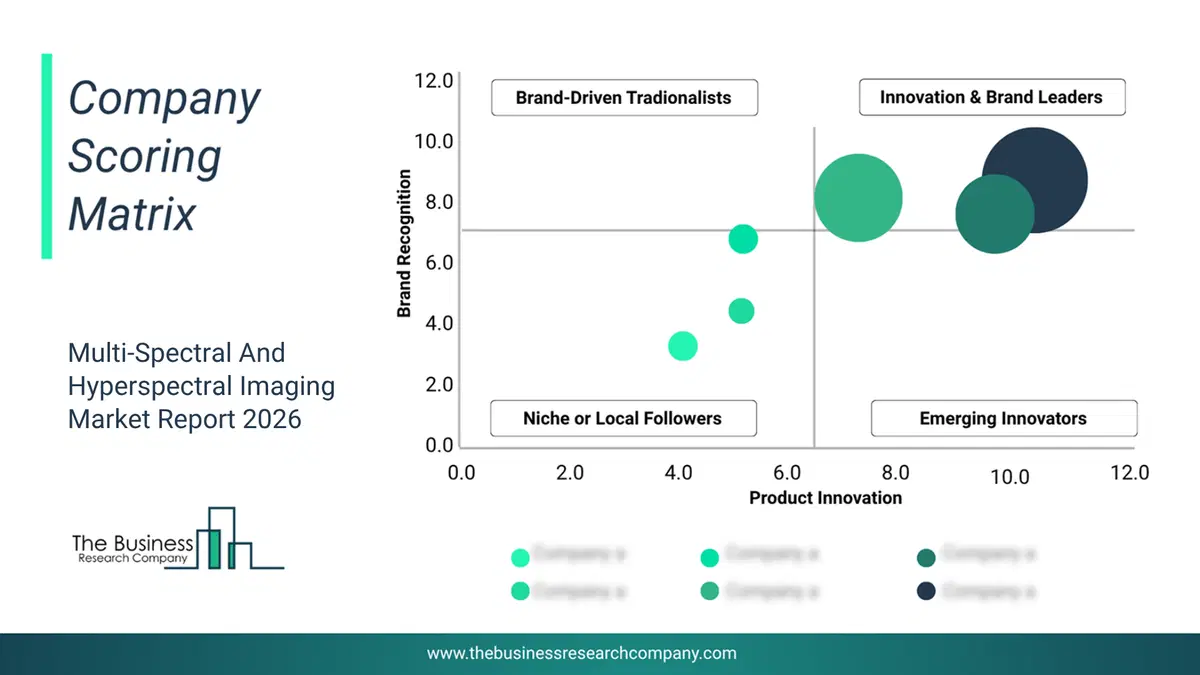
This chart maps companies by product innovation and brand strength, with bubble size indicating relative revenue, helping identify market leaders, challengers, and niche players. This is an illustrative chart; the full report provides a complete and accurate competitive analysis.
Global Multi-Spectral And Hyperspectral Imaging Market Trends and Insights
Major companies operating in the multi-spectral and hyperspectral imaging market are focusing on developing artificial intelligence driven spectral analytics to improve material detection, chemical composition identification, and environmental monitoring with greater speed, accuracy, and automation. Artificial intelligence driven spectral analytics refers to systems that use machine learning algorithms to process hyperspectral data, extract meaningful spectral signatures, detect subtle variations invisible to the human eye, and enable real-time decision-making in industrial, medical, and environmental applications. For instance, in January 2023, Panasonic Holdings Corporation, a Japan-based technology company, launched its hyperspectral imaging technology with the world’s highest sensitivity. The launched technology improves detection sensitivity by about 10 times compared to conventional systems, enables accurate color and spectral recognition under indoor lighting (550 lux), and allows high-frame-rate hyperspectral imaging at video speeds (over 30 fps), enhancing usability for industrial, medical, and research applications.What Are Latest Mergers And Acquisitions In The Multi-Spectral And Hyperspectral Imaging Market?
In January 2024, Headwall Photonics, Inc., a US-based provider of hyperspectral imaging and spectral sensing solutions, acquired inno-spec GmbH for an undisclosed amount. With this acquisition, Headwall Photonics aims to expand its industrial hyperspectral imaging capabilities by integrating inno-spec’s application-specific system expertise with its advanced optical and remote sensing technologies to enhance solutions across industrial inspection and machine vision applications. inno-spec GmbH is a Germany-based company specializing in industrial hyperspectral imaging systems and solutions for real-time material analysis and quality control.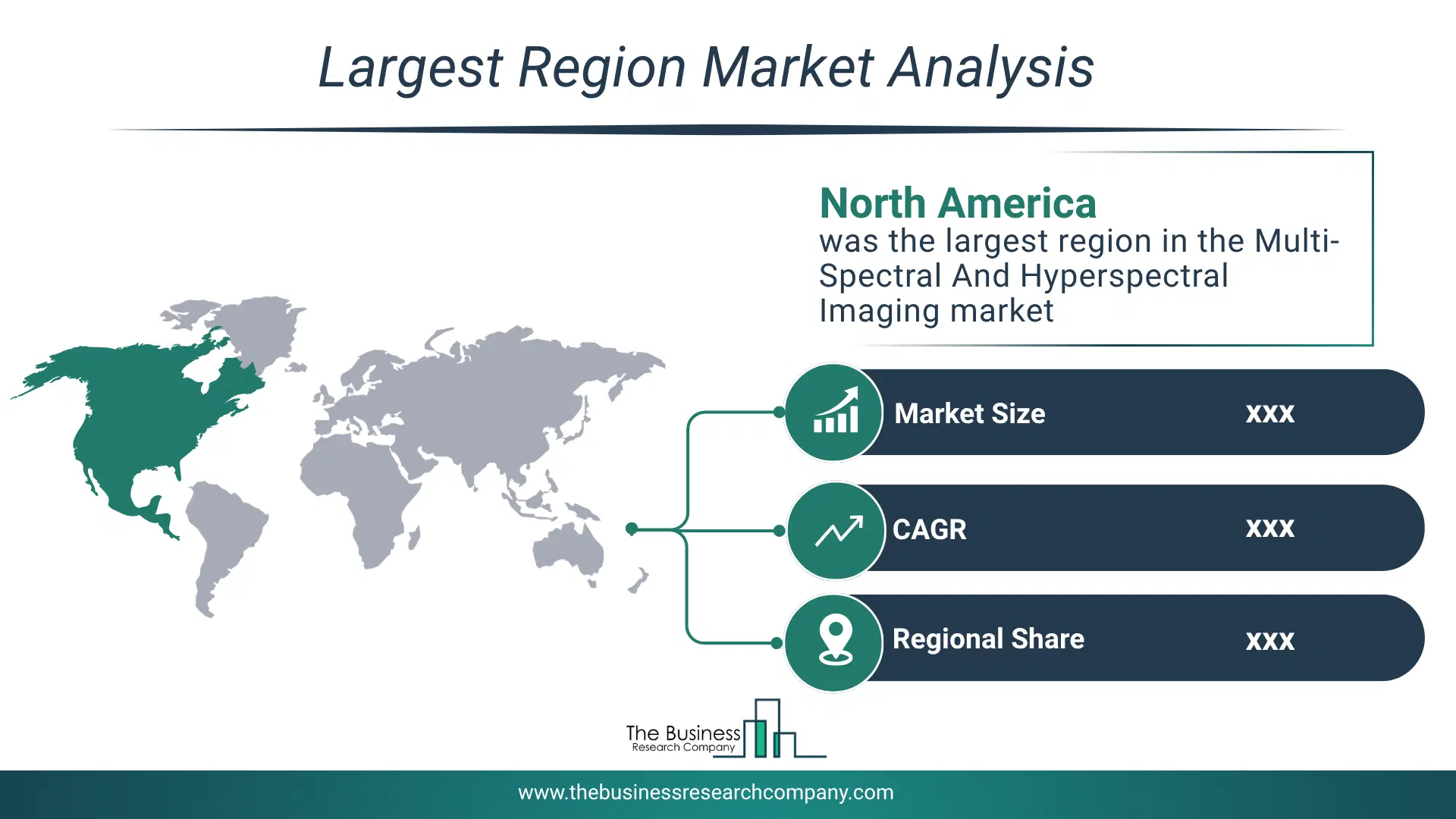
Regional Insights
North America was the largest region in the multi-spectral and hyperspectral imaging market in 2025. Asia-Pacific is expected to be the fastest-growing region in the forecast period. The regions covered in this market report are Asia-Pacific, South East Asia, Western Europe, Eastern Europe, North America, South America, Middle East, Africa. The countries covered in this market report are Australia, Brazil, China, France, Germany, India, Indonesia, Japan, Taiwan, Russia, South Korea, UK, USA, Canada, Italy, Spain.What Defines the Multi-Spectral And Hyperspectral Imaging Market?
The multi-spectral and hyperspectral imaging market consists of revenues earned by entities by providing services such as environmental monitoring, agriculture analysis, mineral exploration, surveillance and defense imaging, medical diagnostics, food quality inspection, industrial inspection and remote sensing services. The market value includes the value of related goods sold by the service provider or included within the service offering. The multi-spectral and hyperspectral imaging market includes sales of multispectral imaging, hyperspectral imaging, push broom imaging, snapshot imaging and scanning imaging. Values in this market are ‘factory gate’ values, that is, the value of goods sold by the manufacturers or creators of the goods, whether to other entities (including downstream manufacturers, wholesalers, distributors, and retailers) or directly to end customers. The value of goods in this market includes related services sold by the creators of the goods.How is Market Value Defined and Measured?
The market value is defined as the revenues that enterprises gain from the sale of goods and/or services within the specified market and geography through sales, grants, or donations in terms of the currency (in USD unless otherwise specified). The revenues for a specified geography are consumption values that are revenues generated by organizations in the specified geography within the market, irrespective of where they are produced. It does not include revenues from resales along the supply chain, either further along the supply chain or as part of other products.
This chart presents market attractiveness based on a quantitative evaluation of growth, competition, strategic alignment, and risk, offering a clear view of opportunity areas for decision-making. This chart is for illustrative purposes; the full report contains the complete analysis.

This chart highlights the Total Addressable Market (TAM) by estimating the maximum revenue opportunity using an assumption-driven approach, supporting strategic planning and opportunity sizing across markets. The chart is illustrative; the full report provides a more comprehensive analysis.
What Key Data and Analysis Are Included in the Multi-Spectral And Hyperspectral Imaging Market Report 2026?
The multi-spectral and hyperspectral imaging market research report is one of a series of new reports from The Business Research Company that provides market statistics, including industry global market size, regional shares, competitors with the market share, detailed market segments, market trends and opportunities, and any further data you may need to thrive in the multi-spectral and hyperspectral imaging industry. The market research report delivers a complete perspective of everything you need, with an in-depth analysis of the current and future state of the industry.Multi-Spectral And Hyperspectral Imaging Market Report Forecast Analysis
| Report Attribute | Details |
|---|---|
| Market Size Value In 2026 | $4.49 billion |
| Revenue Forecast In 2030 | $6.72 billion |
| Growth Rate | CAGR of 10.60% from 2026 to 2030 |
| Base Year For Estimation | 2025 |
| Actual Estimates/Historical Data | 2020-2025 |
| Forecast Period | 2026 - 2030 |
| Market Representation | Revenue in USD Billion and CAGR from 2026 to 2030 |
| Segments Covered | Type, Platform Type, Technology Type, Application, End User |
| Regional Scope | Asia-Pacific, Western Europe, Eastern Europe, North America, South America, Middle East, Africa |
| Country Scope | The countries covered in the report are Australia, Brazil, China, France, Germany, India, Indonesia, Japan, Taiwan, Russia, South Korea, UK, USA, Canada, Italy, Spain. |
| Key Companies Profiled | Teledyne Technologies Incorporated, Bruker Corporation, ZEISS Group, Hamamatsu Photonics K.K., Interuniversity Microelectronics Centre, Thorlabs Inc., Pixxel Inc, Brimrose Corporation, Surface Optics Corporation, XIMEA GmbH, BaySpec Inc., Resonon Inc., Norsk Elektro Optikk AS, ITRES Research Ltd., SpecTIR LLC, HyperSpectral Corp, Hyperspectral Intelligence Inc., Living Optics Ltd, HAIP Solutions GmbH, HyVista Corp Pty Ltd., CytoViva Inc |
| Customization Scope | Request for Customization |
| Pricing And Purchase Options | Explore Purchase Options |