

Multimodal Embeddings Market Report 2026
Global Outlook – By Component (Software, Hardware, Services), By Modality (Text, Image, Audio, Video, Sensor Data, Other Modalities), By Deployment Mode (On-Premises, Cloud), By Application (Natural Language Processing, Computer Vision, Speech Recognition, Healthcare, Autonomous Vehicles, Robotics, Other Applications), By End-User (Banking, Financial Services, And Insurance (BFSI), Healthcare, Retail And E-Commerce, Media And Entertainment, Information Technology (IT) And Telecommunications, Automotive, Other End-Users) – Market Size, Trends, Strategies, and Forecast to 2030
Multimodal Embeddings Market Overview
• Multimodal Embeddings market size has reached to $2.49 billion in 2025 • Expected to grow to $8.28 billion in 2030 at a compound annual growth rate (CAGR) of 27.2% • Growth Driver: Rising Demand For Personalized And Immersive User Experiences Is Fueling The Growth Of The Market Due To Increasing Use Of AI-Driven Personalization • Market Trend: Technological Advancements In Large Multimodal Foundation Models Shaping Multimodal Embeddings • North America was the largest region in 2025 and Asia-Pacific is the fastest growing region.What Is Covered Under Multimodal Embeddings Market?
Multimodal embeddings are unified numerical representations that encode information from multiple data types such as text, images, audio, and video into a shared vector space. They enable models to understand relationships and similarities across different modalities. They allow seamless interaction and comparison between diverse data formats within artificial intelligence systems. The main components of multimodal embeddings include software, hardware, and services. Software refers to applications that enable organizations to create and manage unified representations of diverse data types, such as text, images, audio, video, and sensor data, to improve analysis, understanding, and artificial intelligence model performance. These solutions support multiple modalities, including text, image, audio, video, sensor data, and other modalities, and are deployed through on-premises and cloud models depending on organizational infrastructure and requirements. The various applications involved are natural language processing, Computer Vision, speech recognition, healthcare, autonomous vehicles, robotics, and other applications. The end users of multimodal embeddings solutions include banking, financial services, and insurance companies, healthcare providers, retail and e-commerce companies, media and entertainment companies, information technology and telecommunications companies, automotive companies, and other organizations leveraging multimodal data for advanced analytics and artificial intelligence applications.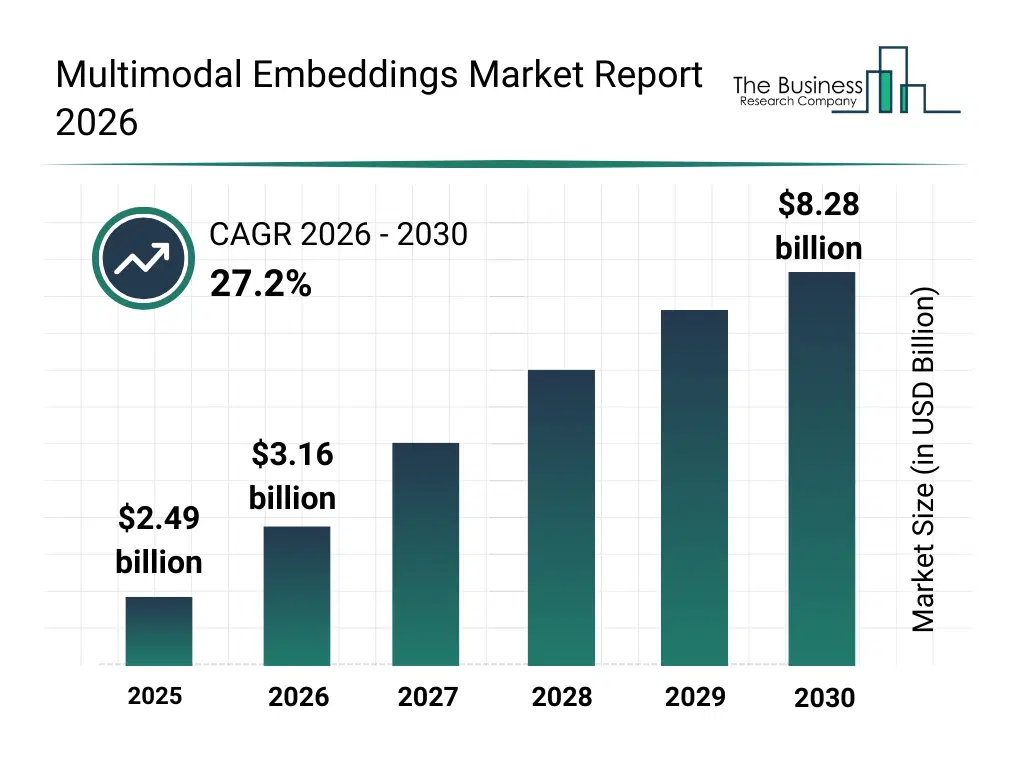
What Is The Multimodal Embeddings Market Size and Share 2026?
The multimodal embeddings market size has grown exponentially in recent years. It will grow from $2.49 billion in 2025 to $3.16 billion in 2026 at a compound annual growth rate (CAGR) of 27.0%. The growth in the historic period can be attributed to growth of nlp embeddings, rise of vector search databases, expansion of Deep Learning models, increase in unstructured data, adoption of semantic search.What Is The Multimodal Embeddings Market Growth Forecast?
The multimodal embeddings market size is expected to see exponential growth in the next few years. It will grow to $8.28 billion in 2030 at a compound annual growth rate (CAGR) of 27.2%. The growth in the forecast period can be attributed to demand for multimodal retrieval systems, growth of AI agents, expansion of cross modal search, enterprise vector database adoption, rise of multimodal foundation models. Major trends in the forecast period include cross modal vector representation models, shared embedding space architectures, large scale embedding apis, real time similarity search systems, domain tuned multimodal embeddings.
Global Multimodal Embeddings Market Segmentation
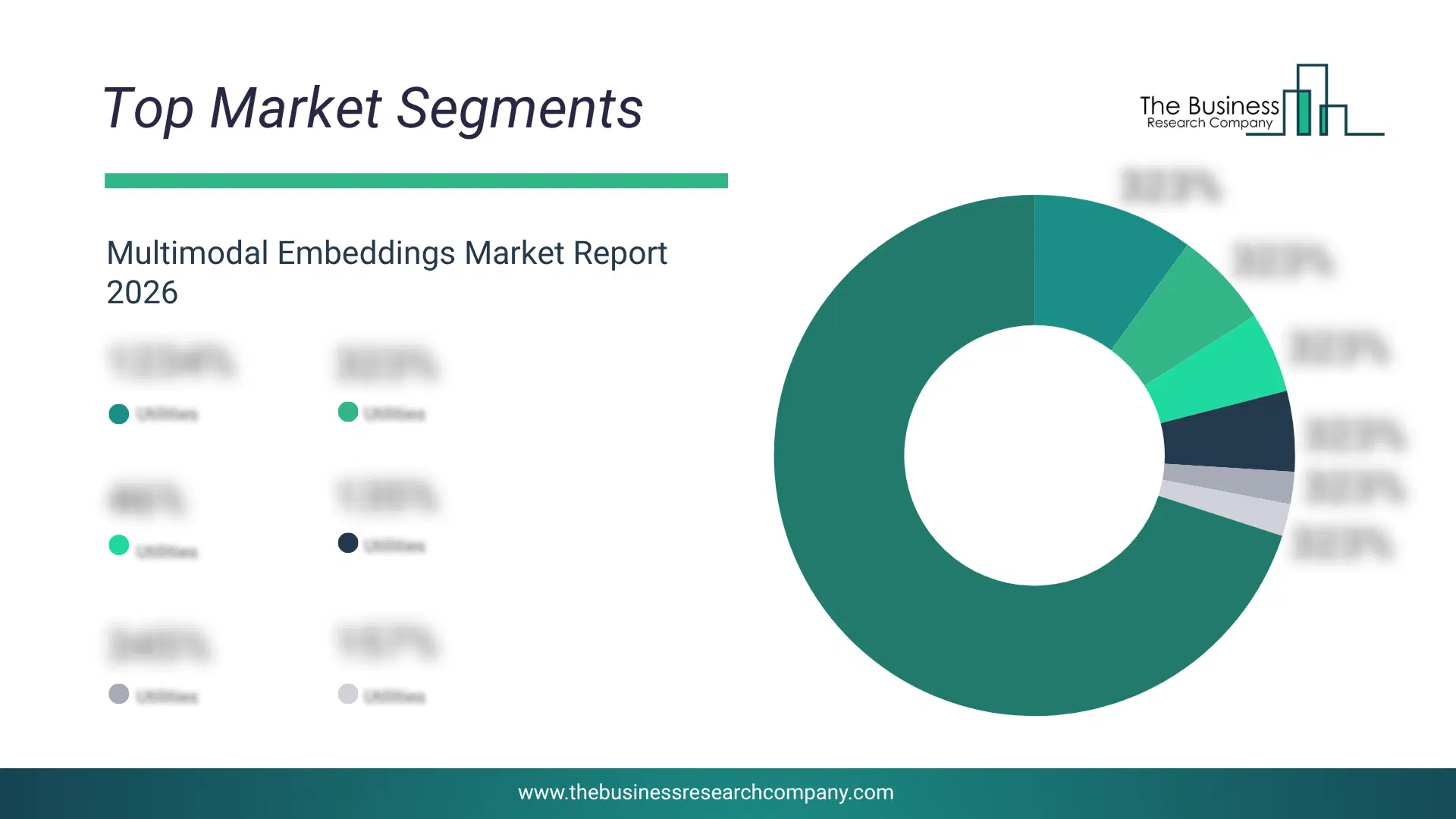
1) By Component: Software; Hardware; Services 2) By Modality: Text; Image; Audio; Video; Sensor Data; Other Modalities 3) By Deployment Mode: On-Premises; Cloud 4) By Application: Natural Language Processing; Computer Vision; Speech Recognition; Healthcare; Autonomous Vehicles; Robotics; Other Applications 5) By End-User: Banking, Financial Services, And Insurance (BFSI); Healthcare; Retail And E-Commerce; Media And Entertainment; Information Technology (IT) And Telecommunications; Automotive; Other End-Users Subsegments: 1) By Software: Core Multimodal Embedding Models; Model Training And Optimization Platforms; Application Programming Interfaces And Software Development Kits; Data Preprocessing And Feature Engineering Tools; Deployment And Integration Platforms 2) By Hardware: Graphics Processing Units; Tensor Processing Units; Central Processing Units; Artificial Intelligence (AI) Accelerators; Edge Computing Devices 3) By Services: Consulting And Strategy Services; System Integration Services; Model Customization And Optimization Services; Deployment And Maintenance Services; Managed And Support ServicesWhat Is The Driver Of The Multimodal Embeddings Market?
The rising demand for personalized and immersive user experiences is expected to propel the growth of the multimodal embeddings market going forward. Personalized and immersive user experiences refer to digital interactions that are tailored to individual preferences and fully engage users through interactive and multimodal interfaces. The increasing demand for such experiences is driven by the growing use of digital platforms and services that adapt to user behavior, enabling more engaging and customized interactions. Multimodal embeddings support personalized and immersive experiences by enabling different types of data to be combined and interpreted together, enhancing personalization and contextual understanding. For instance, in February 2025, according to SAP Emarsys, an Austria-based company, research conducted in 2024 revealed that 64% of US shoppers reported that AI had improved their retail experiences, representing a 25% increase in positive sentiment from 2023. This trend is expected to accelerate as AI technologies become more sophisticated. Therefore, the rising demand for personalized and immersive user experiences is driving the growth of the multimodal embeddings industry.Key Players In The Global Multimodal Embeddings Market
Major companies operating in the multimodal embeddings market are Vector AI Limited, Vector Flow Inc., Scale AI Inc., DataRobot, Eleven Labs Inc., AI21 Labs, Mistral AI, Pinecone Systems, Zilliz, Aleph Alpha, deepset, Jina AI, Vespa.ai, Replicate, Voyage AI, Chroma, ApertureData, Nomic AI, Prodia, DeepAI, Qdrant, Weaviate, Marqo, Redis Labs, and Anthropic.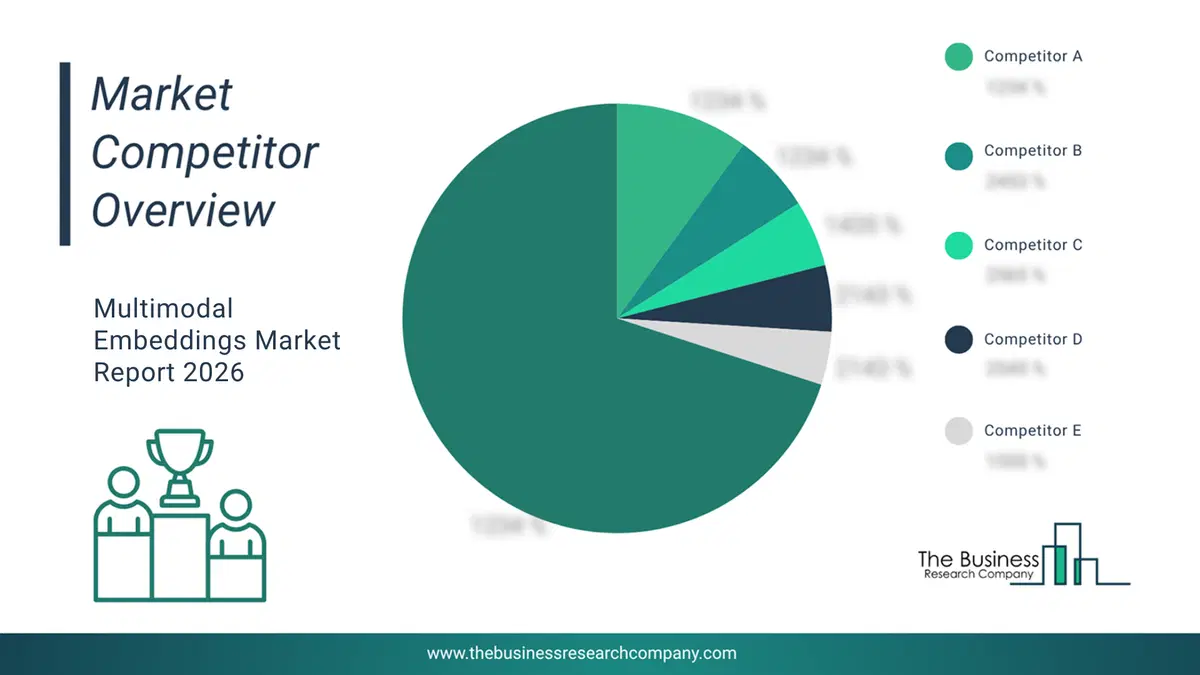
This chart is for illustrative purposes; the full report includes a detailed competitor analysis and comprehensive overview of the top 10 companies in the market.
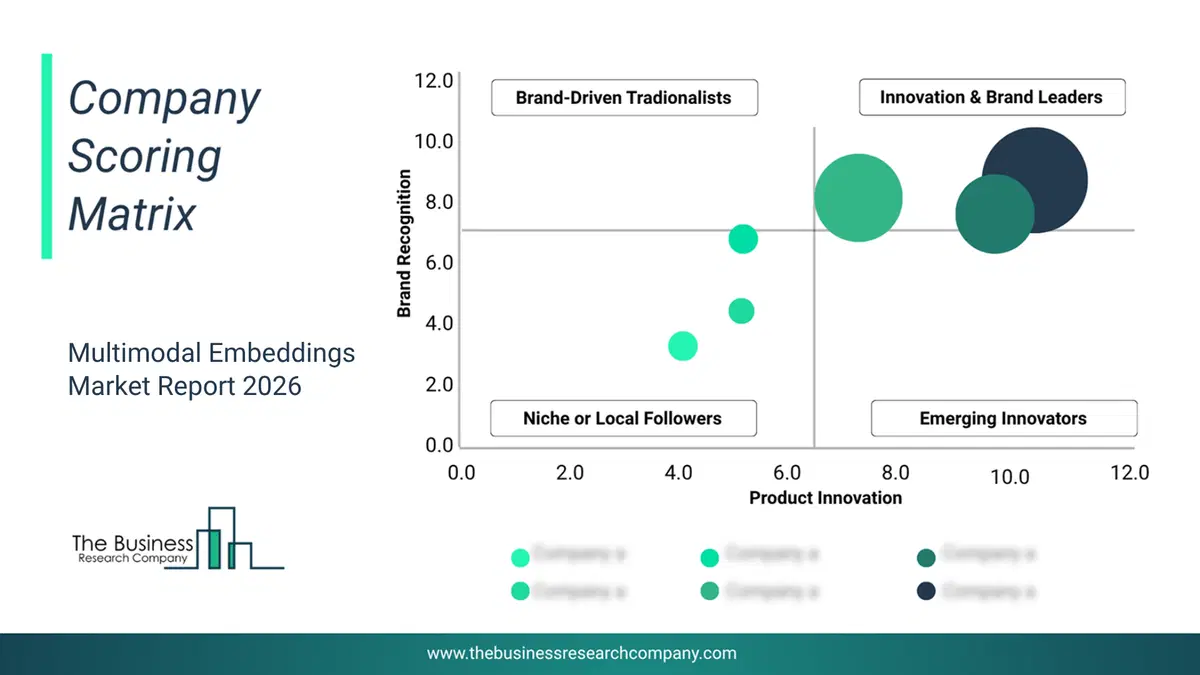
This chart maps companies by product innovation and brand strength, with bubble size indicating relative revenue, helping identify market leaders, challengers, and niche players. This is an illustrative chart; the full report provides a complete and accurate competitive analysis.
Global Multimodal Embeddings Market Trends and Insights
Major companies operating in the multimodal embeddings market are focusing on technological advancements in large multimodal foundation models such as high-dimensional semantic vectors, which allow for meaning-based comparison and retrieval of complex data across different modalities. High-dimensional semantic vectors refer to numerical representations of data encoded as vectors in a high-dimensional space where the geometry of the space captures the meaning or semantics of the data. For instance, in April 2025, Cohere Inc., a Canada-based company, launched Embed 4. Embed 4 offers advanced multimodal embedding capabilities that allow enterprises to generate unified embeddings from text, images, scanned documents, and handwriting. With a 128,000-token context window, it can process documents up to 200 pages, enabling deep understanding of large, unstructured datasets. The model is optimized for enterprise RAG and agentic AI use cases, delivering high accuracy even with noisy or imperfect real-world data. It supports over 100 languages and is particularly effective in regulated industries such as finance, healthcare, and manufacturing.What Are Latest Mergers And Acquisitions In The Multimodal Embeddings Market?
In February 2025, MongoDB, Inc., a US-based database company specializing in modern data platforms and artificial intelligence-powered database solutions, acquired Voyage AI, Inc. for an undisclosed amount. Through this acquisition, MongoDB aims to integrate Voyage AI’s advanced embedding and reranking models into its database platform to enhance AI-powered search capabilities, reduce hallucinations in artificial intelligence applications, and enable developers to build more reliable and scalable AI solutions. Voyage AI, Inc. is a US-based startup specializing in artificial intelligence models for retrieval-augmented generation and vector-based information ranking.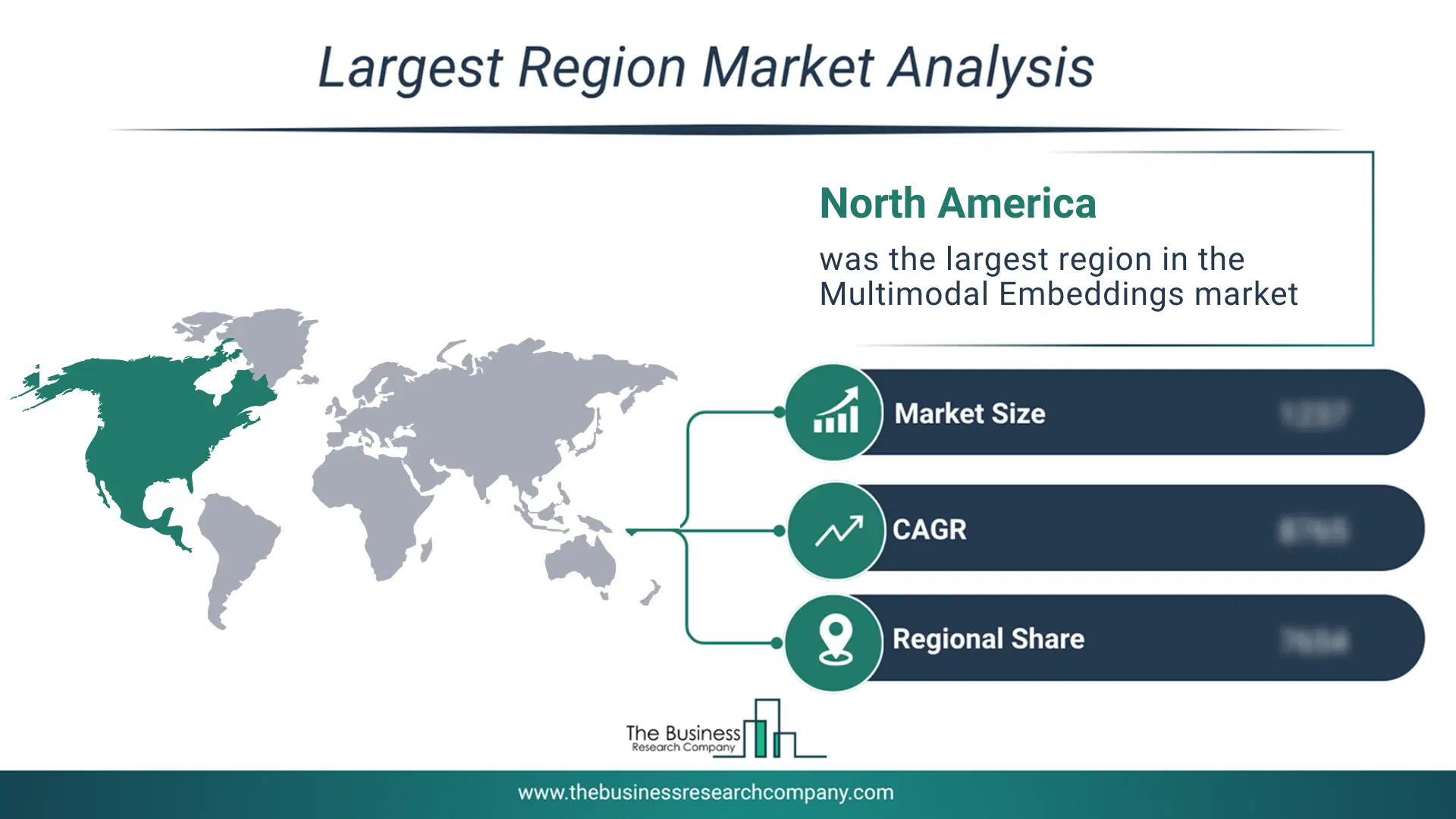
Regional Insights
North America was the largest region in the multimodal embeddings market in 2025. Asia-Pacific is expected to be the fastest-growing region in the forecast period. The regions covered in this market report are Asia-Pacific, South East Asia, Western Europe, Eastern Europe, North America, South America, Middle East, Africa. The countries covered in this market report are Australia, Brazil, China, France, Germany, India, Indonesia, Japan, Taiwan, Russia, South Korea, UK, USA, Canada, Italy, Spain.What Defines the Multimodal Embeddings Market?
The multimodal embeddings market consists of revenues earned by entities by providing services such as vectorization services, multimodal data indexing, similarity search enablement, model training and fine-tuning, API-based embedding services, and embedding performance optimization. The market value includes the value of related goods sold by the service provider or included within the service offering. The multimodal embeddings market also includes sales of multimodal AI models, vector databases, embedding libraries, pre-trained embedding models, and multimodal data representation platforms. Values in this market are ‘factory gate’ values, that is the value of goods sold by the manufacturers or creators of the goods, whether to other entities (including downstream manufacturers, wholesalers, distributors and retailers) or directly to end customers. The value of goods in this market includes related services sold by the creators of the goods.How is Market Value Defined and Measured?
The market value is defined as the revenues that enterprises gain from the sale of goods and/or services within the specified market and geography through sales, grants, or donations in terms of the currency (in USD unless otherwise specified). The revenues for a specified geography are consumption values that are revenues generated by organizations in the specified geography within the market, irrespective of where they are produced. It does not include revenues from resales along the supply chain, either further along the supply chain or as part of other products.
This chart presents market attractiveness based on a quantitative evaluation of growth, competition, strategic alignment, and risk, offering a clear view of opportunity areas for decision-making. This chart is for illustrative purposes; the full report contains the complete analysis.

This chart highlights the Total Addressable Market (TAM) by estimating the maximum revenue opportunity using an assumption-driven approach, supporting strategic planning and opportunity sizing across markets. The chart is illustrative; the full report provides a more comprehensive analysis.
What Key Data and Analysis Are Included in the Multimodal Embeddings Market Report 2026?
The multimodal embeddings market research report is one of a series of new reports from The Business Research Company that provides market statistics, including industry global market size, regional shares, competitors with the market share, detailed market segments, market trends and opportunities, and any further data you may need to thrive in the multimodal embeddings industry. The market research report delivers a complete perspective of everything you need, with an in-depth analysis of the current and future state of the industry.Multimodal Embeddings Market Report Forecast Analysis
| Report Attribute | Details |
|---|---|
| Market Size Value In 2026 | $3.16 billion |
| Revenue Forecast In 2030 | $8.28 billion |
| Growth Rate | CAGR of 27.2% from 2026 to 2030 |
| Base Year For Estimation | 2025 |
| Actual Estimates/Historical Data | 2020-2025 |
| Forecast Period | 2026 - 2030 |
| Market Representation | Revenue in USD Billion and CAGR from 2026 to 2030 |
| Segments Covered | Component, Modality, Deployment Mode, Application, End-User |
| Regional Scope | Asia-Pacific, Western Europe, Eastern Europe, North America, South America, Middle East, Africa |
| Country Scope | The Countries Covered In This Market Report Are Australia, Brazil, China, France, Germany, India, Indonesia, Japan, Taiwan, Russia, South Korea, Uk, Usa, Canada, Italy, Spain. |
| Key Companies Profiled | Vector AI Limited, Vector Flow Inc., Scale AI Inc., DataRobot, Eleven Labs Inc., AI21 Labs, Mistral AI, Pinecone Systems, Zilliz, Aleph Alpha, deepset, Jina AI, Vespa.ai, Replicate, Voyage AI, Chroma, ApertureData, Nomic AI, Prodia, DeepAI, Qdrant, Weaviate, Marqo, Redis Labs, and Anthropic. |
| Customization Scope | Request for Customization |
| Pricing And Purchase Options | Explore Purchase Options |