
Multimodal Retrieval-Augmented Generation (RAG) Tooling Market Report 2026
Global Outlook – By Component (Software, Hardware, Services), By Modality (Text, Image, Audio, Video, Multimodal), By Deployment Mode (On-Premises, Cloud), By Enterprise Size (Small And Medium Enterprises, Large Enterprises), By End-User (Banking, Financial Services, And Insurance (BFSI), Healthcare, Retail And E-Commerce, Media And Entertainment, Manufacturing, Information Technology (IT) And Telecommunications, Other End-Users) – Market Size, Trends, Strategies, and Forecast to 2030
Multimodal Retrieval-Augmented Generation (RAG) Tooling Market Overview
• Multimodal Retrieval-Augmented Generation (RAG) Tooling market size has reached to $3.32 billion in 2025 • Expected to grow to $10.5 billion in 2030 at a compound annual growth rate (CAGR) of 25.9% • Growth Driver: Growth Of Unstructured Data Driving Market Growth Due To Rising Adoption Of Digital Platforms • Market Trend: Accelerating Knowledge Discovery With Multimodal AI • North America was the largest region in 2025 and Asia-Pacific is the fastest growing region.Market Gains By 2030 – Top Opportunities By Segment
Market Gain identifies the most promising market opportunities by highlighting the segments or products expected to generate the highest incremental revenue growth over the next five years.
What Is Covered Under Multimodal Retrieval-Augmented Generation (RAG) Tooling Market?
Multimodal retrieval-augmented generation (RAG) tooling refers to software platforms or frameworks that combine retrieval-based methods with Generative AI to produce responses or content using information from multiple data modalities, such as text, images, audio, or video. These tools fetch relevant knowledge from large datasets or knowledge bases and integrate it with generative models to provide accurate, context-aware outputs. It helps to enhance AI output quality by grounding generative responses in relevant, multimodal information sources. The main components of multimodal retrieval-augmented generation tooling include software, hardware, and services. Software refers to applications that enable organizations to build, manage, and optimize retrieval-augmented generation workflows using multiple types of data inputs for enhanced content creation and decision-making. These solutions support multiple modalities, including text, image, audio, video, and multimodal data, and are deployed through on-premises and cloud models depending on organizational infrastructure. They are adopted by small and medium enterprises as well as large enterprises. The end users of multimodal retrieval-augmented generation tooling solutions include banking, financial services, and insurance companies, healthcare providers, retail and e-commerce companies, media and entertainment companies, manufacturing companies, information technology and telecommunications companies, and other organizations utilizing advanced generative and retrieval-based tools.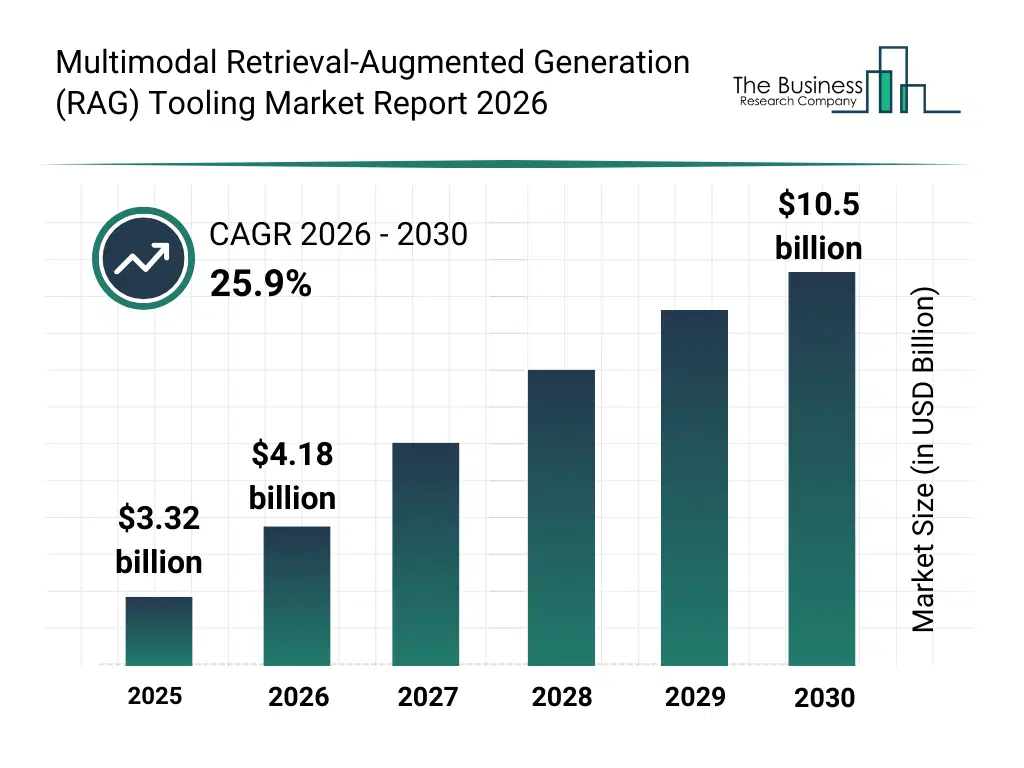
What Is The Multimodal Retrieval-Augmented Generation (RAG) Tooling Market Size and Share 2026?
The multimodal retrieval-augmented generation (rag) tooling market size has grown exponentially in recent years. It will grow from $3.32 billion in 2025 to $4.18 billion in 2026 at a compound annual growth rate (CAGR) of 25.7%. The growth in the historic period can be attributed to rapid growth in generative ai adoption, expansion of enterprise knowledge bases, rising demand for semantic search solutions, early development of vector database ecosystems, increasing focus on reducing ai hallucinations.What Is The Multimodal Retrieval-Augmented Generation (RAG) Tooling Market Growth Forecast?
The multimodal retrieval-augmented generation (rag) tooling market size is expected to see exponential growth in the next few years. It will grow to $10.5 billion in 2030 at a compound annual growth rate (CAGR) of 25.9%. The growth in the forecast period can be attributed to accelerating multimodal ai deployments across industries, rising investment in embedding and indexing infrastructure, growth in cloud-based rag tooling platforms, increasing demand for real-time context-aware ai systems, expansion of multimodal datasets for enterprise applications. Major trends in the forecast period include multimodal knowledge base integration, vector database optimization, semantic search and embedding advancements, cross-modal retrieval accuracy improvement, enterprise adoption of grounded ai content generation.
Global Multimodal Retrieval-Augmented Generation (RAG) Tooling Market Segmentation
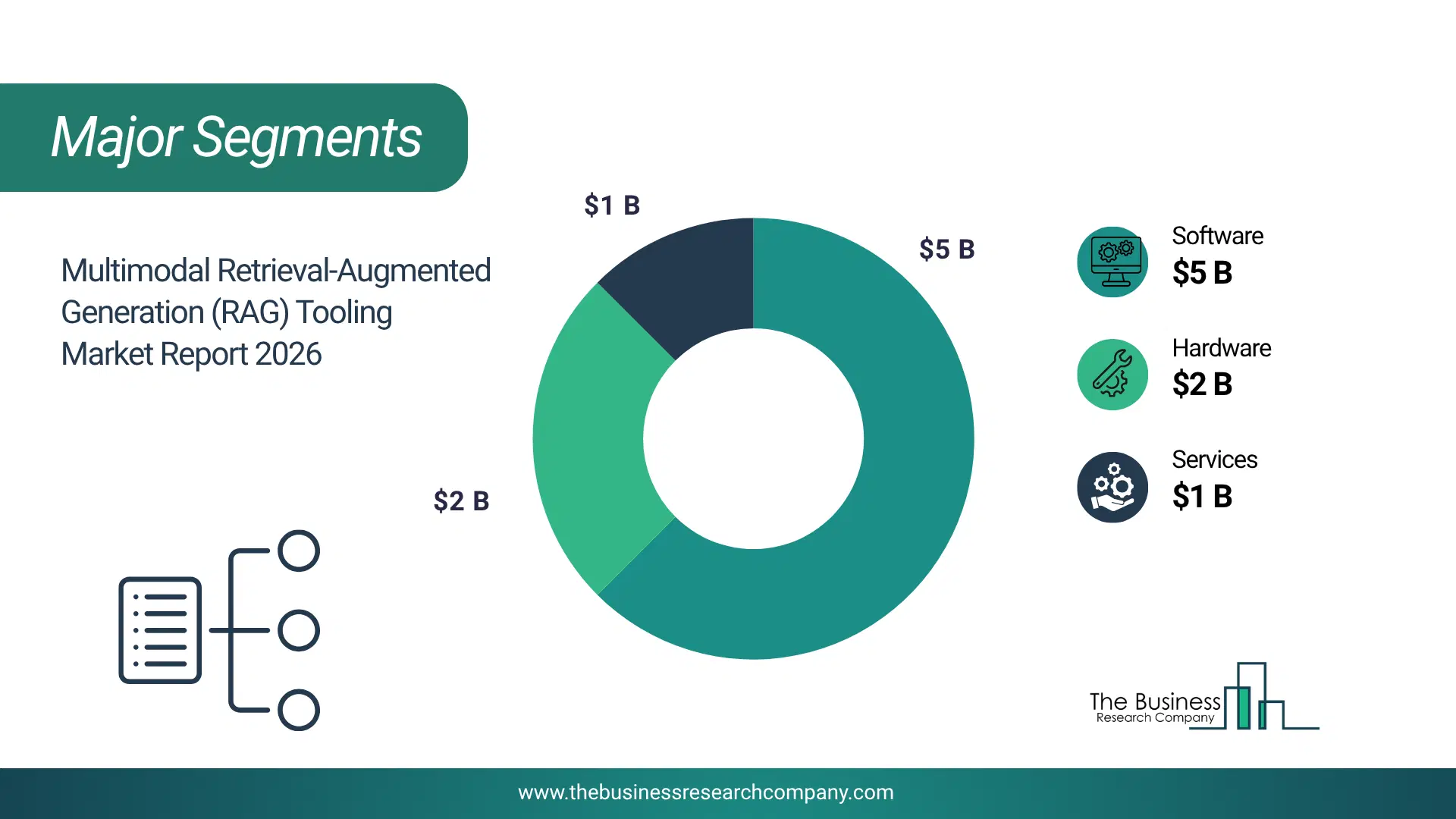
1) By Component: Software, Hardware, Services 2) By Modality: Text, Image, Audio, Video, Multimodal 3) By Deployment Mode: On-Premises, Cloud 4) By Enterprise Size: Small And Medium Enterprises, Large Enterprises 5) By End-User: Banking, Financial Services, And Insurance (BFSI), Healthcare, Retail And E-Commerce, Media And Entertainment, Manufacturing, Information Technology (IT) And Telecommunications, Other End-Users Subsegments: 1) By Software: Robot Operating Systems And Firmware, Simulation And Digital-Twin Software, Motion Planning And Path Optimization, Machine Learning Software, Vision And Perception Software, Cell And Fleet Management Software, Integration Software, Predictive Maintenance And Analytics, Cybersecurity Software, Low-Code Or No-Code Programming Tools 2) By Hardware: Robot Arms And Manipulators, Collaborative Robots, End-Effectors And Grippers, Sensors And Perception Hardware, Actuators And Drives, Machine Vision Systems, Controllers And Programmable Logic Controllers (PLCs), Safety Systems And Fencing, Power And Cabling Infrastructure 3) By Services: System Design And Engineering, Integration And Commissioning, Maintenance And Field Support, Training And Skill Development, Retrofit And Modernization Services, Custom Application Development, Robotics-As-A-Service (RAAS), Validation And Testing Services, Consulting And Return On Investment (ROI) Analysis, Research And Development And Co-Innovation Services The top segments in the multimodal retrieval-augmented generation (rag) tooling market will be: • Software will reach $5.41 Billion by 2030. • Hardware will reach $1.68 Billion by 2030. • Services will reach $1.1 Billion by 2030.What Is The Driver Of The Multimodal Retrieval-Augmented Generation (RAG) Tooling Market?
The growth of unstructured data is expected to propel the growth of the multimodal retrieval-augmented generation tooling market going forward. Unstructured data refers to information that lacks a predefined data model or organized structure, including text documents, images, videos, audio files, social media content, and emails. Unstructured data is rising due to the rapid growth of digital content creation, including text, images, videos, audio, and social media, which generates massive volumes of data that lack a fixed structure or predefined schema. Multimodal retrieval-augmented generation tooling supports unstructured data by enabling organizations to ingest, index, retrieve, and reason across diverse formats such as text, images, audio, and video, transforming fragmented and schema-less content into contextual, searchable knowledge that can be accurately grounded and generated into meaningful, actionable outputs. For instance, in March 2024, according to Edge Delta, a US-based software company, the world generated approximately 120 zettabytes (ZB) of data in 2023, equivalent to about 337,000 petabytes (PB) per day, highlighting the unprecedented scale and acceleration of global data creation driven by billions of internet-connected users and devices. Therefore, the growth of unstructured data is driving the growth of the multimodal retrieval-augmented generation tooling market.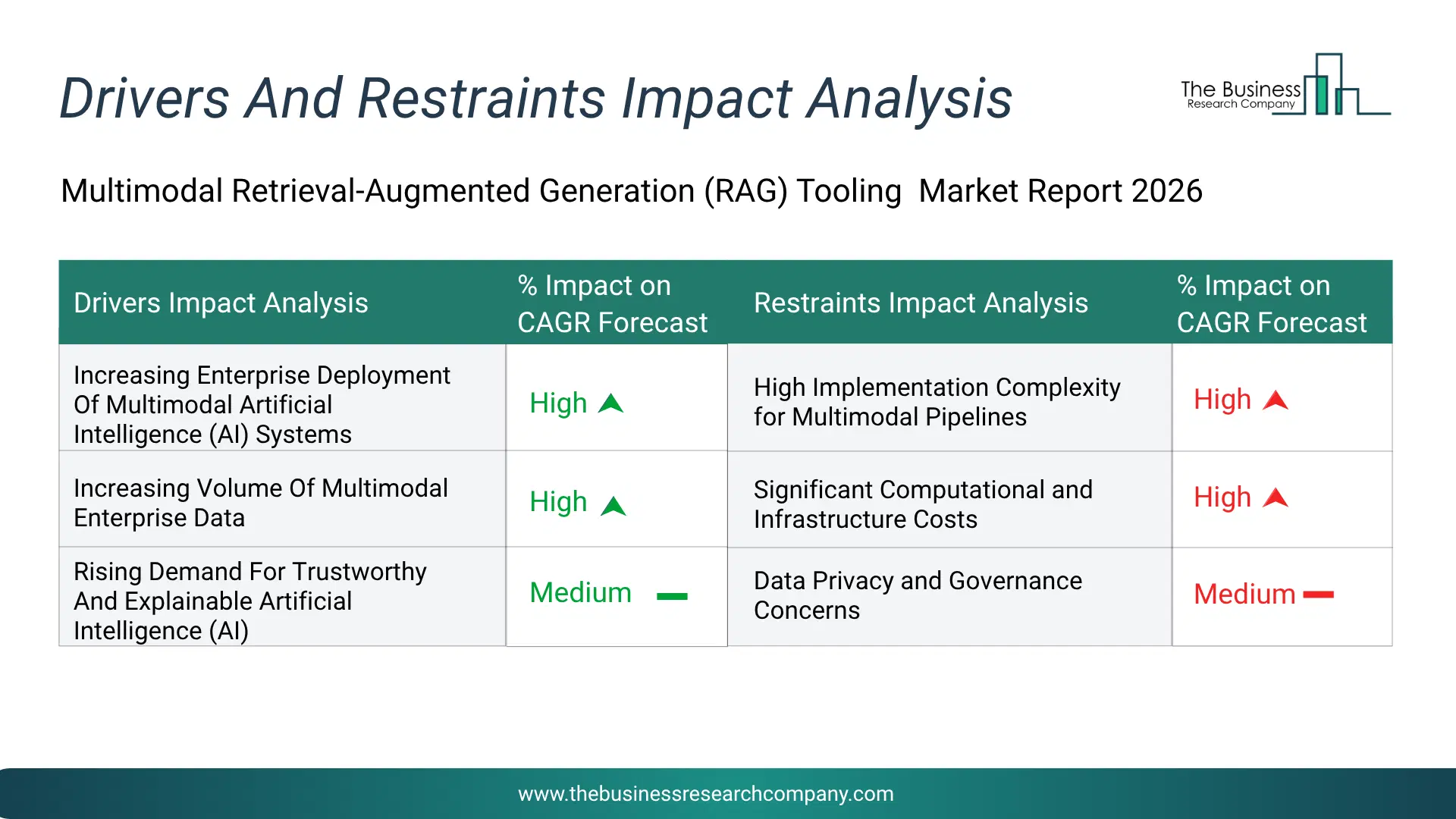
Infographic Chart Showing Key Market Drivers Analysis And Restraints For Multimodal Retrieval-Augmented Generation (Rag) Tooling Market
The chart presents an impact analysis of key drivers and restraints, quantifying their relative influence on the market's growth rate and helping assess the balance between growth enablers and limiting factors. This chart offers a high-level perspective; the full report contains more detailed insights.
How Will The Drivers Impact Growth In The Global Multimodal Retrieval-Augmented Generation (RAG) Tooling Market?
• Increasing Enterprise Deployment Of Multimodal Artificial Intelligence (AI) Systems (High) – During the forecast period, the increasing enterprise deployment of multimodal artificial intelligence (AI) systems is expected to become a key growth driver for the multimodal retrieval-augmented generation (RAG) tooling market by 2030. Organizations are increasingly integrating AI systems capable of processing and correlating text, images, audio, and video inputs to enhance operational efficiency and business intelligence. Multimodal RAG tools enable seamless retrieval of contextually relevant information across diverse data sources, improving the performance of enterprise applications such as virtual assistants, document processing, and analytics platforms. This shift is accelerating demand for scalable and interoperable RAG frameworks that support complex multimodal workflows. As enterprises continue to adopt advanced AI systems, the need for robust retrieval-augmented architectures is expected to expand significantly. • Increasing Volume Of Multimodal Enterprise Data (High) – During the forecast period, the increasing volume of multimodal enterprise data is expected to emerge as a major factor driving the expansion of the multimodal retrieval-augmented generation (RAG) tooling market by 2030. Enterprises are generating vast amounts of unstructured and semi-structured data across formats such as documents, images, videos, and voice recordings, creating challenges in efficient data retrieval and utilization. Multimodal RAG tooling enables organizations to index, search, and retrieve relevant insights from these diverse datasets, supporting improved knowledge management and decision-making processes. The growing reliance on data-driven operations is further reinforcing the need for advanced retrieval mechanisms that can handle high data complexity and scale. • Rising Demand For Trustworthy And Explainable Artificial Intelligence (AI) (Medium) – During the forecast period, the rising demand for trustworthy and explainable artificial intelligence (AI) is expected to act as a key growth catalyst for the multimodal retrieval-augmented generation (RAG) tooling market by 2030. Enterprises are placing greater emphasis on transparency, accountability, and interpretability in AI-driven outputs, particularly in regulated industries such as healthcare, finance, and legal services. Multimodal RAG systems enhance trust by grounding generated responses in verifiable data sources and providing traceable retrieval pathways across multiple data modalities. This capability supports compliance requirements and reduces risks associated with hallucinated or biased outputs. As organizations prioritize responsible AI adoption, the demand for explainable retrieval-augmented solutions is expected to rise.How Will The Restraints Impact Growth In The Global Multimodal Retrieval-Augmented Generation (RAG) Tooling Market?
• High Implementation Complexity for Multimodal Pipelines (High) – During the forecast period, high implementation complexity for multimodal pipelines is restricting the growth of the multimodal retrieval-augmented generation (RAG) tooling market. Integrating text, image, audio, and video data pipelines along with retrieval and generation layers is increasing architectural complexity and slowing deployment across enterprises • Significant Computational and Infrastructure Costs (High) – During the forecast period, significant computational and infrastructure costs are restricting the growth of the multimodal retrieval-augmented generation (RAG) tooling market. High demand for storage, processing power, and scalable infrastructure is increasing operational expenses and limiting adoption among cost-sensitive organizations • Data Privacy and Governance Concerns (Medium) – During the forecast period, data privacy and governance concerns are restricting the growth of the multimodal retrieval-augmented generation (RAG) tooling market. Handling diverse and sensitive datasets across modalities is raising compliance challenges and increasing risks related to data security and governanceKey Players In The Global Multimodal Retrieval-Augmented Generation (RAG) Tooling Market
Major companies operating in the multimodal retrieval-augmented generation (rag) tooling market are Google LLC, Microsoft Corporation, Meta Platforms Inc., International Business Machines Corporation, NVIDIA Corporation, Salesforce Inc., Snowflake Inc., Databricks Inc., Uniphore Software Systems Inc., Pryon Inc., Pinecone Systems Inc., LangChain Inc., Zilliz Inc., Twelve Labs Inc., Aleph Alpha GmbH, Cohere Technologies Inc., deepset GmbH, Hume AI Inc., LightOn SA, Contextual AI Inc., Vectara Inc., Qdrant Solutions Inc., Weaviate Holding B.V.,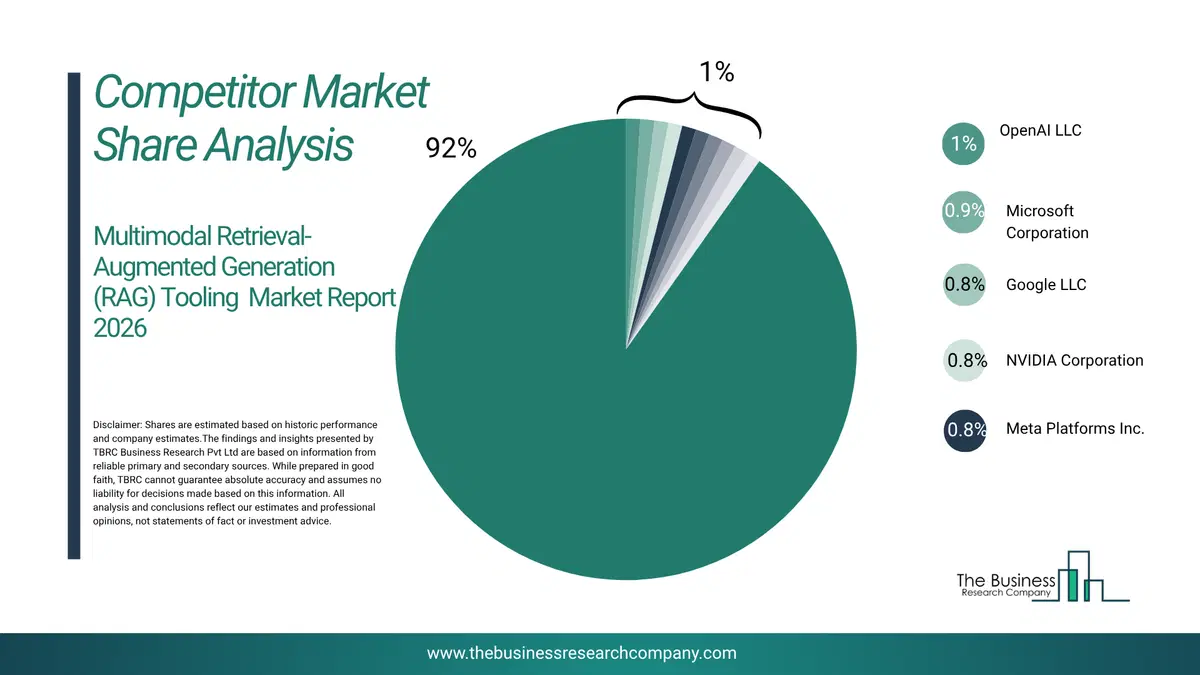
This chart is for illustrative purposes; the full report includes a detailed competitor analysis and comprehensive overview of the top 10 companies in the market.
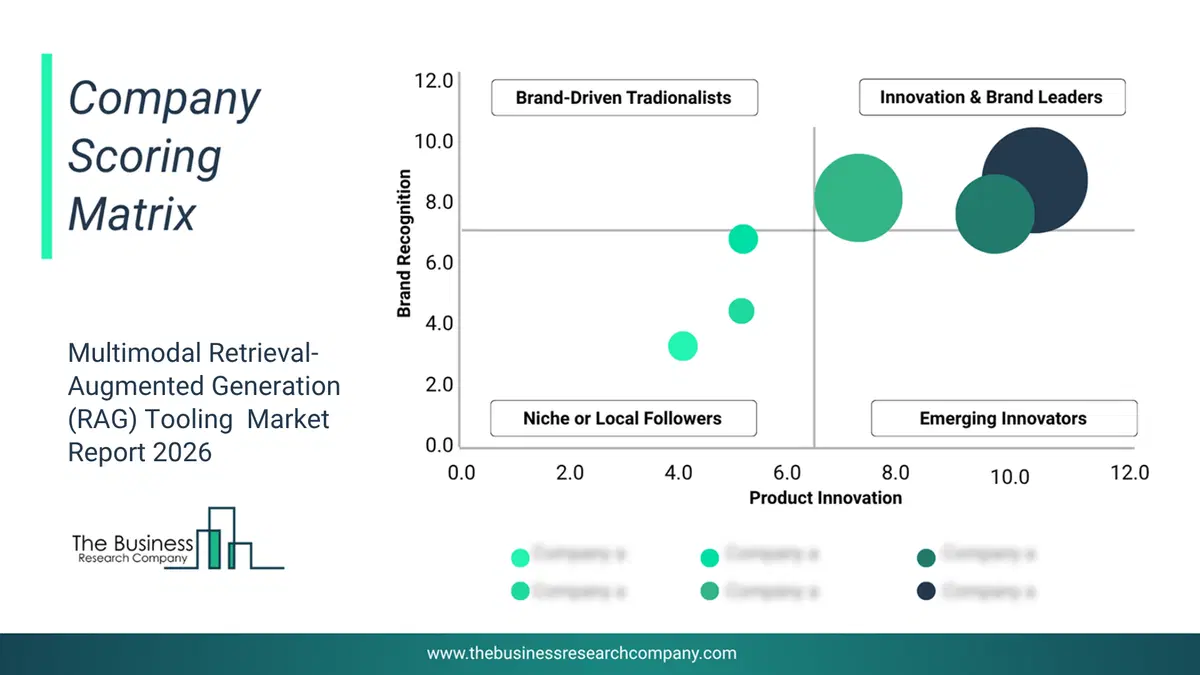
This chart maps companies by product innovation and brand strength, with bubble size indicating relative revenue, helping identify market leaders, challengers, and niche players. This is an illustrative chart; the full report provides a complete and accurate competitive analysis.
Global Multimodal Retrieval-Augmented Generation (RAG) Tooling Market Trends and Insights
Major companies operating in the multimodal retrieval-augmented generation tooling market are focusing on developing innovative solutions such as source-backed AI interactions to enable accurate, transparent, and secure insights from proprietary data. Source-backed AI interactions are AI responses that include verifiable references to the original data or documents, helping users trust the accuracy of the answers and trace information directly to its source. For instance, in August 2025, Qubrid AI, a US-based AI and GPU Cloud solutions provider, launched its 2-Step No-Code Multimodal RAG-as-a-Service, a breakthrough platform that lets users instantly chat with their own data across multiple modalities. The service features instant upload-and-chat functionality, source-backed AI responses, compatibility with text, images, and small audio files, and GPU-accelerated processing for high-speed, enterprise-grade performance. It is particularly suited for industries such as, legal, healthcare, finance, research, and customer support, where accuracy, transparency, and control over proprietary data are critical.What Are Latest Mergers And Acquisitions In The Multimodal Retrieval-Augmented Generation (RAG) Tooling Market?
In October 2025, Elastic N.V., a Netherlands-based technology company specializing in search and observability software, acquired Jina AI Inc. for an undisclosed amount. With this acquisition, Elastic aims to enhance its generative AI and search platform by integrating advanced multimodal and multilingual embeddings, reranking, and small language model capabilities to strengthen context engineering and retrieval performance. Jina AI Inc. is a US-based technology company that specializes in developing open-source frontier models for multimodal and multilingual search, including dense vector embeddings and rerankers for processing text and images.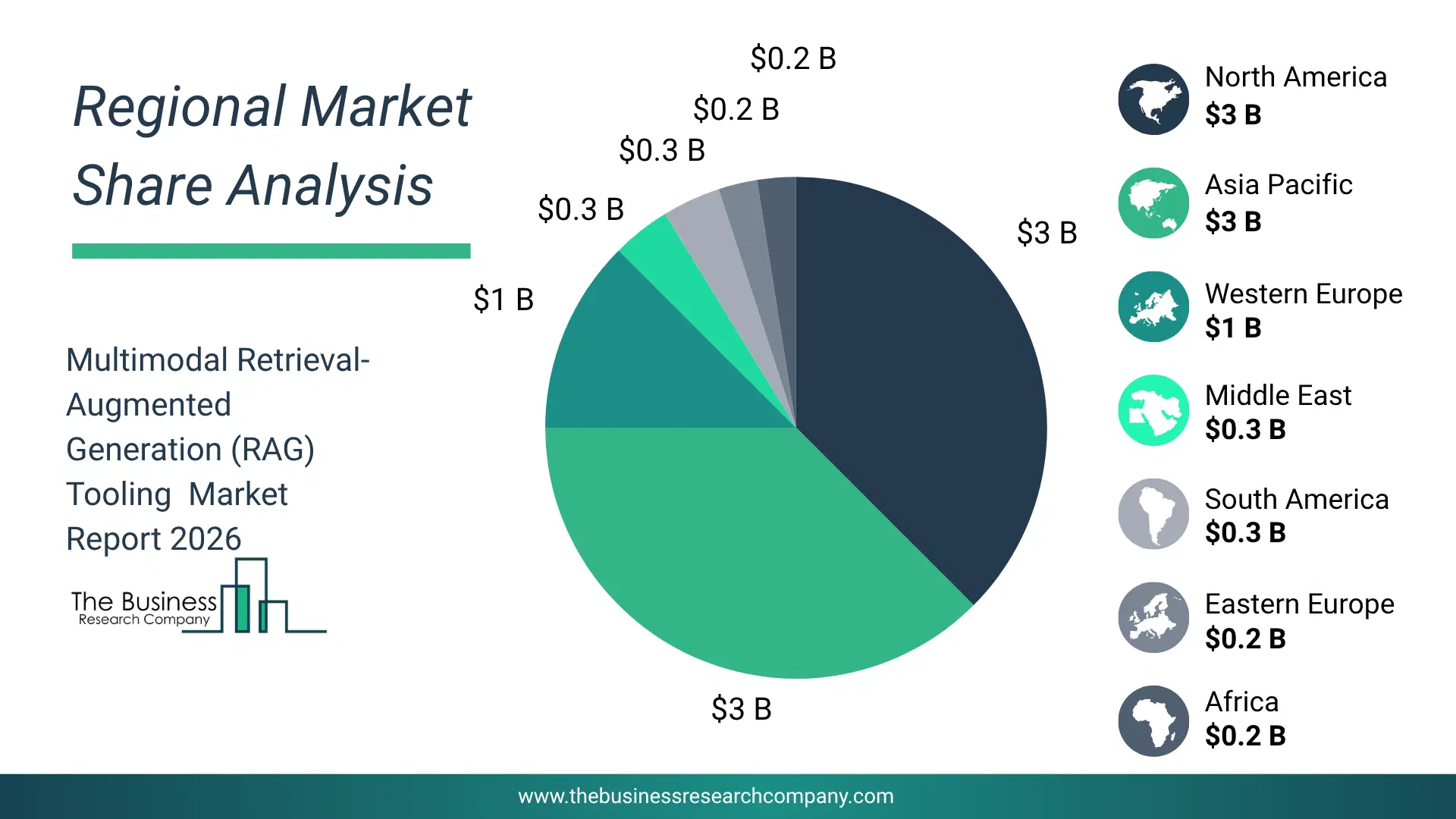
Regional Outlook
North America was the largest region in the multimodal retrieval-augmented generation (RAG) tooling market in 2025. Asia-Pacificis expected to be the fastest-growing region in the forecast period. The regions covered in this market report are Asia-Pacific, South East Asia, Western Europe, Eastern Europe, North America, South America, Middle East, Africa. The countries covered in this market report are Australia, Brazil, China, France, Germany, India, Indonesia, Japan, Taiwan, Russia, South Korea, UK, USA, Canada, Italy, Spain.What Defines the Multimodal Retrieval-Augmented Generation (RAG) Tooling Market?
The multimodal retrieval-augmented generation (RAG) tooling market consists of revenues earned by entities by providing services such as data indexing, knowledge base management, AI model training, embedding generation, vector database management, semantic search integration, and AI-driven content generation support. The market value includes the value of related goods sold by the service provider or included within the service offering. The multimodal retrieval-augmented generation (RAG) tooling market consists of sales of software platforms, AI models, vector databases, API toolkits, embeddings libraries, and multimodal datasets. Values in this market are ‘factory gate’ values, that is, the value of goods sold by the manufacturers or creators of the goods, whether to other entities (including downstream manufacturers, wholesalers, distributors, and retailers) or directly to end customers. The value of goods in this market includes related services sold by the creators of the goods.How is Market Value Defined and Measured?
The market value is defined as the revenues that enterprises gain from the sale of goods and/or services within the specified market and geography through sales, grants, or donations in terms of the currency (in USD unless otherwise specified). The revenues for a specified geography are consumption values that are revenues generated by organizations in the specified geography within the market, irrespective of where they are produced. It does not include revenues from resales along the supply chain, either further along the supply chain or as part of other products.
This chart presents market attractiveness based on a quantitative evaluation of growth, competition, strategic alignment, and risk, offering a clear view of opportunity areas for decision-making. This chart is for illustrative purposes; the full report contains the complete analysis.

This chart highlights the Total Addressable Market (TAM) by estimating the maximum revenue opportunity using an assumption-driven approach, supporting strategic planning and opportunity sizing across markets. The chart is illustrative; the full report provides a more comprehensive analysis.
What Key Data and Analysis Are Included in the Multimodal Retrieval-Augmented Generation (RAG) Tooling Market Report 2026?
The multimodal retrieval-augmented generation (rag) tooling market research report is one of a series of new reports from The Business Research Company that provides market statistics, including industry global market size, regional shares, competitors with the market share, detailed market segments, market trends and opportunities, and any further data you may need to thrive in the multimodal retrieval-augmented generation (rag) tooling industry. The market research report delivers a complete perspective of everything you need, with an in-depth analysis of the current and future state of the industry.Multimodal Retrieval-Augmented Generation (RAG) Tooling Market Report Forecast Analysis
| Report Attribute | Details |
|---|---|
| Market Size Value In 2026 | $4.18 billion |
| Revenue Forecast In 2030 | $10.5 billion |
| Growth Rate | CAGR of 25.7% from 2026 to 2030 |
| Base Year For Estimation | 2025 |
| Actual Estimates/Historical Data | 2020-2025 |
| Forecast Period | 2026 - 2030 |
| Market Representation | Revenue in USD Billion and CAGR from 2026 to 2030 |
| Segments Covered | Component, Modality, Deployment Mode, Enterprise Size, End-User |
| Regional Scope | Asia-Pacific, Western Europe, Eastern Europe, North America, South America, Middle East, Africa |
| Country Scope | The countries covered in the report are Australia, Brazil, China, France, Germany, India, Indonesia, Japan, Taiwan, Russia, South Korea, UK, USA, Canada, Italy, Spain. |
| Key Companies Profiled | Google LLC, Microsoft Corporation, Meta Platforms Inc., International Business Machines Corporation, NVIDIA Corporation, Salesforce Inc., Snowflake Inc., Databricks Inc., Uniphore Software Systems Inc., Pryon Inc., Pinecone Systems Inc., LangChain Inc., Zilliz Inc., Twelve Labs Inc., Aleph Alpha GmbH, Cohere Technologies Inc., deepset GmbH, Hume AI Inc., LightOn SA, Contextual AI Inc., Vectara Inc., Qdrant Solutions Inc., Weaviate Holding B.V., |
| Customization Scope | Request for Customization |
| Pricing And Purchase Options | Explore Purchase Options |